Showing posts with label Aristida. Show all posts

Monday, October 31, 2022

Mass Flowering of Native C4 Grasses in a Florida Savanna

Andropogon ternarius (syn. Andropogon cabanisii)

Update: Thanks to an unknown commentator and the infernal never ending work of taxonomists, the following corrections are added - the Andropogon ternarius depicted is synonymously termed Andropogon cabanisii, while the Andropogon glomeratus here is Andropogon tenuispatheus, which is synonymous with Andropogon glomeratus var. pumilus. 

Update 2: Added comments and pics of Saccharum giganteum.

The passing of the seasons can be seen in the regular changes in the grasses that make up a landscape. Even here in subtropical Florida, the coming of Fall heralds the flowering of many of the C4 grasses that dominate the longleaf pine savannas that are a marvelous (but threatened) fixture of the natural environment. 

Andropogon glomeratus (syn. Andropogon tenuispatheus)

I visit the Nature Conservancy's Disney Preserve in Kissimmee fairly regularly, and during my visit this late October, the surroundings were suddenly aglow with the sudden flowering of several C4 grasses. 

If you remember from earlier posts, C4 grasses have a specialized carbon-concentrating photosynthetic mechanism that allows them to be more efficient in hot and arid conditions, and they tend to grow fastest and flower during the latter parts of the season. 

Andropogon ternarius (syn. Andropogon cabanisii)

Whereas before, the preserve was a somewhat monotonous landscape of Serenoa repens (saw palmetto) and various smaller grasses like Aristida beyrichiana, with longleaf pines interspersed at almost regular intervals, now the area was dominated by the visually arresting inflorescence of different Andropogon spp. and a few other C4 grasses.,

Sorghastrum secundum

I admittedly am still learning how to identify the many Andropogon spp, but there were a few species that stood out enough that even I was able to identify them. Among the most beautiful was Andropogon ternarius (locally called Splitbeard Bluestem in this area, syn Andropogon cabanisii). Each inflorescence contained a pair of silvery racemes that formed a distinct V, with the awned spikelets giving it a beautiful feathery appearance.

Sorghastrum secundum

Some other Andropogon spp that were in flower included A. glomeratus (Bushy Bluestem, syn Andropogon tenuispatheus), A. virginicus (Broomsedge), and others that I cannot yet identify to species. 

Sorghastrum secundum flowerheads rise up from the understory

An interesting new grass that I found was Sorghastrum secundum, which is related of course to the more well known Sorghastrum nutans (locally called Indiangrass). Unlike S. nutans, the spikelets in S. secundum are all located to one side of the raceme, and this gave rise to one of the local names for it, Lopsided Indiangrass.

Sorghastrum secundum with mostly detached spikelets

But perhaps the most beautiful species that graced the preserve during my visits was Muhlenbergia sericea. This grass is also known as Muhlenbergia capillaris var filipes, and known locally as Gulf Muhly and Sweetgrass.

Muhlenbergia sericea (capillaris)

The purplish inflorescence waved easily in the breeze, and looked almost ethereal when seen in front of the sun's bright rays. M. sericea and its relatives are used often as ornamental grasses here in the peninsula, although I noticed that there is a hit and miss quality when it comes to the lavishness of its flowering in cultivation.

Muhlenbergia sericea (capillaris) line the hiking trail

People were not the only ones appreciative of this species. I also saw a juvenile alligator hiding in the shade of one of the M. sericea specimens (see image below).

An alligator under Muhlenbergia sericea

Perhaps most remarkable of all were vast fields of Saccharum giganteum (locally called Sugarcane Plumegrass), which lay behind rows of Andropogon glomeratus that lined the road leading in and out of the preserve.

Andropogon grasses were in abundance at the preserve (forefront). The tall grasses behind it in the far distance were Saccharum giganteum.

I could not identify them at first due to the distance, but after an unknown commentator mentioned the name, I later came back and waded into the field and took pics.

Saccharum giganteum

The culms and sheaths were quite hairy, and so too were the flowerheads. Macroshots revealed that the spikelets had a ring of long white hairs rising from the base, and straight awns that nailed the ID as S. giganteum.

Saccharum giganteum flowerhead. Inside pic shows expansion of the inflorescence against an aroid backdrop.
Saccharum giganteum spikelet showing long callus hairs and awn.

In the end, there were quite a few species that were in flower that I could not identify at the time. This was especially true for the Andropogon spp, which I am still learning about. Nevertheless, I'll be sure to drop by again soon to continue my exploration of this beautiful grassland, and perhaps someday I'll be able to name all the various species I encounter.


Sunday, February 20, 2022

Through the Fire: How Grasses Rise Up from the Flames

Aristida beyrichiana (wiregrass), a resprouter
The fact that the Poaceae use fire to create stable ecological states like grasslands and savannas is well known, but resolving the fine details on the mechanisms underlying these processes is a work in progress.

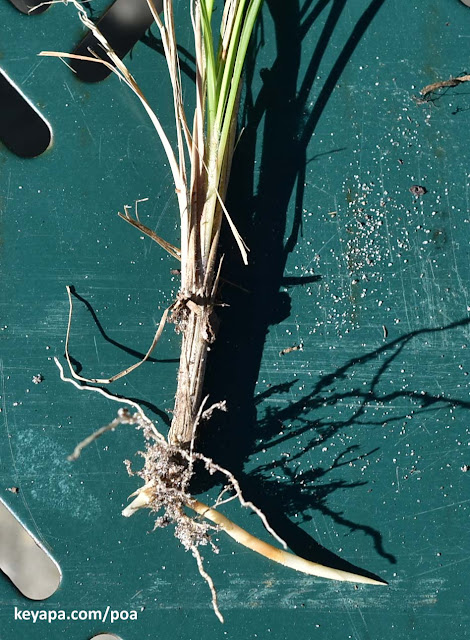
Grass populations can recover from these fire events via two paths or so-called persistence strategies. Some species die back and resprout from underground rhizomes or undamaged crowns. These are the so-called resprouters. For example, both Imperata cylindrica (cogon grass) and Aristida beyrichiana (wiregrass) come back after a fire from surviving remnants (using tough rhizomes in the case of the former). 

Sharp rhizome of Imperata cylindrica, which is a resprouter
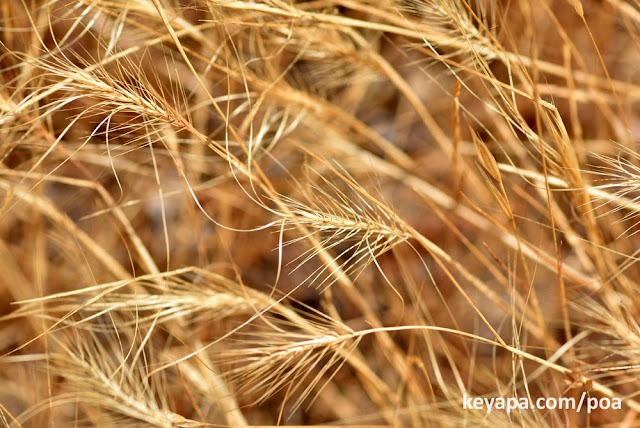
The other way to get a population through a fire is by reseeding. These grasses are the so-called seeders, and they include species like Taeniatherum caput-medusae (medusahead grass), Bromus tectorum (cheatgrass), and Microstegium vimineum (stiltgrass). In this case, the population develops to sexual maturity rapidly, and then sets seed, which can survive past the fire event to form a new population and generation.

Dried seedheads of Taeniatherum caput-medusae, a seeder
The two types of persistence strategies significantly affect the various morphological and physiological traits of each species, as listed in the table below.

Trait

Relationship with resprouting ability

Photosynthetic pathway
Resprouters are more likely to be C4 than C3 (Moore et al., 2019). C4 species are highly efficient in fire-prone environments and may therefore have greater stored resources to resprout (Tix & Charvat, 2005; Ratnam et al., 2011)

Bud position

Resprouters are more likely to have buds below the soil surface (rhizome resprouters) where they are protected from intense heat (Pausas & Paula, 2020)

Specific leaf area (SLA)

Resprouters will have lower SLA than seeders (Forrestel et al., 2014). High SLA will aid the rapid growth of seeder species

Leaf nitrogen (N) content

Resprouters will have lower leaf N contents than seeders. Resprouters may experience fire multiple times in their lifetime and thus low-N availability (due to N volatilisation during fire; Reich et al., 2001; Hernández & Hobbie, 2008). In these conditions, a high N-use efficiency (low leaf N content) may be advantageous (Wedin & Tilman, 1990; Reich et al., 2001)

Leaf C : N ratio

Resprouters will have higher leaf C : N ratios than seeders. High leaf C : N ratio, which is linked to low decomposition rates and the accumulation of a highly flammable fuel load (Aerts, 1997), may be advantageous to shade-intolerant resprouting species in maintaining an open canopy (by aiding the removal of standing dead and woody biomass; Everson et al., 1988)

Life history

Resprouters are more likely to be perennial than seeders. Perennial-grass species have buds from which to regrow, which annual species may lack

Table 1. From Simpson et al, 2021

These persistence strategies in grasses have a complex and fascinating relationship with the existing fire regime, but in order to understand it, the different characteristics of an existing fire regime have to be defined.

Fire Frequency is the time between fires in an area. More frequent fires tend to be more damaging to a plant.

Fire Intensity refers to the amount of energy released by the flames. Higher amounts of released energy increases the probability of severe damage or death to a plant.

Fire Severity is an index of the damage caused by a fire by measuring the amount of organic matter lost.

These three attributes are related in a simple manner. The less frequent fire events are, the more biomass can be accumulated, which leads to more intense fires and a corresponding increase in the severity of the event.

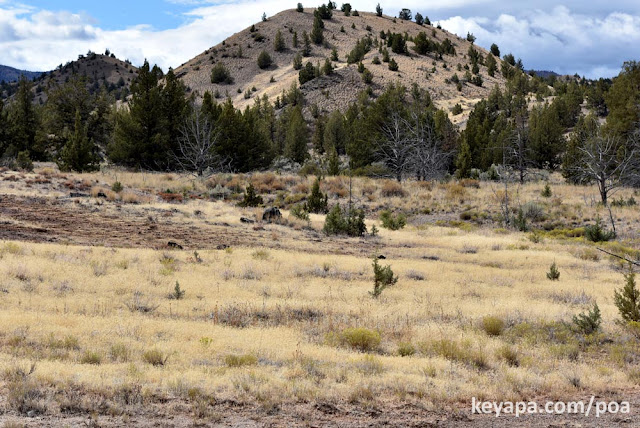
Grass seeders proliferate under fire regimes of high frequency and low intensity, whereas resprouters dominate when the fires are more intense after a longer period between fire events. The rapid sexual maturity of seeders allows them to seed quickly, and these grasses can persist even in fire frequencies that are as short as a year!  

However, if fires do not occurs frequently, this leads to a larger accumulation of fuel biomass, and more intense fires. In this case, reprouters have an advantage and will dominate an area because they do not need to pass through the more vulnerable seed and seedling stages. 

The golden hued seeder T. caput-medusae (medusahead) carpets an area
Knowledge about the relationship between fire regimes and persistence strategy is not only fascinating, but can also be used to predict community composition in a habitat given specific changes in the fire regime. For example, changes in fire regimes due to climate change can cause dramatic alterations in the ecology. It may also be possible to use this knowledge to dent the advance of invasive grasses that hew to a particular persistence strategy.


References

Simpson, K.J., Jardine, E.C., Archibald, S., Forrestel, E.J., Lehmann, C.E.R., Thomas, G.H. and Osborne, C.P. (2021), Resprouting grasses are associated with less frequent fire than seeders. New Phytol, 230: 832-844. https://doi.org/10.1111/nph.17069

Monday, January 31, 2022

A Nice Lazy Sunday with the Wiregrass Aristida beyrichiana

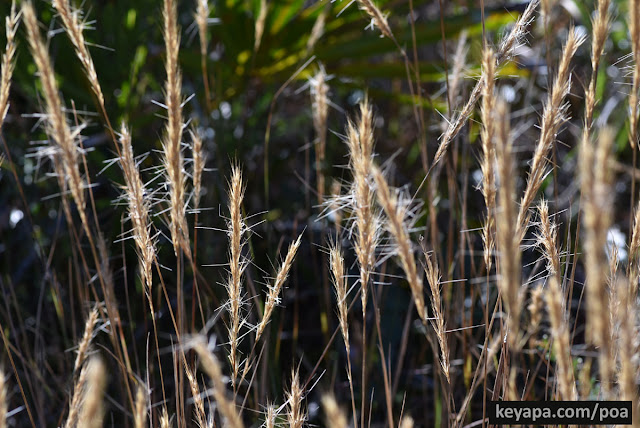
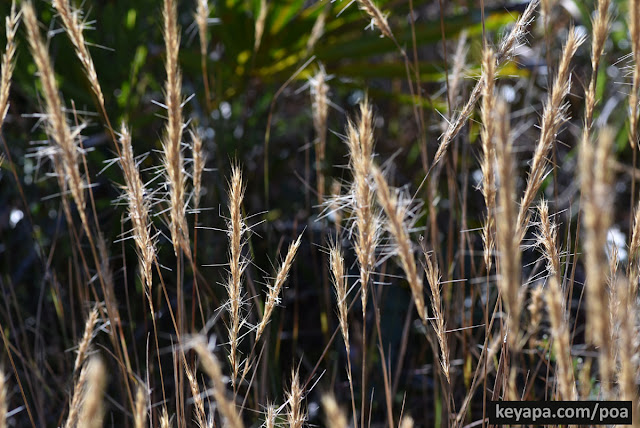
Seedheads of A. beyrichiana (A. stricta)

It was a chilly but very sunny Sunday yesterday, and I decided to go visit the Disney Wilderness Preserve. I always enjoy exploration trips, so macro lens and camera in hand I made the short drive to what I consider one of the more well maintained and preserved hiking parks in the state.

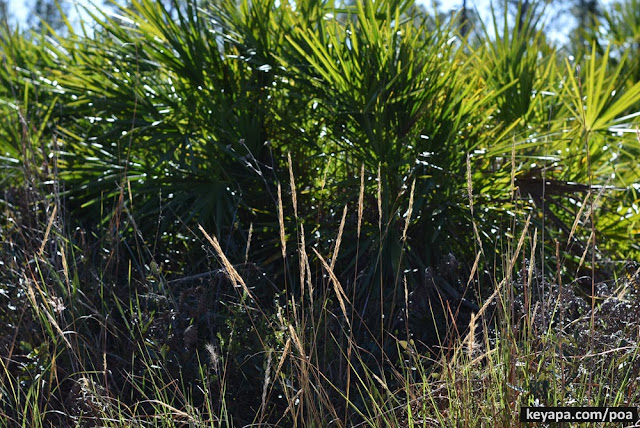
Dwarfed by some understory Palms

When I visited there last, the most visible parts of the understory included Andropogon spp, as well as the palm Serenoa repens. I also saw several large specimens of what I believe is Muhlenbergia expansa. But this time I took a closer look at the surrounding vegetation as I made my way along the trail and to my absolute delight discovered what I took to be clusters of Aristida beyrichiana (aka Aristida stricta var beyrichiana), many of which had developing or spent inflorescences.

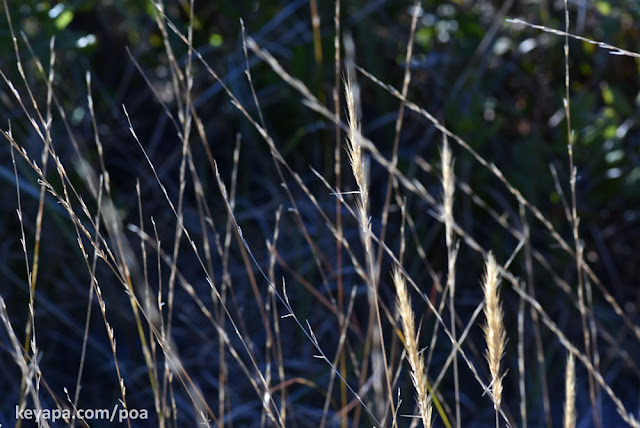
The grasses were not tall, perhaps up to half a meter in height, though the seedheads pushed some of them close to a meter. But the yellowish brown inflorescences were quite distinctive amongst the brown remnants of the other grasses and I had no problems at all finding my quarry.

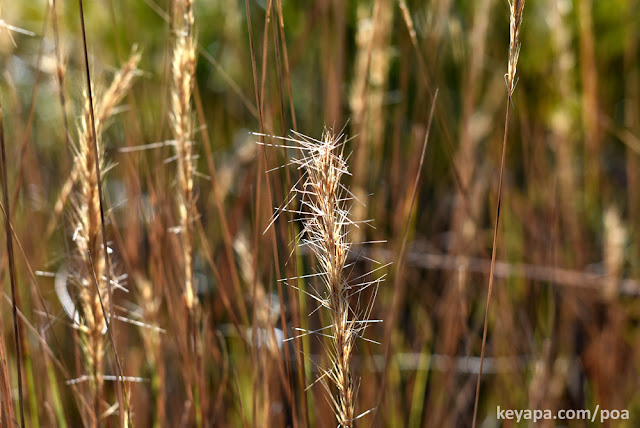
Drying seedhead of Aristida beyrichiana (A. stricta)

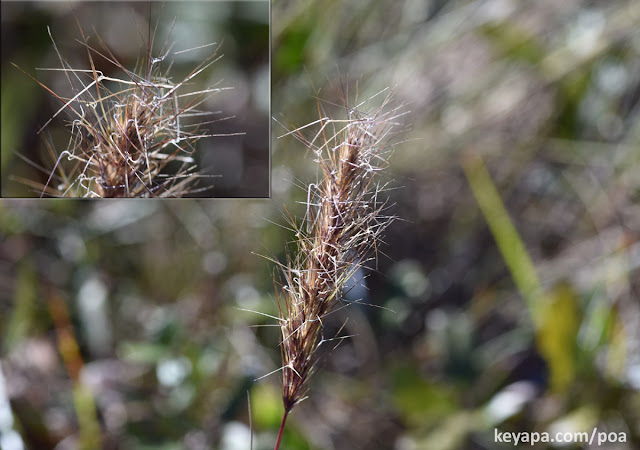
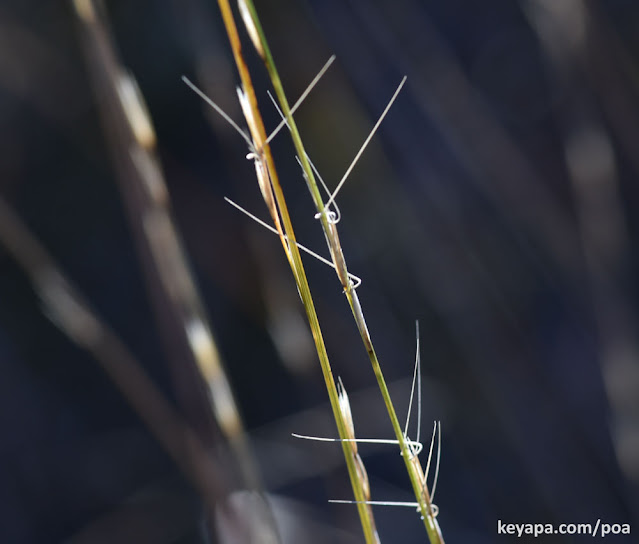
Under my macro lens the distinctive 3 awned Aristida spikelets looked like cactus spines. The awns project out of the lemma, and in A. beyrichiana twist and turn along their lengths. In fact as the seedheads dry they reminded me of twisted barb wire, which is quite apt given that one of the common names of A. beyrichiana is "wiregrass" (although the term commonly refers to the thin wiry leaf blades).

The twisted awns of wiregrass spikelets

As I continued along the trail, more and more of the clusters of wiregrass had older and completely stripped seedheads. This might have been because various areas of the path had been burned at different times, which might have influenced the growth and flowering times of the specimens in each location. 

The twisted awns of wiregrass

I had been so focused on photographing the clusters that I suddenly realized that 3 hours had already passed, and it was almost time for the park to close. I had to hurry and jog back to the visitor center, but I was exhilarated by all the plants that I had found, and I drove home with a big smile on my face. 

I love this native grass!

Stripped seedheads behind some younger examples 

Saturday, January 29, 2022

The Love Affair of Aristida beyrichiana with Fire in the Wiregrass and Long Leaf Pine Savannas of Florida

Beautiful Disney Wilderness Preserve

We were hiking in the Disney Wilderness Preserve, which is managed and owned by the Nature Conservancy, when we came upon blackened areas along the trail, and my wife wondered whether those were accidental fires. When I told her that these were probably set deliberately, she was at first doubtful and I had to explain the rational behind it.

Unfortunately, many people likely would have the same incredulous response to the notion that people would intentionally set fires to pristine areas. But in fact, fire is a natural part of many ecosystems, and it is a major factor in maintaining the integrity and health of the wiregrass-long leaf pine savannas that are the pride of Florida.
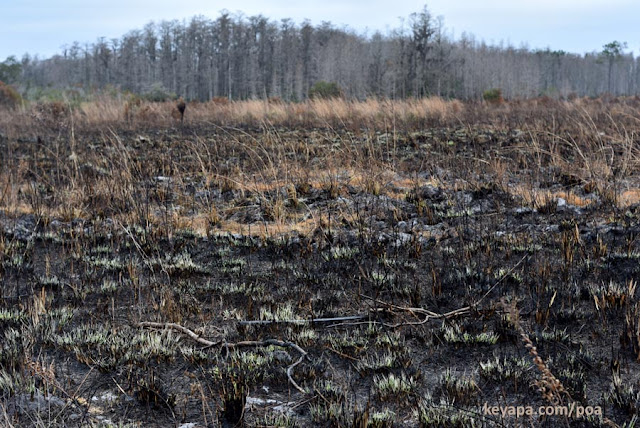
Prescribed burn at Disney Wilderness Preserve in Kissimmee, Florida

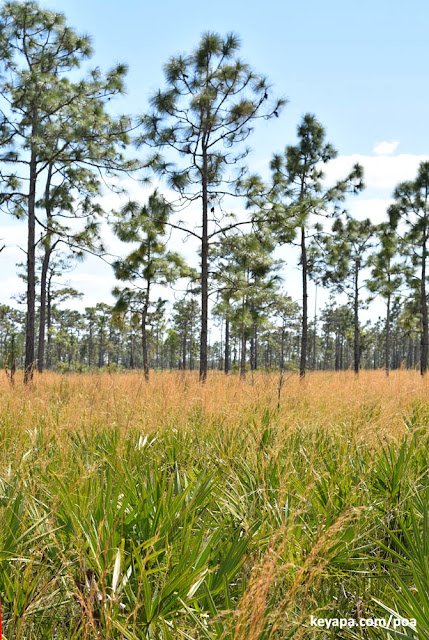
These savannas are characterized by having a relatively open canopy of long leaf pine (Pinus palustris), a sparse or absent midstory, and an understory dominated by bunch grasses composed mainly of Aristida beyrichiana (synonymous with A. stricta var beyrichiana) and various Andropogon species. Without a relatively frequent fire regime (2-3 years) to remove other species, the area will slowly be converted to a less diverse closed canopy forest.
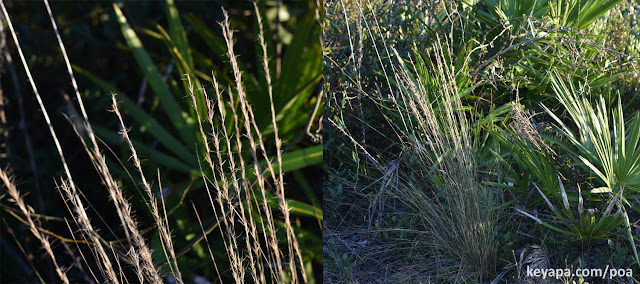
A. beyrichiana (wiregrass) inflorescence and habit

The foundation of this habitat is A. beyrichiana (wiregrass), a perennial C4 grass which normally only flowers after fire during the growing season. It is an obligate pyrogenic species, and A. beyrichiana and the other native bunch grasses provide the fine fuel that makes this habitat possible by keeping tree density low and light levels high. If fire is actively excluded from an area, this species slowly disappears from the landscape, probably due to competition or the growing leaf litter, and its loss will negatively impact the entire ecosystem and might ultimately result in its disappearance. Wiregrass is thus essential if you want to restore any degraded wiregrass-long leaf pine habitat. 
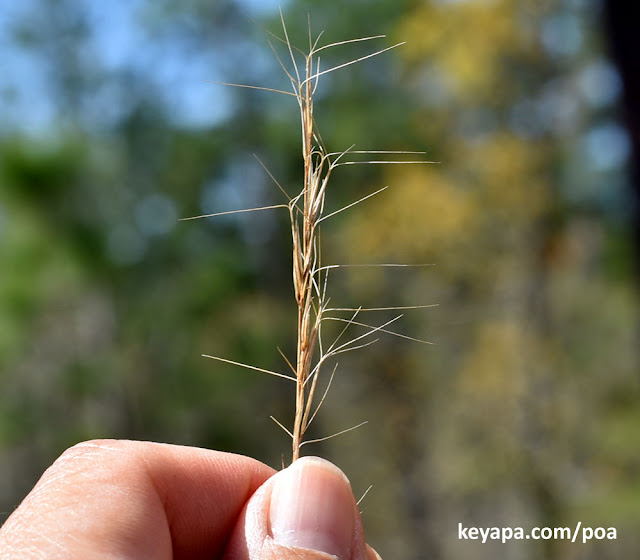
The characteristic three-awned spikelets of wiregrass

Fortunately, studies have shown that even after fire exclusion for decades, this species is resilient enough to start flowering again after a fire (Fill et al, 2021; Shearman et al, 2019). This gives hope that it will be possible to restore degraded wiregrass-pine savannas back to their pristine condition with the start of a regular fire regime. But in order for us to continue to maintain these precious habitats, we must change our widely held view that fire is always bad.

People need to rethink the way they view fire in nature, and realize that fire is a natural part of the system that helps maintain beautiful and unique habitats like the wiregrass-pine savannas of the southeastern USA. 

Spread the word if you can. 
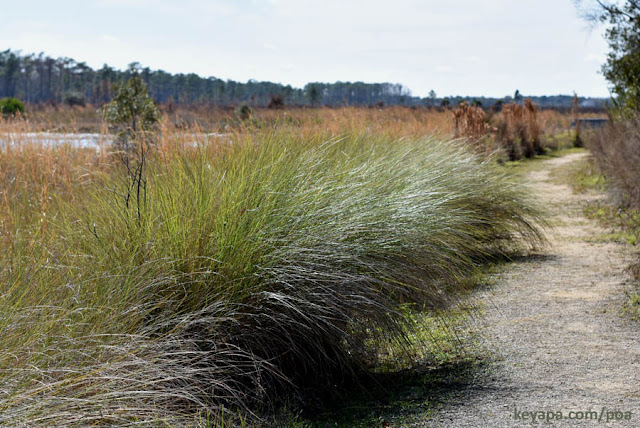
Muhlenbergia expansa, which can be mistaken for A. beyrichiana

Literature Cited:

Fill JM, Zamora C, Baruzzi C, Salazar-Castro J, Crandall RM (2021) Wiregrass (Aristida beyrichiana) survival and reproduction after fire in a long-unburned pine savanna. PLoS ONE 16(2): e0247159.

Shearman, T. M., Varner, J. M., and Kreye, J. K.. 2019. Pyrogenic flowering of Aristida beyrichiana following 50 years of fire exclusion. Ecosphere 10( 1):e02541. 10.1002/ecs2.2541

Saturday, March 20, 2021

The Major Grasses of the Pine Flatwoods and Sandhills of Florida


Any corrections to the identification of the species are always welcome. I do not pretend to be an expert at it.

It's quite interesting to hike and see the various habitats in central and southern Florida.

In addition to the hardwood hammocks which contain broadleaved trees, the most common ecosystem I've seen are the mesic pine and scrubby flatwoods, as well as the pine sandhills, which contain various dominant grasses. 

Shrub and Scrub understory at Oscar Scherer State Park
When I hiked, one of the most common understory denizens of these ecosystems were the very distinctive Saw Palmetto (Serenoa repens), which forms the shrubby layer below the taller pines and Sabal palmetto.

Grasses at Oscar Scherer State Park
But there were also vast areas covered with various grasses in these ecosystems, and it was quite amazing to see them waving in the wind below the tall stately pines and Sabal palms. Although there were smaller stands of grasses in area with a denser canopy, the really large stands occurred when the canopy was more open.

Andropogon along the path at Ocala National Forest
One of the more distinctive species I saw while hiking was Aristida beyrichiana (wiregrass), which is one of the common denizens of these sandhills and flatwoods. This species is a major component of the ecosystem and is so reliant on fire in that it only produces viable seeds when a fire goes through the area during the growing season.

A. beyrichiana at Ocala National Forest
The other grasses all tended to be from the genus Andropogon, with A. virginicus dominating in some areas, in addition to being quite obvious as weedy occupiers of roadsides all over the central and southern portions of the state.

A. virginicus at Ocala National Forest
Another Andropogon that looks somewhat similar, although with much thicker and profuse seedheads was Andropogon glomeratus, although some botanists consider this to be a subspecies of A. virginicus.

A. glomeratus
In addition to the major native grasses, I also stumbled on a few pockets of Imperata cylindrica (cogon grass), which is usually treated when found by workers in the parks.

I. cylindrica (Cogon grass) at Oscar Scherer State Park (straight blades in foreground)
In Oscar Scherer State Park for example, I found a small cluster somewhat hidden close to the periphery of the park. It had probably escaped detection due to being off the main path.

I. cylindrica (Cogon grass) at Ocala National Forest Campsite (in foreground)
At Ocala National Forest,  I found spreading clusters near the area reserved for camping, where it looked to be slowly muscling aside the other understory vegetation.


I also saw some interesting animal species during my hikes. One of the most memorable was when I accidentally bumped into a Gopher Tortoise that was crossing the trail at Oscar Scherer State Park. My wife had passed by a few minutes earlier, and the tortoise must have thought it was safe to cross the road, not knowing that I was lagging behind her (taking pics of everything).

Grasses flank the trail at the Disney Nature Preserve
It withdrew into its shell and would not come out until I had moved far away from it, whereupon it continued to trundle to the opposite side of the road, perhaps muttering about the inconsiderate humans that share its world. 

Grass understory at Ocala National Forest