Showing posts with label Panicum. Show all posts

Sunday, September 10, 2023

A Short History of Ornamental Grasses

World's Fair Pavilion in Forest Park, in St. Louis

Ornamental non-bamboo grasses have become such a ubiquitous feature of suburban and urban landscapes nowadays, that it might surprise some people that their widespread use is a relatively new phenomenon here in the USA.

This was brought home to me after I visited the World's Fair Pavilion in Forest Park, St. Louis last week.

The park itself is amazingly large, but what interested me most was a building that was surrounded by large stands of beautiful ornamental grasses. This World's Fair Pavilion was built in 1909 from proceeds of the World's Fair that was held in 1904. It's built on top of a hill and is surrounded by a large expanse of lawn and other plants.

Gigantic Panicum virgatum in Forest Park, St. Louis

The largest Panicum virgatum specimens I have ever seen in masses graced both sides of the area in front of the pavilion. There were also stands of Miscanthus sinensis, as well as the usual stately Calamagrostis. These ornamental grasses dominate the landscape today, but pictures of the same pavilion from the 1930s showed no signs of the stately and graceful grasses. Instead, shrubs and bushes and trees were the norm (see image below).

The pavilion in the 1930s. From the Missouri Historical Society. Note the lack of ornamental grasses.

The drastic change in the landscaping is significant. Although the use of bamboo for landscape decoration was popular even during ancient times, ornamental non-bamboo grasses did not enjoy the same popularity. However, during the 1930s, the renowned  German nurseryman, Karl Foerster pushed for their use in Germany and Europe. He collected grass seeds and plants from all over the world, and after cultivating them in his nurseries he introduced them to the market.

Calamagrostis to the left, Panicum virgatum to the right. In Forest Park, St. Louis

Among the many plants he introduced, perhaps his most famous creation is the outstanding ornamental grass Calamagrostis × acutiflora 'Karl Foerster', which he released to the market in 1950 as a natural hybrid of C. epigejos (native to Europe, Asia and Africa) and C. arundinacea (native to Eurasia, China and India).

Calamagrostis in background, Cenchrus setaceus in foreground, in Colorado

This rise in the use of ornamental grasses in Europe was not mirrored in the USA until much later, but various growers were instrumental in pushing for this new paradigm.

In the early 1960s, Kurt Bluemel began the introduction of ornamental grasses into America through his nursery in Maryland, called Kurt Bluemel Inc. Educated in Germany and Switzerland, Bluemel was passionate about grasses, and by the time he passed away decades later, he was well known as Der Gras König, the Grass King. 

Kurt Bluemel. From Baltimore Sun.

He is said to have carried his first grass specimens in his luggage when he came to America, and his collaboration with Wolfgang Oehme, a German-born landscape architect based in Towson, was highly influential in creating a growing appreciation for ornamental grasses in the country. Some of his notable works include creating the savannas at Disney World's Animal Kingdom, and Busch Gardens. 

Panicum virgatum

By the 1980s, the momentum behind ornamental grasses had finally reached a crux, and an influx of growers finally pushed it into the mainstream. In 1986, John and Jill Hoffman established the Hoffman Nursery in North Carolina, which specialized in ornamental grasses. 

John Hoffman. From Hoffman Nursery.

John's interest in ornamental grasses was stoked during a visit to Germany, where he met the plant breeder Ernst Pagels. Pagels was an enthusiastic supporter of grass-filled gardens, and this along with the support of his mentor,  J.C. Raulston at North Carolina State University, fueled his passion. Today, Hoffman Nursery is one of the largest suppliers of ornamental and native grasses in the country.

Miscanthus sinensis

The trend towards landscaping with grasses then moved from the East Coast to the West Coast through the efforts of people like horticulturalist John Greenlee. In order to complete an oak savanna project in California in the 1980s, he travelled to Kurt Bluemel's Nursery in Maryland, where he was astounded by the hundreds of varieties of ornamental grasses that were on display. He ended up trucking a load of the grasses in a tractor trailer from Maryland to California, and after a stint in Brazil with the renowned landscape architect Roberto Burle Marx (who is also held in high esteem in the aroid community), he finally opened the first ornamental grass nursery in the West Coast.

John Greenlee. From Greenlee Meadow Collection.

Fast forward to today, when people routinely use ornamental grasses both in residential and commercial landscaping. And although many of the varieties used are the showy exotics (such as Miscanthus sinensis and Cenchrus setaceus), the use of native grasses as ornamentals (such as Trypsacum dactyloides in Florida, and Bouteloua gracilis in Colorado) is also widespread.
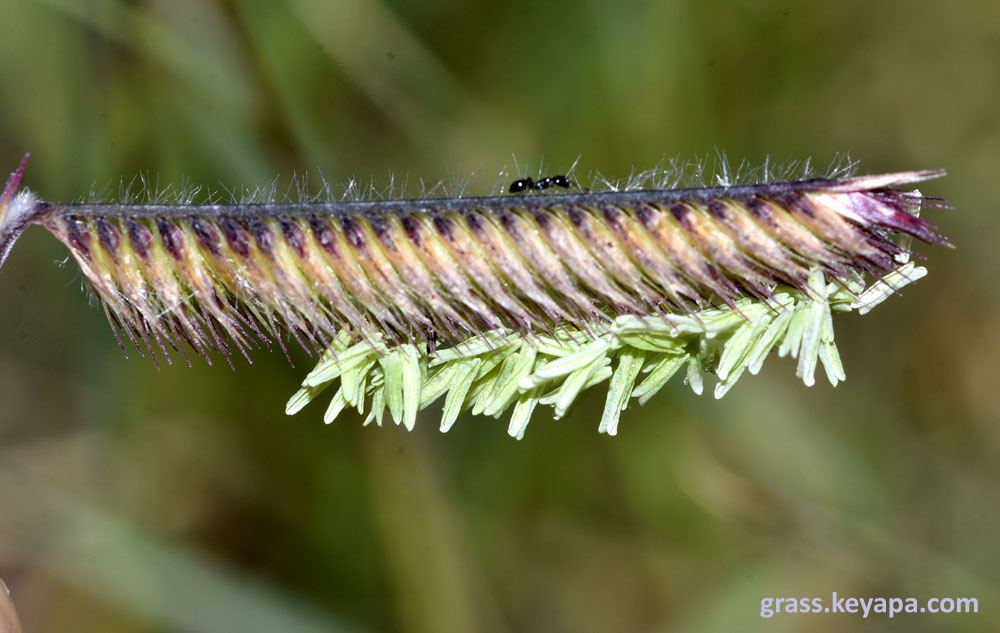
Bouteloua gracilis in Colorado

Meanwhile, new varieties and species continue to be introduced into the market. Not only do they contribute linear structure to a design, but their ease of maintenance, resistance to herbivores like deer, and their ability to impart movement to an otherwise static landscape, make ornamental grasses perfect components for any project.

Looking out from the pavilion in Forest Park, St. Louis. White flowerheads are Miscanthus sinensis cultivars

Thursday, August 17, 2023

Barley and Millet: Yes, Some Foods Do Grow like Weeds

Hordeum vulgare (Barley)

Barley is the 4th largest in terms of grain production, behind the other grass crops such as maize/corn, rice, and wheat. The species was domesticated around 10,000 years ago in the Eurasian region, and most barley is used for animal fodder, with the rest being used as food or for the making of fermented products such as beer. 

I was walking along one of the sidewalks here in Broomfield, CO, when I noticed quite a few attractive looking grasses along the sides of a building construction site. They weren't the usual Hordeum jubatum (commonly called foxtail barley here), which is pretty abundant in the area, and instead looked like some kinda short wheat (Triticum aestivum).

Spikelets of H. vulgare

Intrigued by the specimens, I started looking more into it. In terms of identification, I like trying to figure out the various wheat-like species only about a bit more than I like trying to make some sense of the different wheatgrass species. But after poring over identification guides and some apps, I finally decided that what I was looking at was the common barley.

Well-developed auricles of H. vulgare

Hordeum vulgare is an annual from the subfamily Pooideae, and the fact that this crop species also grows as a weed is a revelation to me. It's like coming upon a vast field of rice that grew naturally, without any help from the hand of people. Nevertheless, it turns out that this species, even though cultivated for millennia, does indeed have the capacity to still grow adventitiously along roadsides and other off-field areas.

The specimens seemed to be concentrated in that small block, as I have not really seen it elsewhere in the area, which is also intriguing. In fact, close to this cluster (the next block over) I found a second grass species that is also used as a food crop.

Panicum miliaceum (commonly called Proso Millet) is in the subfamily Panicoideae, and is just one of the many species that make up the group of food crops called "millet".

Panicum miliaceum (commonly called Proso Millet)

Proso millet was first domesticated around 8000 years ago in Northern China. There are some suggestions that this species, because of its ability to be harvested in as little as 45 days after planting, as well as its ability to produce crop in very little moisture, may have formed the bridge between hunter gatherer lifestyles and more sedentary agriculture. 

Panicum miliaceum

The domesticated crop has a tendency to revert to wild type, and the single specimen that I found was growing near a construction site, next to some landscape plantings on the sidewalk. It formed an arresting sight, with the heavy flowerheads drooping in thick bunches almost to the ground.

It is tempting to imagine how these food crops were first domesticated. Perhaps some hunter gatherers who had missed out on snagging a large prehistoric herbivore were dejectedly slouching back home, when they chanced upon fields of Panicum miliaceum, their tops overflowing with ripe grains. Or perhaps the discoverers of this new food crop were women who had been searching for edible berries and other vegetable goodies. Maybe people were getting tired of the vagaries of hunting and searching for food, and decided that planting food crops close to you might be a better idea. Or maybe a plant started as a weed infesting earlier crop plants, but was later seen to be another good food source and thus domesticated. This was what happened in the case of oats (Avena spp), which started as weeds in barley and wheat fields. The study of how agriculture started is endlessly fascinating, and one that I'll likely get into in a future post.

As an aside, the sight of food crops like these still growing wild reminds me that humanity's time here on earth is but a blip in the much larger time periods that some species inhabit. If ever our kind dies out, whether through disease or war or some unlikely event that we cannot fathom, it's likely that many of our "domesticated" plants will revert back to their wild ways, their brief tenure as indentured "servants" to the "raging apes" soon forgotten in the dim corridors of time.  

Wednesday, August 9, 2023

Here come the Four Horsemen of the Prairies

Panicum virgatum in Open Space area, in Broomfield, CO

Colorado is short grass territory (or at the least the eastern part of the state is), but as summer here is getting into full swing, I noticed that some of the iconic tallgrass prairie species are starting to show themselves.

The Four Horsemen of the Prairies refers to four species that tend to dominate the prairies farther east. The ensemble cast includes Andropogon gerardii (Big Bluestem), Panicum virgatum (Switchgrass) , Schizachyrium scoparium (Little Bluestem), and Sorghastrum nutans (Indiangrass).

Sorghastrum nutans in Broomfield, CO

I must admit that I was not really looking for them, engrossed as I was by the more western oriented species here, but I was walking along one of the Open Spaces in Broomfield when I spotted what looked to be Panicum virgatum in flower. The largish specimens lined part of the path, and a quick check of the flowerhead confirmed the identity.

I've always been a fan of this species as an ornamental, but seeing it in situ always is a treat, especially when in flower.

Sorghastrum nutans in Broomfield, CO

The second "horseman" I saw was one that for one reason or the other, I have not encountered much. This time, I found a slew of Sorghastrum nutans (Indiangrass) flowering along a sidewalk in Broomfield, CO, as well as in the various trails around Boulder.

Many people consider it a beauty, but personally, the fleshy colored and awned flowerheads of the species has never struck me as particularly attractive. Nevertheless, I was enchanted by the small flowerheads, which had escaped the mower blades by virtue of being shielded underneath some metal handhold along the path.

Schizachyrium scoparium along sidewalk in Broomfield, CO

And then there's Schizachyrium scoparium (Little bluestem), which I have owned as an ornamental and is an attractive plant to me. Unfortunately, the single specimen I have stumbled upon so far was still in the earlier stages of flowering, but I am looking forward to seeing more of this species going forward. 

Ladybug on Bothriochloa ischaemum(?). Where art thou Andropogon gerardii?

I was also on the lookout for the biggest horseman of all - Andropogon gerardii (Big Bluestem), but all the lookalikes I found at first seemed to be of some other species...specifically, Bothriochloa ischaemum, which is called yellow bluestem or King ranch Bluestem (in Texas).

Andropogon gerardii near Enchanted Mesa Trail, Boulder, CO

There are trails in that city called Lower and Upper Bluestem trails, and so I expected to find bluestems in the area, which I did. Unfortunately, most seemed to be yellow bluestem (Bothriochloa ischaemum) at this time.

It did not help that my identification skills aren't the best, but I finally found specimens of this large species during one of my hikes in Boulder. Not, as it turns out in the bluestem trails, but in trails closer to Chautauqua Park. Perhaps later in the season this tallest of the Four Horsemen will make its presence more widely known.

Sporobolus michauxianus (formerly Spartina pectinata) near Lower Bluestem Trail, Boulder, CO

Finally, I also found a really tall and attractive species that I identified as Sporobolus michauxianus (formerly Spartina pectinata). This is commonly called Prairie Cordgrass here, and it has amazing
pinkish anthers! When I first saw it from a distance I thought it was some weird A. gerardii, but I'm happy to have met the acquaintance of another spectacular looking member of the Poaceae during my trip to Colorado.

Sporobolus michauxianus (formerly Spartina pectinata) near Lower Bluestem Trail, Boulder, CO


Tuesday, July 11, 2023

The Case for Urban Open Spaces

Bouteloua dactyloides staminate spikelet (from another location)

One of the first things I noticed here in Colorado is the prevalence of land called "Open Spaces". These Open Spaces are preserved land that is not developed, although they may be adjacent to the usual parks and other recreational locations.

According to the department that manages these areas in the city of Boulder:

The open space lands teem with native plants and wildlife and are home to threatened and endangered species. They serve as a buffer between Boulder and nearby development. They sustain agriculture uses and add untold benefits to the natural environment - clean air, water, and earth. The lands shape the urban mosaic of the Boulder Valley and provide residents with passive recreation opportunities. Trails are used by walkers, hikers, bicyclists, horseback riders, dog walkers and other passive recreational uses.

I visited one of these Open Spaces in nearby Broomfield, which has kept their city beautiful by preserving large tracts of land. In the Open Space that I visited there, walking paths crisscrossed the place, and people were jogging, walking their dogs, and generally just enjoying nature. I did some botanizing one morning, and found many native grasses, although they were outnumbered by the usual naturalized exotics that have become ubiquitous wherever humanity has taken hold.

Part of an Open Space in Broomfield, CO
I spent  an enjoyable morning just walking the paths and looking at the critters, and managed to identify some of the major species during my botanizing. As always, I am always open to corrections of my identifications.

One of the most notable denizens of the area was Bromus inermis, which existed in large clusters and is commonly called Smooth Brome. You can identify it not only by the recognizable spikelets and habit, but by a W crimp in the middle of the leaves. This species is an introduced forage grass, but it has become somewhat invasive in many places.

Bromus inermis
The native Pascopyrum smithii (called Western Wheatgrass here) was also quite abundant. It is rhizomatous, and so exists in the area in large groupings.

Pascopyrum smithii
Close to it I also saw Thinopyrum obtusiflorum, which looks somewhat similar, but is significantly taller than its neighbor. This species is not native, but had been introduced from Eurasia. It has a few common names, such as tall wheatgrass, rush wheatgrass, and Eurasian quackgrass.

Thinopyrum obtusiflorum
Another naturalized Eurasian species was also quite abundant. Agropyron cristatum is called crested wheat grass, and the sight of its flowerheads en masse was quite attractive.

Agropyron cristatum
There were also stands of what I first took to be escaped cultivated plants. but which may instead be a native called Hordeum brachyantherum (meadow barley). These were one of the taller species in the community, dwarfing everything but some of the Thinopyrum obtusiflorum specimens.

Hordeum brachyantherum
The smaller species I found along the sides of the path, and included native grasses from the genus Bouteloua (which has become one of my fav genera, and which I'll explore more in a later article).

Bouteloua gracilis (called Blue Grama grass here) was in evidence along the margins, their distinctive flowerheads dangling bright green anthers. This species is one of the dominant inhabitants of the short grass prairies in Eastern Colorado.

Bouteloua gracilis
I also found some specimens of the equally diminutive Bouteloua dactyloides (called buffalo grass here), another dominant species of the short grass prairies that has been used as turf. More on this later, but it is one of the few dioecious grasses, with some individuals having only staminate flowers,  and others only pistillate flowers.

Bouteloua dactyloides (staminate spikelet)
Other species that I found included the natives Panicum capillare, Bouteloua curtipendula, and Hordeum jubatum, as well as a few clusters of the invasive Bromus tectorum. In a creek, I even found a lone cattail (Typha sp, not Poaceae) surrounded by the invasive Phalaris arundinacea (Reed Canary Grass).

Phalaris arundinacea surrounds a lone cattail (Typha sp)
The variety of species was fantastic, and I loved the time I spent botanizing. All in all, I have to say that I am fully and heavily in support of creating such Open Spaces. I would rather see natural areas like these preserved, than more gated communities, mini-malls, McMansions and parking lots. 

As noted above, some of the advantages include:

  • They serve as home to threatened and endangered species.
  • They serve as a buffer between a city and nearby development.
  • They sustain agriculture uses and add untold benefits to the natural environment - clean air, water, and earth.
  • The lands shape the urban mosaic and provide residents with passive recreation opportunities. Trails are used by walkers, hikers, bicyclists, horseback riders, dog walkers and other passive recreational uses.

In addition, I believe Open Spaces give an airy and open vibe to a city, provide habitats for a large variety of plants and animals, and serve as a shining example of how nature and people can coexist together.

Kudos to the city of Broomfield, Boulder, and all the other enlightened communities in Colorado that have the foresight and the perseverance to protect the natural beauty of the land!

Thursday, October 6, 2022

The Mysterious Mound in Split Rock (Pennsylvania)

The mysterious grassy mound at Split Rock. The rock formation is behind it, hidden by trees.
Hidden behind a veil of tall trees in deep Pennsylvania lies Split Rock, a gargantuan rock with a cleft in its middle.

We stayed at the nearby Split Rock Resort and Lake Harmony last month and took one day to visit this strange rock formation, which was created 300 million ago when glaciers swept across the land and also created Lake Harmony.

Drone view of Split Rock with the cleft near middle
The rock itself was fascinating, and you can access the top by climbing up a wooden platform. But another thing that caught my eye as we walked from the parking lot was an equally strange small hill or mound that lay to the side of the formation. It was almost dead center in a clearing, surrounded by trees.

It was also covered in grass, but not turf grass. Instead, I noticed Panicum virgatum (switchgrass) and another species that I at first thought was Schizachyrium scoparium (Little Bluestem).

P. virgatum spikelets
The P. virgatum had beautiful purplish spikelets, with purple fuzzy stigmas and orange anthers.

P. virgatum spikelet showing purple stigmas and orange anthers
The other notable species I found was something that I at first thought was S. scoparium. It had fluffy flowerheads and a similar habit to that species.

A.virginicus seedheads
But when I used macro on the spikelets, the first thing that was noticeable was the very long and straight awns. S. scoparium has awns, but they are noticeably bent, and I decided that what I was seeing was Andropogon virginicus, which is a robust species that is even common in disturbed areas.

For more on the spiketlets of the beautiful S. scoparium, click here.

A. virginicus spikelet. (A) Sessile fertile floret with long awn. (B) Sterile floret on a stalk. (C)  Disconnected raceme connection to the other spikelets.
I have no idea how this mound was formed, or even whether it is a natural formation or one that was man-made. When I was there and it was getting into dusk, the entire place felt dark and otherworldly, and I could not help but wonder whether some eerie rituals were held atop this grassy knoll. The somber lighting, dark forested location, and weird clearing would be perfect for some Hollywood horror film. 

If you ever visit this area in Pennsylvania, then take some time to get a glimpse of this mysterious mound with its trove of native grasses, and the riven rock behind it. Just don't do it in the dark!

Friday, July 8, 2022

Ornamental Grass Hunting at the Big Box Stores (and Where Big Box Grasses Go to Die)

Leymus arenarius spikelets (taken using non-macro lens)

I am a big fan of ornamental grasses. 

In my time I have purchased many natives such as various Panicum virgatum cultivars ("Northwind",  "Thundercloud", "Heavy Metal", "Hot Rod"), Andropogon gerardii cultivars ("Black Hawk", "RainDance"), and even a few Schizachyrium scoparium like “Twilight Zone”. I even have potential invasives like Miscanthus sinensis "Morning Light" and Japanese Blood Grass (Imperata cylindrica), both of which I obtained a long time back before I knew they were considered iffy ornamentals.

Most of my purchases have been at specialized Garden Centers or from online, but every time I visit Lowe's or Home Depot, I make it a point to visit their Garden department in search of unusual grasses.

The typical store scatters the grasses across various sections, but Lowe's is a favorite of mine because some Lowe's stores even have an ornamental grass section!

You go, Lowe's!

On one trip to a New Jersey Lowe's I decided to list all the available ornamental grasses in the store. 

Most of the ornamental grasses were crowded into one bench, but there were still a few scattered here and there. The usual purple fountain grasses were available (Cenchrus setaceus/Pennisetum setaceum), as were varieties of Miscanthus sinensis ("Adagio", "Variegata"), and the really cute Festuca glauca (in this case, "Beyond Blue"). There were even pots of Cymbopogon citratus (Lemon grass), which normally is placed separately from other ornamentals. These are typical types for this region, as well as in Florida stores (especially the fountain grasses).

Interestingly enough, I did find a species that I normally don't see in New Jersey stores. A couple of pots had Cortaderia selloana (White Pampas Grass)!

An unusual Cortaderia selloana for sale

This species of course has been considered invasive for some time now, but it would be wrong to say it is not gorgeous when in full flower, and so it has been a favorite of lay gardeners in many places. I was surprised to see it here though, as  it usually grows better farther south.

But the species that really stopped me in my tracks was a row of Leymus arenarius. The grasses were in flower, and the blue green hue of the leaves of this native species made me love it on sight. It's safe to say that I will likely get this sand-loving grass in future if I have space for it in my new home.

Leymus arenarius - beautiful in blue

On the way back to my car, I saw some clearance racks that had been parked to the side of the store. Curious about what I would find, I walked closer and found myself staring at the dying and drying bodies of various potted grass specimens. 

Where box store grasses go to die

Most of the dried up plants had grown long, their limp blades obscuring the name tags. I peered closely and found that many of them were Calamagrostis spp, with a couple of Miscanthus sinensis cultivars thrown in and a lone Muhlenbergia sp. A few still had green blades poking up through the mass of dried gold, and I knew that these could still be saved.

When I asked some store reps about the items, they said those plants were going be thrown away if no one bought them at clearance. It seems too many were in stock, and most had deteriorated due to negligence and poor lighting. 

I left after awhile, feeling a bit sad for the dying grasses. There should be a way to calculate the correct stock, and a way to take better care of these ornamental plants.


Saturday, November 13, 2021

Wild on Ornamental Switchgrass (Panicum virgatum)


I admit I am a sucker for Panicum virgatum ornamental grasses.

I think it all started when I read The Obsessive Neurotic Gardener, a gardening blog whose author was particularly enamored of ornamental grasses.

He introduced me to a cultivar called P. virgatum 'Northwind', which not only has metallic green leaves, but looked quite stunning because it grew straight up and did not tend to flop after awhile. 

P, virgatum "Northwind"
I bought  one of these 2 years ago and it was indeed a beauty, with seemingly iridescent blue green  leaves that stood straight as an arrow.  This cultivar was introduced by  Roy Diblik of Northwind Perennial Farm, Lake Geneva, WI, and in 2014 it won the Perennial Plant of the Year, awarded by the Perennial Plant Association. I have seen it stand up to very strong winds, the thin blades not bending to the force of the storm.

"Thundercloud" to the left, and "Northwind" to the right

I also bought one of the crosses made using P. virgatum " Northwind" (with the tall cultivar P. virgatum "Cloud Nine") by Hoffman Nurseries, one of the premier ornamental grass suppliers here in the USA. 

P. virgatum "Thundercloud" attains a height of about 2.5 meters, with bluish leaves and the usual airy cloud of panicles. I got it this Spring, and it shot up to 1.3 meters this year (1.5 m with the panicles), easily overshadowing the more diminutive "Northwind". I can't wait to see how it does next year, although I have some concerns about the availability of growing space!

P. virgatum during winter

The largest ornamental grasses in our neighborhood are various cultivars of the non-native Miscanthus  sinensis, although one home seems to have a group of Saccharum ravennae as an unusual addition to their front lawn. But native ornamental grasses like P. virgatum are just as attractive and are certainly just as hardy, and I hope their popularity continues to grow.

Saccharum ravennae