Showing posts with label Bamboo. Show all posts

Tuesday, October 10, 2023

Grasses all day, every day, and grasses ever after, amen!

My life, as well as the lives of billions of other people, are intertwined with grasses...we are touched by them....from the time we wake up in the morning, to the time we sleep at night.

This was what I tried to convey during a talk with Matt Candelas of In Defense of Plants.

In my case, when I wake up in the morning, I (like literally billions of other people around the world) encounter members of the grass family, or derivatives of it, throughout the day.

The first thing I do in the morning is eat a bowl of oatmeal, and oatmeal of course is from the grass Avena sativa. 

When I eat my bowl of oatmeal, I put  some sugar into the mix of fruits, and around 80% of sugar in the world is derived from a grass, sugarcane (Saccharum officinarum).

I walk out to my car, and I'll see suburban lawns stretching to the horizon, and the turf grass of course is a mix of various grass species. In Florida it would be Stenotaphrum secundatum (St. Augustine grass), Paspalum notatum (Bahia grass) and maybe Cynodon dactylon (Bermuda grass), while in the Northeast you get various mixes of Poa pratensis (Kentucky bluegrass), Festuca spp, and Lolium spp.

Such species are what people normally think of when you mention the word "grass" to them. Ornamental grasses also fall into this category of grasses that are used in landscaping.

When I drive my car to work, the ethanol in my gasoline tank is likely as not made from Zea mays. In fact, around 40% of all corn production is used as bioethanol!

During lunch, I might go out and get a burger, and where would that be without the bread that frames the delicious ingredients between them? Bread of course is from a grass that we call wheat,  (Triticum aestivum and its ilk).

Maybe I also eat some snacks for lunch, and if you are brave enough to look at the ingredients of your candy or chips, you'll probably find something called high fructose corn syrup in it. This is a very common ingredient of packaged foods, because it adds to the sweetness of the food, and this is of course derived from a grass that we already mentioned above, Zea mays (corn/maize).


In fact, if you live in the USA, your body is probably mostly derived from that single grass species. Here is a great documentary that explores in some depth the ubiquity of Z. mays in American life.  

Finally, during some part of the day, I'll probably eat rice (Oryza sativa) during either lunch or dinner (and sometimes breakfast too!). Rice is, of course, one of those grasses that have been essential in the creation and and molding of entire civilizations (which I'll look into next time).


And I'm not even including all the times we use bamboo implements and tools!

So no matter how you look at it, the family Poaceae is by far the most influential and important plant family in the world. It's grasses all day, every day, and grasses ever after, amen!

Sunday, April 30, 2023

A Mountain Bamboo in Machu Picchu

Note: Due to the rain at the time, I had to resort to phone pics at times, so I apologize in advance for the quality of those images. 

The rain and drizzle could not fully detract from the beauty of Machu Picchu, but it did hinder my ability to take good photographs. The fact that I was also part of a tour and needed to go as fast as the tour guide also affected any botanizing that I might have wanted to do.

Nevertheless, I did manage to see some interesting specimens in the rush to finish the tour, and among the grasses I found I spotted individuals that looked like bamboo.

Lining the path
Some of the bamboo-like individuals carpeted the side of the paths, while others draped over the passing people as they trudged along beneath. All had delicate and slender leaves, and were somewhat vine-like in their general habit. They were overall one of the best looking of the plants in the park, and quite distinct from the surrounding vegetation.

I decided later that they were of the bamboo genus Chusquea of the grass subfamily Bambusoideae, and after further research perhaps the species Chusquea delicatula. Members of the genus Chusquea are sometimes called the South American mountain bamboos, which I'll admit is a really cool common name.

Chusquea delicatula draped above passersby
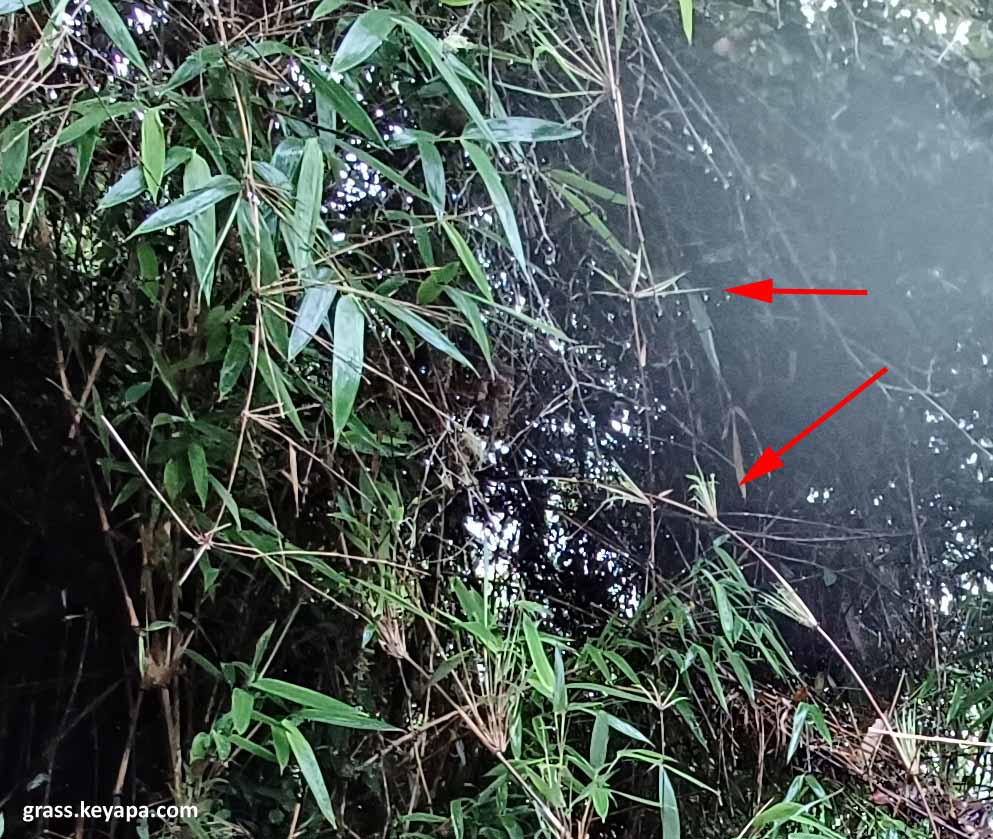
C. delicatula itself is an Andean bamboo that has very long and thin culms. It is viney, and the nodes sport side branches that form star-like shapes (see pic below). The images of this species that I found on the web seemed to show a rather more delicate looking bamboo, but perhaps the vagaries of living in the wild instead of luxuriating as a somewhat more pampered ornamental makes a difference. Either way, I am always happy to accept corrections to my identifications. 

Nodes with side branches forming star patterns (red arrows)
Chusquea is the most diverse neotropical bamboo genus, and has the widest latitudinal range of any bamboo genus, occurring from 24 degrees North in Mexico to 47 degrees South in Chile. It also has the largest altitudinal range, and can be found from sea level to over 4000 m. Species in this genus are sometimes dominant parts of montane forests and high altitude grasslands. Machu Pichu at 2400 m is seemingly perfect for C. delicatula, and I saw quite a number of these grasses during my tour of the park.

Chusquea delicatula (?)
Unfortunately, the rain and the somewhat rapid pace of the tour meant that I could not really spend much time observing and photographing the specimens. They are beautiful plants, with their arching habit and dark green slender leaves. I hope that the next time I am in that area, I can hike the Incan Trail to Machu Picchu, and thus have a lot more time to devote to what has become one of my favorite bamboo groups.

Part of a bamboo looms over a group of rain-soaked tourists

Wednesday, November 30, 2022

Bamboo, Bamboo Look-Alikes, and a 'Miracle' Grass at the Harry P. Leu Botanical Garden

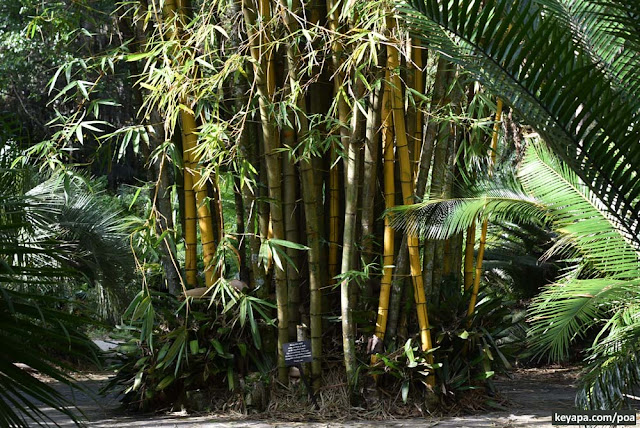
Bambusa vulgaris 'Vittata' (Striped Timber Bamboo)

Bamboos form the subfamily Bambusoideae, and there is no doubt that they are some of the most beautiful grasses around. Their colorful culms, delicate leaves, and the majestic heights reached by some bamboo species, make them a favorite of many plant collectors and  growers, and their economic importance as structural materials is second to none in the Poaceae. In addition, bamboos hold a special place in the cultures of many East Asian countries.
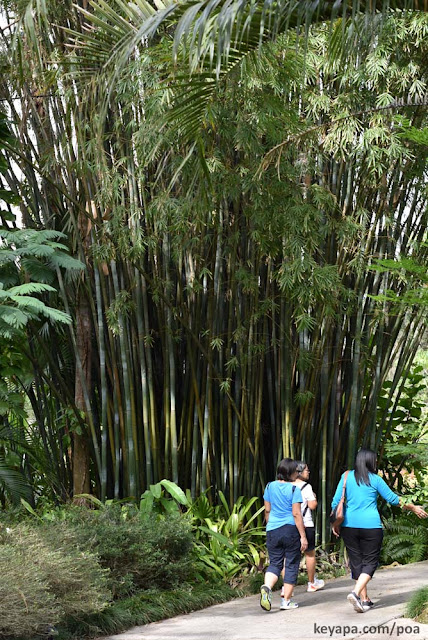
Bambusa malingensis (?) dwarfs passersby

I visited the Harry P. Leu Botanical Garden in Orlando, FL and spent some time marveling over these plants, but also discovered a few other new grasses that I had never encountered before.

As always, the bamboos were probably one of the highlights for many of the people visiting the garden.  People were especially enthralled by the larger specimens, which towered over them and rose to reach the heights of the surrounding trees. Unfortunately, even though there were signs that urged people not to do so, I saw instances of culms with the initials of visitors carved into them. 
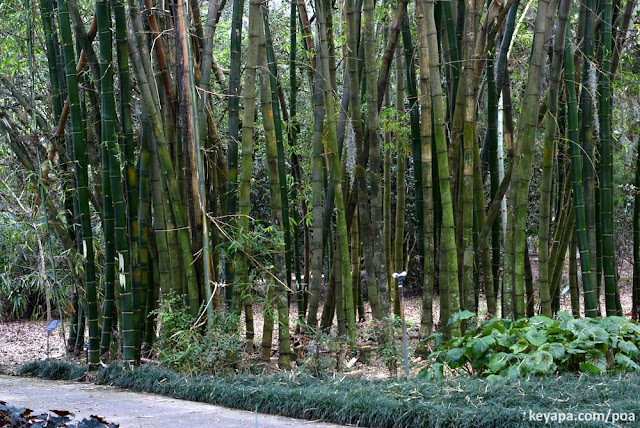
Bambusa vulgaris

There is a common misconception that the bamboos are the most "primitive" of the grasses (probably due to the fact some are woody), but recent studies show that the Bambusoideae diverged after the rice subfamily (Oryzoideae), and much later than the three earliest grass subfamilies (Anomochlooideae, Pharoideae, and Puelioideae). More on grass phylogeny in some future post, I promise.

Although many of the specimens I found were varieties of Bambusa vulgaris (Timber Bamboo), there were quite a few other species that caught my eye. 

A medium sized bamboo (Dendrocalamus minor 'Amoenus') that had a bluish tint to its culms entranced me.
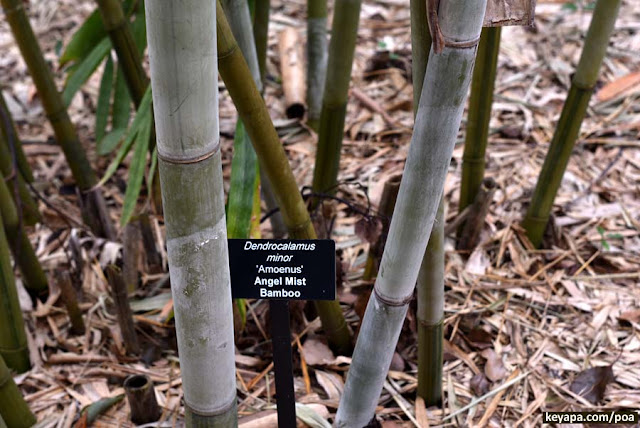
Dendrocalamus minor 'Amoenus'

I was also interested in a smallish bamboo with the funny name of Pseudosasa japonica 'Tsutsumiana' that was hidden among its towering brethren. Its form and attractive foliage made me think it would make a nice houseplant, if only it stopped growing at a manageable height! But the highlight of my trip turned out to be some of the non-Bamboo grasses.
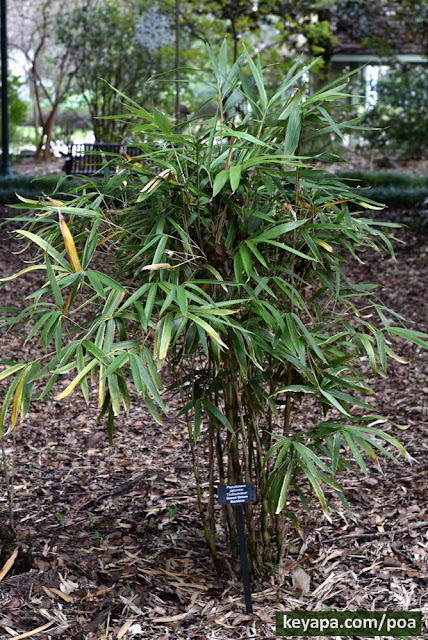
Pseudosasa japonica 'Tsutsumiana'

A few of the species that were also in the bamboo section of the park looked remarkably like small bamboo, but were in fact not in the subfamily Bambusoideae at all! 
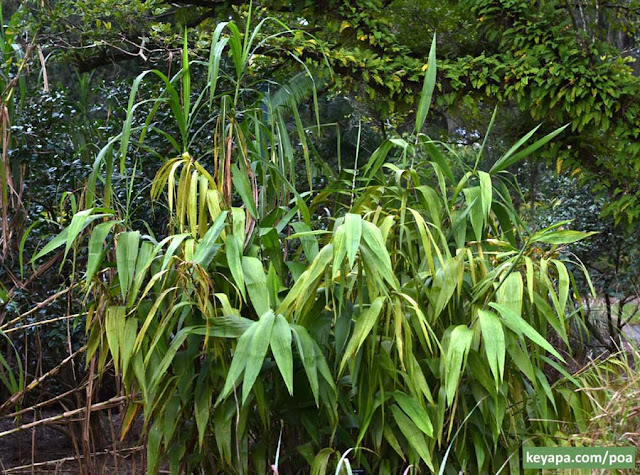
Thysanolaena latifolia

Thysanolaena latifolia (called Tiger Grass in some places, and Broom Grass in others) had elegant broad leaves, and I thought at first it was another bamboo. The specimen I found in the shade sported dried flowerheads that looked like brooms, and in their native habitat they are in fact used for sweeping.
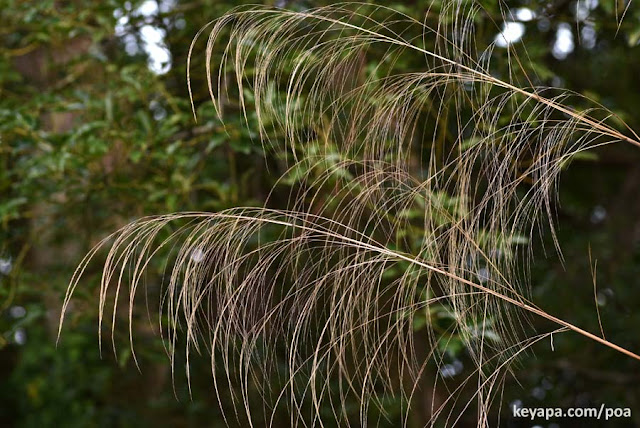
Thysanolaena latifolia seedheads

Another grass that really caught my attention was a small cutie that only reached to my calf called Pogonatherum paniceum. It looked like a bamboo as well, and it had gorgeous striped leaves and an attractive roundish habit. It is used as an ornamental in some places, and I have a feeling I might get one for my garden someday.

Pogonatherum paniceum

One other specimen that held my attention showed up near the end of my visit. The day was coming to a close, and I was hurrying towards the exit when I came upon an entire section that was dedicated to ornamental, and other, grasses.

In addition to the usual ornamental grass suspects like Miscanthus spp, as well as economically important species like Saccharum officinarum (Sugarcane), the lot had a species that I had been hearing about a lot in my sojourns on facebook, but which I had never seen in person.
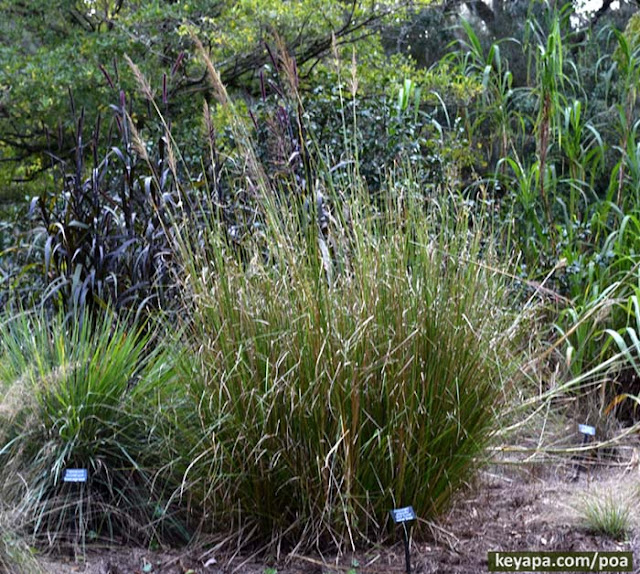
Chrysopogon zizanioides (Vetiver grass) habit

Chrysopogon zizanioides, which is also called Vetiver grass, is a species which has its own groups in Facebook, and its many economic benefits has been been touted loudly and repeatedly by its many boosters around the world.
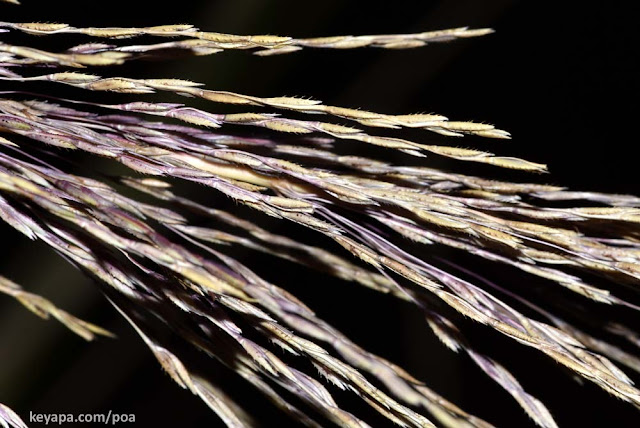
Chrysopogon zizanioides (Vetiver grass) seedheads

C. zizanioides is considered part of a low cost technology solution that has helped to solve various problems. It has a massive root system that grows vertically and deep into the soil, which makes it ideal for erosion control. These same roots also spread and slow down runoff so it passes harmlessly across farmland, and the ability of the grass to tolerate very high levels of heavy metals makes it ideal for soil remediation. It is also used for pest control in that it is attractive to many insect pests (e.g. stem borer moths), which lay their eggs on the plants instead of nearby crops. The larvae who feast on C. zizanioides die due to chemicals in the grass that interfere with their digestive system.

It really is  a so-called 'Miracle' Grass to the many people around the world who have used it! 

Here are some of the species that I discovered and mapped by GPS in the Harry P. Leu Botanical Gardens:

Bamboo:

Bambusa dissimulator
Bambusa eutuldoides 'Viridivittata'
Bambusa malingensis
Bambusa multiplex
Bambusa multiplex 'Golden Goddess'
Bambusa oldhamii
Bambusa textilis var gracilis
Bambusa vulgaris
Bambusa vulgaris 'Vittata' 
Dendrocalamus asper
Dendrocalamus minor 'Amoenus'
Otatea fimbriata
Pseudosasa japonica 'Tsutsumiana'

In addition to the bamboos, I was happy to find some Other Grasses:

Arundo formosana
Chrysopogon zizanioides
Miscanthus spp
Pogonatherum paniceum
Thysanolaena latifolia
Saccharum officinarum
Trypsacum spp

...and a few more that I had no time to survey due to the park closing.

For visitors to the park later, I created a google map of the specimens that I found. You can find it here:



Friday, February 4, 2022

The Symbolism of the Bamboo Planet as Home of the New Jedi Temple (Star Wars: The Book of Boba Fett Episode 6)

SPOILERS WARNING!

Do not read if you are about to watch episode 6 of the Boba Fett Saga.

What a great episode in the new Star Wars series on Disney Plus!

Not only did we get to see many of the major characters in Star Wars come back, but the setting for most of the new episode is on a planet that seems to be dominated by various bamboo species!

In this episode, the Mandalorian travels to where he believes Luke Skywalker has taken Grogu.

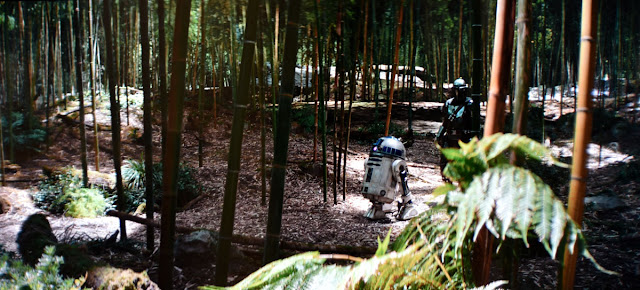
When he lands, the first thing he meets is the venerable R2-D2, who guides him through a bamboo forest to a clearing, where ant-like robots are building what looks to be a stone structure. 

R2-D2 guides the Mandalorian
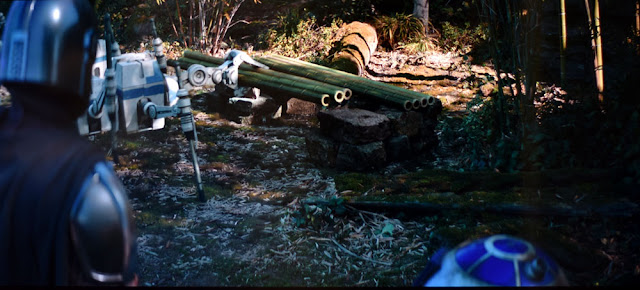
When the Mandalorian presses him on the whereabouts of Grogu, R2-D2 shuts down and the Mandalorian is forced to rest on a bench that the ant-like robots made for him using stones and bamboo poles.
The bamboo bench
Meanwhile, we cut to Luke Skywalker and Grogu in the bamboo forest. Luke is teaching Grogu how to become a Jedi, and there are many scenes of them in various settings surrounded by bamboo.

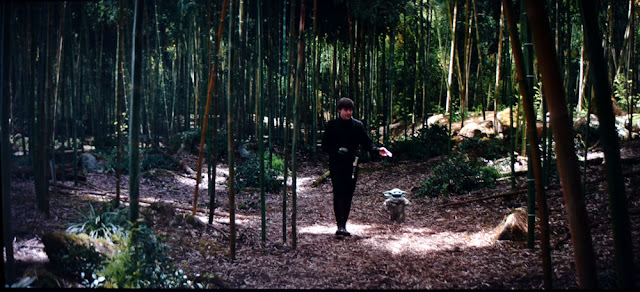
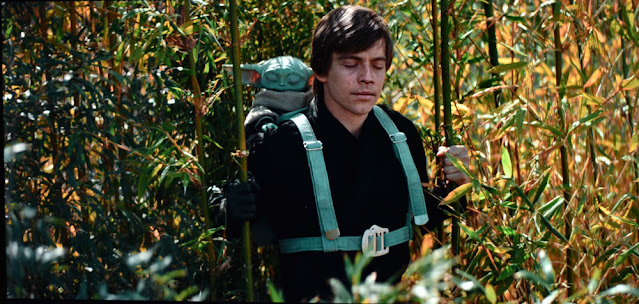
In one scene, they are walking along a trail through the bamboo forest, and Luke asks Grogu whether he wants to remember what happened to him in the past. When Grogu seemingly gives assent, Luke places his hand on top of Grogu and we suddenly see scenes of battle, with Clone Troopers killing Jedi and Grogu staring in horror at the devastation.

Luke Skywalker and Grogu walking along a bamboo grove
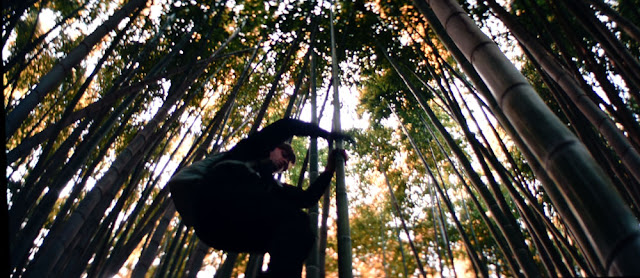
In another scene, Luke takes Grogu on his shoulders, just like he did Yoda when he himself was being trained as a Jedi, and Luke runs through a forest filled with huge bamboos, before climbing nimbly up to the top of the canopy. 
Luke Skywalker climbing up bamboo stand with Grogu on his shoulders
There Luke tells Grogu about the Force, and how the world exists in balance, and that through the Force Grogu will find balance as well.  It is a moving moment, with the two staring out towards the wider world, and bamboo leaves fluttering around them in the breeze.
Feeling the Force
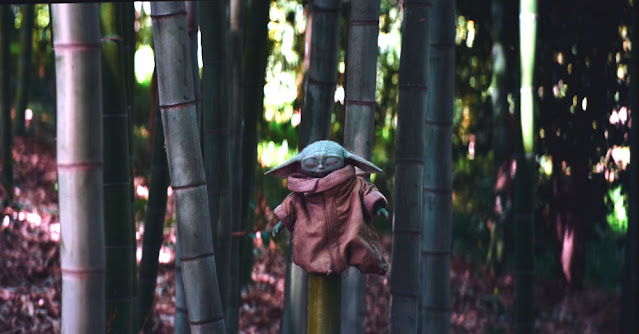
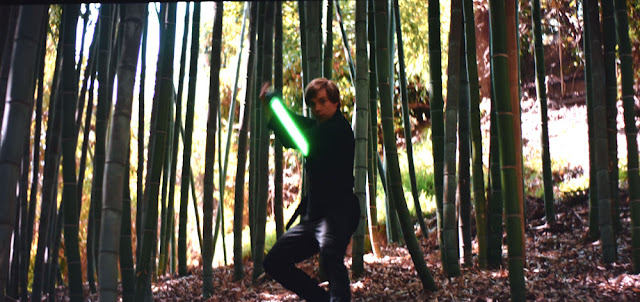
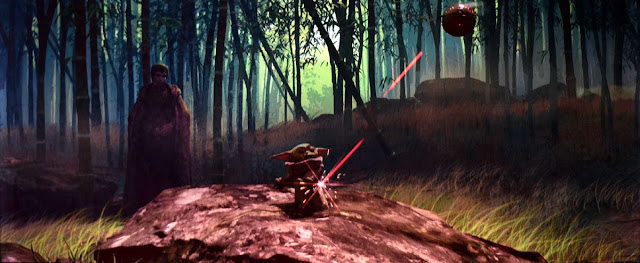
Finally, we cut to a small clearing surrounded by gigantic bamboo, and we see Grogu balancing successfully on a bamboo culm, while Luke draws his lightsaber and displays his swordsmanship. It is another moving moment in an episode with so many deep emotional currents.
Grogu balancing on a bamboo culm
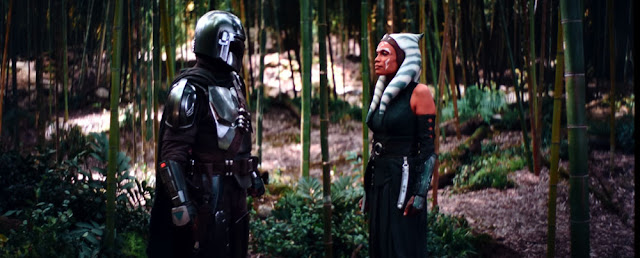
My favorite character Ahsoka Tano then suddenly shows up. There is no fanfare, no big reveal. The Mandalorian suddenly realizes he is not alone, and when he stands quickly from his rest and draws his gun, he is confronted by Ahsoka, who is casually leaning on some bamboo culms and waiting for him. 

Ahsoka Tano talks to the Mandalorian
She tells him that the structure being built is going to be a new Jedi temple, and that Grogu will be its first pupil. When the Mandalorian insists on seeing Grogu, she leads him through the bamboo groves and tells him he has the option of seeing Grogu, but that this meeting would only cause more difficulty for the child. After some thought, the Mandalorian decides that he will not see Grogu, but he asks Ahsoka to give the child a suit made from Mandalorian armor.

Near the end, we see Ahsoka and Luke talking by a lake, bamboo trees behind them, as Luke asks her what he should do with Grogu. Ahsoka responds that he should trust his instincts, and when she turns to leave, Luke wonders whether he would see her again. She says "perhaps" and wishes him farewell in that most time honored of fashion: "May the Force be with you."

Luke Skywalker 
The continuous use of scenes with bamboo in this episode is likely not accidental. 

In many Asian cultures, bamboo symbolizes harmony and balance, mainly due to the fact this grass features an unmatched combination of flexibility and strength in the structure of its culm. This is analogous to the balance that Luke tells Grogu is inherent in the Force. George Lucas had been heavily influenced by Eastern mysticism in his creation of the Star Wars Jedi ethos, and especially by Taoism, and the series continues to hew to this bias by using bamboo as the primary setting for Grogu's training.

The fact that the planet will also be home to the new Jedi Temple is also heavily symbolic. Bamboos are the fastest growing plants in the world, and they can also be used to symbolize the nascent growth of the Jedi after their decimation by the Sith Emperor.

I cannot emphasize enough how cool this episode was, not only because of the introduction of many of the most beloved characters in the Star Wars universe, but also because of the many beautiful scenes of bamboo that surrounded (and perhaps defined) them.

Go watch it!


Tuesday, November 23, 2021

The Bad-Ass Bamboo Forest in Shang-Chi

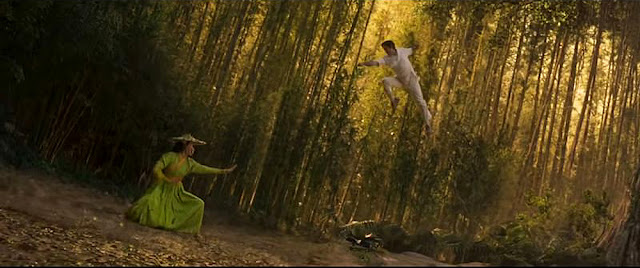
Shang-Chi's parents meet with the Bamboo Forest as backdrop for their fight

I just watched the new Marvel movie Shang-Chi on Disney Plus, and I have to say I enjoyed it a lot.

It was funny, the cast was personable and relatable, and the special effects were fantastic. The movie has a 92% rating at rottentomatoes.com, and it broke several box office records during its release.

But two scenes in particular made me really like the movie.

The mother of Shang-Chi comes from a village called Ta Lo, which is filled with magical beasts from Chinese folklore. This village is guarded by a bamboo forest, which forms a beautiful backdrop for a fight scene between the hero's parents when they first meet.

The bamboo in the forest also can move, and they have a penchant for wanting to squash intruders who try to find Ta Lo.

This awesome behavior is in full view in two different car scenes, where the maze-like forest opens up in front of rushing cars, only to close violently behind them. Anyone not fast enough to outwit and outrun the closing forest is smashed into bits and "eaten".


Fiction books and movies are replete with hostile plants, but this variation on the theme was entertaining and unique, and I highly recommend the movie to everyone. Enjoy!

Official Trailer:


Tuesday, March 16, 2021

A Lost Bamboo in Tampa

We were walking along the paved path in Rowlett Park in Tampa Bay, FL when I stopped in surprise.

The trees in the park were a mixture of hardwoods, including oak trees covered in Spanish Moss, as well as pine hammocks. The oaks in particular were quite enchanting in their epiphytic finery. 

But what stopped me in my tracks was a sight that seemed quite out of place in that genteel surroundings Rising up like some mountainous upthrust from between bent hardwood trees and a small palm were the beautiful culms of a large bamboo grass! 

It was as if the trees had been pushed to the side by the more aggressive bamboo, as can be seen in the image above, where I marked the trunk of one tree with a yellow arrow.

I examined the bamboo, and found that its leaves were quite delicate looking, and the culms were an attractive dark green. The bamboo reared up from the surrounding foliage of the hardwoods and clearly had no problem gaining access to the sun.

I wondered who had planted it, and when. Was it there by design, a gift from the landscapers who populated the park? Did some itinerant local gardener lovingly plant it during one of his sojourns? Or perhaps it was even a natural event, a consequence of some seed or bamboo fragment being deposited into this unlikely spot.

I also wondered whether any of the joggers and walkers and passers-by even noticed this unusual resident of their local community park, something almost miraculous in the heart of their thriving urban jungle.

For anyone interested, the coordinates of this unusual bamboo are: 28.02272,-82.43262


Friday, February 12, 2021

Winter Bamboo Shoots: A Grassy Delicacy for The New Year of the Ox


When someone talks about bamboo, the first image that may crop up would  be of pandas in the wild. Some people who grow bamboo for its beauty may also pipe in that it has many horticultural uses. And for many, this versatile grass is well known as a building material, and is used to make not only housing facilities and various equipment, but is also a major component of kitchen utensils such as chopsticks and chopping boards. Some people have even created bamboo toilet paper! 

I was shopping at a Chinese supermarket a couple days back when I chanced upon an example of one other use for this versatile group of plants. Nestled next to a wall was a bin overflowing with whitish conical bamboo shoots! More specifically, they were the tips of bamboo shoots called "Winter Bamboo Shoots", which a quick google search said are dug up and cut during winter, even before the shoots have a chance to emerge into the open air. Each of the shoot tips was fat and heavy, and at $6.99 per pound (or more than US $3 per kg), they were not exactly cheap. 

Today marks the beginning of the Year of the Ox, a change from the unlucky Year of the Rat, and if ever there was a time to celebrate the turning of a season, then it would be now. So thinking, I bought one of the shoots, and today we will be preparing it for dinner using a recipe that I found in the New York Times. I posted the recipe below, and I look forward to having my first taste of bamboo ;-) 

Ingredients

1 tablespoon dried shrimp

1 teaspoon cornstarch

2 tablespoons chicken stock

2 cups julienned winter bamboo shoots (see note)

1 cup peanut oil

2 teaspoons rice wine

2 tablespoons chopped chives

½ teaspoon sugar

 Salt to taste

1 teaspoon sesame oil

PREPARATION

  1. Pour boiling water over shrimp and soak 30 minutes. Drain and chop finely. Set aside.
  2. Make a paste of the cornstarch and a little chicken stock; stir in remaining stock. Set aside.
  3. Rinse and drain winter bamboo shoots. Using julienne blade of a food processor, process bamboo shoots. Dry well in a cloth towel.
  4. Heat oil to 375 degrees F. Add bamboo shoots and fry 5 to 7 minutes, until bamboo begins to turn golden. Drain off all but one tablespoon of the oil and set aside bamboo to drain.
  5. Add shrimp and stir-fry in the remaining tablespoon of oil.
  6. Add rice wine, chopped chives, sugar, salt, sesame oil and chicken stock mixture.
  7. Return bamboo shoots to mixture and cook until liquid has been absorbed.


Saturday, November 21, 2020

What determines the maximum height of bamboos?


Bamboos are by far the tallest grasses, with the species Dendrocalamus giganteus capable of growing up to 50 m tall. By comparison, the other grass subfamilies can only boast of species like Arundo donax, which tops out at around 6 m tall.

So how do bamboos accomplish this feat?

Researchers have found that the maximum height of tall plants is limited by the ability of the plant to pull water up from the ground to supply the highest leaves. The water column is drawn through xylem vessels, which are the specialized tubes that transport water in plants. When the cost of supplying water to the leaves is higher than the photosynthetic benefits given by those top leaves, then the plant ceases to grow taller. 

Arundo donax in New Mexico

But that's not the entire story.

In addition to gravity, tall plants also have to deal with cavitation, which involves air bubbles forming in the xylem vessels and preventing the water from being drawn up. The formation of such embolisms is a daily occurrence, and can have fatal consequences when the problem is not fixed. In dicot trees which can grow larger in diameter, one solution is for the tree to simply produce more xylem as old ones become non-functional.

But bamboos cannot produce new xylem to replace older ones that have been filled with air bubbles, so researchers tried to determine how bamboos solve this problem of cavitation, which would be a serious limitation on how tall they can grow.

What they found out was something surprising.

They discovered that bamboos repair any embolisms that occur during the day by closing their stomata at night then using  pressure generated from their roots to dissolve the air bubbles back into solution! The root pressure is generated by actively pumping ions and causing water to flow into the roots as it follows an osmotic gradient.

Even more surprising, they tested 59 species of bamboos and measured the heights of the grasses as a function of their basal root pressures, and they found out that  there was a strong correlation between the two values. The higher the root pressure generated, the taller the bamboo.

So it seems that in bamboos at least, the maximum height of each species is directly related to the ability of that species to generate higher root pressure! The greater the ability of the species to generate high root pressure, the higher its potential maximum height.

Reference

Cao KF, Yang SJ, Zhang YJ, Brodribb TJ. The maximum height of grasses is determined by roots. Ecol Lett. 2012 Jul;15(7):666-72. doi: 10.1111/j.1461-0248.2012.01783.x. Epub 2012 Apr 11. PMID: 22489611.


Saturday, June 6, 2020

A short history of my obsession with grasses

Bambusa malingensis
Bambusa malingensis
I've recently wondered when my interest in grasses first manifested itself.

My fascination with a specific plant group for a long time was confined to Aroids, and I maintained one of the longest running aroid-specific websites on the internet when I started my Thaumatophyllum (at the time, Meconostigma) site in 2005.

Of course, I have almost always been involved with one species of grass, Oryza sativa (rice), which I have grown almost every year for more than a decade as something like a ceremonial ritual. But I think this interest did not extend beyond to other grasses until Summer of 2011, when I obtained my first ornamental grass, Imperata cylindrica 'Red Baron' (Japanese Blood Grass, but more well known in its wild form as Cogon grass).

Imperata cylindrica 'Red Baron' (Japanese Blood Grass)
This started my first love affair with grasses, and that JBG is still with me and thriving wildly to this day. In fact, it interested me so much that I bought a few more grasses in 2012, including a Miscanthus sinensis 'Gold Bar', which I unceremoniously stuck below the front passenger seat after I bought it ;-)

Miscanthus sinensis 'Gold Bar'
I also remember 2012 was when we went on a road trip to Florida, and I took several pictures of grasses that we met along the way.

Cortaderia selloana (Pampas grass)
The first were specimens of Cortaderia selloana (Pampas grass) in the Carolina Premium Outlets on the outskirts of Raleigh, North Carolina.

Cortaderia selloana (Pampas grass)

There were some truly impressive specimens of this species in that outlet, with a central plant near the entrance rising perhaps 3-4 meters high. The outlet had also planted them on the islands next to the parking lots, and I had a field day taking photos of the grass while waiting for my wife to finish shopping.

Miscanthus sinensis
Miscanthus sinensis cultivar
In addition, the outlet had a few Miscanthus sinensis specimens scattered about, although I was admittedly less impressed with these than the flowering Cortaderia.

Bambusa malingensis
Bambusa malingensis
Once we got to Florida, we visited The Fairchild Botanical Garden in Miami, where I admired the huge bamboo groves, and on the way back home, we also visited Myrtle Beach, where I marveled at the tall Sea Oats (Uniola paniculata) waving in the sea breeze,

Uniola paniculata
Uniola paniculata at Myrtle Beach

Spikelets of Uniola paniculata

It was at this point that for some reason my interest in grasses wavered then waned, and for about 6 years I barely thought about them due to a rising interest in Banyan Trees (Ficus spp).

This changed in Summer of 2018, and it had to do with Cogon grass (Imperata cylindrica) again. This time, I became interested in the invasive wild form, and my fascination with this one species started to slowly encompass other species in the Poaceae.

During our trip to Baanf National Park in Canada in Fall 2018, I took quite a lot of pictures of grasses in that area, and by the next Summer, I had been enmeshed enough in the family to start this site.

Hordeum jubatum in Lake Louise (Baanf National Park)
In a way, it was a case of positive feedback, where my interest in grasses pushed me to write articles and take pictures of them, while the solid presence of my work provided an impetus for me to write even more and study them even more.

This coming July will mark the first year anniversary of this site. I have enjoyed the journey immensely and I am hoping that my ramblings and photos will encourage others to be just as fascinated by this plant family as I am.