Showing posts with label Cortaderia. Show all posts

Wednesday, October 12, 2022

Winter is Coming: How Grasses Conquered the Long Freeze

Tundra (By Education Specialist)

There are vast areas of the world where cold temperatures create problems for plants.

Such "cold stress" happens when temperatures that are below what are optimal for plants creates physiological problems for the individual plants. Depending on the species, optimal growing conditions usually hovers between 10℃ and 30℃. 

There are two types of cold stress, depending on the temperatures involved.

Chilling refers to cold stress where the temperatures range between 0℃ and 15℃, whereas freezing refers to cold stress where the temperatures are below freezing (0℃). 

In the case of freezing, plants can respond via two different methods. Freezing avoidance is when the plant is able to delay or even prevent freezing altogether in their tissues. In contrast, in freezing tolerance, the plants do not prevent ice crystal formation, but they avoid damage by controlling the size of the crystals and/or where the crystals are formed. Freeze-tolerant plants can survive even freezing of their tissues, and represent the extreme adaptation to conquering the cold over long time periods.

Deschampsia antartica (c) Lomvi2 - Wikipedia

Grasses initially evolved as tropical plants that loved the warmth. But over time, the grasses have managed to adapt to the cold and have become the most widespread vascular plant family, and present in all continents. Indeed, the grass Deschampsia antartica is only one of two vascular plants that are native to Antarctica, and its optimal growing temperature is an amazing 10℃!

Freezing can kill grasses via the formation of ice crystals. At first, ice crystals form in the extracellular spaces between cells, which causes water to be pulled from the cell interior. The loss of intracellular water (and later solutes) results in dehydration and osmotic stress. As ice crystals continue to form into the interior of the cells, the cell membranes start to degrade and programmed cell death occurs.

The evolution of the ability to tolerate freezing in the Poaceae is fascinating, and is confined mostly to species in two different subfamilies of the Poaceae. Grasses in the subfamilies Pooideae (in the Northern Hemisphere) and Danthonioideae (in the Southern Hemisphere) live in cold temperate continental regions, and they have solved the problem in two different ways. 

Hordeum jubatum of the subfamily Pooideae (Northern Hemisphere)

The grasses in subfamily Pooideae in the Northern Hemisphere all use the C3 mode of photosynthesis, and are commonly called the cool season grasses. They include many turf grasses (such as Poa pratensis or Kentucky Bluegrass), as well as food staples such as Triticum aestivum (wheat), Avena sativa (oat), and Hordeum vulgare (barley). 

The ancestors of the Pooideae evolved about 67 million years ago in small niches during the formation of the Eurasian mountain ranges. In this group, ice binding proteins evolved which decreased the rate of the formation of ice, as well as altering the shape of the ice crystals being formed. These anti-freeze proteins prevent the formation of large crystals that can physically damage cells and tissues.

Cortaderia selloana from the subfamily Danthonioideae (Southern Hemisphere)

In contrast, cold-acclimated grasses from the subfamily Danthonioideae in the Southern Hemisphere have evolved a different method for conquering the cold. The members of this group are also C3 grasses, and include the large ornamental grass Cortaderia selloana (Pampas grass). The freeze tolerant members of this subfamily produce ice-nucleation proteins that allow them to control where ice crystals form. Thus, they can prevent damage by limiting crystal formation in the extra-cellular spaces and the leaf surfaces, but not within the cell interiors.

The independent evolution of such mechanisms by the Danthonioideae and Pooideae to tolerate freezing have enabled grasses to dominate large areas where there are extreme seasonal fluctuations in temperature, and contributed to the grassy world we live in today. 

As an interesting aside, at the other end of the temperature spectrum, C4 grasses such as those in the grass subfamilies Chloridoideae and Andropogoneae - which include corn/maize (Zea mays), the bluestems (Andropogon spp), sugarcane (Saccharum officinarum), and cogon grasses (Imperata cylindrica) - have extended the range of environments conquered by the Poaceae to much warmer and drier climes. 

For a quick look at the difference between C3, C4 and CAM photosynthesis in grasses, click here.

Muhlenbergia sericea of the subfamily Chloridoideae, a C4 grass

Finally, to read more about the fascinating topic of cold adaptation in grasses in depth, check out the references below.

Note: In addition to the specialized mechanisms of freezing tolerance above, grasses can deploy other additional mechanisms for coping with the cold that are beyond the scope of this shirt post, such as accumulating fructan in their vacuoles, using supercooling (for shorter cold spells), and increasing anti-oxidant enzymes.

Phalaris arundinacea of the subfamily Pooideae

References:

Timothy J. Gallaher, T. J. Gallaher, Paul M. Peterson, P. M. Peterson, Robert J. Soreng, R. J. Soreng, Fernando O. Zuloaga, F. O. Zuloaga, De-Zhu Li, D. Li, Lynn G. Clark, L. G. Clark, Christopher D. Tyrrell, C. D. Tyrrell, Cassiano A.D. Welker, C. A.D. Welker, Elizabeth A. Kellogg, E. A. Kellogg, & Jordan K. Teisher, J. K. Teisher. (2022). Grasses through space and time: An overview of the biogeographical and macroevolutionary history of Poaceae. Journal of systematics and evolution, 60, 522-569. doi: 10.1111/jse.12857

Schubert M, Humphreys AM, Lindberg CL, Preston JC, Fjellheim S. 2020. To coldly go where no grass has gone before: A multidisciplinary review of cold adaptation in Poaceae. In: Annual Plant Reviews online.Wiley.523–562.

Friday, July 8, 2022

Ornamental Grass Hunting at the Big Box Stores (and Where Big Box Grasses Go to Die)

Leymus arenarius spikelets (taken using non-macro lens)

I am a big fan of ornamental grasses. 

In my time I have purchased many natives such as various Panicum virgatum cultivars ("Northwind",  "Thundercloud", "Heavy Metal", "Hot Rod"), Andropogon gerardii cultivars ("Black Hawk", "RainDance"), and even a few Schizachyrium scoparium like “Twilight Zone”. I even have potential invasives like Miscanthus sinensis "Morning Light" and Japanese Blood Grass (Imperata cylindrica), both of which I obtained a long time back before I knew they were considered iffy ornamentals.

Most of my purchases have been at specialized Garden Centers or from online, but every time I visit Lowe's or Home Depot, I make it a point to visit their Garden department in search of unusual grasses.

The typical store scatters the grasses across various sections, but Lowe's is a favorite of mine because some Lowe's stores even have an ornamental grass section!

You go, Lowe's!

On one trip to a New Jersey Lowe's I decided to list all the available ornamental grasses in the store. 

Most of the ornamental grasses were crowded into one bench, but there were still a few scattered here and there. The usual purple fountain grasses were available (Cenchrus setaceus/Pennisetum setaceum), as were varieties of Miscanthus sinensis ("Adagio", "Variegata"), and the really cute Festuca glauca (in this case, "Beyond Blue"). There were even pots of Cymbopogon citratus (Lemon grass), which normally is placed separately from other ornamentals. These are typical types for this region, as well as in Florida stores (especially the fountain grasses).

Interestingly enough, I did find a species that I normally don't see in New Jersey stores. A couple of pots had Cortaderia selloana (White Pampas Grass)!

An unusual Cortaderia selloana for sale

This species of course has been considered invasive for some time now, but it would be wrong to say it is not gorgeous when in full flower, and so it has been a favorite of lay gardeners in many places. I was surprised to see it here though, as  it usually grows better farther south.

But the species that really stopped me in my tracks was a row of Leymus arenarius. The grasses were in flower, and the blue green hue of the leaves of this native species made me love it on sight. It's safe to say that I will likely get this sand-loving grass in future if I have space for it in my new home.

Leymus arenarius - beautiful in blue

On the way back to my car, I saw some clearance racks that had been parked to the side of the store. Curious about what I would find, I walked closer and found myself staring at the dying and drying bodies of various potted grass specimens. 

Where box store grasses go to die

Most of the dried up plants had grown long, their limp blades obscuring the name tags. I peered closely and found that many of them were Calamagrostis spp, with a couple of Miscanthus sinensis cultivars thrown in and a lone Muhlenbergia sp. A few still had green blades poking up through the mass of dried gold, and I knew that these could still be saved.

When I asked some store reps about the items, they said those plants were going be thrown away if no one bought them at clearance. It seems too many were in stock, and most had deteriorated due to negligence and poor lighting. 

I left after awhile, feeling a bit sad for the dying grasses. There should be a way to calculate the correct stock, and a way to take better care of these ornamental plants.


Tuesday, December 21, 2021

Google Maps Reveals the Inability of Some Escaped Ornamental Grasses to Expand Laterally

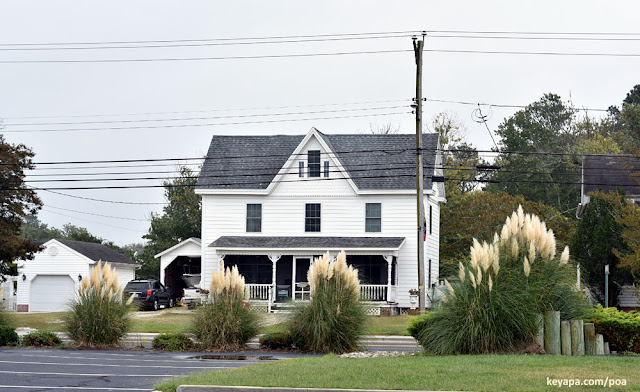
Escaped Cortaderia selloana near Tanger 2 Outlets in December, 2021
I have touted the use of Google Street View as a way to view the behavior of grasses over time. I did this with the invasives Neyraudia reynaudiana (burmareed) and also Imperata cylindrica (cogongrass). In both of those species, Google Street View showed an expansion of the grass as the years passed. 

When I visited the Tanger Outlets in Hilton Head, South Carolina a few days back, I noticed the presence of "escaped" ornamental Cortaderia selloana (pampasgrass) along the roadsides. This species is heavily used in the southeastern states, and the fact that some may have escaped from cultivation was not entirely a surprise. One stand in particular southeast of the outlet had a dense cluster of the invasive.

When I used Google Street View to look at the same area in the past (coordinates 32.237168,-80.8178924), I did not anticipate seeing this same stand years back, but imagine my surprise when I went all the way back to 2013 and the same exact cluster of C. selloana seems to have been in the same spot!

The same stand of Cortaderia selloana in 2013

This seeming stability in pampas grass is interesting because like many grasses it has rhizomes which can aggressively push its way into new territory. Perhaps in this case the surrounding vegetation or environment is not conducive to its spread, or perhaps the last 7 or so years is not enough time to see major changes. When compared to cogongrass especially, such slow expansion is curious, and it would be interesting to find more instances of other escaped ornamentals and see whether this slow rate of expansion is normal.

Saturday, November 27, 2021

The Vexing Problem of Invasive Ornamental Grasses

Cortaderia  selloana in Virginia 

The use of ornamental grasses has been growing rapidly since the 1970s, when Cortaderia selloana (pampas grass) and Festuca glauca (blue fescue) were the only well known ornamental grasses sold in West Coast retail stores.

It's a different situation today, with ornamental grasses gracing many residential and commercial areas, and even having their own sections in gardening stores.  

But look closely at the selection in many stores and you'll come to realize that many (if not most) of the ornamental grasses are not native to the region in which they are being sold.

Huge Cortaderia selloana on sidewalks in Virginia 

Unfortunately, many people select ornamental  grasses without any consideration about their potential for harming the environment, and  the horticultural industry itself may exacerbate  the problem by continuing to sell plants that have been proven to be invasive. This lack of awareness extends to even reputable botanical gardens and arboretum, and I have repeatedly seen some institutions make heavy use of ornamental grasses like Miscanthus sinensis. Granted, these non-native grasses are often beautiful, but this dependence on such cultivars creates problems due to the potential invasiveness of the species. 

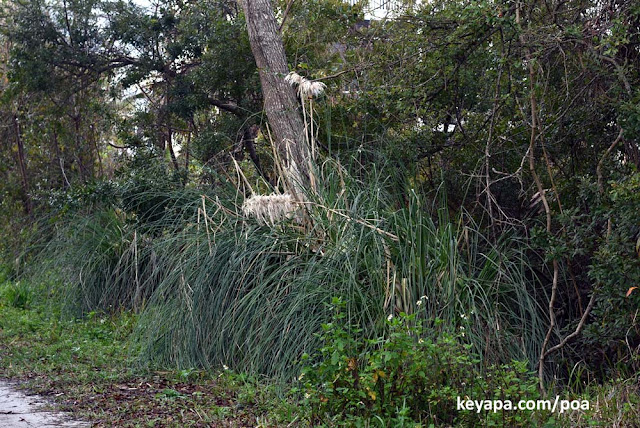
Escaped Cortaderia selloana in Florida

It's not all black and white though. What may be invasive in one region, might be relatively benign in another clime. For example, Imperata cylindrica is one of the most invasive grass in many subtropical and tropical areas in the world, but a red  cultivar (called Japanese Blood Grass)  is relatively harmless in colder areas, even though it can allegedly revert to an all-green invasive form when grown in a more suitable climate.


Large Miscanthus sinensis in parking lot of suburban strip mall in NJ

However, a species that may at first seem non-invasive can become invasive over time. This might have been the case with the popular  Cortaderia selloana (pampas grass) from South America.

Escaped Miscanthus sinensis at forest edge in NJ

This species became very popular in the late 19th century, with society becoming enamored of the large pure white inflorescence and using it almost everywhere. At one point, half a million of the plumes were being sold yearly. But for decades, the invasive nature of C. selloana seems to have been overshadowed by a close relative. C. jubata. In fact, even in the 1970s, researchers reported most of the infestations they found were of C. jubata, and non-cultivated C. selloana did not exist far from human habitation. This seems to have changed by the 1990s, when new surveys showed that C. selloana had become the more invasive of the two, with outcrossing populations found in many different native habitats. Even the morphology of these populations had changed, with the pure white plumes becoming darker.

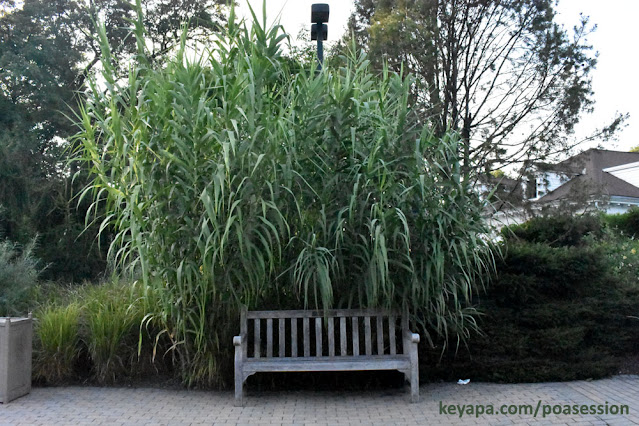
Arundo donax in an arboretum in NJ

There are sterile options when it comes to non-native ornamental  grasses, including hybrids of M. sinensis. These can be a way out of the trap of desiring particular grasses that have the potential to be invasive, although consumers have to do their research  before buying such species.

In the end, there are several possible solutions to the problem of invasive  ornamental  grasses:

  1. Make it illegal for the retail industry to sell invasive species, and enforce the law.

  2. If possible, sell sterile cultivars of any non-native species.

  3. Continue to inform people about the problems associated with non-native ornamentals, even those that do not seem to be currently invasive.

  4. Promote the use of native ornamental grasses, such as Panicum virgatum, Schizachyrium scoparium, and Andropogon gerardii cultivars. Emphasize not only the environmental reasons for using these, but also their beauty and adaptability.
Only through the rigorous implementation of all these will we be able to make sure we continue to protect the integrity and beauty of our native habitats.

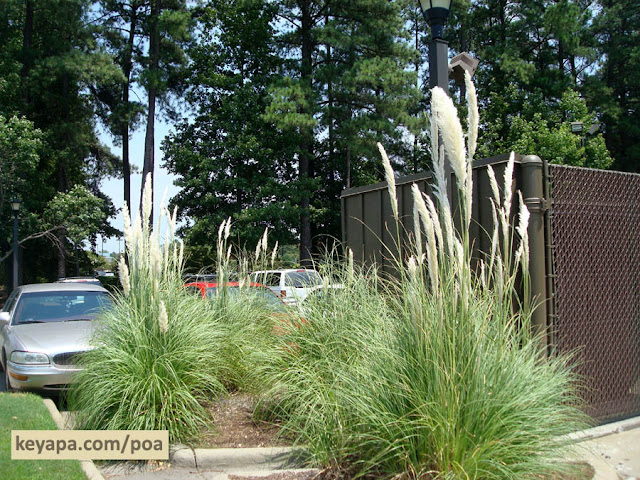
Cortaderia selloana in North Carolina parking lots

References

Lambrinos, JG (2004). A tale of two invaders. The dynamic history of pampas grass and jubata grass in California. Cal-IPC News. Vol. 12, Nos. 3/4


Saturday, June 6, 2020

A short history of my obsession with grasses

Bambusa malingensis
Bambusa malingensis
I've recently wondered when my interest in grasses first manifested itself.

My fascination with a specific plant group for a long time was confined to Aroids, and I maintained one of the longest running aroid-specific websites on the internet when I started my Thaumatophyllum (at the time, Meconostigma) site in 2005.

Of course, I have almost always been involved with one species of grass, Oryza sativa (rice), which I have grown almost every year for more than a decade as something like a ceremonial ritual. But I think this interest did not extend beyond to other grasses until Summer of 2011, when I obtained my first ornamental grass, Imperata cylindrica 'Red Baron' (Japanese Blood Grass, but more well known in its wild form as Cogon grass).

Imperata cylindrica 'Red Baron' (Japanese Blood Grass)
This started my first love affair with grasses, and that JBG is still with me and thriving wildly to this day. In fact, it interested me so much that I bought a few more grasses in 2012, including a Miscanthus sinensis 'Gold Bar', which I unceremoniously stuck below the front passenger seat after I bought it ;-)

Miscanthus sinensis 'Gold Bar'
I also remember 2012 was when we went on a road trip to Florida, and I took several pictures of grasses that we met along the way.

Cortaderia selloana (Pampas grass)
The first were specimens of Cortaderia selloana (Pampas grass) in the Carolina Premium Outlets on the outskirts of Raleigh, North Carolina.

Cortaderia selloana (Pampas grass)

There were some truly impressive specimens of this species in that outlet, with a central plant near the entrance rising perhaps 3-4 meters high. The outlet had also planted them on the islands next to the parking lots, and I had a field day taking photos of the grass while waiting for my wife to finish shopping.

Miscanthus sinensis
Miscanthus sinensis cultivar
In addition, the outlet had a few Miscanthus sinensis specimens scattered about, although I was admittedly less impressed with these than the flowering Cortaderia.

Bambusa malingensis
Bambusa malingensis
Once we got to Florida, we visited The Fairchild Botanical Garden in Miami, where I admired the huge bamboo groves, and on the way back home, we also visited Myrtle Beach, where I marveled at the tall Sea Oats (Uniola paniculata) waving in the sea breeze,

Uniola paniculata
Uniola paniculata at Myrtle Beach

Spikelets of Uniola paniculata

It was at this point that for some reason my interest in grasses wavered then waned, and for about 6 years I barely thought about them due to a rising interest in Banyan Trees (Ficus spp).

This changed in Summer of 2018, and it had to do with Cogon grass (Imperata cylindrica) again. This time, I became interested in the invasive wild form, and my fascination with this one species started to slowly encompass other species in the Poaceae.

During our trip to Baanf National Park in Canada in Fall 2018, I took quite a lot of pictures of grasses in that area, and by the next Summer, I had been enmeshed enough in the family to start this site.

Hordeum jubatum in Lake Louise (Baanf National Park)
In a way, it was a case of positive feedback, where my interest in grasses pushed me to write articles and take pictures of them, while the solid presence of my work provided an impetus for me to write even more and study them even more.

This coming July will mark the first year anniversary of this site. I have enjoyed the journey immensely and I am hoping that my ramblings and photos will encourage others to be just as fascinated by this plant family as I am.