Showing posts with label Miscanthus. Show all posts

Sunday, September 10, 2023

A Short History of Ornamental Grasses

World's Fair Pavilion in Forest Park, in St. Louis

Ornamental non-bamboo grasses have become such a ubiquitous feature of suburban and urban landscapes nowadays, that it might surprise some people that their widespread use is a relatively new phenomenon here in the USA.

This was brought home to me after I visited the World's Fair Pavilion in Forest Park, St. Louis last week.

The park itself is amazingly large, but what interested me most was a building that was surrounded by large stands of beautiful ornamental grasses. This World's Fair Pavilion was built in 1909 from proceeds of the World's Fair that was held in 1904. It's built on top of a hill and is surrounded by a large expanse of lawn and other plants.

Gigantic Panicum virgatum in Forest Park, St. Louis

The largest Panicum virgatum specimens I have ever seen in masses graced both sides of the area in front of the pavilion. There were also stands of Miscanthus sinensis, as well as the usual stately Calamagrostis. These ornamental grasses dominate the landscape today, but pictures of the same pavilion from the 1930s showed no signs of the stately and graceful grasses. Instead, shrubs and bushes and trees were the norm (see image below).

The pavilion in the 1930s. From the Missouri Historical Society. Note the lack of ornamental grasses.

The drastic change in the landscaping is significant. Although the use of bamboo for landscape decoration was popular even during ancient times, ornamental non-bamboo grasses did not enjoy the same popularity. However, during the 1930s, the renowned  German nurseryman, Karl Foerster pushed for their use in Germany and Europe. He collected grass seeds and plants from all over the world, and after cultivating them in his nurseries he introduced them to the market.

Calamagrostis to the left, Panicum virgatum to the right. In Forest Park, St. Louis

Among the many plants he introduced, perhaps his most famous creation is the outstanding ornamental grass Calamagrostis × acutiflora 'Karl Foerster', which he released to the market in 1950 as a natural hybrid of C. epigejos (native to Europe, Asia and Africa) and C. arundinacea (native to Eurasia, China and India).

Calamagrostis in background, Cenchrus setaceus in foreground, in Colorado

This rise in the use of ornamental grasses in Europe was not mirrored in the USA until much later, but various growers were instrumental in pushing for this new paradigm.

In the early 1960s, Kurt Bluemel began the introduction of ornamental grasses into America through his nursery in Maryland, called Kurt Bluemel Inc. Educated in Germany and Switzerland, Bluemel was passionate about grasses, and by the time he passed away decades later, he was well known as Der Gras König, the Grass King. 

Kurt Bluemel. From Baltimore Sun.

He is said to have carried his first grass specimens in his luggage when he came to America, and his collaboration with Wolfgang Oehme, a German-born landscape architect based in Towson, was highly influential in creating a growing appreciation for ornamental grasses in the country. Some of his notable works include creating the savannas at Disney World's Animal Kingdom, and Busch Gardens. 

Panicum virgatum

By the 1980s, the momentum behind ornamental grasses had finally reached a crux, and an influx of growers finally pushed it into the mainstream. In 1986, John and Jill Hoffman established the Hoffman Nursery in North Carolina, which specialized in ornamental grasses. 

John Hoffman. From Hoffman Nursery.

John's interest in ornamental grasses was stoked during a visit to Germany, where he met the plant breeder Ernst Pagels. Pagels was an enthusiastic supporter of grass-filled gardens, and this along with the support of his mentor,  J.C. Raulston at North Carolina State University, fueled his passion. Today, Hoffman Nursery is one of the largest suppliers of ornamental and native grasses in the country.

Miscanthus sinensis

The trend towards landscaping with grasses then moved from the East Coast to the West Coast through the efforts of people like horticulturalist John Greenlee. In order to complete an oak savanna project in California in the 1980s, he travelled to Kurt Bluemel's Nursery in Maryland, where he was astounded by the hundreds of varieties of ornamental grasses that were on display. He ended up trucking a load of the grasses in a tractor trailer from Maryland to California, and after a stint in Brazil with the renowned landscape architect Roberto Burle Marx (who is also held in high esteem in the aroid community), he finally opened the first ornamental grass nursery in the West Coast.

John Greenlee. From Greenlee Meadow Collection.

Fast forward to today, when people routinely use ornamental grasses both in residential and commercial landscaping. And although many of the varieties used are the showy exotics (such as Miscanthus sinensis and Cenchrus setaceus), the use of native grasses as ornamentals (such as Trypsacum dactyloides in Florida, and Bouteloua gracilis in Colorado) is also widespread.
Bouteloua gracilis in Colorado

Meanwhile, new varieties and species continue to be introduced into the market. Not only do they contribute linear structure to a design, but their ease of maintenance, resistance to herbivores like deer, and their ability to impart movement to an otherwise static landscape, make ornamental grasses perfect components for any project.

Looking out from the pavilion in Forest Park, St. Louis. White flowerheads are Miscanthus sinensis cultivars

Thursday, October 20, 2022

Halloween Horrors in the Cornfields

Yeah, Zea mays (maize/corn) can be spooky

It's that time of the year again when pagan rituals (aka Halloween) sweep across this land, and in honor of that occasion I just have to list some of the horror movies that have made cornfields one of the least likely places to visit during night time.

I remember mentioning that I get spooked hiking forests at night, but I think being stuck in a field with tall grasses like corn would not be Disney time either.

We'll start with the better one of the lot - the movie adaptation of Stephen King's short story.

Children of the Corn (1984 original + all the sequels)


But here are more goodies that I dug up from youtube (in year descending order). I cannot vouch for their quality (other than Signs, Jeepers Creepers, and Escape the Field, which were ok), but if you're into dark and dangerous cornfields (and scarecrows!), you'll probably dig most of them.

This next one actually looked good, and was released by Lions Gate, a major studio. I dug it up (yes, I know I used the term "dig" twice...because Halloween) as a streamed movie in my cable lineup and watched it after posting this. It was ok, though the ending might be confusing. Reminds me of the 2010 Predators movie mixed with King's In the Tall Grass (more on that later).

Escape the Field (2022)

This next one is also in one of the streaming services, but it looks so horribly campy that I am giving it a pass.

Sharks of the Corn (2021)

The next several movies I have not seen, nor am I probably ever going to watch them (except for 1922 maybe, which is based on a Stephen King story).

Scarecrows (2018)

1922 (2017)

Husk and sequels (2011)

The Fields (2011)

A Brush with Death (2007)

Dark harvest (2004)

I watched this one a while back by M. Night Shyamalan and it was good drama, but probably not as good as his Sixth Sense, which was a classic.

Signs (2002)

Jeepers Creepers and sequels (2001)

Psycho Scarecrow (1997)- Full Movie


Finally, we'll end with another adaptation of a Stephen King work. No cornfields this time, but a field of another tall grass (Miscanthus spp in real life it turns out) that is just as deadly.

In the Tall Grass (2019)


Happy Halloween!


Sunday, July 17, 2022

Now, THAT'S a front yard!

Google Street View in May 2022

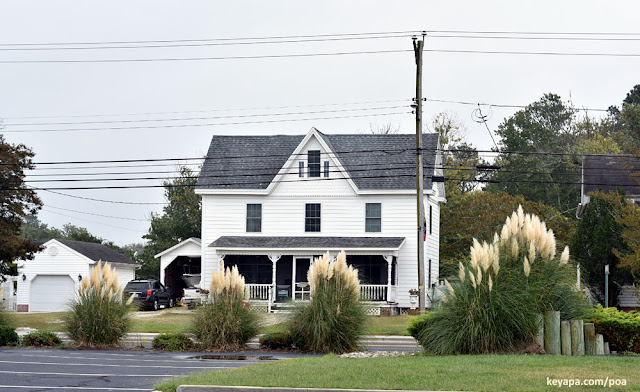
We were on our way to a hiking location here in North New Jersey, and  on the way we passed by some fairly upscale communities. Most had wide front lawns, the grasses kept immaculately low to the ground, with occasional homes sporting large ornamental grasses like Miscanthus sinensis and Calamagrostis cultivars.

But suddenly, I gasped and pointed at something to my fellow passengers in the car. One of the houses had a front yard that was absolutely wild. Lots of tall stately grasses waved in the wind, and there were so many of the tall grasses and shrubs and forbs that the house itself was almost obscured from view.

Unfortunately, we did not have time to stop, but I made a quick mental note of some landmarks around us. When I got home later, I used google street view to try to find the home again, although I was thinking it was a long shot. But amazingly enough, the house front yard was so distinctive I actually did manage to locate it! 

The google street view image was from spring of this year, so the plants were not as high as they are now, and thus not as majestic. But there was no doubt that I had found the right house.

I thought it was charming and daring of this homeowner to go against the grain by not using the usual turf grasses, and I liked the overall effect. But one of my passengers had exclaimed "It's like a jungle!" 

Oh well, you can't please everyone!

UPDATE (2022-07-23)

I managed to take a pic of the front lawn as it looks now, and it looks great. Sorry for the quality of the photo, but I was just using my smartphone at the time. Love the masses of Calamagrostis!


Friday, July 8, 2022

Ornamental Grass Hunting at the Big Box Stores (and Where Big Box Grasses Go to Die)

Leymus arenarius spikelets (taken using non-macro lens)

I am a big fan of ornamental grasses. 

In my time I have purchased many natives such as various Panicum virgatum cultivars ("Northwind",  "Thundercloud", "Heavy Metal", "Hot Rod"), Andropogon gerardii cultivars ("Black Hawk", "RainDance"), and even a few Schizachyrium scoparium like “Twilight Zone”. I even have potential invasives like Miscanthus sinensis "Morning Light" and Japanese Blood Grass (Imperata cylindrica), both of which I obtained a long time back before I knew they were considered iffy ornamentals.

Most of my purchases have been at specialized Garden Centers or from online, but every time I visit Lowe's or Home Depot, I make it a point to visit their Garden department in search of unusual grasses.

The typical store scatters the grasses across various sections, but Lowe's is a favorite of mine because some Lowe's stores even have an ornamental grass section!

You go, Lowe's!

On one trip to a New Jersey Lowe's I decided to list all the available ornamental grasses in the store. 

Most of the ornamental grasses were crowded into one bench, but there were still a few scattered here and there. The usual purple fountain grasses were available (Cenchrus setaceus/Pennisetum setaceum), as were varieties of Miscanthus sinensis ("Adagio", "Variegata"), and the really cute Festuca glauca (in this case, "Beyond Blue"). There were even pots of Cymbopogon citratus (Lemon grass), which normally is placed separately from other ornamentals. These are typical types for this region, as well as in Florida stores (especially the fountain grasses).

Interestingly enough, I did find a species that I normally don't see in New Jersey stores. A couple of pots had Cortaderia selloana (White Pampas Grass)!

An unusual Cortaderia selloana for sale

This species of course has been considered invasive for some time now, but it would be wrong to say it is not gorgeous when in full flower, and so it has been a favorite of lay gardeners in many places. I was surprised to see it here though, as  it usually grows better farther south.

But the species that really stopped me in my tracks was a row of Leymus arenarius. The grasses were in flower, and the blue green hue of the leaves of this native species made me love it on sight. It's safe to say that I will likely get this sand-loving grass in future if I have space for it in my new home.

Leymus arenarius - beautiful in blue

On the way back to my car, I saw some clearance racks that had been parked to the side of the store. Curious about what I would find, I walked closer and found myself staring at the dying and drying bodies of various potted grass specimens. 

Where box store grasses go to die

Most of the dried up plants had grown long, their limp blades obscuring the name tags. I peered closely and found that many of them were Calamagrostis spp, with a couple of Miscanthus sinensis cultivars thrown in and a lone Muhlenbergia sp. A few still had green blades poking up through the mass of dried gold, and I knew that these could still be saved.

When I asked some store reps about the items, they said those plants were going be thrown away if no one bought them at clearance. It seems too many were in stock, and most had deteriorated due to negligence and poor lighting. 

I left after awhile, feeling a bit sad for the dying grasses. There should be a way to calculate the correct stock, and a way to take better care of these ornamental plants.


Saturday, November 27, 2021

The Vexing Problem of Invasive Ornamental Grasses

Cortaderia  selloana in Virginia 

The use of ornamental grasses has been growing rapidly since the 1970s, when Cortaderia selloana (pampas grass) and Festuca glauca (blue fescue) were the only well known ornamental grasses sold in West Coast retail stores.

It's a different situation today, with ornamental grasses gracing many residential and commercial areas, and even having their own sections in gardening stores.  

But look closely at the selection in many stores and you'll come to realize that many (if not most) of the ornamental grasses are not native to the region in which they are being sold.

Huge Cortaderia selloana on sidewalks in Virginia 

Unfortunately, many people select ornamental  grasses without any consideration about their potential for harming the environment, and  the horticultural industry itself may exacerbate  the problem by continuing to sell plants that have been proven to be invasive. This lack of awareness extends to even reputable botanical gardens and arboretum, and I have repeatedly seen some institutions make heavy use of ornamental grasses like Miscanthus sinensis. Granted, these non-native grasses are often beautiful, but this dependence on such cultivars creates problems due to the potential invasiveness of the species. 

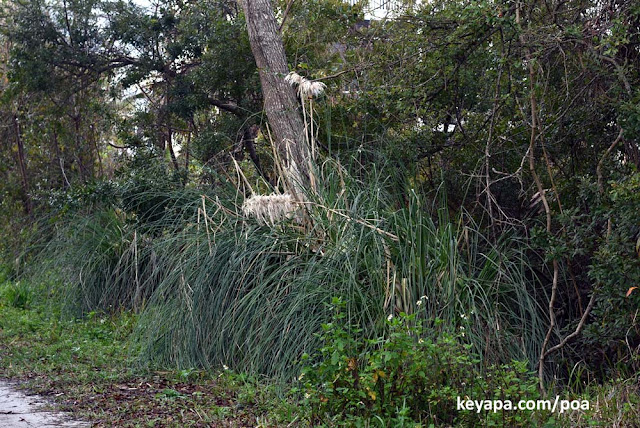
Escaped Cortaderia selloana in Florida

It's not all black and white though. What may be invasive in one region, might be relatively benign in another clime. For example, Imperata cylindrica is one of the most invasive grass in many subtropical and tropical areas in the world, but a red  cultivar (called Japanese Blood Grass)  is relatively harmless in colder areas, even though it can allegedly revert to an all-green invasive form when grown in a more suitable climate.


Large Miscanthus sinensis in parking lot of suburban strip mall in NJ

However, a species that may at first seem non-invasive can become invasive over time. This might have been the case with the popular  Cortaderia selloana (pampas grass) from South America.

Escaped Miscanthus sinensis at forest edge in NJ

This species became very popular in the late 19th century, with society becoming enamored of the large pure white inflorescence and using it almost everywhere. At one point, half a million of the plumes were being sold yearly. But for decades, the invasive nature of C. selloana seems to have been overshadowed by a close relative. C. jubata. In fact, even in the 1970s, researchers reported most of the infestations they found were of C. jubata, and non-cultivated C. selloana did not exist far from human habitation. This seems to have changed by the 1990s, when new surveys showed that C. selloana had become the more invasive of the two, with outcrossing populations found in many different native habitats. Even the morphology of these populations had changed, with the pure white plumes becoming darker.

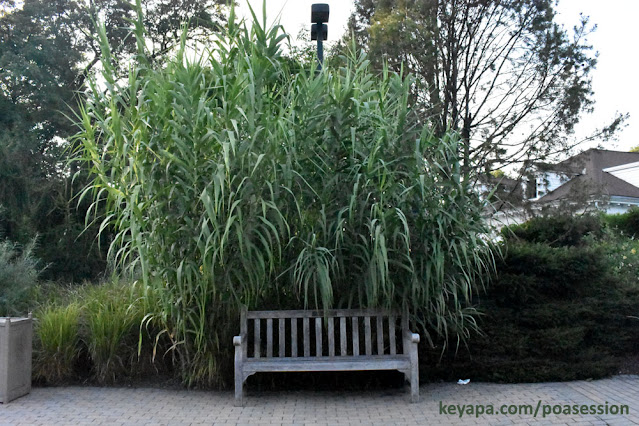
Arundo donax in an arboretum in NJ

There are sterile options when it comes to non-native ornamental  grasses, including hybrids of M. sinensis. These can be a way out of the trap of desiring particular grasses that have the potential to be invasive, although consumers have to do their research  before buying such species.

In the end, there are several possible solutions to the problem of invasive  ornamental  grasses:

  1. Make it illegal for the retail industry to sell invasive species, and enforce the law.

  2. If possible, sell sterile cultivars of any non-native species.

  3. Continue to inform people about the problems associated with non-native ornamentals, even those that do not seem to be currently invasive.

  4. Promote the use of native ornamental grasses, such as Panicum virgatum, Schizachyrium scoparium, and Andropogon gerardii cultivars. Emphasize not only the environmental reasons for using these, but also their beauty and adaptability.
Only through the rigorous implementation of all these will we be able to make sure we continue to protect the integrity and beauty of our native habitats.

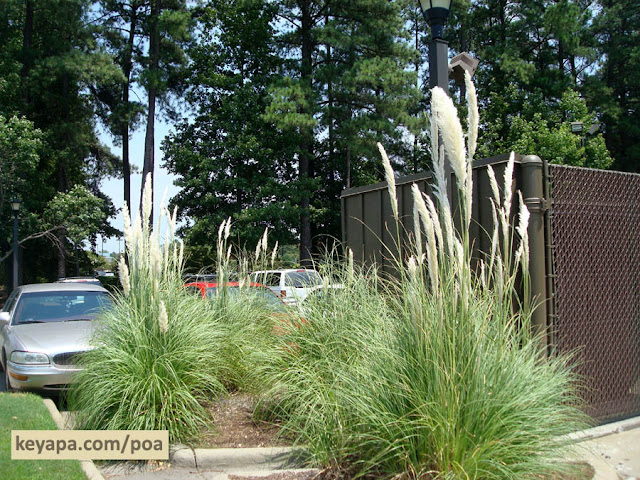
Cortaderia selloana in North Carolina parking lots

References

Lambrinos, JG (2004). A tale of two invaders. The dynamic history of pampas grass and jubata grass in California. Cal-IPC News. Vol. 12, Nos. 3/4


Sunday, December 27, 2020

Sound the alarm! Miscanthus hoodlums escaping!

There is no doubt that the exotic species Miscanthus sinensis (Chinese silvergrass) is very heavily used in commercial and residential landscaping. I see them everywhere nowadays, from mall parking lots, office lots, to the front yards of suburban homes. Even arboretums like the Frelinghuysen Arboretum  in Morristown,  New Jersey use it extensively due to its beautiful form and flowers. But at least until recently, I have not seen "escaped" specimens that have jumped the fence here in New Jersey and made its way into the wild.

M. sinensis behind Panicum virgatum and Pennisetum sp, and Festuca glauca (Frelinghuysen Arboretum)

This changed when I visited the South Mountain Recreation Complex in Essex County, which featured a huge reservoir surrounded by a paved path. People can walk or run around the lake using this path, and trails peel off from it to go into the deeper woodland hiking paths.

All along the perimeter of this path are planted shrubbery as well as ornamental grasses, and one of the species used was of course M. sinensis. I was able to tell it was this because even though all the grasses had been cut to the ground for the winter, I still spotted some of the distinctive inflorescence spikes of this species lying nearby.

Escaped M. sinensis along side of woods
Imagine my surprise when we left the main path and crossed a hilly outcrop to intersect a hiking path entrance, only to see uncut but dried clumps of M. sinensis growing along the woodland edges! There was one main cluster perhaps 4 meters away from some of the cut ornamentals, but there were also secondary clusters and individuals farther away and enmeshed in the native undergrowth.
Escaped M. sinensis in the undergrowth

Fortunately, unlike some other invasive grasses, rhizome expansion in this species is not as aggressive, but it still is somewhat of a concern that this particular population is showing signs of expansion into the nature trails. Time will only tell if this burgeoning invasion will create significant problems in the future.

Saturday, December 12, 2020

Winter Beauty: Ornamental Grasses!

Panicum virgatum, Schizachyrium scoparium, Calamagrostis sp, Panicum virgatum 

You can find beauty in the most mundane of surroundings.

Deep Cut Gardens in Middletown, NJ features a gorgeous formal garden, tropical and other interesting plants in greenhouses, and short trails for nature lovers. 

But hidden in plain sight in the main parking lot was something that actually made me gasp.

There between the rows of parking spaces and parked cars stood masses of ornamental grasses, their now-dried stems and leaves rising tall and straight towards the cold November sky. Every single island in the lot was filled with these botanical wonders.

The great thing about it was that these were not the non-native Miscanthus sinensis cultivars that are so beloved nowadays by landscape designers, but mostly native perennial grasses.

The tallest were Panicum virgatum cultivars (switch grass), their erect forms standing like disciplined soldiers ready for battle.

P. virgatum
Between stood reddish-hued Schizachyrium scoparium (little bluestem),  another hold-over from the vast prairies of olden America, plus short groupings of what I took to be an elegant Calamagrostis cultivar.
S. scoparium

And for lovers of Miscanthus sinensis, the park had a huge specimen towering over a small decorative pond just steps away from the entrance.

M. sinensis across the pond from the cattails
I love that there has been this strong shift in the landscaping business towards using ornamental grasses as part of their designs. I mean, with their dynamic forms and dramatic color changes over the course of the seasons, such grasses beat boring shrubbery all the time! ;-)

P. virgatum with dried airy panicles still in place


Sunday, July 19, 2020

Ornamental grasses take center stage at the Virginia House


I visited Shrine Mont in Orkney Springs, VA during a survey for the new invasive Oplismenus undulatifolius. While there, I marveled at a 4 story building that seemed the embodiment of some antebellum fantasy.

In fact, the building was built in 1847 and restored in 1987, after it had been purchased by the Shrine Mont in 1979. It now functions as the conference center for the retreat center, which hosts workshops, conferences, and music festivals, as well as family reunions and vacations, parish weekends , and individual retreats,

The grounds around the building had been designed with simplicity and elegance in mind, and the centerpiece of the large lawn was a round growing space where a huge Miscanthus specimen stood, surrounded by four clumps of Japanese Blood Grass (Imperata cylindrica). Various low growing dicot flowering plants completed the tableau.


I love it when landscapers make major use of ornamental grasses, and the towering Miscanthus and its attendant plants certainly make for an arresting display. Images from a decade back show that the space had more taller non-graminoid flowering plants at the time, and neither the Miscanthus nor the I. cylindrica were present, so this might been a somewhat recent design.

The other interesting thing was the fact they had made use of I. cylindrica, which just so happens to be designated as a Tier 2 noxious weed in that state. This means that it is present in the state and is subject to suppression and eradication efforts, and that its movement is controlled. One wonders what the groundskeepers would think if the plants suddenly reverted to their wild all-green form ;-)


Saturday, June 6, 2020

A short history of my obsession with grasses

Bambusa malingensis
Bambusa malingensis
I've recently wondered when my interest in grasses first manifested itself.

My fascination with a specific plant group for a long time was confined to Aroids, and I maintained one of the longest running aroid-specific websites on the internet when I started my Thaumatophyllum (at the time, Meconostigma) site in 2005.

Of course, I have almost always been involved with one species of grass, Oryza sativa (rice), which I have grown almost every year for more than a decade as something like a ceremonial ritual. But I think this interest did not extend beyond to other grasses until Summer of 2011, when I obtained my first ornamental grass, Imperata cylindrica 'Red Baron' (Japanese Blood Grass, but more well known in its wild form as Cogon grass).

Imperata cylindrica 'Red Baron' (Japanese Blood Grass)
This started my first love affair with grasses, and that JBG is still with me and thriving wildly to this day. In fact, it interested me so much that I bought a few more grasses in 2012, including a Miscanthus sinensis 'Gold Bar', which I unceremoniously stuck below the front passenger seat after I bought it ;-)

Miscanthus sinensis 'Gold Bar'
I also remember 2012 was when we went on a road trip to Florida, and I took several pictures of grasses that we met along the way.

Cortaderia selloana (Pampas grass)
The first were specimens of Cortaderia selloana (Pampas grass) in the Carolina Premium Outlets on the outskirts of Raleigh, North Carolina.

Cortaderia selloana (Pampas grass)

There were some truly impressive specimens of this species in that outlet, with a central plant near the entrance rising perhaps 3-4 meters high. The outlet had also planted them on the islands next to the parking lots, and I had a field day taking photos of the grass while waiting for my wife to finish shopping.

Miscanthus sinensis
Miscanthus sinensis cultivar
In addition, the outlet had a few Miscanthus sinensis specimens scattered about, although I was admittedly less impressed with these than the flowering Cortaderia.

Bambusa malingensis
Bambusa malingensis
Once we got to Florida, we visited The Fairchild Botanical Garden in Miami, where I admired the huge bamboo groves, and on the way back home, we also visited Myrtle Beach, where I marveled at the tall Sea Oats (Uniola paniculata) waving in the sea breeze,

Uniola paniculata
Uniola paniculata at Myrtle Beach

Spikelets of Uniola paniculata

It was at this point that for some reason my interest in grasses wavered then waned, and for about 6 years I barely thought about them due to a rising interest in Banyan Trees (Ficus spp).

This changed in Summer of 2018, and it had to do with Cogon grass (Imperata cylindrica) again. This time, I became interested in the invasive wild form, and my fascination with this one species started to slowly encompass other species in the Poaceae.

During our trip to Baanf National Park in Canada in Fall 2018, I took quite a lot of pictures of grasses in that area, and by the next Summer, I had been enmeshed enough in the family to start this site.

Hordeum jubatum in Lake Louise (Baanf National Park)
In a way, it was a case of positive feedback, where my interest in grasses pushed me to write articles and take pictures of them, while the solid presence of my work provided an impetus for me to write even more and study them even more.

This coming July will mark the first year anniversary of this site. I have enjoyed the journey immensely and I am hoping that my ramblings and photos will encourage others to be just as fascinated by this plant family as I am.