Showing posts with label Ornamental. Show all posts

Sunday, September 10, 2023

A Short History of Ornamental Grasses

World's Fair Pavilion in Forest Park, in St. Louis

Ornamental non-bamboo grasses have become such a ubiquitous feature of suburban and urban landscapes nowadays, that it might surprise some people that their widespread use is a relatively new phenomenon here in the USA.

This was brought home to me after I visited the World's Fair Pavilion in Forest Park, St. Louis last week.

The park itself is amazingly large, but what interested me most was a building that was surrounded by large stands of beautiful ornamental grasses. This World's Fair Pavilion was built in 1909 from proceeds of the World's Fair that was held in 1904. It's built on top of a hill and is surrounded by a large expanse of lawn and other plants.

Gigantic Panicum virgatum in Forest Park, St. Louis

The largest Panicum virgatum specimens I have ever seen in masses graced both sides of the area in front of the pavilion. There were also stands of Miscanthus sinensis, as well as the usual stately Calamagrostis. These ornamental grasses dominate the landscape today, but pictures of the same pavilion from the 1930s showed no signs of the stately and graceful grasses. Instead, shrubs and bushes and trees were the norm (see image below).

The pavilion in the 1930s. From the Missouri Historical Society. Note the lack of ornamental grasses.

The drastic change in the landscaping is significant. Although the use of bamboo for landscape decoration was popular even during ancient times, ornamental non-bamboo grasses did not enjoy the same popularity. However, during the 1930s, the renowned  German nurseryman, Karl Foerster pushed for their use in Germany and Europe. He collected grass seeds and plants from all over the world, and after cultivating them in his nurseries he introduced them to the market.

Calamagrostis to the left, Panicum virgatum to the right. In Forest Park, St. Louis

Among the many plants he introduced, perhaps his most famous creation is the outstanding ornamental grass Calamagrostis × acutiflora 'Karl Foerster', which he released to the market in 1950 as a natural hybrid of C. epigejos (native to Europe, Asia and Africa) and C. arundinacea (native to Eurasia, China and India).

Calamagrostis in background, Cenchrus setaceus in foreground, in Colorado

This rise in the use of ornamental grasses in Europe was not mirrored in the USA until much later, but various growers were instrumental in pushing for this new paradigm.

In the early 1960s, Kurt Bluemel began the introduction of ornamental grasses into America through his nursery in Maryland, called Kurt Bluemel Inc. Educated in Germany and Switzerland, Bluemel was passionate about grasses, and by the time he passed away decades later, he was well known as Der Gras König, the Grass King. 

Kurt Bluemel. From Baltimore Sun.

He is said to have carried his first grass specimens in his luggage when he came to America, and his collaboration with Wolfgang Oehme, a German-born landscape architect based in Towson, was highly influential in creating a growing appreciation for ornamental grasses in the country. Some of his notable works include creating the savannas at Disney World's Animal Kingdom, and Busch Gardens. 

Panicum virgatum

By the 1980s, the momentum behind ornamental grasses had finally reached a crux, and an influx of growers finally pushed it into the mainstream. In 1986, John and Jill Hoffman established the Hoffman Nursery in North Carolina, which specialized in ornamental grasses. 

John Hoffman. From Hoffman Nursery.

John's interest in ornamental grasses was stoked during a visit to Germany, where he met the plant breeder Ernst Pagels. Pagels was an enthusiastic supporter of grass-filled gardens, and this along with the support of his mentor,  J.C. Raulston at North Carolina State University, fueled his passion. Today, Hoffman Nursery is one of the largest suppliers of ornamental and native grasses in the country.

Miscanthus sinensis

The trend towards landscaping with grasses then moved from the East Coast to the West Coast through the efforts of people like horticulturalist John Greenlee. In order to complete an oak savanna project in California in the 1980s, he travelled to Kurt Bluemel's Nursery in Maryland, where he was astounded by the hundreds of varieties of ornamental grasses that were on display. He ended up trucking a load of the grasses in a tractor trailer from Maryland to California, and after a stint in Brazil with the renowned landscape architect Roberto Burle Marx (who is also held in high esteem in the aroid community), he finally opened the first ornamental grass nursery in the West Coast.

John Greenlee. From Greenlee Meadow Collection.

Fast forward to today, when people routinely use ornamental grasses both in residential and commercial landscaping. And although many of the varieties used are the showy exotics (such as Miscanthus sinensis and Cenchrus setaceus), the use of native grasses as ornamentals (such as Trypsacum dactyloides in Florida, and Bouteloua gracilis in Colorado) is also widespread.
Bouteloua gracilis in Colorado

Meanwhile, new varieties and species continue to be introduced into the market. Not only do they contribute linear structure to a design, but their ease of maintenance, resistance to herbivores like deer, and their ability to impart movement to an otherwise static landscape, make ornamental grasses perfect components for any project.

Looking out from the pavilion in Forest Park, St. Louis. White flowerheads are Miscanthus sinensis cultivars

Thursday, August 24, 2023

Hybrid Prairie Lawns in Colorado

Turfgrass to the left, natural field to the right, in front of residential complex in Broomfield, CO. The field is actually closer to the complex, which is to the right.

One of the things that has most impressed me during my stay here in Colorado has been the way they have managed to integrate natural components into the suburban and even urban landscape.

The so-called Open Spaces is one aspect of this. but I also found smaller examples that were even more immediate and accessible to people.

Turfgrass to the left, natural field in front of residential complex to the right

In many places I've visited, including Broomfield and Boulder, landscapers have integrated traditional lawn and ornamentals with natural fields of grass and forbs around residential and commercial buildings. In the picture above for example, traditional turf grass that remain cropped close to the ground stands next to an open field. 

Turfgrass lawn backstopped by natural grass field, in front of residential building

These hybrid prairie lawns (HPL) are quite attractive, and the natural fields pull the eye away from the rather dull and relatively boring turfgrass. Unlike turfgrass lawn, the natural fields changes in appearance over the course of the season, with more green tints in the earlier parts of the year, before the golden light browns of summer and fall as the grasses senesce. Another big positive is the significant savings to the property owner, since the fields are not irrigated, and mowing of the fields is kept to a minimum.

As far as I can tell, the fields in HPLs are kept quite natural, with most of the grasses being the usual naturalized exotics such as Bromus inermis, mixed in with natives such as Panicum virgatum and Sorghastrum nutans.

Bromus inermis, which is normally a big part of fields here

I kept wondering whether the HPL concept would fly in some other states. This part of Colorado is lucky because the area is naturally high desert, where open savanna and pure grasslands are natural parts of the landscape.

In a place like New Jersey for example, which does not normally have lots of natural grasslands, any space left untended would soon become a big mess of brambles and forbs and weedy plants, which isn't as "attractive" as prairies. Energy and money would be needed to maintain a "cleaner" look, and this would probably discourage landscapers from exploring possibilities.

I did notice even here in Colorado that parts of some natural fields have a proliferation of weedy looking forbs in them, but on the whole, the system seems to maintain a nice equilibrium of small and medium tall grasses, with some forbs mixed in.

This plus the heavily maintained turfgrass next to it proves that such HPLs are a great alternative to the more boring landscapes with pure turfgrass. 

 Now, that's a "lawn" that I would love to have all year round.

Panicum virgatum, another species that forms part of the field

Tuesday, July 25, 2023

Cogon in Colorado: An Alarming Case of Natural Reversion from the Ornamental Variety

Click here for a new update to this article.

The highly aggressive Imperata cylindrica is normally considered an invasive weed, but it is sold as an ornamental in some places due to an attractive variety called Japanese Blood Grass or Red Baron.

This variety has reddish leaves and is significantly smaller than the wildtype form. It is also notably less competitive than the latter. In addition, flowering in this variety is extremely rare, and it is cold tolerant. 

Ornamental form in New Jersey

The problem with the ornamental variety is that it has been shown to revert to the aggressive green form under certain environmental conditions, and so this variety cannot be sold, traded, or grown in certain states that have major cogon grass problems. The fear is that it might hybridize with the green form to form very aggressive, and cold tolerant, varieties that can become problematic even in cooler areas.

Cogon grass stand in Broomfield, CO. The dense mass has started to insinuate itself into the nearby shrubbery.

Natural conversion from the ornamental to the green form is probably very rare, and in the many years that I have known it in New Jersey, I never encountered such an event. However, I was walking along a street in Broomfield, CO, when I had to do a double take and take a closer look at a stand of grasses. Rising from the dense mass were flowerheads that looked similar to the distinctive inflorescence of I. cylindrica. 

Spent flowerhead

Most had already lost their spikelets, but a few still had the characteristic fluffy white seeds of the species sticking to them.

White hairy seeds of I. cylindrica from the reverted stand

There was no trace of red blades in the stand, and the grasses were up to more than 1 meter tall, which is significantly taller than I've ever seen the ornamental variety grow. All indications pointed to the fact that these were wild type cogon grass. In fact, the stand looked exactly like any cogon grass stand in Florida, the dense mass almost excluding all other plants from living in it.

Spent flowerhead with a few fluffy seedheads still attached

I surveyed the area and found at least two stands of reverted cogon grass in the vicinity. In the second stand, there was a mixture of both ornamental and green forms, with the green forms sprouting multiple flowerheads as well. In both stands, a few other plants managed to hold onto their spots, including Bromus inermis, which is normally one of the dominant naturalized exotics here in the Boulder area. Most will probably succumb to the much denser and more aggressive I. cylindrica over time.

Dense mass of reverted Cogon grass fills up all the available space. The brown flowerheads to one side are from a few Bromus inermis that have survived in their midst

Broomfield, CO is definitely not a subtropical or tropical location, so to say that I was surprised to find green-form cogon grass in the place would be an understatement. The ornamental variety of cogon grass seems to be used here though, probably because the assumption is that the cold and snow would keep it in "safe mode".

The reverted wild type form is significantly taller than the ornamental form, and is green in color.

However, the record heat prevalent in the southwest right now is probably increasing the average temperature in this area as well. Add in the wet winter and spring this year, and conditions might be optimal enough for the ornamental variety to revert. 

Ornamental form between Calamagrostis spp.

The origin of the cogon grass is likely ornamental forms that had been planted along the sidewalk. I found a couple of these sandwiched in between the usual Calamagrostis ornamentals. 

The question on whether these naturally-reverted forms will continue to survive is important. Will the cold and winter of Colorado convert these back to the ornamental form going forward, or will the warming climate allow it to flourish and start aggressively taking over swathes of the environment?

Time will tell.

Note: I have contacted the relevant authorities who can handle these clusters, so they will probably be extirpated going forward.

Unlikely pairing of Bromus japonicus and Imperata cylindrica "Japanese Blood Grass"

Friday, June 30, 2023

The Purple Sentinels of Mulholland Drive

Cenchrus setaceous in Mulholland Drive

Mulholland drive is a scenic and winding road through the canyons of Los Angeles that connects the Hollywood Hills to Malibu.  It overlooks the City of Angels, and has been the home site of many celebrities, including Madonna, Jack Nicholson, John Lennon, Roman Polanski, Marlon Brando, Demi Moore, and Bruce Willis. Mulholland Drive has also been made rather famous by the movie of the same name, which stars Naomi Watts and is directed by David Lynch.

I visited this famous area last month and drove around the many mysterious and narrow roads that ramified throughout the sheltered canyons. It was a fascinating trip, and one that I had never taken, even though I lived in Los Angeles in the 1990s. I had decided to visit here because of Clive Barker's novel Coldheart Canyon, which is about ghosts in a celebrity mansion that was hidden in one of the many beautiful canyons.

Crowds at Lake Hollywood Park, with the famous Hollywood sign in the background.

While driving through, I could not help but notice that purplish flowerheads decorated some of the canyon sides in very thick masses. I tagged it as Cenchrus setaceus (synonymous with the older name Pennisetum setaceum), which is commonly called fountain grass here in the USA. This species is from the subfamily Panicoideae, and has been heavily used as an ornamental because of its beautiful and abundant inflorescence. In fact, this species is one of the most commonly used ornamental grasses in Florida.

C. setaceus lines road, with hills and mansions in the background.

C. setaceus is a C4 bunchgrass that is not native to the USA, and hails instead from North Africa and Western Asia. It is particularly aggressive in warm, arid environments with full sun. Unfortunately, this makes Southern California an almost perfect place for it to grow, and it has escaped from cultivation and become invasive. It outcompetes other herbaceous native plants to decrease diversity and available habitats for wildlife, and also significantly increases the chances of fires in the area. To add insult to injury, the species is not good forage. 

C. setaceus with Washingtonia palm in background

All these negatives of course passed through my mind as I drove along Mulholland Drive and gazed at the passing masses of purple flowerheads. But I also had to acknowledge the beauty of the sight, one that tourists probably noticed as well. Perhaps they even think that the specimens along the road were planted deliberately to beautify the surroundings, an ironic twist to the current fate of this invasive grass, given that it was originally brought here as part of the horticultural trade.

C. setaceus pushing against native Opuntia (?) cacti

There are of course other invasive weedy grasses along that road, including the almost ubiquitous Avena fatua/Avena barbata, which dot the hillside, albeit in smaller numbers than in more natural settings. But fountainhead grass is surely the most noticeable, and the most attractive. So the next time you travel to Southern California and decide to visit the canyonlands of the City of Angels, keep an eye out for the Purple Sentinels of Mulholland Drive. 

PS. Coincidentally, it's been an interesting month that has just passed, one that was celebrated by and for the LGBTQ+ community. Its symbol, the Rainbow Flag, has a purple/violet band, which stands for spirit - for the courage, energy, and determination to stand up to bullying and oppression. This is something that is sadly needed in today's world, where it has become okay to persecute those who are "others". So here's to all the brave people who just want to be and show who they are. Be strong.

Thursday, March 30, 2023

Accidental Epiphytic Beauty

Cenchrus setaceus

In December 2020, I discovered a grass that was perched between two large branches of a tree.

This made me start thinking about why the Poaceae, even though it's the 4th or 5th most speciose plant family, did not really have real epiphytic species. I discussed this mystery in that old post, and came to the conclusion that it probably has to do with the fact that grasses are creatures of the light and wind. True epiphytes are pretty much all animal pollinated, and tend to occur in forested areas.

But "accidental" grass epiphytes do occur, and I came upon an instance of this again when strolling around a neighborhood and canvassing the many ornamental grasses that graced its grounds.

Cenchrus setaceus inflorescence (white stigma and yellow anthers)

Varieties of Cenchrus setaceus (subfamily Panicoideae) were in evidence everywhere. They have beautiful cylindrical flowerheads that are tinged with purple, and I was gazing at a group of the ornamental C4 grasses when I was astonished to find that two of the specimens were literally growing from the trunk of nearby palm trees! Not only that, but both had flowerheads rising from their tops, a testament to the tenacity of the individuals.

Flowering accidental epiphyte (red arrow points to base of grass)

I examined one of them (see image below), and found that the shoots of the grass emerged from what I think are balls of moss that had adhered to the trunk. The moss piece felt hard to the touch and crumbled slightly when I handled it. So it is possible that seeds from this species had landed on the moss, and had been able to grow to maturity in such an unusual location.

Rooted in moss (Cenchrus setaceus)

Although Florida is considered a humid area, it does have a dry season when rain does not occur for many days or even weeks on end. But the air must retain enough moisture that allows not only mosses to survive on the exposed palm trees, but other more complex plants as well, such as the ferns and Tillandsia "air plants" that decorate many of the tree limbs here. In addition, this is a suburban community, and I have a feeling the various underground sprinklers that dot the landscape contribute some water as well. Finally, this species has been known to become invasive, and thus might possess some rugged attributes that belie its graceful appearance and allow it to colonize inhospitable locations.

But whatever the reason for their growth and survival, the two C. setaceus specimens certainly prove that the Poaceae might not have many true epiphytes, but it's not because of lack of trying.  


Sunday, July 17, 2022

Now, THAT'S a front yard!

Google Street View in May 2022

We were on our way to a hiking location here in North New Jersey, and  on the way we passed by some fairly upscale communities. Most had wide front lawns, the grasses kept immaculately low to the ground, with occasional homes sporting large ornamental grasses like Miscanthus sinensis and Calamagrostis cultivars.

But suddenly, I gasped and pointed at something to my fellow passengers in the car. One of the houses had a front yard that was absolutely wild. Lots of tall stately grasses waved in the wind, and there were so many of the tall grasses and shrubs and forbs that the house itself was almost obscured from view.

Unfortunately, we did not have time to stop, but I made a quick mental note of some landmarks around us. When I got home later, I used google street view to try to find the home again, although I was thinking it was a long shot. But amazingly enough, the house front yard was so distinctive I actually did manage to locate it! 

The google street view image was from spring of this year, so the plants were not as high as they are now, and thus not as majestic. But there was no doubt that I had found the right house.

I thought it was charming and daring of this homeowner to go against the grain by not using the usual turf grasses, and I liked the overall effect. But one of my passengers had exclaimed "It's like a jungle!" 

Oh well, you can't please everyone!

UPDATE (2022-07-23)

I managed to take a pic of the front lawn as it looks now, and it looks great. Sorry for the quality of the photo, but I was just using my smartphone at the time. Love the masses of Calamagrostis!


Friday, July 8, 2022

Ornamental Grass Hunting at the Big Box Stores (and Where Big Box Grasses Go to Die)

Leymus arenarius spikelets (taken using non-macro lens)

I am a big fan of ornamental grasses. 

In my time I have purchased many natives such as various Panicum virgatum cultivars ("Northwind",  "Thundercloud", "Heavy Metal", "Hot Rod"), Andropogon gerardii cultivars ("Black Hawk", "RainDance"), and even a few Schizachyrium scoparium like “Twilight Zone”. I even have potential invasives like Miscanthus sinensis "Morning Light" and Japanese Blood Grass (Imperata cylindrica), both of which I obtained a long time back before I knew they were considered iffy ornamentals.

Most of my purchases have been at specialized Garden Centers or from online, but every time I visit Lowe's or Home Depot, I make it a point to visit their Garden department in search of unusual grasses.

The typical store scatters the grasses across various sections, but Lowe's is a favorite of mine because some Lowe's stores even have an ornamental grass section!

You go, Lowe's!

On one trip to a New Jersey Lowe's I decided to list all the available ornamental grasses in the store. 

Most of the ornamental grasses were crowded into one bench, but there were still a few scattered here and there. The usual purple fountain grasses were available (Cenchrus setaceus/Pennisetum setaceum), as were varieties of Miscanthus sinensis ("Adagio", "Variegata"), and the really cute Festuca glauca (in this case, "Beyond Blue"). There were even pots of Cymbopogon citratus (Lemon grass), which normally is placed separately from other ornamentals. These are typical types for this region, as well as in Florida stores (especially the fountain grasses).

Interestingly enough, I did find a species that I normally don't see in New Jersey stores. A couple of pots had Cortaderia selloana (White Pampas Grass)!

An unusual Cortaderia selloana for sale

This species of course has been considered invasive for some time now, but it would be wrong to say it is not gorgeous when in full flower, and so it has been a favorite of lay gardeners in many places. I was surprised to see it here though, as  it usually grows better farther south.

But the species that really stopped me in my tracks was a row of Leymus arenarius. The grasses were in flower, and the blue green hue of the leaves of this native species made me love it on sight. It's safe to say that I will likely get this sand-loving grass in future if I have space for it in my new home.

Leymus arenarius - beautiful in blue

On the way back to my car, I saw some clearance racks that had been parked to the side of the store. Curious about what I would find, I walked closer and found myself staring at the dying and drying bodies of various potted grass specimens. 

Where box store grasses go to die

Most of the dried up plants had grown long, their limp blades obscuring the name tags. I peered closely and found that many of them were Calamagrostis spp, with a couple of Miscanthus sinensis cultivars thrown in and a lone Muhlenbergia sp. A few still had green blades poking up through the mass of dried gold, and I knew that these could still be saved.

When I asked some store reps about the items, they said those plants were going be thrown away if no one bought them at clearance. It seems too many were in stock, and most had deteriorated due to negligence and poor lighting. 

I left after awhile, feeling a bit sad for the dying grasses. There should be a way to calculate the correct stock, and a way to take better care of these ornamental plants.


Saturday, November 27, 2021

The Vexing Problem of Invasive Ornamental Grasses

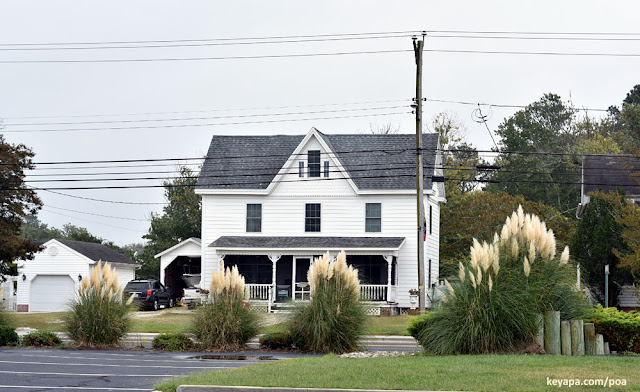
Cortaderia  selloana in Virginia 

The use of ornamental grasses has been growing rapidly since the 1970s, when Cortaderia selloana (pampas grass) and Festuca glauca (blue fescue) were the only well known ornamental grasses sold in West Coast retail stores.

It's a different situation today, with ornamental grasses gracing many residential and commercial areas, and even having their own sections in gardening stores.  

But look closely at the selection in many stores and you'll come to realize that many (if not most) of the ornamental grasses are not native to the region in which they are being sold.

Huge Cortaderia selloana on sidewalks in Virginia 

Unfortunately, many people select ornamental  grasses without any consideration about their potential for harming the environment, and  the horticultural industry itself may exacerbate  the problem by continuing to sell plants that have been proven to be invasive. This lack of awareness extends to even reputable botanical gardens and arboretum, and I have repeatedly seen some institutions make heavy use of ornamental grasses like Miscanthus sinensis. Granted, these non-native grasses are often beautiful, but this dependence on such cultivars creates problems due to the potential invasiveness of the species. 

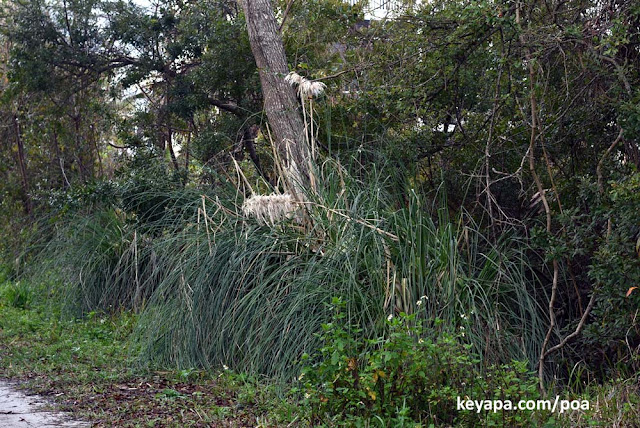
Escaped Cortaderia selloana in Florida

It's not all black and white though. What may be invasive in one region, might be relatively benign in another clime. For example, Imperata cylindrica is one of the most invasive grass in many subtropical and tropical areas in the world, but a red  cultivar (called Japanese Blood Grass)  is relatively harmless in colder areas, even though it can allegedly revert to an all-green invasive form when grown in a more suitable climate.


Large Miscanthus sinensis in parking lot of suburban strip mall in NJ

However, a species that may at first seem non-invasive can become invasive over time. This might have been the case with the popular  Cortaderia selloana (pampas grass) from South America.

Escaped Miscanthus sinensis at forest edge in NJ

This species became very popular in the late 19th century, with society becoming enamored of the large pure white inflorescence and using it almost everywhere. At one point, half a million of the plumes were being sold yearly. But for decades, the invasive nature of C. selloana seems to have been overshadowed by a close relative. C. jubata. In fact, even in the 1970s, researchers reported most of the infestations they found were of C. jubata, and non-cultivated C. selloana did not exist far from human habitation. This seems to have changed by the 1990s, when new surveys showed that C. selloana had become the more invasive of the two, with outcrossing populations found in many different native habitats. Even the morphology of these populations had changed, with the pure white plumes becoming darker.

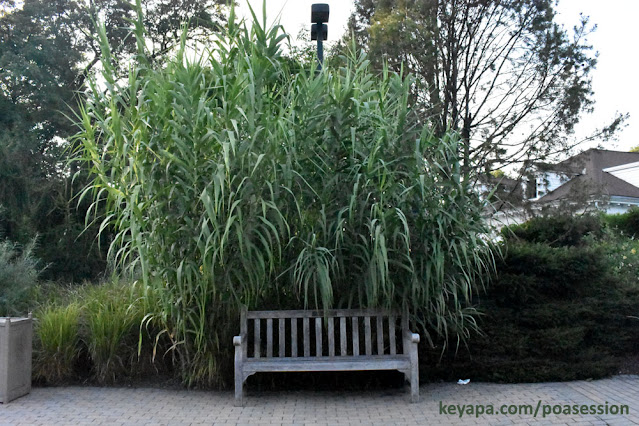
Arundo donax in an arboretum in NJ

There are sterile options when it comes to non-native ornamental  grasses, including hybrids of M. sinensis. These can be a way out of the trap of desiring particular grasses that have the potential to be invasive, although consumers have to do their research  before buying such species.

In the end, there are several possible solutions to the problem of invasive  ornamental  grasses:

  1. Make it illegal for the retail industry to sell invasive species, and enforce the law.

  2. If possible, sell sterile cultivars of any non-native species.

  3. Continue to inform people about the problems associated with non-native ornamentals, even those that do not seem to be currently invasive.

  4. Promote the use of native ornamental grasses, such as Panicum virgatum, Schizachyrium scoparium, and Andropogon gerardii cultivars. Emphasize not only the environmental reasons for using these, but also their beauty and adaptability.
Only through the rigorous implementation of all these will we be able to make sure we continue to protect the integrity and beauty of our native habitats.

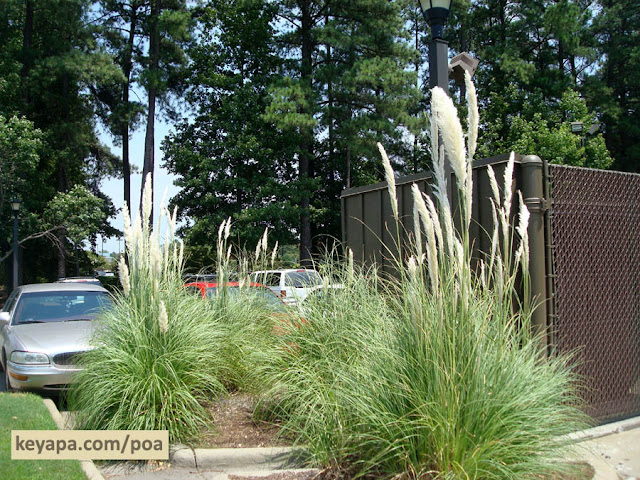
Cortaderia selloana in North Carolina parking lots

References

Lambrinos, JG (2004). A tale of two invaders. The dynamic history of pampas grass and jubata grass in California. Cal-IPC News. Vol. 12, Nos. 3/4