Showing posts with label Microstegium vimineum. Show all posts

Wednesday, March 23, 2022

Grasses in my head and how a C4 grass learned to love the shade

When do you know you think about something way too much? It's when you start dreaming about it!

In my case, I dreamed repeatedly of Microstegium vimineum (Japanese Stiltgrass) last night.

In my dream, there was a hill covered in the small bamboo-like grass, and I was teaching someone how to identify the species by showing them a leaf.

In M. vimineum, a distinctive mark is the silvery midvein on the upper side of the leaves, which you can see by tilting a leaf every which way until the light catches the line.

This species is not only interesting because it is a notorious invasive in the East Coast of the USA, but because it is a C4 grass that is shade tolerant, and it's relatively rare that a C4 grass is efficient in shady conditions.

The C4 photosynthetic pathway allows efficient photosynthesis under hot and arid conditions, but the structural changes needed in C4 grasses can make them less phenotypically pliable, such as when placed in shade. 

In this situation, some are unable to maintain high quantum yields when grown in low-light conditions. Quantum yield refers to how fast the process works relative to how fast photons are being absorbed. Other C4 grasses cannot take advantage of sunflecks because they cannot maintain a high state of photosynthetic induction (increasing CO2 uptake temporarily when light is temporarily increased). Still others fail to reduce carboxylase in the shade, and thus leaves the photosynthetic enzymes  (PEP Carboxylase and Rubisco) with nothing to do (Sage and McKown, 2006).


But it turns out that M. vimineum overcomes the limitations of its photosynthetic pathway by taking advantage of sunflecks. A study showed that it is able to rapidly take in CO2 under flashing lights, and then rapidly close stomata in very low light in order to prevent excess water loss (Horton and Neufield, 1998), although the exact mechanisms of this adaptation has not been elucidated.

I know many people hate this species for being invasive, but one cannot help but admire its adaptability, as well as its ability to overcome the seeming limitations of its kind, and perhaps that is why I dreamed of it. I've been watching X Factor UK auditions on YouTube recently  (don't ask!), and I was awed by the passion and abilities of some of the singers, some of whom surprised the judges - just like M. vimineum surprises me because of its tolerance to shade. 

References

Horton JL, Neufeld HS. Photosynthetic responses of Microstegium vimineum (Trin.) A. Camus, a shade-tolerant, C4 grass, to variable light environments. Oecologia. 1998 Mar;114(1):11-19. doi: 10.1007/s004420050414. PMID: 28307549.

Sage RF, McKown AD. Is C4 photosynthesis less phenotypically plastic than C3 photosynthesis? J Exp Bot. 2006;57(2):303-17. doi: 10.1093/jxb/erj040. Epub 2005 Dec 19. PMID: 16364950.


Monday, September 6, 2021

How roads are aiding our worst plant enemies

Japanese stiltgrass growing on abandoned railroad tracks along Ashokan Rail Trail
I was hiking the Ashokan Rail Trail in New York and noticed how the gravel path was frequently lined with masses of the invasive grass Microstegium vimineum (Japanese Stiltgrass), which crowded out other invasives, as well as the native flora.

This predilection of the species for roadsides and paths is one that I am familiar with, and so once I got home I looked up whether there was any reason for its behavior. My first thought was that roadsides created an environment with higher light levels than the interior of the canopy, but it turns out there are other reasons why such man made strictures aid invasive plants in general

The characteristic silver midrib of Japanese stiltgrass
Large scale studies have shown that M. vimineum presence in forests was strongly correlated with the presence and proximity of roads and other man-made paths. The probability of finding this species along the east facing sides of roads was as high as 83% in one study area. In addition, experiments revealed that the natural spread of this species was greatest in patches closer to roads, and that these patches also tended to have higher populations.  There was something in the areas around roads and paths that proved advantageous to the proliferation and spread of this invasive species,

Japanese stiltgrass lining the sides of a hiking path
One interesting and important finding from studies of M. vimineum is that the species if left to itself spreads very slowly, with seeds landing only 1 to 2 meters away from the parent plant. This was perplexing because land managers noticed that Japanese stiltgrass can quickly spread throughout an entire forest within a few years, which implied a rate of invasion that was orders of magnitude faster than it should be.
Japanese stiltgrass expanding from roadside into forest interior

It turns out that human activity along the forest roads is one of the major causes of the rapid and unnatural spread of stiltgrass in invaded forests, whether it's from hikers picking up seeds as they trudge along hiking paths, or vehicles doing the same along passable roadways.

In addition, the forest roads themselves can create conditions that are environmentally advantageous for this invasive grass. For example, the use of limestone gravel in many unpaved roads can raise the pH of the surrounding soil, which is favored by M. vimineum.

Unfortunately, it is neither possible nor perhaps even desirable to completely remove all human structures from parks and other forested areas in a quest to return the forests to their original pristine condition, But we can at least minimize the negative impact we have on these environments through more studies that delineate the many ways our presence in the natural world affect the denizens of the forests.

Tuesday, September 8, 2020

A simple contrast: Diversity vs Monoculture


M. vimineum in Watching Reservation, NJ in Spring (top) and
diverse flora in French Mountain, Lake George NY in Fall (bottom)

I'm currently hiking the Lake George area of the Adirondacks, in New York State.

The Adirodacks has been fighting a long war against Phragmites australis, but it has so far escaped the ravages of the equally  aggressive Microstegium vimineum (Stiltgrass).

I hiked both the French Mountain Trail and the Buck Mountain Trail, and so far I have not seen any signs of stiltgrass.

Instead, I have seen lots of diverse flora inhabiting the forest understory, from moses, to ferns, to non-invasive grasses like Leersia virginica.

I took a pic of the diverse flora surrounding a dead tree trunk, and suddenly realized I had taken a somewhat similar photo in Watchung Reservation in NJ, but this time of a dead tree trunk in Spring surrounded by sprouting M. vimineum. 

By the time Fall came around, the short culms of the stiltgrass would perhaps be so dense and tall that they would look like the colony of stiltgrass in the pic below!

Microstegium vimineum surrounding tree in Fall


Sunday, August 23, 2020

A stiltgrass-free area in the northeast USA? Surely you jest! Exploring the boundary of Microstegium vimineum


Pristine forest understory sans Microstegium vimineum

The invasive grass Microstegium vimineum (Stiltgrass) is so ubiquitous in New Jersey forested areas that it would be hard to imagine a time when it wasn't the noxious weed that it is right now.

In fact, its spread from Tennessee in 1919 was well documented, with the species reaching Virginia in 1931, North Carolina in 1933, and Alabama in 1934. From there it spread to Pennsylvania and Kentucky in 1938, Delaware in 1942, and finally New Jersey in 1959. But even in the early 1980s, it was still fairly uncommon in NJ (Hunt et al, 1992). 

Surveyed areas (A) Stockbridge, MA parks, and (B) Storm King State Park, NY

There are still states in the Northeast where M. vimineum has not been documented, or is only known from a few samples, and a quick look at the map of the species at EDDMaps shows the approximate boundaries of its distribution.

In order to confirm the presence or absence of this invasive species, I hiked an area at the boundary of its main invasion front (icon A in image above, in Massachusetts), as well as a spot some distance to the south (icon B, in New York State). M. vimineum was first discovered at 3 sites in NY in the early 1990s, and appeared in Hamden County, Massachusetts in 1998, so the species is a fairly recent arrival to at least the latter state.

Surveyed areas in Massachussetts

In Massachusetts, I hiked several state and public parks, including:

  • Mount Greylock State Reservation
  • Alford Springs Trail 
  • Monument Mountain 
  • Benedict Pond Loop and Appalachian Trail in Beartown State Forest
  • Basin Pond Loop and Appalachian Trail in October Mountain State Forest
In none of these hikes in MA did I see a single specimen of M. vimineum, although there were quite a few look-alikes. I even surveyed a short 100 meter portion of the Appalachian Trail in October Mountain State Forest near Becket Rd, where the species was reportedly spotted in 2013, as in here. But again, I failed to find evidence of stiltgrass, which made me wonder whether previous sightings of the species in the area had been mis-identifications of some other plant, such as Leersia virginica.

Stiltgrass look-alikes

What I found instead was a quite diverse understory, with beautiful ferns dominating the shadier undisturbed areas, and many different kinds of other herbaceous plants sharing the limelight! It was quite a refreshing change from the carpets of M.vimineum that sometimes even lines the sides of paths in NJ.
Ferns

It was a different story across the border in NY state, where I found ample evidence of the species in Storm King State Park. In fact, the small parking lot next to the trailhead had a dense carpet of stiltgrass sprawling under the tree canopy, as well as on decorative depressions in the parking lot wall.

M. vimineum near trailhead parking lot of Storm King State Park, NY

Farther out in the trail itself, there were occasional clumps of the species along the sides, but nowhere near the level of infestation as in some NJ parks. Nevertheless, I saw ferns surrounded by stiltgrass, their fronds rising desperately out of the grass like the arms of a drowning swimmer.

Ferns surrounded by Stiltgrass.

I'll admit that the sight of the invasive species generated some excitement in me, given that I had not seen it at all in the next door state. This feeling was however tempered by the knowledge that it is probably only a matter of time before that surveyed area in MA is also inundated with stiltgrass, perhaps through seeds carried along the Appalachian Trail. Studies have shown that without human or other intervention, that M. vimineum actually spreads quite slowly (Rauschert, 2010), but its advance has so far been steady and inexorable.

Appalachian Trail near Beckett Road in October Mountain State Forest, MA
 

Literature Cited

EDDMapS. 2020. Early Detection & Distribution Mapping System. The University of Georgia - Center for Invasive Species and Ecosystem Health. Available online at http://www.eddmaps.org/; last accessed August 21, 2020.

Hunt, David M.; Zaremba, Robert E. 1992. The northeastward spread of Microstegium vimineum (Poaceae) into New York and adjacent states. Rhodora. 94(878): 167-170.

Rauschert, E.S.J. 2010. Slow spread of the aggressive invader, Microstegium vimineum (Japanese stiltgrass). Biological Invasions12:563-579


Friday, August 14, 2020

Native grasses during a hike at the Environmental Education Center at Lord Stirling Park (Great Swamp National Wildlife Refuge)

Inflorescence of Andropogon gerardii

Little did I know when we started our hike at the Environmental Education Center (EEC) at Lord Stirling Park that I would finally encounter and identify one of my more sought after species, one of the members of the legendary "Four Horsemen" of the Tall Grass Prairies. These 4 native grasses (Andropogon gerardii/Big Bluestem, Panicum virgatum/Swirchgrass, Sorghatrum nutans/Indiangrass, and Schizachyrium scoparium/Little Bluestem) dominated vast swathes of America before giving way to the spread of another type of grassland with the introduction of corn. 

I was not expecting much because the EEC is located in the Great Swamp National Wildlife Refuge, a remnant of the Wisconsin Glacier, which retreated around 11,000 years ago to form the New Jersey Wetlands. So I thought I would see lots of marshy areas, wilt under the high humidity, and of course be attacked by lots of mosquitoes.

What I did not expect was a very well maintained, and honestly impressive trail system, but that's what I saw. A significant proportion of the path was on wooden boardwalks, which was impressive, and the trails were wide enough that you didn't have to touch vegetation on either side - always a recipe for picking up ticks. It even had a garden near the EEC building, with labeled plants, though not many of the plants were flowering at the time we went there.

Carpet of Microstegium vimineum

We found a trail map of the area and decided that we would move from trail to trail along the periphery of the place, thus maximizing our hiking time. We first traveled counter clockwise along the yellow trail towards Lenape Meadow, and as usual I saw lots of Microstegium vimineum (Stiltgrass) covering the sides of the path, as well as sometimes extending deeper into canopy. This invasive grass is the bane of forest managers, and I had already grown used to encountering it every time I entered some forested area. You can identify stilt grass by the bamboo-like leaves as well as the silvery stripe that runs along the upper leaf surface.

Close up of leaves of Microstegium vimineum

Fortunately however, we did encounter some other plants along the way, including a quite striking plant with dark red flowers, which I later identified as Lobelia cardinalis.

Lobelia cardinalis

We also saw lots of cattails (Typha species) as we crossed the Boondocks Boardwalk along the north end of Lord Stirling Park. The sight of so many cattails was interesting and unexpected because this plant is being pushed aside by a grass called Phragmites australis in most places.. The reason for its health in the area seems to be because the park managers are actively controlling populations of the invasive grass.

Cattail

But what excited me at first was the sight of clumps of S. scoparium (Little Bluestem) at Lenape Meadow.

A clump of S. scoparium at Lenape Meadow (center of pic)

I've always been fond of this species ever since I saw fields of it in New Hampshire, with the distinctive red flowerheads arrowing stright up into the air. Of course, it's only early August, so the S. scoparium I saw at Lenape Meadow still had not gained their full beauty.

S. scoparium in New Hampshire

However, my delight at the discovery of my old friend Little Bluestem was nothing to the amazement that I experienced when we passed Alexander Meadow at the extreme southwest of the park. There I saw a field of grass that almost made my jaw drop. Rising more than 3 meters into the air were flowerheads that looked like turkey feet waving in the air. I had come upon my first field of A. gerardii (Big Bluestem)!!!!

I believe I have never encountered this species before, ever since I started learning more about grasses last year.  The distinctive turkey feet flowerheads and towering height made them almost instantly recognizable, and we passed through the meadow surrounded by these impressive grasses.

A. gerardii inflorescence, looking like turkey feet

I took a few macroshots of the spikelets, which were tightly appressed and had a few dangling yellow or red anthers, although it was obvious that full anthesis had not yet started for many flowerheads.

I also saw quite a number of P. virgatum (Switchgrass) in the field, their wispy flowerheads forming almost a mist-like cloud above the grasses. This species is the 3rd member of the Four Horsemen of the Tall Grass Prairie present in the park, and I had a feeling the 4th and final member (Sorghastrum nutans) might also be somewhere there, although I did not have time to explore the place further.

P.virgatum flowerheads

In the end, it was a very nice and productive hike, although we did sweat throughout the experience, and were bitten by quite a few mosquitoes. 


Thursday, July 16, 2020

In search of a new forest invasive : Oplismenus undulatifolius (Wavyleaf Basketgrass)

Oplismenus undulatifolius (Wavyleaf basketgrass)

The Wildflower Trail is a 1.3 km paved trail that follows along the route Gen. Stonewall Jackson took when he marched from the Shenandoah Valley to Fredericksburg through New Market, Virginia.

I had some time in between hikes in Shenandoah and so I had decided to visit this very easy trail in search of one of the newest invasive grasses in the country.

Trudging deeper into the woods
Oplismenus undulatifolius (Wavyleaf Basketgrass) was first discovered in the 1990s in Patapsco State Park in Maryland (Peterson et al, 1999). It is a very shade-tolerant perennial grass that reputedly can crowd out competitors and cover the dark understory of forests. It is currently found only in Maryland, Virginia, West Virginia, and Pennsylvania (one treated colony), and some specimens have been found as far west as the Shenandoah area (EDDSMaps, 2020). Its ability to thrive in as low as 2-11 mols m(-2) day(-1) means it can occupy niches where even the dreaded Microstegium vimineum (Stiltgrass) has trouble dominating.

It should be noted that a native species of this genus (Oplismenus hirtellus and perhaps others) is also found in the United States, mostly in the Southeastern part of the country, and should not be confused with this non-native invader. They can be distinguished by the fact O. undulatifolius is conspicuously hairier and has white flowers, whereas O. hirtellus has purplish or reddish flowers.

The fallen logs
The entrance to the Wildflower Trail is  pretty unobtrusive, and I would have easily missed it if I had not been using google maps to plot my way. But when I cruised into the rather large parking lot I saw that people still knew about it, because there were 5 other cars parked.

Oplismenus undulatifolius (Wavyleaf basketgrass)
The surprise find
Heartened by the presence of other  hikers, I trudged into the trail and made my way deeper into the forest. There were smatterings of M. vimineum along the sides, but none of the other many plants looked like the pictures of O. undulatifolius that I had seen on the web.

Oplismenus undulatifolius (Wavyleaf basketgrass)
Rippled leaves
The trail ended in a circular open space, and I still had not found any evidence of the invasive grass.  Instead of going back to my car in defeat, I decided to press on into the woods, and I slowly made my way forward where the piles of decaying leaves that coated the ground was less thick.
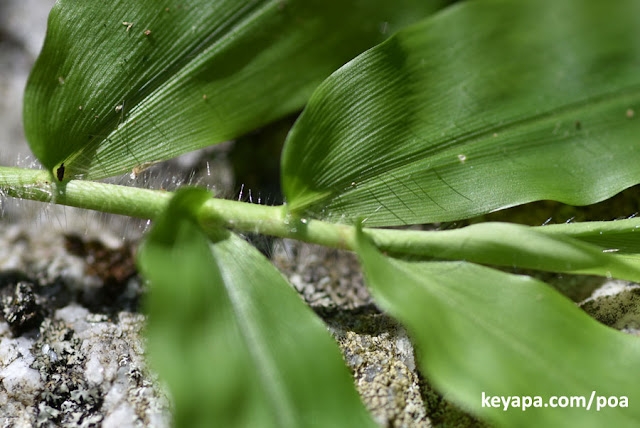
Oplismenus undulatifolius (Wavyleaf basketgrass)
Hairy stems
When I spied two large fallen logs I carefully leveled myself up onto one and peered into the shadowy depression formed by their intersection. Imagine the surprise I felt when I spotted a few leaves that seemed to have the rippled surface so characteristic of O. undulatifolius!

The grass was intermixed with masses of M. vimineum, as well as a few other plants, and a careful search of my surroundings revealed more of the invasive (including near a large clump of stiltgrass), although never in a large enough grouping to merit unusual attention. I even found a very young specimen that even at that small stage had the characteristic rippled leaves. I was able to quickly ID the plants because in addition to the rippled leaves, O. undulatifolius has very hair stems, and its sprawling behavior on the forest floor also helps in the identification.

Oplismenus undulatifolius (Wavyleaf basketgrass)
Mixed in with the stiltgrass
While hiking through trails in nearby Shenandoah National Park, I made it a point to look for the species, although the rapid pace of our hike meant my search was not very comprehensive at all. Nevertheless, O. undulatifolius had been seen in the area, and it is being actively controlled by park management. This is because unlike M. vimineum, which is now ubiquitous, this new invasive is still at that stage where it may be possible to control its spread.
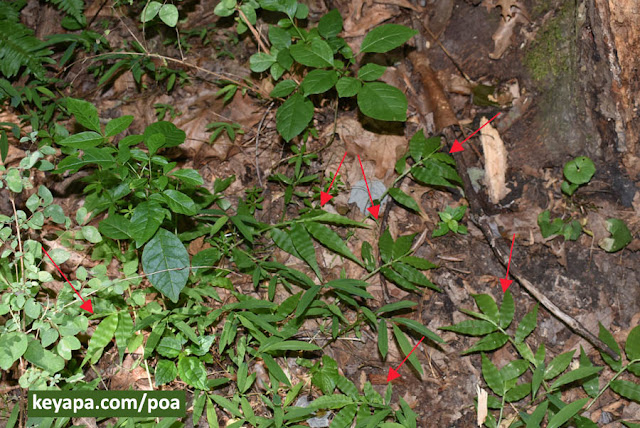
Oplismenus undulatifolius (Wavyleaf basketgrass)
More specimens around the base of a tree
Although it is currently only found in Maryland, Virginia, and small outbreaks in northern West Virginia, there was a chance that it might have spread towards West Virginia from the Shenandoah area, and so when I visited Wolf Gap Recreation Area in Wardenville, WV, I combed the nearby trails and campgrounds for any signs of the species. I also visited Shrine Mont in Orkney Springs, which lies near the border of West Virginia and Virginia. In both cases, I found M. vimineum in abundance, but no sign of the newer invasive.

Oplismenus undulatifolius (Wavyleaf basketgrass)
Two younger individuals
However, the spread of O. undulatifolius to other states is something that I believe is inevitable. Vanessa Beauchamp, an invasive plant ecologist in Maryland who specializes in the species and fought valiantly to contain its spread, found that its sticky seeds stuck easily not only to people's pants legs, but also to passing animals like pet dogs. During one test, she discovered that a pet dog who run for 30 seconds in a field of O. undulatifolius managed to pick up an amazing 2000 seeds.

Given such fecundity, and coupled to the perennial lifestyle of the species and its ability to thrive in deep forest canopies, it is probably only a matter of time before it threatens major parts of the northeastern half of the USA.

Oplismenus undulatifolius (Wavyleaf basketgrass)
A very young specimen already has the characteristic rippled leaves
For more on O. undulatifolius on this site, click here.

Literature Cited

EDDMapS. 2020. Early Detection & Distribution Mapping System. The University of Georgia - Center for Invasive Species and Ecosystem Health. Available online at http://www.eddmaps.org/; last accessed July 25, 2020.

Peterson, P.M., E.E. Terrell, E.C. Uebel, C.A. Davis, H. Scholz, and R.J. Soreng. 1999. (Scientific Note) Oplismenus hirtellus subspecies undulatifolius, A new record for North America. Castanea 64:201-202.

Sunday, July 5, 2020

Merrill Creek Reservoir Trails and the lowdown on Microstegium vimineum (Stiltgrass)

Microstegium vimineum
A carpet of Microstegium vimineum covers the forest floor in Merrill Creek Reservoir
We hiked two trails in the Merrill Creek Reservoir in Harmony, NJ during the July 4th holiday. We traversed the entire length of the Shoreline Trail (blue) along the southeastern flank of the area, then spent an hour or more on the northwestern part of the Perimeter Trail (black).

There were very few hikers in either trail, and the Shoreline Trail in particular seemed relatively unmaintained, with grass frequently on the ground and understory vegetation crowding hikers from the sides. Although there were some nice views of the lake at certain spots, on the whole the tight narrow paths in some parts of the trails made for uneasy going, and we later found out my wife had a deer tick biting her shoulder!

The distinctive bamboo-like leaves of M. vimineum, with the distinctive line of silvery hairs along the midline
The hike did make me think about one of the worst invasive plants spreading in our forests right now.

Microstegium vimineum (or Stiltgrass) has small bamboo-like leaves with a distinctive silvery line along the midline. It is a low-growing grass species that has been pushing aside native vegetation in shady forested areas, and when people talk about this invasive, one sometimes has visions of immense swaths of forest understory clothed in its delicate green blades. Instead of a varied mix of other grasses and low herbaceous plants, one sees a monoculture that has strangled other competitors and holds sway over vast tracts of parkland and virgin woods.

Microstegium vimineum lines a hiking trail  in Merrill Creek Reservoir
I hike a lot in New Jersey and the surrounding states, and in my walks I have found that the reality is of course somewhat different than the visions of botanical Armageddon that some may have.

It's true that there are large areas which have undulating carpets of stiltgrass covering the forest floor, and there are many more cases where the hiking paths are lined on both sides by this invasive. But for much of the time M. vimineum is represented by perhaps only a few specimens whose small forms are lost in the riotous tangle of other understory vegetation.

This of course does not mean that we should become lax about protecting the biodiversity of our parks and forests. From all indications this invasive is expanding its range, and just because it does not completely dominate entire forest understories right now does not mean it won't do so in the near future.

The spread of this invasive is aided partly by mechanical means, including through the clothing of passing hikers. So if you encounter this species during one of your hikes in the woods, be sure not to inadvertently contribute to its spread by brushing against the plants.


Tuesday, June 30, 2020

A broad-leaved forest grass that flowers twice

Dichanthelium latifolium

Nowadays, when I hike among the shaded tree-lined paths of some park in New Jersey, i invariably encounter Microstegium vimineum as it grows in luxuriant carpets along the sides of the trail and into the deeper canopy.

This was at first the case last Thursday, when we went exploring in the Watchung Reservation, and I resigned myself to photographing more of the invasive grass.

Dichanthelium latifolium

Thus it was a pleasant surprise when I spotted an interesting grass nestled in the shady base of one of the trees. It had much larger leaves than stiltgrass, and it also had airy panicles that ended in tiny spikelets. The blades also had distinctive cordate bases, and were quite wide.

I managed to identify the species as  Dichanthelium clandestinum, one of the rosette panic grasses.

Dichanthelium latifolium

This species lives in forests, and has an unusual flowering behavior.

Near the beginning of the season, it produces "normal" flowers which are pollinated when open ("chasmogamous"). Then later in the season, the same individual has closed flowers hidden in the sheaths that will be self-pollinated ("cleistogamous").

Dichanthelium latifolium

The evolutionary advantage of cleistogamy is that the grass does not need to expend a lot of energy into the production of flower accessory structures, and this mode of flowering seems to prevalent in some plants when they are stressed. However, its disadvantage is that it dampens genetic diversity in the population due to self-fertilization.

Dichanthelium latifolium

It was quite nice to find such a new species, and I'll be sure to keep my eyes open for more grasses from the genus  Dichanthelium is future hikes.

Monday, May 25, 2020

Another year, another burst of Microstegium vimineum (Japanese stiltgrass)

Microstegium vimineum - Japanese stiltgrass
A carpet of M.vimineum surrounds a dead tree trunk 
The last time I had seen the invasive grass Microstegium vimineum (Japanese stiltgrass), it had been Fall 2019, and the grasses had already turned golden in color.

Before today, I had not seen the species during late Spring, but when we hiked the Watching Reservation in Watchung, NJ this afternoon, the invasive grass was already starting to show itself in force.

Microstegium vimineum - Japanese stiltgrass
M. vimineum carpet goes deep into the shaded canopy
Although each individual grass was still quite small and had only a few leaves, the ability of this species to dominate and overwhelm its environs is not in doubt. Carpets of the grass had already started forming along the sides of some parts of the trail, and some clumps had even formed deeper into the forest.

I even found a clump of large ferns facing what looked like an encroaching mass of the invaders!

Microstegium vimineum - Japanese stiltgrass
Ferns surrounded by M. vimineum
Sadly, I know that by the time winter comes rolling in, that lone group of ferns will probably be drowning in a sea of Japanese stiltgrass.


Monday, October 7, 2019

Autumn creeps on Cheesequake State Park


In October 2019, I visited Cheesequake State Park in Matawan/Old Bridge, NJ, which is notable because it lies in the transition zone between two different ecosystems, and harbors organisms that are native to both south and north New Jersey.

Microstegium vimineum (Japanese stiltgrass)
One of the more interesting things I noticed was that the carpets of invasive Microstegium vimineum (Japanese stiltgrass) that covered some of the forest floor had turned golden in color, and made the scenery seem quite magical and surreal.

Microstegium vimineum (Japanese stiltgrass)
But perhaps the highlight of the place for me was the Crabbing Bridge, a long boardwalk that passed over the marshlands in the park and was surrounded by tall grasses.

Crabbing Bridge on Sept, 2018
Birds flew and waded in the grasses that stretched into the distance.

Sporobolus pumilus  (saltmeadow cordgrass)
Sporobolus pumilus  (saltmeadow cordgrass)
Although they were too far for me to make an ID easily, at least some of them were Sporobolus pumilus  (saltmeadow cordgrass), which was previously named Spartina patens.

Sporobolus pumilus  (saltmeadow cordgrass)
Sporobolus pumilus  (saltmeadow cordgrass)
Also present in the park was the invasive Phragmites australis, which is one of the more ubiquitous grasses in the state, and which I will be discussing in a separate future post.

Phragmites australis