Showing posts with label Dichanthium. Show all posts

Monday, December 12, 2022

A Fantastic Botanical Caribbean Cruise Trip

Dactyloctenium aegyptium in foreground and our cruise ship in background (in Costa Maya)

We went on our first cruise in 3 years since the pandemic. Our ship landed in 4 destinations, and I spent some time botanizing close to shore. 

The locations varied in terms of the ease of botanizing and the diversity of species found.

Melinis repens in Costa Maya

COCOCAY, BAHAMAS

The first island is wholly owned by Royal Caribbean, and it is a tiny piece of land that is immaculately kept as clean as an urban park.

Most of the specimens I found were ornamental grasses that were deliberately planted, including Trypsacum dactyloides and the fountain grass Cenchrus setaceus (?) .

Trypsacum dactyloides, with male flowers (orangey anthers and filament showing) on the left and female flowers (purple stigma showing) on the right

However,  scattered along the undergrowth I found smaller specimens, such as an Axonopus sp and a single specimen that looks like a tiny Eragrostis or  Poa sp. These tiny weedy species still thrived despite the wholly artificial nature of the location.

COZUMEL, MEXICO

I walked along the Avenida Rafael E. Melgar, the coastal road that leads from the International Cruise Terminal to the downtown proper of San Miguel de Cozumel. It was a pleasant 5 km walk along a well maintained sidewalk, and I descended at times onto the beach proper, which was mostly rocky and small.

Along the way I encountered not only the usual weedy species that seemed to proliferate in all urban locations, but lawn turf grasses and the occasional coastal inhabitants like Paspalum vaginatum. This species had rigid looking leaves and robust stolons, which it used to crawl along the rocky and sandy beaches.

Paspalum vaginatum (inset inflorescence)

I also came upon a few specimens that looked remarkably like Andropogon spp on first look.

Andropogon sp (?)

Many of the larger areas had specimens of Megathyrsis maximus, which managed to rake in some sun along the edges of wooded lots next to the sidewalks.

Megathyrsus maximus spikelets (inset inflorescence), with purple stigmas and yellow-orange anthers

Quite a few areas had the turf grass Cynodon dactylus, which also showed up as escaped specimens in cracked sidewalks and parking lots.

Cynodon dactylum, with white anthers and purple stigmas

Amazingly, I also came upon many more specimens of the same tiny putative Eragrostis or  Poa sp that I had encountered once in Cococay. In one case, it had swamped the original inhabitants of a stone container along the sidewalk!

Unknown Eragrostis sp/Poa sp (?)

But by far the most exciting find I made was a species that I at first was disinclined to think was a grass. It had an inflorescence that looked nothing like the usual spikelets, but I later typed it as Paspalum fimbriatum.

Paspalum fimbriatum

The spikelets of this species had glumes and lemma that formed a fringe around the florets. Its  leaves are relatively broad,  with a slight sinuous quality in some. 

Other specimens that I encountered in Cozumel were:

Melinis repens

Dactyloctenium aegyptium

Dichanthium sp

Cenchrus spinifex (?)

Andropogon sp (?)

Sporobolus jacquemontii (which I also encounter a lot in Florida)

Eragrostis sp (?)

Eustachys sp
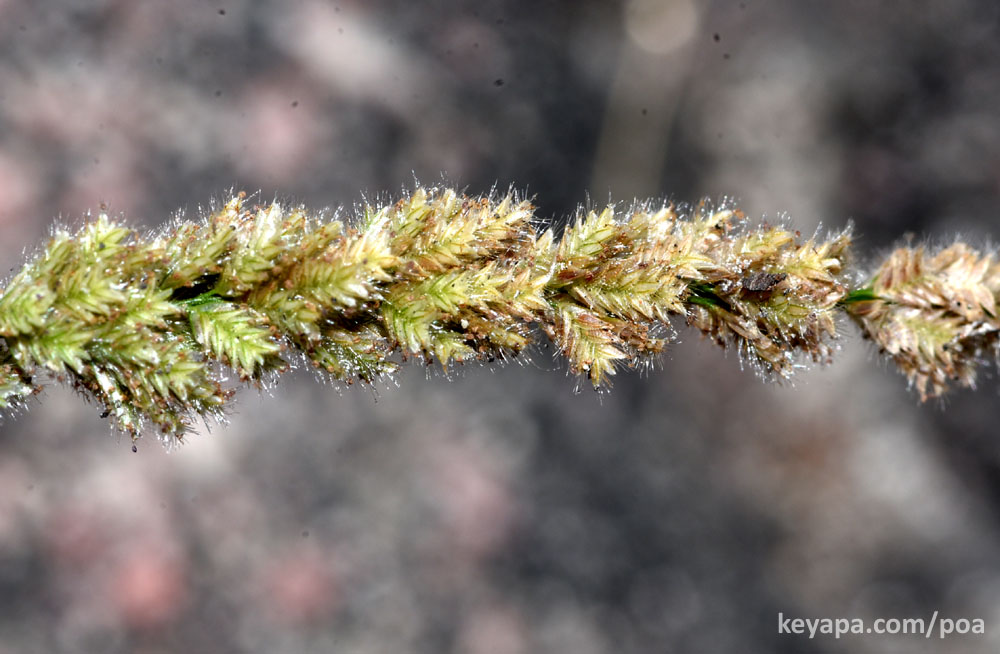
Eragrostis sp (?) in Cozumel, Mexico

ROATAN, HONDURAS

This stop was the least attractive in terms of surroundings.  Our ship docked in the center of the city Coxen Hole, and it was raining sporadically the entire time.

I walked east along Main St. after disembarking from the ship, although in hindsight I probably should have gone the opposite direction. 

The empty lots were filled with Megathyrsus maximus, while sprouting from the cracks in the sidewalks and other marginal places I found the usual "weedy" species, including Eustachys sp, Digitaria sp, Echinochloa crus-galli, Eleucine indica, and a single Cenchrus sandbur sp.

I returned to the ship after enduring the sporadic rains for perhaps a couple of hours, with the hope that the next landfall would yield better returns. 

Eustachys sp growing on the rocky beach at the pier 

COSTA MAYA, MEXICO

I was not disappointed, because the stop at the Puerto Costa Maya near the town of Mahahual was the most fruitful of all.

The port itself was clean and large, with the usual tourist shops. But it was the surrounding area that made the area a prime spot for botanizing grasses.

The streets were wide and clean, with resorts and large private homes interspersed with empty lots. Closer to the Port, the wide street (Avenida P del Puerto) did not have sidewalks along the sides, but it instead had a very wide island that was filled with trees and plants. Amazingly enough, a dirt path run through the center of the island, so pedestrians using this "sidewalk" seemed to be in some forest path! It was a rather innovative idea, and one that I had never encountered before.

Path between stands of vegetation in the street island of(Avenida P del Puerto)! A great concept for urban and suburban roads

It goes without saying that I felt safe wandering into the smaller side streets, and just a few blocks from the port I came upon an empty lot that was filled with all sorts of species. 
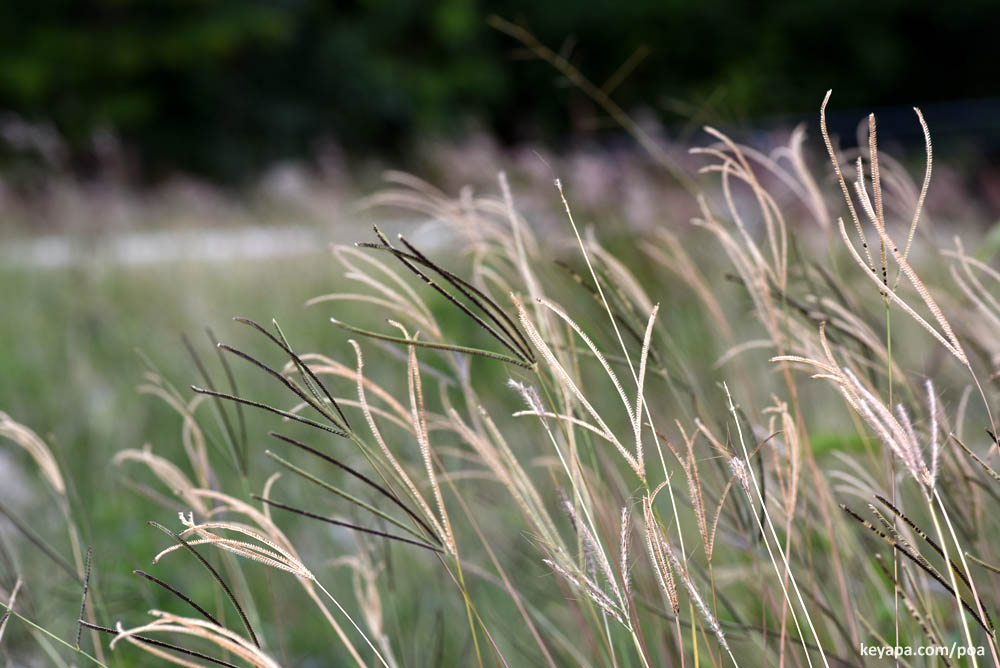
Field of Botanizing Dreams. Eustachys sp and Dichantium sp in foreground, pinkish Melinis repens in background.

It was a literal field of botanizing delights, with waving masses of Eustachys sp mingling with clusters of pink and red Melinis repens. 

Melinis repens

Other inhabitants included the ubiquitous Dactylocnium aegyptium, Dichantium sp, as well as Cenchrus sp and an unknown species that was probably a Paspalum. There was even a large Megathyrsus maximus to one side.
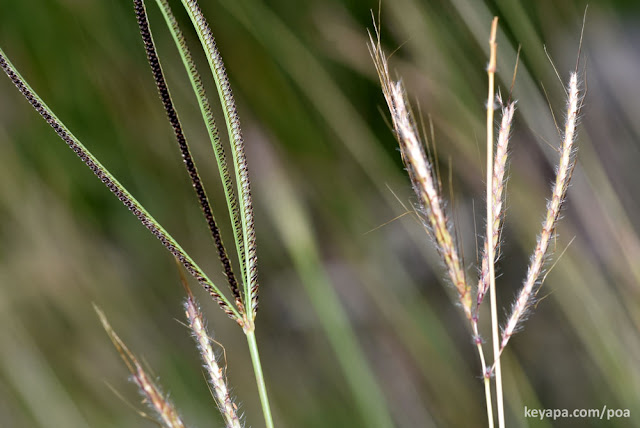
Eustachys sp (left) and Dichantium sp (right)

Beyond the field I continued in the general direction of Mahuhual Beach, and I continued to encounter interesting specimens.

Once in awhile I came upon individual plants that I typed as Andropogon (perhaps A. virginicus because of a sheath that partly covers the spikelets) , which surprised me, as I always associated that clade with North America, and not tropical regions.

Andropogon sp (?), habit and spikelets

I also found an attractive broad leaved grass that I identified as Paspalum mandiocanum. The leaves had minute dark sinuous curves along their edges, and I found specimens along the sides of one of the main thoroughfares (Carretera A Mahahual).

Paspalum mandiocanum

Even the crabgrasses caught my attention. One specimen had a beautiful sinuously striped rachis and ciliated spikelets, and I typed it as Digitaria ciliaris.

Digitaria ciliaris

I also encountered specimens that I could not type, including a tallish and elegantly slim grass that had alternating green and white appearance to its culms (due to the leaf sheaths staying close to the culm). I typed it to perhaps Hyparrhenia rufa.

Unknown species (Hyparrhenia rufa?)

All in all, it was a great day for botanizing, and a great end to my December Caribbean Cruising trip!


Tuesday, September 6, 2022

Dodging Tricycles and Jeepneys: My First Urban Botanizing in the Philippines

Jeepney in a crowded street, Cavite Province, Philippines

Heat. Humidity. Suffocation from carbon monoxide poisoning, with death or injury just an arm's length away as cars and tricycles and the ever colorful jeepneys zoom past me on narrow roads with no sidewalks.

Welcome to my first botanical expedition on the streets of Cavite Province in the Philippines.

I won't be here long, and I am otherwise busy, but I made it a point to walk the streets of the town I was in on the third day of my stay. I was excited to see what kinds of grasses thrived in this disturbed tropical urbanized area.

Of course some grasses are so successful that what I see in New Jersey (or Florida) also makes its home in this tropical location halfway around the world, and I wasn't disappointed.

In the home I am staying in, a new cluster of Imperata cylindrica (called kogon locally) has started dominating a side lawn, shading out the turf grasses and engulfing an ornamental plant. I caressed the long blade-like leaves, feeling the sharp edges and feeling almost proprietary towards this globe-trotting tropical invader. It's native to this country, but just as aggressive and dominant. In fact, it is so dominant that people here call the vast grasslands covered in this species "kogonales".

Imperata cylindrica - showing who's the boss

Once I stepped out of the home, a thriving colony of Dactyloctenium aegyptium (called damung-balang here) greeted me, their rather pretty inflorescence quite easy to identify. I have seen this same plant thriving in the heat in south Florida, and here it is a ubiquitous grass. In fact, it is one of the top weeds in vegetable and rice gardens, although it is native.

Dactyloctenium aegyptium - digitate inflorescence

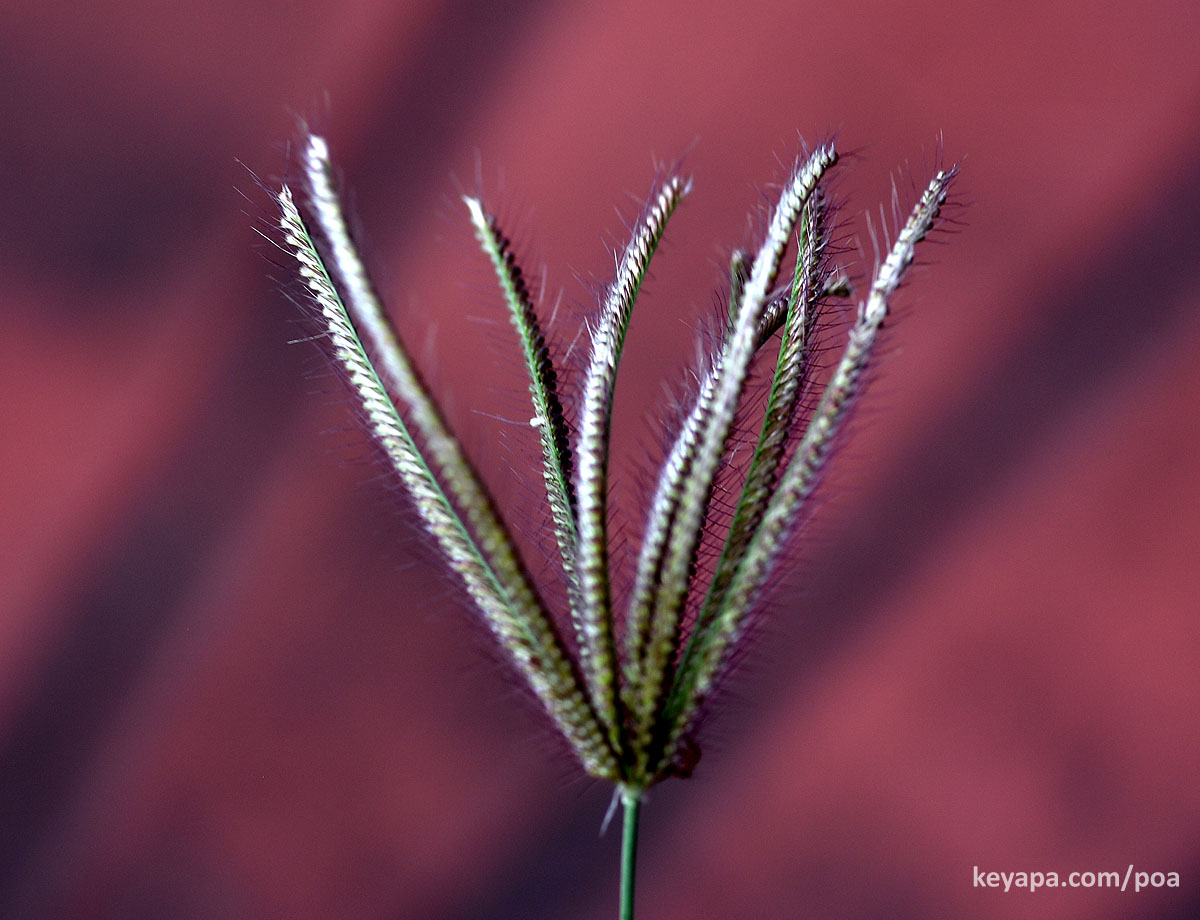
The next grass I saw as I walked the suburban streets was one that at least was not in the USA. It had digitate inflorescence and strikingly enough, a row of encircling white hairs on some nodes! I typed it later as a Dichanthium spp, perhaps Dichanthium annulatum (called "lindi" here). It is naturalized in the area and probably came between 1945 and 1950s as a potential forage. Of course it escaped and is now probably found all over.

Dichanthium annulatum - inflorescence

Dichanthium annulatum - ring of white hairs around node

Dichanthium annulatum - ligule and white hairs

Dichanthium annulatum

I then entered a main road, vehicles whizzing past me close enough to feel the wind of their passing, and I encountered an individual flowering specimen that I at first thought I had last seen in the Nature Conservancy's Disney Wilderness Preserve in Florida. It had the same digitate inflorescence that seemed to curl inwards, and I was thinking it was Eustachys petraea. But looking later at lists of Philippines grasses, it is probably Chloris barbata.

Chloris barbata? - digitate inflorescence

Chloris barbata?- habit

On the sides of the main road were various stores and private residences (there does not seem to be any zoning going on obviously), and as I passed one home I noticed that a fine bladed grass had crawled up the side of a stone wall, using the cracks in the wall as its path. The specimen was stoloniferous, and had tiny spike-like inflorescence jutting out of the mass of blades at various points.

Zoysia matrella cliimbs up a wall

Zoysia matrella - the specimen had lots of spike like inflorescence

A quick inspection showed that it was a turf grass that had moseyed out of the home's lawn. I was thinking it looked slightly like Eremochloa ophiuroides (centipedegrass in the USA), another turf grass which I had profiled in an earlier post. But further study typed it as from the genus Zoysia, perhaps Zoysia matrella. 

This turfgrass genus is also an inhabitant of the lawns in the warmer parts of the USA, and I was not surprised to find it here as well. 

Zoysia matrella - inflorescence with purple stigmas and yellow anthers

An old "friend" made an acquaintance as I continued along the road. I encountered specimens of  Eleusine indica (called "paragis" here, as well as a LONG list of other common names due to the different dialects and languages in the country), the unmistakable inflorescence and white center a dead give-away for this ubiquitous weed. It has become naturalized in the country, and it is just as much of a pest here as in many other countries in the world.

Eleusine indica - inflorescence

Eleusine indica - white center

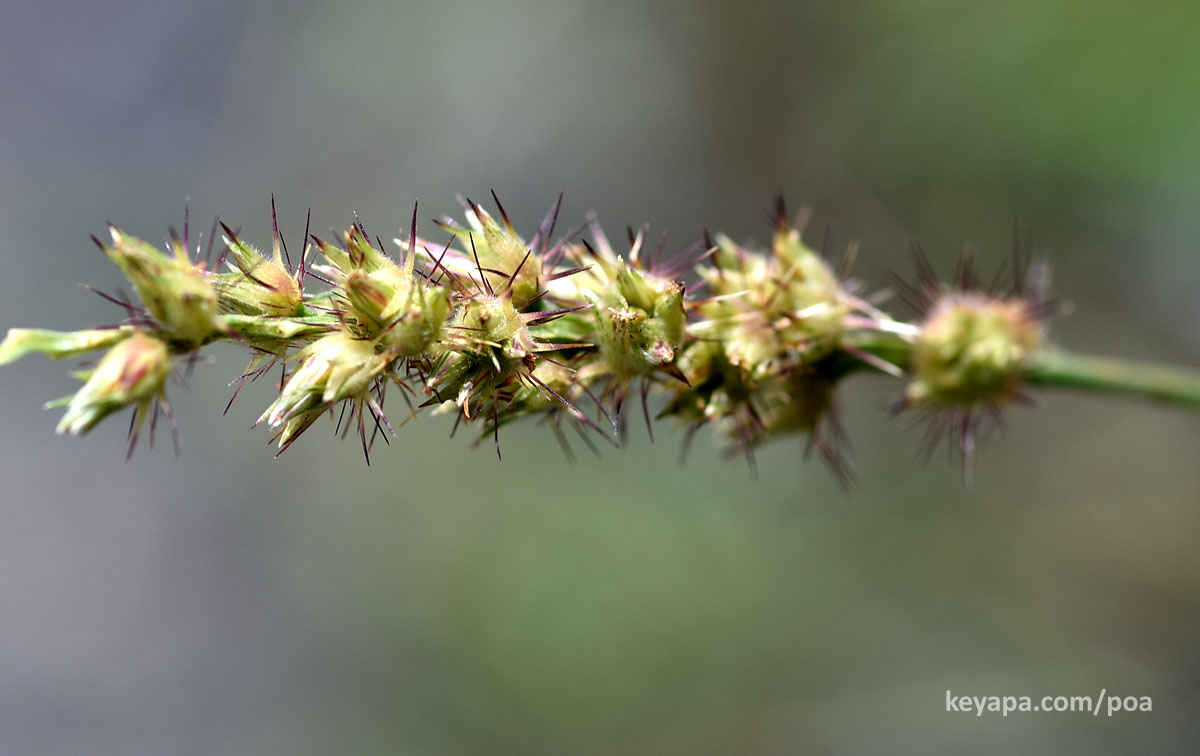
On the way home after ranging perhaps 0.5 km along the narrow dusty road, I stopped by a convenience store called Alfamart, and by chance happened upon a cluster of grasses that were living beneath the shade of a tired palm. The specimens were in flower, and the spikelets on the spike-like inflorescence reminded me of the sandbur (Cenchrus longispinus) that I had profiled in the USA. 

Cenchrus brownii - habit

Each spikelet had silvery white stigmas peeking out of the purple tinged spines, and in this case, I typed the species to perhaps Cenchrus brownii or Cenchrus echinatus. Both are native to the Americas but have become naturalized in the Philippines, and both are inhabitants of open waste spaces and other disturbed areas.

Cenchrus brownii - inflorescence with spikelets (and white stigmas) 

   
Cenchrus brownii -  inflorescence with spikelets

The spines on the spikelet function to attach to passing traffic, allowing the grass seeds to hitchhike using passersby. Unfortunately, the spines are also quite sharp and can pierce the skin (much to the horror of beachgoers everywhere with their bare feet), and I made the mistake of storing an inflorescence in my camera bag and later getting spiked when I reached into the bag! Definitely painful!  

Cenchrus seedhead attaching to unfortunate cameraman

Finally, I saw one particularly tiny grass that seemed to crop up sporadically all over, whether in decrepit lawns, or cracks in the road. This particular species had fine panicles, and I was thinking that it was the notorious Poa annua, one of the most widespread grasses in the planet and one that is even threatening the ecology in far away Antarctica!

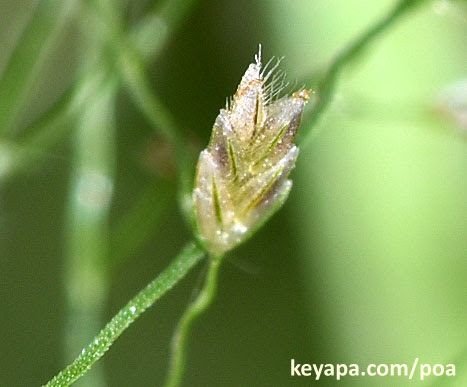
But a closer inspection revealed some discrepancies. For one thing, the spikelets seemed much smaller than those I had typed as P. annua in the USA (on the order of only 1-2 mm long at most). Nor were the tips of the leaf blades folded and boat like, and I did not find any long ligule at the blade junctions, a diagnostic characteristic of the species. In addition, the long hairs near the ligule did not seem to be present in P. annua. I am left with a mystery, but what is life without the added incentive of such goals? I can only hope that one day I will be pointed in the right direction. Below are images of the so far unknown (but very ubiquitous here) species.


Macros of the extremely tiny spikelets (note the dark red-brown seeds in some):


I have to say that the ability of many grasses to spread and colonize far away lands was on full display during this first botanical jaunt that I did. Fully half of the species I encountered were those that I had already encountered in the USA, half a world away! Of course the count was biased by the fact I limited my tour to a semi urban environment, which usually housed cosmopolitan disturbance specialists. But I was impressed anyways. 

Urban botanizing is not for the faint of heart in this town, what with the narrow roads with no sidewalks, and the allegedly rampant holdups (especially when one is lugging around relatively expensive stuff like a DSLR camera with a large macro lens). In this first botanical expedition in the heart of a bustling town in Cavite, Philippines, I did not cover a lot of ground (perhaps 0.5 km at most away from the house), but the diversity of grasses was still a pleasant surprise. I thoroughly enjoyed it, and will do a few more before the end of my stay.