Showing posts with label Oplismenus. Show all posts

Wednesday, May 17, 2023

The Viking Syndrome: Why Grasslands (and Grasses) Became Wildly Successful

The open spaces, the open grasslands. Nothing could be better.

The overwhelming success of the Poaceae is not simply because of their well known habit of growing from the base, unlike many other plants. It is also because they exhibit traits that when taken together, researchers have termed the "Viking Syndrome", in honor of the ancient group that ranged far and wide, colonized many places, and had profound effects in areas where they landed.

One of the grasses I saw as I first stepped into the streets of Lima, Peru last month was a species that I had seen many times in many different places. There was no mistaking the distinctive digitate inflorescence, nor the wiry stoloniferous habit that was one factor that allowed the grass to become a fearsome competitor and so valuable to turf grass managers. I had seen the same species in New Jersey, in Florida, in several Caribbean Islands, and even in the Philippines. It was the common Cynodon dactylon (called Bermuda grass in the USA), and its success is one that is repeated time and time again in the Poaceae.

Cynodon dactylon in Peru
The discovery of this species in Peru was not even a surprise to me, because I have grown accustomed to seeing grass species that are extremely cosmopolitan in their distribution.

In an earlier article, I had summarized some of the reasons why grasses can be considered the most successful plant family in the world, even not taking into account their economic importance to humanity (e.g. rice, wheat, maize/corn, etc). 

Grasses are only the fifth most species-rich angiosperm family with about 12,000 species (Clayton et al., 2015). And yet ecologically, grasses are by far the most dominant plant family. Areas dominated by grasses cover up to 43% of the surface of the world (Gibson, 2009), and they are found in almost every ecological habitat, including Antarctica. Up to 37% of the land area of the USA is dominated by grasses! Entire ecosystems of animals and other plants depend on grasses for their continued health and existence.

In fact, although grasses account for only 3% of plant species on Earth, grass-dominated landscapes contribute 33% of global primary productivity, the amount of CO2 removed from the atmosphere every year to fuel photosynthesis (Beer et al., 2010).

The overwhelming success of the Poaceae is not simply because of their well known habit of growing from the base, unlike many other plants. It is also because they exhibit a suite of invasive traits that when taken together, researchers have termed the "Viking Syndrome," in honor of the ancient group that ranged far and wide, colonized many places, and had profound effects in areas where they landed (Linder et al, 2018). 

Specifically, grasses have:
  1. Efficient dispersal, 
  2. Rapid population growth, 
  3. Environmental flexibility 
  4. Flexible growth forms and phenotypic plasticity
  5. The ability to transform environments to benefit themselves
It is this combination of invasive traits that have allowed grasses to become the most successful plant family in the world today.

1. Efficient Dispersal

Grasses certainly are able to disperse far and wide. The method of dispersal after pollination varies among species, but include wind dispersal (anemochory), dispersal via animal coats
(epizoochory), and dispersal after ingestion by an animal (endozoochory). The ability of grass species to be efficiently dispersed is almost everywhere in evidence. 

For example, the dune grass Leymus arenarius was one of only 4 plants to appear during the first decade after the formation of the volcanic island of Surtsey in 1963 (Magnusson et al, 2014). Some grass species like Phragmites australis are also hailed as being perhaps the most widely distributed angiosperm in the world, with a range that extends from 70 degrees N to the tropics (Holm et al, 1977). 

The unit of dispersal is the inflorescence in whole or part. This "diaspore" includes the basic unit of the grass flowers, which are the spikelets. In many grasses these are frequently tiny and lend themselves to easy dispersal, but beyond that grass spikelets can show various modifications that enable them to be carried far and wide. The most common have long awns that help in wind dispersal, but some Cenchrus spp have sharp barbed "thorns" that can easily catch on animal fur or clothing.

The deadly spines of Cenchrus sp

In some others like Oplismenus undulatifolius the awns exude sticky droplets of liquid which can also adhere to passing traffic. Studies have found that a dog running through this grass could pick up 12000 or more seeds on its fur! People are also used as vehicles for dispersal, with one study showing that around 800 seeds adhered to fleece within 30 seconds, while even denim pulled in around 300 seeds within the same timespan (Beauchamp et al, 2013)!

The sticky awns of Oplismenus undulatifolius helps in its dispersaL

2. Rapid Population Growth

The ability to create enormous populations very quickly might be another trait that helps in their invasive success. Such rapid population growth can be the result of shorter generation times and early reproduction. This allows pioneer populations in new habitats to quickly overrun the area, and the shorter generation times also creates more rapid responses to directional selection.

Although no definitive study has been made to compare entire plant families, many grasses have extremely short generations times. For example, the weedy and cosmopolitan Poa annua can flower just six weeks after germination (Cope et al, 2009) . In the same way, the weedy and extremely invasive Bromus tectorum (called cheatgrass in the USA) also can flower within 5 weeks (Meyer et al, 2004).

Interestingly enough, the grass embryo might be one factor that contributes to their reproductive success. Unlike other plants in their order (the Poales), which consist of undifferentiated cells, the embryos of grasses is already differentiated into specialized tissues, including the root, a shoot with leaf initials, and a specialized structure called the scutellum, which digests endosperm and moves it to the rest of the embryo. 

Bromus tectorum can flower within 5 weeks of germination 

3. Environmental Flexibility

The Poaceae as a whole occupy all the environmental niches available to angiosperms. This ability is related to the amazing flexibility of the grasses when it comes to adapting to various environments.

For example, grasses have the ability to survive in the widest range of temperatures among plants, with Deschampsia antartica able to live down to -10 degrees C (with an optimum of 10 degrees), and Dichanthelium thermale able to tolerate up to 65 degrees C in the active geothermal areas of Yellowstone National Park. The evolution of freezing tolerance in the family in particular opened up vast areas of the colder parts of the world to colonization by the grasses.

Another example of the ability of members of the Poaceae to exist in extreme environments is the large number of halophytes in the family. Halophytes are organisms that are very tolerant of high salt concentrations, and the grass family is second only to the Amaranthaceae in the number of species that are halophytes (Moray et al, 2015), with studies indicating that salt tolerance evolved independently at least 70 times in the family (Bennett et al, 2013).

This ability to flourish in a wide range of environments is founded on various traits. As an example, the Poaceae exhibits all 3 different types of photosynthesis (C3, C4, and CAM), an attribute it shares with only 8 other plant families. Since the the type of photosynthesis used by a plant greatly influences where it grows best, this means the Poaceae is capable of existing in innumerable and varied environments. 

The Poaceae also have a strong propensity to readily absorb novel genetic information from  their environment, and incorporate them into their own genome (Hibdige et al, 2021). They do this via a process called Lateral Gene Transfer (LGT), where a species can acquire new adaptive genes and traits from completely different species without any sexual reproduction. Such instances of LGT are an amazing way for a grass to "leap frog" the slower evolutionary pathways and suddenly acquire traits that allow them to survive in extreme and varied environments.

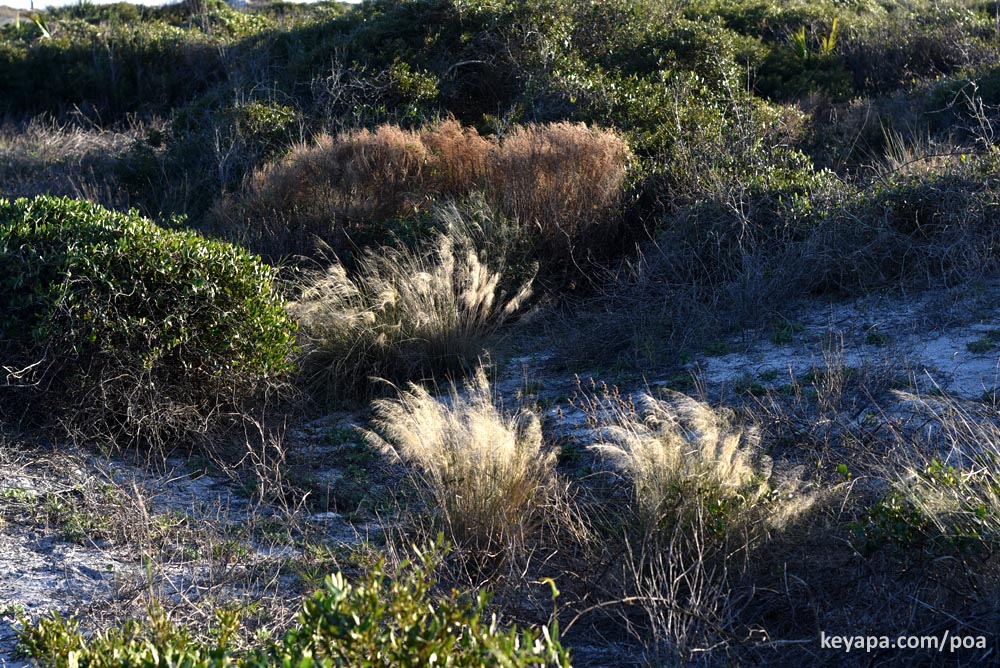
Muhlenbergia capillaris is a salt tolerant dune grass

4. Flexible growth forms and phenotypic plasticity

Grasses have evolved  a variety of growth forms that allow them to adapt to almost any situation or event, whether it be (a) continuous defoliation, such as by herbivores, (b) periodic defoliation, such as in seasonal climates, or (c) competition against other plants such as in forests.

In terms of vertical reach, most grasses are low lying organisms, but some species are tall, and form towering grasslands that reach high above the height of a man (e.g. Saccharum spontaneum grasslands). Bamboos are even taller, and their woody stems allow them to reach the height of mature trees in shaded forests.

In terms of horizontal spread, some grasses are bunch grasses that form tussocks, while others spread horizontally via stolons (above ground horizontal shoots) or rhizomes (below ground horizontal shoots) to form (for example) the typical lawns. This type of growth is controlled mainly by whether the species has intravaginal innovation (new shoots originate from axillary buds within the leaf sheaths) or extravaginal innovation (new shoots grow from axillary buds outside the leaf sheaths). In the latter case, the result is the ability of the grass to spread horizontally and blanket an entire area.

The vast majority of grasses also exhibit hemicryptophyte growth, which means that their buds are at or near the soil surface. This is one of the key mechanisms that allows grasses to withstand repeated defoliation via grazing or fire, and thus create climax communities that demonstrate an alternative biome state. This trait also means grasses do not necessarily need to maintain above ground structures during periods of extreme stress, such as droughts and cold, and it is the common reason that people assume grasses are so successful.

Bamboo sp (probably Bambusa vulgaris)

5. Transformation of Environments

The ability of members of the Poaceae to significantly transform their environment is perhaps the primary key to their success. By changing their surroundings, grasses create a hostile environment for other plants (including trees and shrubs) that may usurp their dominance, and even relegate them to minor components of the biota.

The way grasses transform the environment is rooted in their makeup. The reproductive fecundity of the grasses allows them to exist in numberless hordes, and their growth forms enable them to blanket entire habitats in contiguous swards, denying food, water and sunlight to competing plants. Their enormous populations, enabled via wind pollination, also allows them to use biotic feedback mechanisms that utilize fire and herbivore grazing to transform closed canopy forests into grasslands, and later maintain this alternative climax state. 

African Tropical Grassland (Savanna), by Gossipguy)

All the factors above combine to give to the Poaceae an invasive and aggressive quality that is perhaps unmatched in the plant kingdom. It allowed the grasses to range far and wide, colonizing all four corners of the world, and transforming vast lands into the wide open spaces that we see today. 

LITERATURE CITED

Beauchamp, Vanessa B.; Koontz, Stephanie M.; Suss, Christine; Hawkins, Chad; Kyde, Kerrie L.; Schnase, John L. (2013). "An introduction to Oplismenus undulatifolius(Ard.) Roem. & Schult. (wavyleaf basketgrass), a recent invader in Mid-Atlantic forest understories". The Journal of the Torrey Botanical Society. 140 (4): 391–413.

Beer, C., Reichstein, M., Tomelleri, E., Ciais, P., Jung, M., Carvalhais, N., Rodenbeck, C., Arain, M. A., Baldocchi, D., Bonan, G. B., Bondeau, A., Cescatti, A., Lasslop, G., Lindroth, A., Lomas, M., Luyssaert, S., Margolis, H., Oleson, K. W., Roupsard, O., Veenendaal, E., Viovy, N., Williams, C., Woodward, F. I. & Papale, D. (2010). Terrestrial gross carbon dioxide uptake: global distribution and covariation with climate. Science 329,
834–838

Bennett TH, Flowers TJ, Bromham L. Repeated evolution of salt-tolerance in grasses. Biol Lett. 2013;9:20130029-20130029

Cope, T., Gray, A. J., Tebbs, M. & Ashton, P. (2009). Grasses of the British Isles. Botanical Society of the British Isles, London.

Estep, M. C., McKain, M. R., Vela Diaz, D., Zhong, J., Hodge, J. G., Hodkinson, T. R., Layton, D. J., Malcomber, S. T., Pasquet, R. & Kellogg, E. A. (2014). Allopolyploidy, diversification, and the Miocene grassland expansion. Proceedings of the National Academy of Sciences of the United States of America 111, 15149–15154.

Gibson, D. J. (2009). Grasses and Grassland Ecology. Oxford University Press, Oxford.

Hibdige, S.G.S., Raimondeau, P., Christin, P.-A. and Dnning, L.T. (2021), Widespread lateral gene transfer among grasses. New Phytol. https://doi.org/10.1111/nph.17328

Holm, LeRoy G.; Plocknett, Donald L.; Pancho, Juan V.; Herberger, James P. 1977. The world's worst weeds: distribution and biology. Honolulu, HI: University Press of Hawaii. 609 p.

Linder, H.P., Lehmann, C.E., Archibald, S., Osborne, C.P., & Richardson, D.M. (2018). Global grass (Poaceae) success underpinned by traits facilitating colonization, persistence and habitat transformation. Biological Reviews, 93.

Magnusson, Borgthor & Magnússon, Sigurður & Ólafsson, Erling & Sigurdsson, Bjarni. (2014). Plant colonization, succession and ecosystem development on Surtsey with reference to neighbouring islands. Biogeosciences. 11. 5521-5537. 10.5194/bg-11-5521-2014. 

Meyer, Susan & Nelson, David & Carlson, Stephanie. (2004). Ecological Genetics of Vernalization Response in Bromus tectorum L. (Poaceae). Annals of botany. 93. 653-63. 10.1093/aob/mch088. 

Moray, C., Hua, X. & Bromham, L. Salt tolerance is evolutionarily labile in a diverse set of angiosperm families. BMC Evol Biol 15, 90 (2015). https://doi.org/10.1186/s12862-015-0379-0


Monday, October 18, 2021

How an Invasive Grass Secretly Spread and Eluded Eradication

Tiny spikelets of Oplismenus undulatifolus

The insidious invader first came to light in 1996, in Patapsco State Park in Maryland, and by 2004 it had leapt into the next state and was discovered infesting a large area in Virginia's Shenandoah National Park. Efforts to eradicate it while it had a limited distribution began in earnest, but fifteen years later, it had spread to thousand of hectares in Maryland, Virginia, and even one spot in Pennsylvania. 

The distinctive wavy leaves of O.undulatifolius

The ability of Oplismenus undulatifolius (Wavyleaf Basketgrass) to defeat all efforts to halt its advance was likely due to several factors.  The first is its long lived perennial nature, an attribute different than a congener, the also invasive Microstegium vimineum (Stiltgrass). This allows it to push up from thick litter every year using well developed roots, unlike the latter, which has to germinate from more vulnerable seed every year.

The second factor is the ability of this understory species to thrive in very dim light. One study found that it could still grow in as low as 2-11 mols m2 per day of light. This allows it to exist within the forest interiors, and thus escape the attention of many biologists and others who usually do not wander far from trails. 

Stigma of Wavyleaf Basketgrass

The third factor which allowed Wavyleaf Basketgrass to thwart attempts to contain and eliminate it was a characteristic that was in full display when I chanced upon a small cluster of this invader near Shenandoah National Park yesterday.

I saw what looked to be tiny beads strung along 5 to 10 cm spikes that shot out from the masses of wavy leaves. Each bead was perhaps 1 or 2 mm in diameter, with sharp awns projecting from them.

When I used my macro lens to view the beads, I suddenly realized these were flower and seedheads!

Awns with sticky liquid

Under the macro lens, the spikelets of this grass looked like alien spaceships, with the awns decorated with beads of liquid.

It turns out that O. undulatifolius disperses its seeds using unwitting animals, with the sticky liquid enabling them to attach to the fur or shoes and socks of passing fauna. Wavyleaf Basketgrass is a prolific producer of these sticky seeds, with dense stands developing more than 6000 seeds per square meter every year. It is such a profligate invader that Prof. Vanessa Beauchamp found that a dog running through this grass could pick up 12000 or more seeds on its fur! People are also used as vehicles for dispersal, with one study showing that around 800 seeds adhered to fleece within 30 seconds, while even denim pulled in around 300 seeds within the same timespan!


Given all these attributes, it is certainly understandable why all attempts to eradicate the invasive grass have so far proven futile. But if you are out hiking and find this, then be sure to report the find in order for us to at least contain it.


References

Beauchamp, Vanessa B.; Koontz, Stephanie M.; Suss, Christine; Hawkins, Chad; Kyde, Kerrie L.; Schnase, John L. (2013). "An introduction to Oplismenus undulatifolius(Ard.) Roem. & Schult. (wavyleaf basketgrass), a recent invader in Mid-Atlantic forest understories". The Journal of the Torrey Botanical Society. 140 (4): 391–413.

Peterson, P.M., E.E. Terrell, E.C. Uebel, C.A. Davis, H. Scholz, and R.J. Soreng. 1999. (Scientific Note) Oplismenus hirtellus subspecies undulatifolius, A new record for North America. Castanea 64:201-202.

Thursday, July 23, 2020

Oplismenus undulatifolius at Patapsco Valley State Park (Avalon Area)

Oplismenus undulatifolous

The new invader was first discovered in 1996 in Patapsco State Park in Maryland (Peterson et al, 1999). 15 years later, it had spread to thousand of acres in Maryland, Virginia, and even one spot in Pennsylvania. But its origin in the USA was at this park, and on the way home from Shenandoah we visited it for a very short while to see first hand its presence in the park.


We entered the Cascade Falls Trail using the Cascade Trail North Carpark, and a short walk of around 15 min quickly took us to one of the falls. At the falls itself I was interested in seeing a single plant growing from between two smooth rocks in front of the waterfall, and nearby was a young colony at the base of a tree.

Oplismenus undulatifolous
A single specimen peeking out from rocks near the waterfall
On the trail itself I encountered a few colonies of the species, and what was interesting was that quite a few of the specimens in the area had leaf damage. Although at first I thought this was from too much light or from some herbicide, Dr. Vanessa Beauchamp said that it was most likely leafminers that caused it. Indeed, it seems a few insects like the leafhopper Tylozygus geometricus and wood midges (Lestremiinae spp) can also cause damage.

Oplismenus undulatifolous
Damage from leaf miners
The damaged grasses though were confined to one area of the trail, and many of the other specimens that I saw were fine.

Oplismenus undulatifolius
Clumps of O. undulatifolius along Cascade Falls Trail, with some of the individuals showing leaf damage.
I was also surprised to discover masses of the species intermixed with other weeds on the slopes of the trail area which can be viewed only from across from the parking lot. I had to use my telephoto lens to get close enough to identity the grass.

Oplismenus undulatifolous
Masses of O. undulatifolius on the side of a small hill, I used a telephoto lens to view it.
All in all I enjoyed the very short stop at Patapsco Valley State Park, and wished I had more time to explore more of the area. Perhaps one day when we pass by again.

Literature Cited

Peterson, P.M., E.E. Terrell, E.C. Uebel, C.A. Davis, H. Scholz, and R.J. Soreng. 1999. (Scientific Note) Oplismenus hirtellus subspecies undulatifolius, A new record for North America. Castanea 64:201-202.

Sunday, July 19, 2020

Ornamental grasses take center stage at the Virginia House


I visited Shrine Mont in Orkney Springs, VA during a survey for the new invasive Oplismenus undulatifolius. While there, I marveled at a 4 story building that seemed the embodiment of some antebellum fantasy.

In fact, the building was built in 1847 and restored in 1987, after it had been purchased by the Shrine Mont in 1979. It now functions as the conference center for the retreat center, which hosts workshops, conferences, and music festivals, as well as family reunions and vacations, parish weekends , and individual retreats,

The grounds around the building had been designed with simplicity and elegance in mind, and the centerpiece of the large lawn was a round growing space where a huge Miscanthus specimen stood, surrounded by four clumps of Japanese Blood Grass (Imperata cylindrica). Various low growing dicot flowering plants completed the tableau.


I love it when landscapers make major use of ornamental grasses, and the towering Miscanthus and its attendant plants certainly make for an arresting display. Images from a decade back show that the space had more taller non-graminoid flowering plants at the time, and neither the Miscanthus nor the I. cylindrica were present, so this might been a somewhat recent design.

The other interesting thing was the fact they had made use of I. cylindrica, which just so happens to be designated as a Tier 2 noxious weed in that state. This means that it is present in the state and is subject to suppression and eradication efforts, and that its movement is controlled. One wonders what the groundskeepers would think if the plants suddenly reverted to their wild all-green form ;-)


Saturday, July 18, 2020

How to identify Oplismenus undulatifolius (Wavyleaf Basketgrass)

Oplismenus undulatifolius (Wavyleaf Basketgrass)

I'm not an expert at all in identifying grasses, and in fact I'm quite new at it. But in the case of this new invasive species identification is actually fairly easy so long as you look for certain attributes. And you don't even have to look at ligules!

1. Look for even and regular ripples on the upper leaf surface. This is I think one of the most characteristic feature of this grass.

Oplismenus undulatifolius (Wavyleaf Basketgrass)

2. Check the stems for hairiness. This species is quite hairy, and the hairs are visible to the naked eye. This is also one way to distinguish this species from native Oplismenus, which are much less hairy.

Oplismenus undulatifolius (Wavyleaf Basketgrass)

3. When looking at a riot of understory plants, look for specimens that tend to sprawl on the ground and whose alternate leaves are all on the same plane. The leaf tips are also quite long and sharp.

Oplismenus undulatifolius (Wavyleaf Basketgrass)

Easy, right? Now see whether you can spot this species in the image below.


See them?

Here are some specimens in that pic ;-)

Oplismenus undulatifolius (Wavyleaf Basketgrass)


Thursday, July 16, 2020

In search of a new forest invasive : Oplismenus undulatifolius (Wavyleaf Basketgrass)

Oplismenus undulatifolius (Wavyleaf basketgrass)

The Wildflower Trail is a 1.3 km paved trail that follows along the route Gen. Stonewall Jackson took when he marched from the Shenandoah Valley to Fredericksburg through New Market, Virginia.

I had some time in between hikes in Shenandoah and so I had decided to visit this very easy trail in search of one of the newest invasive grasses in the country.

Trudging deeper into the woods
Oplismenus undulatifolius (Wavyleaf Basketgrass) was first discovered in the 1990s in Patapsco State Park in Maryland (Peterson et al, 1999). It is a very shade-tolerant perennial grass that reputedly can crowd out competitors and cover the dark understory of forests. It is currently found only in Maryland, Virginia, West Virginia, and Pennsylvania (one treated colony), and some specimens have been found as far west as the Shenandoah area (EDDSMaps, 2020). Its ability to thrive in as low as 2-11 mols m(-2) day(-1) means it can occupy niches where even the dreaded Microstegium vimineum (Stiltgrass) has trouble dominating.

It should be noted that a native species of this genus (Oplismenus hirtellus and perhaps others) is also found in the United States, mostly in the Southeastern part of the country, and should not be confused with this non-native invader. They can be distinguished by the fact O. undulatifolius is conspicuously hairier and has white flowers, whereas O. hirtellus has purplish or reddish flowers.

The fallen logs
The entrance to the Wildflower Trail is  pretty unobtrusive, and I would have easily missed it if I had not been using google maps to plot my way. But when I cruised into the rather large parking lot I saw that people still knew about it, because there were 5 other cars parked.

Oplismenus undulatifolius (Wavyleaf basketgrass)
The surprise find
Heartened by the presence of other  hikers, I trudged into the trail and made my way deeper into the forest. There were smatterings of M. vimineum along the sides, but none of the other many plants looked like the pictures of O. undulatifolius that I had seen on the web.

Oplismenus undulatifolius (Wavyleaf basketgrass)
Rippled leaves
The trail ended in a circular open space, and I still had not found any evidence of the invasive grass.  Instead of going back to my car in defeat, I decided to press on into the woods, and I slowly made my way forward where the piles of decaying leaves that coated the ground was less thick.

Oplismenus undulatifolius (Wavyleaf basketgrass)
Hairy stems
When I spied two large fallen logs I carefully leveled myself up onto one and peered into the shadowy depression formed by their intersection. Imagine the surprise I felt when I spotted a few leaves that seemed to have the rippled surface so characteristic of O. undulatifolius!

The grass was intermixed with masses of M. vimineum, as well as a few other plants, and a careful search of my surroundings revealed more of the invasive (including near a large clump of stiltgrass), although never in a large enough grouping to merit unusual attention. I even found a very young specimen that even at that small stage had the characteristic rippled leaves. I was able to quickly ID the plants because in addition to the rippled leaves, O. undulatifolius has very hair stems, and its sprawling behavior on the forest floor also helps in the identification.

Oplismenus undulatifolius (Wavyleaf basketgrass)
Mixed in with the stiltgrass
While hiking through trails in nearby Shenandoah National Park, I made it a point to look for the species, although the rapid pace of our hike meant my search was not very comprehensive at all. Nevertheless, O. undulatifolius had been seen in the area, and it is being actively controlled by park management. This is because unlike M. vimineum, which is now ubiquitous, this new invasive is still at that stage where it may be possible to control its spread.

Oplismenus undulatifolius (Wavyleaf basketgrass)
More specimens around the base of a tree
Although it is currently only found in Maryland, Virginia, and small outbreaks in northern West Virginia, there was a chance that it might have spread towards West Virginia from the Shenandoah area, and so when I visited Wolf Gap Recreation Area in Wardenville, WV, I combed the nearby trails and campgrounds for any signs of the species. I also visited Shrine Mont in Orkney Springs, which lies near the border of West Virginia and Virginia. In both cases, I found M. vimineum in abundance, but no sign of the newer invasive.

Oplismenus undulatifolius (Wavyleaf basketgrass)
Two younger individuals
However, the spread of O. undulatifolius to other states is something that I believe is inevitable. Vanessa Beauchamp, an invasive plant ecologist in Maryland who specializes in the species and fought valiantly to contain its spread, found that its sticky seeds stuck easily not only to people's pants legs, but also to passing animals like pet dogs. During one test, she discovered that a pet dog who run for 30 seconds in a field of O. undulatifolius managed to pick up an amazing 2000 seeds.

Given such fecundity, and coupled to the perennial lifestyle of the species and its ability to thrive in deep forest canopies, it is probably only a matter of time before it threatens major parts of the northeastern half of the USA.

Oplismenus undulatifolius (Wavyleaf basketgrass)
A very young specimen already has the characteristic rippled leaves
For more on O. undulatifolius on this site, click here.

Literature Cited

EDDMapS. 2020. Early Detection & Distribution Mapping System. The University of Georgia - Center for Invasive Species and Ecosystem Health. Available online at http://www.eddmaps.org/; last accessed July 25, 2020.

Peterson, P.M., E.E. Terrell, E.C. Uebel, C.A. Davis, H. Scholz, and R.J. Soreng. 1999. (Scientific Note) Oplismenus hirtellus subspecies undulatifolius, A new record for North America. Castanea 64:201-202.