Showing posts with label Cynodon. Show all posts

Wednesday, May 17, 2023

The Viking Syndrome: Why Grasslands (and Grasses) Became Wildly Successful

The open spaces, the open grasslands. Nothing could be better.

The overwhelming success of the Poaceae is not simply because of their well known habit of growing from the base, unlike many other plants. It is also because they exhibit traits that when taken together, researchers have termed the "Viking Syndrome", in honor of the ancient group that ranged far and wide, colonized many places, and had profound effects in areas where they landed.

One of the grasses I saw as I first stepped into the streets of Lima, Peru last month was a species that I had seen many times in many different places. There was no mistaking the distinctive digitate inflorescence, nor the wiry stoloniferous habit that was one factor that allowed the grass to become a fearsome competitor and so valuable to turf grass managers. I had seen the same species in New Jersey, in Florida, in several Caribbean Islands, and even in the Philippines. It was the common Cynodon dactylon (called Bermuda grass in the USA), and its success is one that is repeated time and time again in the Poaceae.

Cynodon dactylon in Peru
The discovery of this species in Peru was not even a surprise to me, because I have grown accustomed to seeing grass species that are extremely cosmopolitan in their distribution.

In an earlier article, I had summarized some of the reasons why grasses can be considered the most successful plant family in the world, even not taking into account their economic importance to humanity (e.g. rice, wheat, maize/corn, etc). 

Grasses are only the fifth most species-rich angiosperm family with about 12,000 species (Clayton et al., 2015). And yet ecologically, grasses are by far the most dominant plant family. Areas dominated by grasses cover up to 43% of the surface of the world (Gibson, 2009), and they are found in almost every ecological habitat, including Antarctica. Up to 37% of the land area of the USA is dominated by grasses! Entire ecosystems of animals and other plants depend on grasses for their continued health and existence.

In fact, although grasses account for only 3% of plant species on Earth, grass-dominated landscapes contribute 33% of global primary productivity, the amount of CO2 removed from the atmosphere every year to fuel photosynthesis (Beer et al., 2010).

The overwhelming success of the Poaceae is not simply because of their well known habit of growing from the base, unlike many other plants. It is also because they exhibit a suite of invasive traits that when taken together, researchers have termed the "Viking Syndrome," in honor of the ancient group that ranged far and wide, colonized many places, and had profound effects in areas where they landed (Linder et al, 2018). 

Specifically, grasses have:
  1. Efficient dispersal, 
  2. Rapid population growth, 
  3. Environmental flexibility 
  4. Flexible growth forms and phenotypic plasticity
  5. The ability to transform environments to benefit themselves
It is this combination of invasive traits that have allowed grasses to become the most successful plant family in the world today.

1. Efficient Dispersal

Grasses certainly are able to disperse far and wide. The method of dispersal after pollination varies among species, but include wind dispersal (anemochory), dispersal via animal coats
(epizoochory), and dispersal after ingestion by an animal (endozoochory). The ability of grass species to be efficiently dispersed is almost everywhere in evidence. 

For example, the dune grass Leymus arenarius was one of only 4 plants to appear during the first decade after the formation of the volcanic island of Surtsey in 1963 (Magnusson et al, 2014). Some grass species like Phragmites australis are also hailed as being perhaps the most widely distributed angiosperm in the world, with a range that extends from 70 degrees N to the tropics (Holm et al, 1977). 

The unit of dispersal is the inflorescence in whole or part. This "diaspore" includes the basic unit of the grass flowers, which are the spikelets. In many grasses these are frequently tiny and lend themselves to easy dispersal, but beyond that grass spikelets can show various modifications that enable them to be carried far and wide. The most common have long awns that help in wind dispersal, but some Cenchrus spp have sharp barbed "thorns" that can easily catch on animal fur or clothing.

The deadly spines of Cenchrus sp

In some others like Oplismenus undulatifolius the awns exude sticky droplets of liquid which can also adhere to passing traffic. Studies have found that a dog running through this grass could pick up 12000 or more seeds on its fur! People are also used as vehicles for dispersal, with one study showing that around 800 seeds adhered to fleece within 30 seconds, while even denim pulled in around 300 seeds within the same timespan (Beauchamp et al, 2013)!

The sticky awns of Oplismenus undulatifolius helps in its dispersaL

2. Rapid Population Growth

The ability to create enormous populations very quickly might be another trait that helps in their invasive success. Such rapid population growth can be the result of shorter generation times and early reproduction. This allows pioneer populations in new habitats to quickly overrun the area, and the shorter generation times also creates more rapid responses to directional selection.

Although no definitive study has been made to compare entire plant families, many grasses have extremely short generations times. For example, the weedy and cosmopolitan Poa annua can flower just six weeks after germination (Cope et al, 2009) . In the same way, the weedy and extremely invasive Bromus tectorum (called cheatgrass in the USA) also can flower within 5 weeks (Meyer et al, 2004).

Interestingly enough, the grass embryo might be one factor that contributes to their reproductive success. Unlike other plants in their order (the Poales), which consist of undifferentiated cells, the embryos of grasses is already differentiated into specialized tissues, including the root, a shoot with leaf initials, and a specialized structure called the scutellum, which digests endosperm and moves it to the rest of the embryo. 

Bromus tectorum can flower within 5 weeks of germination 

3. Environmental Flexibility

The Poaceae as a whole occupy all the environmental niches available to angiosperms. This ability is related to the amazing flexibility of the grasses when it comes to adapting to various environments.

For example, grasses have the ability to survive in the widest range of temperatures among plants, with Deschampsia antartica able to live down to -10 degrees C (with an optimum of 10 degrees), and Dichanthelium thermale able to tolerate up to 65 degrees C in the active geothermal areas of Yellowstone National Park. The evolution of freezing tolerance in the family in particular opened up vast areas of the colder parts of the world to colonization by the grasses.

Another example of the ability of members of the Poaceae to exist in extreme environments is the large number of halophytes in the family. Halophytes are organisms that are very tolerant of high salt concentrations, and the grass family is second only to the Amaranthaceae in the number of species that are halophytes (Moray et al, 2015), with studies indicating that salt tolerance evolved independently at least 70 times in the family (Bennett et al, 2013).

This ability to flourish in a wide range of environments is founded on various traits. As an example, the Poaceae exhibits all 3 different types of photosynthesis (C3, C4, and CAM), an attribute it shares with only 8 other plant families. Since the the type of photosynthesis used by a plant greatly influences where it grows best, this means the Poaceae is capable of existing in innumerable and varied environments. 

The Poaceae also have a strong propensity to readily absorb novel genetic information from  their environment, and incorporate them into their own genome (Hibdige et al, 2021). They do this via a process called Lateral Gene Transfer (LGT), where a species can acquire new adaptive genes and traits from completely different species without any sexual reproduction. Such instances of LGT are an amazing way for a grass to "leap frog" the slower evolutionary pathways and suddenly acquire traits that allow them to survive in extreme and varied environments.

Muhlenbergia capillaris is a salt tolerant dune grass

4. Flexible growth forms and phenotypic plasticity

Grasses have evolved  a variety of growth forms that allow them to adapt to almost any situation or event, whether it be (a) continuous defoliation, such as by herbivores, (b) periodic defoliation, such as in seasonal climates, or (c) competition against other plants such as in forests.

In terms of vertical reach, most grasses are low lying organisms, but some species are tall, and form towering grasslands that reach high above the height of a man (e.g. Saccharum spontaneum grasslands). Bamboos are even taller, and their woody stems allow them to reach the height of mature trees in shaded forests.

In terms of horizontal spread, some grasses are bunch grasses that form tussocks, while others spread horizontally via stolons (above ground horizontal shoots) or rhizomes (below ground horizontal shoots) to form (for example) the typical lawns. This type of growth is controlled mainly by whether the species has intravaginal innovation (new shoots originate from axillary buds within the leaf sheaths) or extravaginal innovation (new shoots grow from axillary buds outside the leaf sheaths). In the latter case, the result is the ability of the grass to spread horizontally and blanket an entire area.

The vast majority of grasses also exhibit hemicryptophyte growth, which means that their buds are at or near the soil surface. This is one of the key mechanisms that allows grasses to withstand repeated defoliation via grazing or fire, and thus create climax communities that demonstrate an alternative biome state. This trait also means grasses do not necessarily need to maintain above ground structures during periods of extreme stress, such as droughts and cold, and it is the common reason that people assume grasses are so successful.

Bamboo sp (probably Bambusa vulgaris)

5. Transformation of Environments

The ability of members of the Poaceae to significantly transform their environment is perhaps the primary key to their success. By changing their surroundings, grasses create a hostile environment for other plants (including trees and shrubs) that may usurp their dominance, and even relegate them to minor components of the biota.

The way grasses transform the environment is rooted in their makeup. The reproductive fecundity of the grasses allows them to exist in numberless hordes, and their growth forms enable them to blanket entire habitats in contiguous swards, denying food, water and sunlight to competing plants. Their enormous populations, enabled via wind pollination, also allows them to use biotic feedback mechanisms that utilize fire and herbivore grazing to transform closed canopy forests into grasslands, and later maintain this alternative climax state. 

African Tropical Grassland (Savanna), by Gossipguy)

All the factors above combine to give to the Poaceae an invasive and aggressive quality that is perhaps unmatched in the plant kingdom. It allowed the grasses to range far and wide, colonizing all four corners of the world, and transforming vast lands into the wide open spaces that we see today. 

LITERATURE CITED

Beauchamp, Vanessa B.; Koontz, Stephanie M.; Suss, Christine; Hawkins, Chad; Kyde, Kerrie L.; Schnase, John L. (2013). "An introduction to Oplismenus undulatifolius(Ard.) Roem. & Schult. (wavyleaf basketgrass), a recent invader in Mid-Atlantic forest understories". The Journal of the Torrey Botanical Society. 140 (4): 391–413.

Beer, C., Reichstein, M., Tomelleri, E., Ciais, P., Jung, M., Carvalhais, N., Rodenbeck, C., Arain, M. A., Baldocchi, D., Bonan, G. B., Bondeau, A., Cescatti, A., Lasslop, G., Lindroth, A., Lomas, M., Luyssaert, S., Margolis, H., Oleson, K. W., Roupsard, O., Veenendaal, E., Viovy, N., Williams, C., Woodward, F. I. & Papale, D. (2010). Terrestrial gross carbon dioxide uptake: global distribution and covariation with climate. Science 329,
834–838

Bennett TH, Flowers TJ, Bromham L. Repeated evolution of salt-tolerance in grasses. Biol Lett. 2013;9:20130029-20130029

Cope, T., Gray, A. J., Tebbs, M. & Ashton, P. (2009). Grasses of the British Isles. Botanical Society of the British Isles, London.

Estep, M. C., McKain, M. R., Vela Diaz, D., Zhong, J., Hodge, J. G., Hodkinson, T. R., Layton, D. J., Malcomber, S. T., Pasquet, R. & Kellogg, E. A. (2014). Allopolyploidy, diversification, and the Miocene grassland expansion. Proceedings of the National Academy of Sciences of the United States of America 111, 15149–15154.

Gibson, D. J. (2009). Grasses and Grassland Ecology. Oxford University Press, Oxford.

Hibdige, S.G.S., Raimondeau, P., Christin, P.-A. and Dnning, L.T. (2021), Widespread lateral gene transfer among grasses. New Phytol. https://doi.org/10.1111/nph.17328

Holm, LeRoy G.; Plocknett, Donald L.; Pancho, Juan V.; Herberger, James P. 1977. The world's worst weeds: distribution and biology. Honolulu, HI: University Press of Hawaii. 609 p.

Linder, H.P., Lehmann, C.E., Archibald, S., Osborne, C.P., & Richardson, D.M. (2018). Global grass (Poaceae) success underpinned by traits facilitating colonization, persistence and habitat transformation. Biological Reviews, 93.

Magnusson, Borgthor & Magnússon, Sigurður & Ólafsson, Erling & Sigurdsson, Bjarni. (2014). Plant colonization, succession and ecosystem development on Surtsey with reference to neighbouring islands. Biogeosciences. 11. 5521-5537. 10.5194/bg-11-5521-2014. 

Meyer, Susan & Nelson, David & Carlson, Stephanie. (2004). Ecological Genetics of Vernalization Response in Bromus tectorum L. (Poaceae). Annals of botany. 93. 653-63. 10.1093/aob/mch088. 

Moray, C., Hua, X. & Bromham, L. Salt tolerance is evolutionarily labile in a diverse set of angiosperm families. BMC Evol Biol 15, 90 (2015). https://doi.org/10.1186/s12862-015-0379-0


Friday, January 6, 2023

A tale of two contrasting little beauties

Inflorescence of Cynodon dactylon showing purple-pink anthers and stigmas

Update: Change species of Dichanthelium to Dichanthelium portoricense (2025-05-15)

I have always been fascinated more by tiny species than by large showy ones. Even my brief flirtation with the Orchids shows this preference, where I gravitated towards the tiny micro-orchids like Lepanthes. This bias towards the tiny means that I am always on the lookout for Poaceae that are cute and pretty, and last week I focused on two species here in Florida that fulfilled that goal, but were otherwise quite different. 

One is a native, a tight rosette bunchgrass that prefers a shaded and moist habitat. The other is a fast spreading aggressive immigrant, a commonly encountered prolific producer of rhizomes and stolons that luxuriates in the full sun. 

The native is from a genus that I have waxed lyrical about in the past. Dichanthelium portoricense forms a tight rosette. It's quite small, and with its dark green leaves and dark culms it is a really attractive species.

Dichanthelium portoricense

I found specimens of it under a tree in an area with usually dry whitish sand. The tree must be giving them a shady microhabitat place to live, as well as a bit more moist ground. The species is native to the southeastern USA and parts of the Caribbean, and the subspecies is typically found in Georgia, Florida, and the West Indies. It usually lives in relatively undisturbed habitat and prefers moist sandy soil, so longleaf pine savannas would be one place to look for this.

Inflorescence of Dichanthelium portoricense - even the spikelets are cute!

I must admit I was excited to see this beautiful critter under the tree. Its small size, dark culms, and dark green blades with borders made it stand out against the whitish soil and brown detritus around it. Some of the specimens also had flowerheads in bloom, the tiny spikelets marked with purple glumes and stigmas.

I must have spent an hour just looking and photographing the few specimens that I found, but I went home happy and satisfied after that brief hike and discovery.

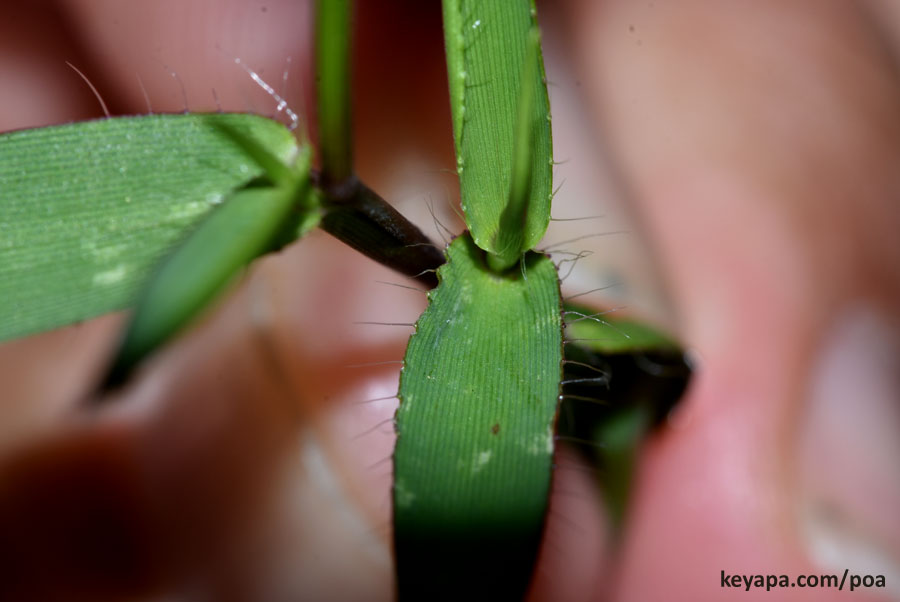
The edges of the leaf blades of Dichanthelium portoricense showing long hars

The second species that I encountered was one that I passed by almost everyday whenever I walked to the gym, but one which I had not yet seen flowering because it was kept cropped and short. There is a golf course in that path, and I have often marveled at the beautiful fine grass that adorned the tee and putting greens. I've even sometimes had the urge to take off my shoes and walk on the fine lawn - although I'm sure this would have annoyed someone just trying to play ;-)

I knew that it was Bermudagrass (Cynodon dactylon), but my attempts at photographing more than just its blades were continuously thwarted. Until, that is, I happened upon some "wild" specimens of this species nearby!

Masses of flowerheads of Cynodon dactylon

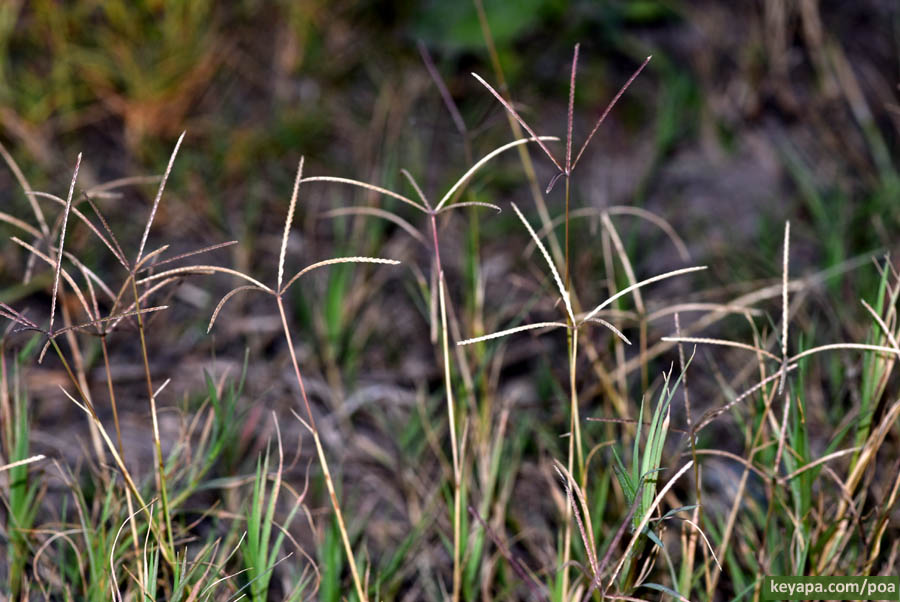
The flowerheads were gorgeous, the distinctive digitate inflorescence rising from the ground like tiny umbrellas.

C. dactylon is native outside the Americas, and is a common turf grass. Its strong rhizomes and stolons allow it to form a dense mat and makes it quite competitive against other plants. It has been shown to strongly inhibit the growth of competitors, and even though it has such fine leaves and a short stature, its roots can go extremely deep into the soil. Some studies showing it going more than 2 meters down!

 Flowerhead of Cynodon dactylon

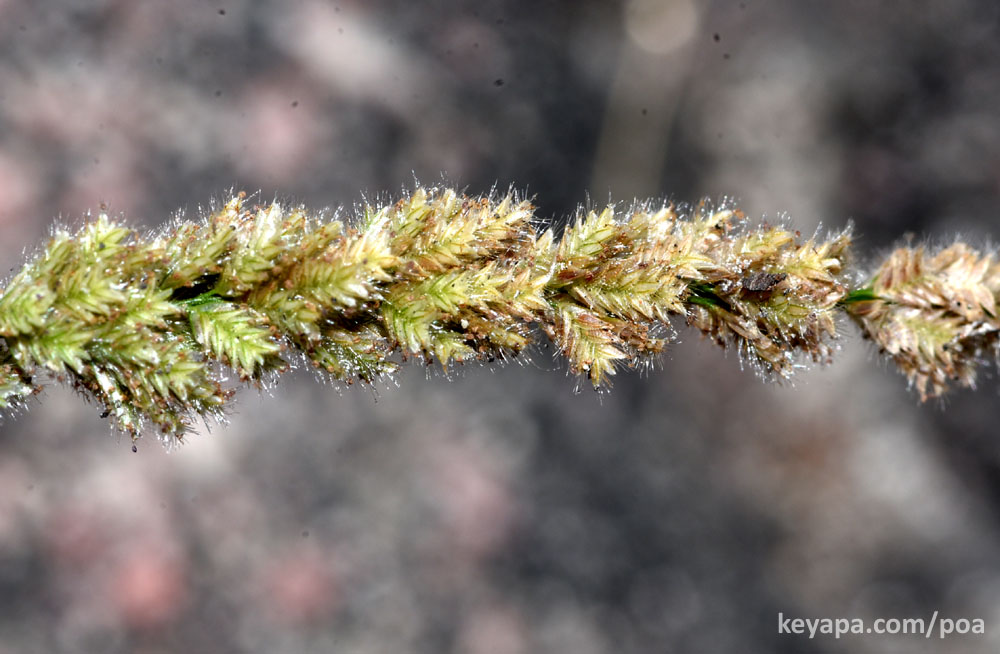
Its inflorescence is quite distinctive, with multiple racemes (usually 4, though I also saw 5, and references note can be from 3-7) radiating out from a common point. The spikelets themselves look like a weird Pacman, or some armored reptilian head!

Dried spikelets of Cynodon dactylon under portable microscope

The two small species had such contrasting looks and lifestyles, and yet I was ecstatic at being able to photograph and see these relatively smaller specimens in full flower. 

Now, my next challenge is to find the absolutely gorgeous Sporobolus discosporus in South Africa!

Sporobolus discosporus (c) Richard Gill


Monday, December 12, 2022

A Fantastic Botanical Caribbean Cruise Trip

Dactyloctenium aegyptium in foreground and our cruise ship in background (in Costa Maya)

We went on our first cruise in 3 years since the pandemic. Our ship landed in 4 destinations, and I spent some time botanizing close to shore. 

The locations varied in terms of the ease of botanizing and the diversity of species found.

Melinis repens in Costa Maya

COCOCAY, BAHAMAS

The first island is wholly owned by Royal Caribbean, and it is a tiny piece of land that is immaculately kept as clean as an urban park.

Most of the specimens I found were ornamental grasses that were deliberately planted, including Trypsacum dactyloides and the fountain grass Cenchrus setaceus (?) .

Trypsacum dactyloides, with male flowers (orangey anthers and filament showing) on the left and female flowers (purple stigma showing) on the right

However,  scattered along the undergrowth I found smaller specimens, such as an Axonopus sp and a single specimen that looks like a tiny Eragrostis or  Poa sp. These tiny weedy species still thrived despite the wholly artificial nature of the location.

COZUMEL, MEXICO

I walked along the Avenida Rafael E. Melgar, the coastal road that leads from the International Cruise Terminal to the downtown proper of San Miguel de Cozumel. It was a pleasant 5 km walk along a well maintained sidewalk, and I descended at times onto the beach proper, which was mostly rocky and small.

Along the way I encountered not only the usual weedy species that seemed to proliferate in all urban locations, but lawn turf grasses and the occasional coastal inhabitants like Paspalum vaginatum. This species had rigid looking leaves and robust stolons, which it used to crawl along the rocky and sandy beaches.

Paspalum vaginatum (inset inflorescence)

I also came upon a few specimens that looked remarkably like Andropogon spp on first look.

Andropogon sp (?)

Many of the larger areas had specimens of Megathyrsis maximus, which managed to rake in some sun along the edges of wooded lots next to the sidewalks.

Megathyrsus maximus spikelets (inset inflorescence), with purple stigmas and yellow-orange anthers

Quite a few areas had the turf grass Cynodon dactylus, which also showed up as escaped specimens in cracked sidewalks and parking lots.

Cynodon dactylum, with white anthers and purple stigmas

Amazingly, I also came upon many more specimens of the same tiny putative Eragrostis or  Poa sp that I had encountered once in Cococay. In one case, it had swamped the original inhabitants of a stone container along the sidewalk!

Unknown Eragrostis sp/Poa sp (?)

But by far the most exciting find I made was a species that I at first was disinclined to think was a grass. It had an inflorescence that looked nothing like the usual spikelets, but I later typed it as Paspalum fimbriatum.

Paspalum fimbriatum

The spikelets of this species had glumes and lemma that formed a fringe around the florets. Its  leaves are relatively broad,  with a slight sinuous quality in some. 

Other specimens that I encountered in Cozumel were:

Melinis repens

Dactyloctenium aegyptium

Dichanthium sp

Cenchrus spinifex (?)

Andropogon sp (?)

Sporobolus jacquemontii (which I also encounter a lot in Florida)

Eragrostis sp (?)

Eustachys sp

Eragrostis sp (?) in Cozumel, Mexico

ROATAN, HONDURAS

This stop was the least attractive in terms of surroundings.  Our ship docked in the center of the city Coxen Hole, and it was raining sporadically the entire time.

I walked east along Main St. after disembarking from the ship, although in hindsight I probably should have gone the opposite direction. 

The empty lots were filled with Megathyrsus maximus, while sprouting from the cracks in the sidewalks and other marginal places I found the usual "weedy" species, including Eustachys sp, Digitaria sp, Echinochloa crus-galli, Eleucine indica, and a single Cenchrus sandbur sp.

I returned to the ship after enduring the sporadic rains for perhaps a couple of hours, with the hope that the next landfall would yield better returns. 

Eustachys sp growing on the rocky beach at the pier 

COSTA MAYA, MEXICO

I was not disappointed, because the stop at the Puerto Costa Maya near the town of Mahahual was the most fruitful of all.

The port itself was clean and large, with the usual tourist shops. But it was the surrounding area that made the area a prime spot for botanizing grasses.

The streets were wide and clean, with resorts and large private homes interspersed with empty lots. Closer to the Port, the wide street (Avenida P del Puerto) did not have sidewalks along the sides, but it instead had a very wide island that was filled with trees and plants. Amazingly enough, a dirt path run through the center of the island, so pedestrians using this "sidewalk" seemed to be in some forest path! It was a rather innovative idea, and one that I had never encountered before.

Path between stands of vegetation in the street island of(Avenida P del Puerto)! A great concept for urban and suburban roads

It goes without saying that I felt safe wandering into the smaller side streets, and just a few blocks from the port I came upon an empty lot that was filled with all sorts of species. 

Field of Botanizing Dreams. Eustachys sp and Dichantium sp in foreground, pinkish Melinis repens in background.

It was a literal field of botanizing delights, with waving masses of Eustachys sp mingling with clusters of pink and red Melinis repens. 

Melinis repens

Other inhabitants included the ubiquitous Dactylocnium aegyptium, Dichantium sp, as well as Cenchrus sp and an unknown species that was probably a Paspalum. There was even a large Megathyrsus maximus to one side.

Eustachys sp (left) and Dichantium sp (right)

Beyond the field I continued in the general direction of Mahuhual Beach, and I continued to encounter interesting specimens.

Once in awhile I came upon individual plants that I typed as Andropogon (perhaps A. virginicus because of a sheath that partly covers the spikelets) , which surprised me, as I always associated that clade with North America, and not tropical regions.

Andropogon sp (?), habit and spikelets

I also found an attractive broad leaved grass that I identified as Paspalum mandiocanum. The leaves had minute dark sinuous curves along their edges, and I found specimens along the sides of one of the main thoroughfares (Carretera A Mahahual).

Paspalum mandiocanum

Even the crabgrasses caught my attention. One specimen had a beautiful sinuously striped rachis and ciliated spikelets, and I typed it as Digitaria ciliaris.

Digitaria ciliaris

I also encountered specimens that I could not type, including a tallish and elegantly slim grass that had alternating green and white appearance to its culms (due to the leaf sheaths staying close to the culm). I typed it to perhaps Hyparrhenia rufa.

Unknown species (Hyparrhenia rufa?)

All in all, it was a great day for botanizing, and a great end to my December Caribbean Cruising trip!