Showing posts with label Uniola. Show all posts

Friday, December 24, 2021

A Grass among the Sea Wrack


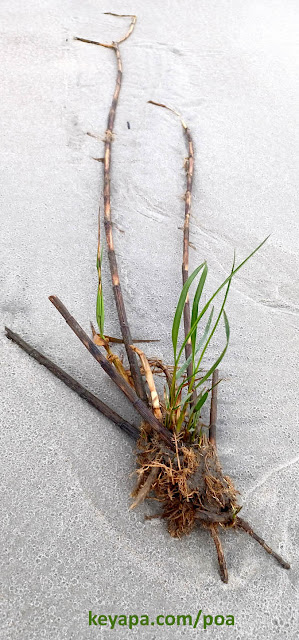
 I was strolling along Coligny Beach in Hilton Head Island, SC when I came upon washed up organic debris that looked like grasses. Up to that point, the most interesting thing I had seen were the empty carapaces of horseshoe crabs.

Much to the annoyance of the wife I took some time examining what I found. 
I've  always been interested in drift seeds and drift fruits, which are carried by ocean currents far from their points of origin and deposited by the tides on beaches, where they may have a chance to root and flourish. If you walk beaches often, you'll notice that a line of organic and other "debris" line the sand during the day, and an entire culture of so-called "beaners" comb these sea "wrack" for seabeans and other hidden treasures. 

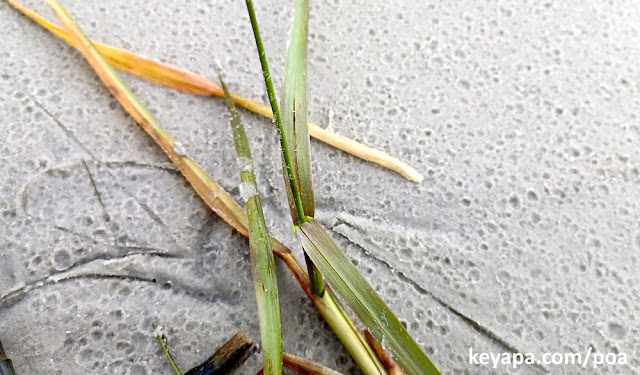
I don't believe grasses are common in such sea wracks, although there have been cases of masses of dead and dying Phragmites australis washing up to litter beaches in the northeast. The putative grasses that I found were composed of broken and intact culms, with attached fibrous roots and even rhizomes. I at first thought they were palm fragments, but the culms actually look similar to those of Saccharum officinarum (sugarcane) or some small bamboo.
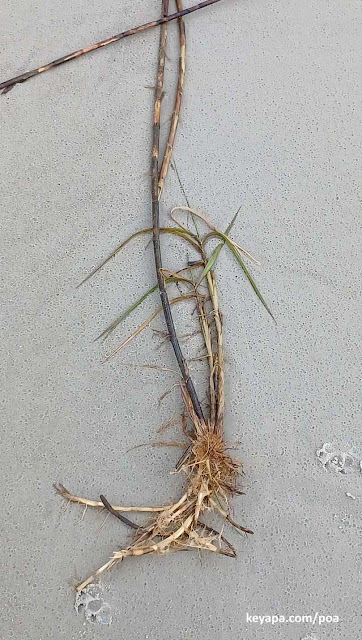

There are of course various dune grasses at the beach, especially Uniola paniculata, which lined the dunes that fronted the whitish sand. But the many fragments I found at the wrack were not this species, nor one of the other dune grasses that I have found.
 
I also marveled at the fact they seemed to be trying to sprout in the sandy beach, although I doubt anything would come of it. I can only imagine that some storm inland had washed these pieces into a river, from whence the grass fragments had been carried into the open ocean.

I'd love to figure out the identity of the plant, and determine whether they actually will be able to somehow root in the beach, unlikely as that possibility may be. The notion of live grass fragments being carried long distances along the ocean currents to distant shores, on which they can start up a new and thriving population, is really quite fascinating.

Monday, April 12, 2021

Sentinels of the Dunes


I posted awhile back about the importance of grasses in maintaining the dune ecosystems that are the foundation of coastal areas. Without such grasses, we would not have the wide sandy beaches that give people so much joy. In the northeast USA, the predominant species is Ammophila breviligulata, which I also discussed in an earlier post. During our trip to Florida I had ample opportunity to see another species that becomes dominant as one goes farther south.

Dried seedheads in Tybee Beach
Uniola paniculata is a larger species that can grow to 2 meters high, and it is easily identified by its seedheads. I encountered it first in Tybee Beach, near Savannah, GA. It was March, so the inflorescences were all dried and brown, but no one can mistake the beautiful seedheads for anything else.

Like other dune grasses, this species accumulates sand around it, and in fact grows much more rapidly when buried in it. It reproduces mainly by asexual means, by forming buds along the bases, but it also produces seeds. The seeds reportedly can be carried long distances by ocean currents! 
A provider of nesting for various birds at Tybee Beach
As I walked along Tybee beach, I looked in wonder at the tall dunes that dominated the rear of the beach, each topped by stands of U. paniculata. They looked almost elven amidst the whitish desolate sands, and I gave thanks to these Sentinels of the Dunes, who stand watch to protect the integrity of the beach, and thus gift us such blessings.


Saturday, June 6, 2020

A short history of my obsession with grasses

Bambusa malingensis
Bambusa malingensis
I've recently wondered when my interest in grasses first manifested itself.

My fascination with a specific plant group for a long time was confined to Aroids, and I maintained one of the longest running aroid-specific websites on the internet when I started my Thaumatophyllum (at the time, Meconostigma) site in 2005.

Of course, I have almost always been involved with one species of grass, Oryza sativa (rice), which I have grown almost every year for more than a decade as something like a ceremonial ritual. But I think this interest did not extend beyond to other grasses until Summer of 2011, when I obtained my first ornamental grass, Imperata cylindrica 'Red Baron' (Japanese Blood Grass, but more well known in its wild form as Cogon grass).

Imperata cylindrica 'Red Baron' (Japanese Blood Grass)
This started my first love affair with grasses, and that JBG is still with me and thriving wildly to this day. In fact, it interested me so much that I bought a few more grasses in 2012, including a Miscanthus sinensis 'Gold Bar', which I unceremoniously stuck below the front passenger seat after I bought it ;-)

Miscanthus sinensis 'Gold Bar'
I also remember 2012 was when we went on a road trip to Florida, and I took several pictures of grasses that we met along the way.

Cortaderia selloana (Pampas grass)
The first were specimens of Cortaderia selloana (Pampas grass) in the Carolina Premium Outlets on the outskirts of Raleigh, North Carolina.

Cortaderia selloana (Pampas grass)

There were some truly impressive specimens of this species in that outlet, with a central plant near the entrance rising perhaps 3-4 meters high. The outlet had also planted them on the islands next to the parking lots, and I had a field day taking photos of the grass while waiting for my wife to finish shopping.

Miscanthus sinensis
Miscanthus sinensis cultivar
In addition, the outlet had a few Miscanthus sinensis specimens scattered about, although I was admittedly less impressed with these than the flowering Cortaderia.

Bambusa malingensis
Bambusa malingensis
Once we got to Florida, we visited The Fairchild Botanical Garden in Miami, where I admired the huge bamboo groves, and on the way back home, we also visited Myrtle Beach, where I marveled at the tall Sea Oats (Uniola paniculata) waving in the sea breeze,

Uniola paniculata
Uniola paniculata at Myrtle Beach

Spikelets of Uniola paniculata

It was at this point that for some reason my interest in grasses wavered then waned, and for about 6 years I barely thought about them due to a rising interest in Banyan Trees (Ficus spp).

This changed in Summer of 2018, and it had to do with Cogon grass (Imperata cylindrica) again. This time, I became interested in the invasive wild form, and my fascination with this one species started to slowly encompass other species in the Poaceae.

During our trip to Baanf National Park in Canada in Fall 2018, I took quite a lot of pictures of grasses in that area, and by the next Summer, I had been enmeshed enough in the family to start this site.

Hordeum jubatum in Lake Louise (Baanf National Park)
In a way, it was a case of positive feedback, where my interest in grasses pushed me to write articles and take pictures of them, while the solid presence of my work provided an impetus for me to write even more and study them even more.

This coming July will mark the first year anniversary of this site. I have enjoyed the journey immensely and I am hoping that my ramblings and photos will encourage others to be just as fascinated by this plant family as I am.