Showing posts with label Sporobolus. Show all posts

Wednesday, August 9, 2023

Here come the Four Horsemen of the Prairies

Panicum virgatum in Open Space area, in Broomfield, CO

Colorado is short grass territory (or at the least the eastern part of the state is), but as summer here is getting into full swing, I noticed that some of the iconic tallgrass prairie species are starting to show themselves.

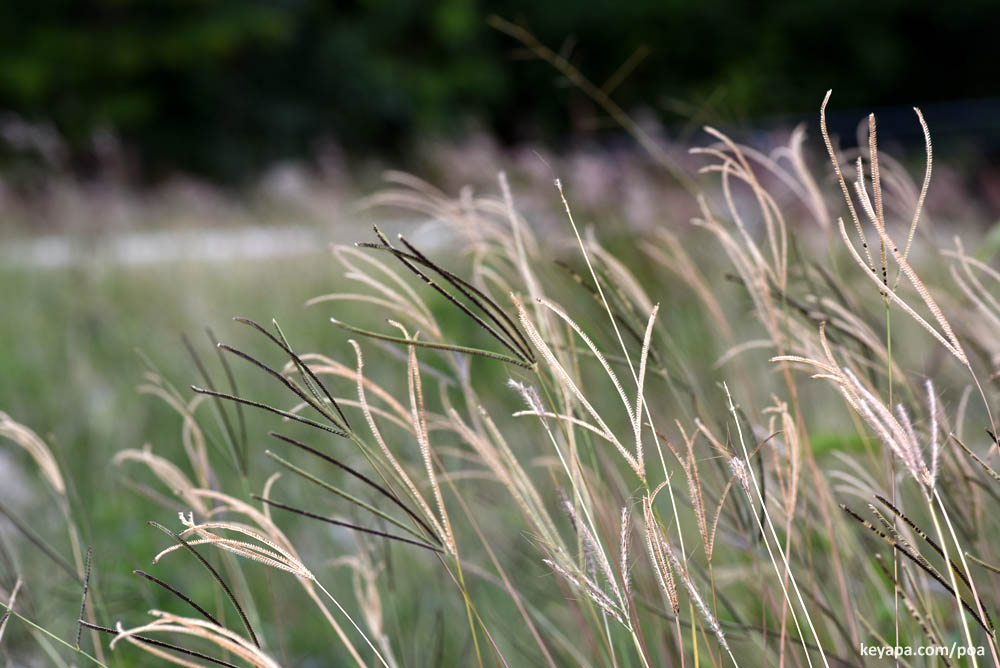
The Four Horsemen of the Prairies refers to four species that tend to dominate the prairies farther east. The ensemble cast includes Andropogon gerardii (Big Bluestem), Panicum virgatum (Switchgrass) , Schizachyrium scoparium (Little Bluestem), and Sorghastrum nutans (Indiangrass).

Sorghastrum nutans in Broomfield, CO

I must admit that I was not really looking for them, engrossed as I was by the more western oriented species here, but I was walking along one of the Open Spaces in Broomfield when I spotted what looked to be Panicum virgatum in flower. The largish specimens lined part of the path, and a quick check of the flowerhead confirmed the identity.

I've always been a fan of this species as an ornamental, but seeing it in situ always is a treat, especially when in flower.

Sorghastrum nutans in Broomfield, CO

The second "horseman" I saw was one that for one reason or the other, I have not encountered much. This time, I found a slew of Sorghastrum nutans (Indiangrass) flowering along a sidewalk in Broomfield, CO, as well as in the various trails around Boulder.

Many people consider it a beauty, but personally, the fleshy colored and awned flowerheads of the species has never struck me as particularly attractive. Nevertheless, I was enchanted by the small flowerheads, which had escaped the mower blades by virtue of being shielded underneath some metal handhold along the path.

Schizachyrium scoparium along sidewalk in Broomfield, CO

And then there's Schizachyrium scoparium (Little bluestem), which I have owned as an ornamental and is an attractive plant to me. Unfortunately, the single specimen I have stumbled upon so far was still in the earlier stages of flowering, but I am looking forward to seeing more of this species going forward. 

Ladybug on Bothriochloa ischaemum(?). Where art thou Andropogon gerardii?

I was also on the lookout for the biggest horseman of all - Andropogon gerardii (Big Bluestem), but all the lookalikes I found at first seemed to be of some other species...specifically, Bothriochloa ischaemum, which is called yellow bluestem or King ranch Bluestem (in Texas).

Andropogon gerardii near Enchanted Mesa Trail, Boulder, CO

There are trails in that city called Lower and Upper Bluestem trails, and so I expected to find bluestems in the area, which I did. Unfortunately, most seemed to be yellow bluestem (Bothriochloa ischaemum) at this time.

It did not help that my identification skills aren't the best, but I finally found specimens of this large species during one of my hikes in Boulder. Not, as it turns out in the bluestem trails, but in trails closer to Chautauqua Park. Perhaps later in the season this tallest of the Four Horsemen will make its presence more widely known.

Sporobolus michauxianus (formerly Spartina pectinata) near Lower Bluestem Trail, Boulder, CO

Finally, I also found a really tall and attractive species that I identified as Sporobolus michauxianus (formerly Spartina pectinata). This is commonly called Prairie Cordgrass here, and it has amazing
pinkish anthers! When I first saw it from a distance I thought it was some weird A. gerardii, but I'm happy to have met the acquaintance of another spectacular looking member of the Poaceae during my trip to Colorado.

Sporobolus michauxianus (formerly Spartina pectinata) near Lower Bluestem Trail, Boulder, CO


Monday, May 29, 2023

Psammophyte Beach Bum in a Barren Land: Sporobolus virginicus in Paracas, Peru


The area around the beach town of Paracas in Peru is pure desert, a desolate land with nary a plant beyond those weedy and cultivated critters that settled into the few human settlements in the region.

But close to the sea, various native plants clung to life against the all encompassing dryness. Precipitation is under 1 cm per year in the region (!), and the few areas with water are an oasis that attracts life.

One of the few plants that was not deliberately planted was Sporobolus virginicus, which thrived in large clusters next to the beach in town. It is called Seashore Dropseed in the USA.

This species is found all over the Caribbean and American coastal mainland, and is an extreme halophyte. That is, it is able to tolerate high salt concentrations, something that is advantageous in the saltwater drenched beaches where it loves to bum around. Some populations of this species can tolerate up to 1.5 M NaCl, which is 3 times the salt concentration of sea water!

In addition, the species is a psammophyte, which simply means that it can thrive in areas that are sandy and often unstable. This again makes it suitable for the changeable landscape of coastal beaches.

The grass itself is a short but tough looking critter, with stiff pointy leaves and a seemingly aggressive manner. Even its flowerheads are no nonsense structures bereft of any extraneous adornments. If this is a beach bum, then it's one that you don't want to tangle with. In fact, I saw one Paracas cluster sending ramets deep into  the midst of a neighboring plant, an act that seemed quite hostile. But appearances can be deceiving, and I have not seen any references that indicate the species has become invasive, or that it is even a particularly aggressive species in all the many places that you can find it.

It is also relatively easy to identify in beach settings, although one needs to see the flowerheads to differentiate it quickly from something like Paspalum vaginatum (which has the more typical Paspalum inflorescence). So the next time you are walking along a beach and see clusters of S. virginicus, think about its adaptability to both salt and sand, and marvel about the tenaciousness of this cosmopolitan beach bum.

Friday, January 6, 2023

A tale of two contrasting little beauties

Inflorescence of Cynodon dactylon showing purple-pink anthers and stigmas

Update: Change species of Dichanthelium to Dichanthelium portoricense (2025-05-15)

I have always been fascinated more by tiny species than by large showy ones. Even my brief flirtation with the Orchids shows this preference, where I gravitated towards the tiny micro-orchids like Lepanthes. This bias towards the tiny means that I am always on the lookout for Poaceae that are cute and pretty, and last week I focused on two species here in Florida that fulfilled that goal, but were otherwise quite different. 

One is a native, a tight rosette bunchgrass that prefers a shaded and moist habitat. The other is a fast spreading aggressive immigrant, a commonly encountered prolific producer of rhizomes and stolons that luxuriates in the full sun. 

The native is from a genus that I have waxed lyrical about in the past. Dichanthelium portoricense forms a tight rosette. It's quite small, and with its dark green leaves and dark culms it is a really attractive species.

Dichanthelium portoricense

I found specimens of it under a tree in an area with usually dry whitish sand. The tree must be giving them a shady microhabitat place to live, as well as a bit more moist ground. The species is native to the southeastern USA and parts of the Caribbean, and the subspecies is typically found in Georgia, Florida, and the West Indies. It usually lives in relatively undisturbed habitat and prefers moist sandy soil, so longleaf pine savannas would be one place to look for this.

Inflorescence of Dichanthelium portoricense - even the spikelets are cute!

I must admit I was excited to see this beautiful critter under the tree. Its small size, dark culms, and dark green blades with borders made it stand out against the whitish soil and brown detritus around it. Some of the specimens also had flowerheads in bloom, the tiny spikelets marked with purple glumes and stigmas.

I must have spent an hour just looking and photographing the few specimens that I found, but I went home happy and satisfied after that brief hike and discovery.

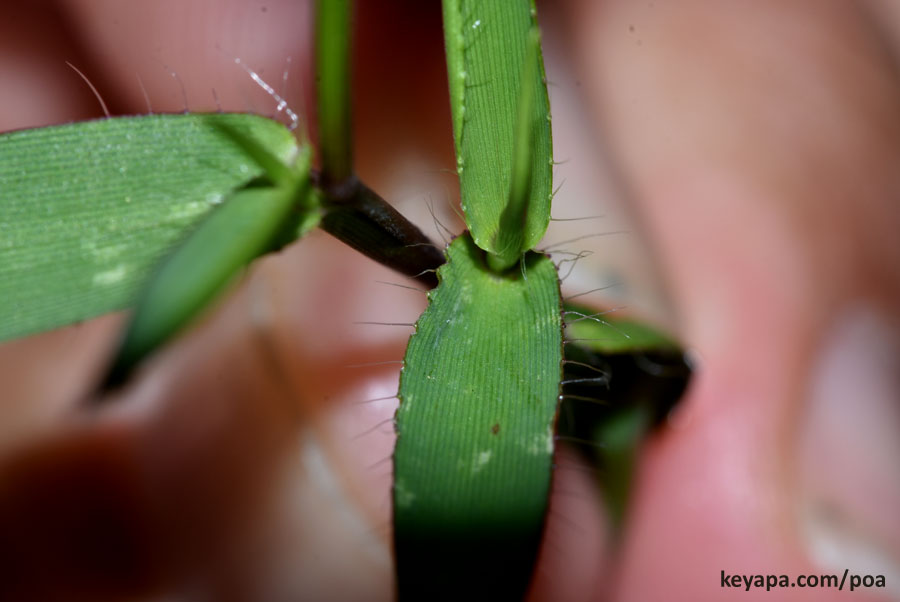
The edges of the leaf blades of Dichanthelium portoricense showing long hars

The second species that I encountered was one that I passed by almost everyday whenever I walked to the gym, but one which I had not yet seen flowering because it was kept cropped and short. There is a golf course in that path, and I have often marveled at the beautiful fine grass that adorned the tee and putting greens. I've even sometimes had the urge to take off my shoes and walk on the fine lawn - although I'm sure this would have annoyed someone just trying to play ;-)

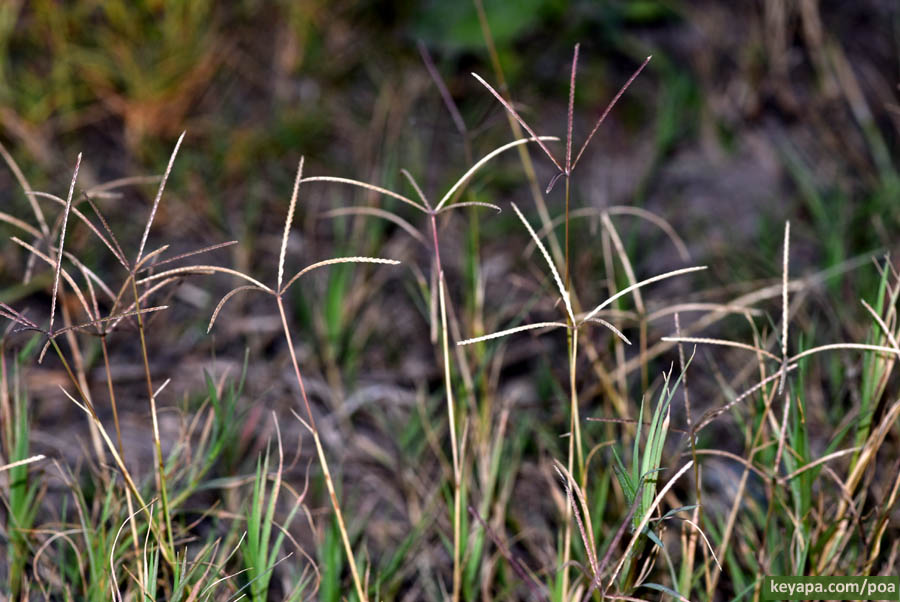
I knew that it was Bermudagrass (Cynodon dactylon), but my attempts at photographing more than just its blades were continuously thwarted. Until, that is, I happened upon some "wild" specimens of this species nearby!

Masses of flowerheads of Cynodon dactylon

The flowerheads were gorgeous, the distinctive digitate inflorescence rising from the ground like tiny umbrellas.

C. dactylon is native outside the Americas, and is a common turf grass. Its strong rhizomes and stolons allow it to form a dense mat and makes it quite competitive against other plants. It has been shown to strongly inhibit the growth of competitors, and even though it has such fine leaves and a short stature, its roots can go extremely deep into the soil. Some studies showing it going more than 2 meters down!

 Flowerhead of Cynodon dactylon

Its inflorescence is quite distinctive, with multiple racemes (usually 4, though I also saw 5, and references note can be from 3-7) radiating out from a common point. The spikelets themselves look like a weird Pacman, or some armored reptilian head!

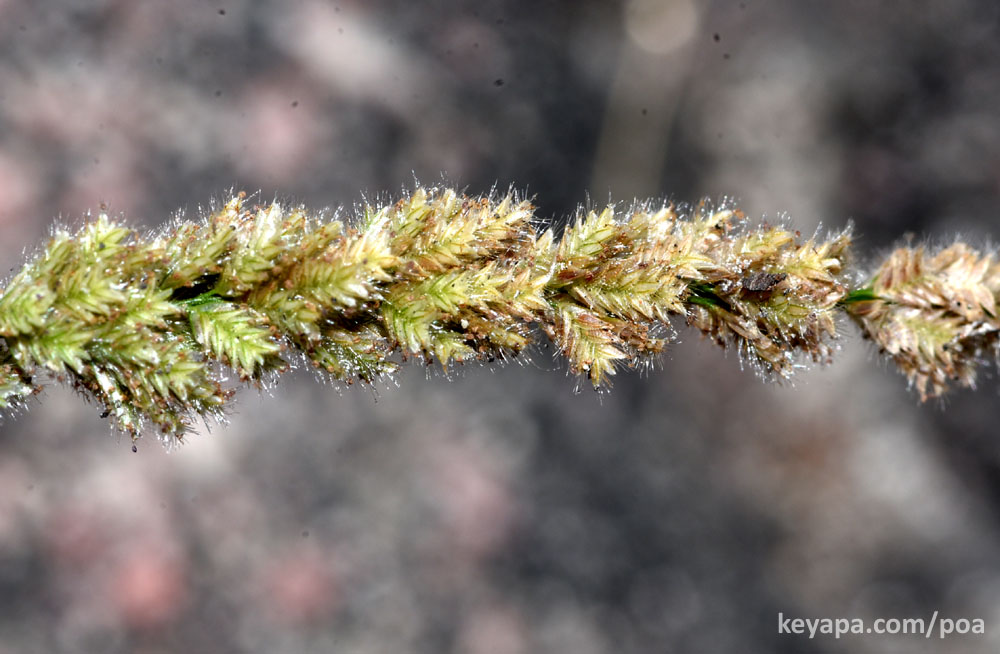
Dried spikelets of Cynodon dactylon under portable microscope

The two small species had such contrasting looks and lifestyles, and yet I was ecstatic at being able to photograph and see these relatively smaller specimens in full flower. 

Now, my next challenge is to find the absolutely gorgeous Sporobolus discosporus in South Africa!

Sporobolus discosporus (c) Richard Gill


Monday, December 12, 2022

A Fantastic Botanical Caribbean Cruise Trip

Dactyloctenium aegyptium in foreground and our cruise ship in background (in Costa Maya)

We went on our first cruise in 3 years since the pandemic. Our ship landed in 4 destinations, and I spent some time botanizing close to shore. 

The locations varied in terms of the ease of botanizing and the diversity of species found.

Melinis repens in Costa Maya

COCOCAY, BAHAMAS

The first island is wholly owned by Royal Caribbean, and it is a tiny piece of land that is immaculately kept as clean as an urban park.

Most of the specimens I found were ornamental grasses that were deliberately planted, including Trypsacum dactyloides and the fountain grass Cenchrus setaceus (?) .

Trypsacum dactyloides, with male flowers (orangey anthers and filament showing) on the left and female flowers (purple stigma showing) on the right

However,  scattered along the undergrowth I found smaller specimens, such as an Axonopus sp and a single specimen that looks like a tiny Eragrostis or  Poa sp. These tiny weedy species still thrived despite the wholly artificial nature of the location.

COZUMEL, MEXICO

I walked along the Avenida Rafael E. Melgar, the coastal road that leads from the International Cruise Terminal to the downtown proper of San Miguel de Cozumel. It was a pleasant 5 km walk along a well maintained sidewalk, and I descended at times onto the beach proper, which was mostly rocky and small.

Along the way I encountered not only the usual weedy species that seemed to proliferate in all urban locations, but lawn turf grasses and the occasional coastal inhabitants like Paspalum vaginatum. This species had rigid looking leaves and robust stolons, which it used to crawl along the rocky and sandy beaches.

Paspalum vaginatum (inset inflorescence)

I also came upon a few specimens that looked remarkably like Andropogon spp on first look.

Andropogon sp (?)

Many of the larger areas had specimens of Megathyrsis maximus, which managed to rake in some sun along the edges of wooded lots next to the sidewalks.

Megathyrsus maximus spikelets (inset inflorescence), with purple stigmas and yellow-orange anthers

Quite a few areas had the turf grass Cynodon dactylus, which also showed up as escaped specimens in cracked sidewalks and parking lots.

Cynodon dactylum, with white anthers and purple stigmas

Amazingly, I also came upon many more specimens of the same tiny putative Eragrostis or  Poa sp that I had encountered once in Cococay. In one case, it had swamped the original inhabitants of a stone container along the sidewalk!

Unknown Eragrostis sp/Poa sp (?)

But by far the most exciting find I made was a species that I at first was disinclined to think was a grass. It had an inflorescence that looked nothing like the usual spikelets, but I later typed it as Paspalum fimbriatum.

Paspalum fimbriatum

The spikelets of this species had glumes and lemma that formed a fringe around the florets. Its  leaves are relatively broad,  with a slight sinuous quality in some. 

Other specimens that I encountered in Cozumel were:

Melinis repens

Dactyloctenium aegyptium

Dichanthium sp

Cenchrus spinifex (?)

Andropogon sp (?)

Sporobolus jacquemontii (which I also encounter a lot in Florida)

Eragrostis sp (?)

Eustachys sp

Eragrostis sp (?) in Cozumel, Mexico

ROATAN, HONDURAS

This stop was the least attractive in terms of surroundings.  Our ship docked in the center of the city Coxen Hole, and it was raining sporadically the entire time.

I walked east along Main St. after disembarking from the ship, although in hindsight I probably should have gone the opposite direction. 

The empty lots were filled with Megathyrsus maximus, while sprouting from the cracks in the sidewalks and other marginal places I found the usual "weedy" species, including Eustachys sp, Digitaria sp, Echinochloa crus-galli, Eleucine indica, and a single Cenchrus sandbur sp.

I returned to the ship after enduring the sporadic rains for perhaps a couple of hours, with the hope that the next landfall would yield better returns. 

Eustachys sp growing on the rocky beach at the pier 

COSTA MAYA, MEXICO

I was not disappointed, because the stop at the Puerto Costa Maya near the town of Mahahual was the most fruitful of all.

The port itself was clean and large, with the usual tourist shops. But it was the surrounding area that made the area a prime spot for botanizing grasses.

The streets were wide and clean, with resorts and large private homes interspersed with empty lots. Closer to the Port, the wide street (Avenida P del Puerto) did not have sidewalks along the sides, but it instead had a very wide island that was filled with trees and plants. Amazingly enough, a dirt path run through the center of the island, so pedestrians using this "sidewalk" seemed to be in some forest path! It was a rather innovative idea, and one that I had never encountered before.

Path between stands of vegetation in the street island of(Avenida P del Puerto)! A great concept for urban and suburban roads

It goes without saying that I felt safe wandering into the smaller side streets, and just a few blocks from the port I came upon an empty lot that was filled with all sorts of species. 

Field of Botanizing Dreams. Eustachys sp and Dichantium sp in foreground, pinkish Melinis repens in background.

It was a literal field of botanizing delights, with waving masses of Eustachys sp mingling with clusters of pink and red Melinis repens. 

Melinis repens

Other inhabitants included the ubiquitous Dactylocnium aegyptium, Dichantium sp, as well as Cenchrus sp and an unknown species that was probably a Paspalum. There was even a large Megathyrsus maximus to one side.

Eustachys sp (left) and Dichantium sp (right)

Beyond the field I continued in the general direction of Mahuhual Beach, and I continued to encounter interesting specimens.

Once in awhile I came upon individual plants that I typed as Andropogon (perhaps A. virginicus because of a sheath that partly covers the spikelets) , which surprised me, as I always associated that clade with North America, and not tropical regions.

Andropogon sp (?), habit and spikelets

I also found an attractive broad leaved grass that I identified as Paspalum mandiocanum. The leaves had minute dark sinuous curves along their edges, and I found specimens along the sides of one of the main thoroughfares (Carretera A Mahahual).

Paspalum mandiocanum

Even the crabgrasses caught my attention. One specimen had a beautiful sinuously striped rachis and ciliated spikelets, and I typed it as Digitaria ciliaris.

Digitaria ciliaris

I also encountered specimens that I could not type, including a tallish and elegantly slim grass that had alternating green and white appearance to its culms (due to the leaf sheaths staying close to the culm). I typed it to perhaps Hyparrhenia rufa.

Unknown species (Hyparrhenia rufa?)

All in all, it was a great day for botanizing, and a great end to my December Caribbean Cruising trip!


Thursday, October 21, 2021

Exploring the Layered Series of Grasses in an Island

Image 1. Ammophila breviligulata in center

Assateague Island straddles both Maryland and Virginia. It is a narrow barrier island that I visited and hiked this month, and it contains several ecological areas that made it quite diverse when it came to species diversity. Click here to look at a map of the island.

While I was there it came to me that the distribution of the grass species could be described as a series of layers. The major species were different as one went inward from the beaches to the marshes, and then to the drier meadows, and it was quite interesting to see how the species changed  as one hiked inward from the beach dunes.

Image 2. Panicum amarum

In the first and outer layer (the beaches), the two main grasses were Ammophila breviligulata and Panicum amarum. Both are dune building species, and A. breviligulata especially is crucial in creating the huge dunes that protect beaches. It is the dominant dune grass along the northeast coast, and I was familiar with it from my trips to the beaches in New Jersey. 

The two species are also easy to tell apart, with A. ammophila having very thin leaves, while P. amarum has much wider and bluish green leaves. You can clearly see this in Image 3 below.

Image 3. Ammophila breviligulata (left) and Panicum amarum (right)

Their inflorescences are very different as well, as you can see in Image 4 below. A. breviligulata has a whitish spike like inflorescence, while P. amarum has the typical Panicum type spikelets,

Image 4. Ammophila breviligulata (left) and Panicum amarum (right)

As I continued hiking inland into the marshes I came upon the second layer, which is actually composed of several sublayers (see Image 5 below). The area of the marsh closest to the sea (the low marsh) is inundated daily and has higher salt concentrations, and this area was dominated by Sporobolus alterniflorus (Spartina alterniflora). The so-called "high marsh" is farther away, is not inundated all the time, and is less salty. Here I found Sporobolus pumilus (Spartina patens) and the graminoid Juncus roemerianus, which is in the rush plant family and is NOT a grass. 

Image 5. Marsh

It was fairly easy to tell the two grass species apart. S. pumilus has wavy looking blades that look quite beautiful and distinctive. In the image below (Image 6) the species looks almost like a nice soft fluffy lawn.

Image 6. Sporobolus pumilus (Spartina patens) in foreground (NJ pic)

Sporobolus alterniflorus is more erect in form, and it forms the vast bulk of the vegetation that people associate with marshes as they drive towards the beach. The geometric shapes of their vast stands was quite pleasing to the eye, and I spent some time taking various artistic pics of the scenery.  

Image 7. Geometric stands of S. alterniflorus (S. alterniflora) in the background

I even found flowerheads on some of the nearby specimens. The inflorescences were spike-like, with white anthers dangling out from the flattened spikelets and looking quite grub-like.

Image 8. Inflorescence of S. alterniflorus (S. alterniflora)

Beyond the marsh layer was a forested area, but also pockets of large meadows. This most inner layer is surrounded by the beaches and marshes, and I was astonished to find some species that I would never associate with islands. 

Next to the trail were rows of what I believe were Schizachyrium scoparium (little bluestem), and behind them the beautiful panicles of Panicum virgatum (switchgrass) waved in the breeze. Farther back were dense stands of the invasive Phragmites australis (common reed), which also was present in the high marsh.

Image 9. Meadow layer with a series of grass species

It was an amazing thing to be surrounded by such grasses, when just a few minutes away was marshy waters. But unfortunately, the drier landscape, combined with the disturbance regime due to human activity, has also introduced invasive species to the area. I found dense pockets of Microstegium vimineum (Japanese Stiltgrass) in some of the trails, the silvery lines on the upper surfaces of their leaves the most distinctive sign of their presence.

Image 10. Microstegium vimineum

Nevertheless, I really enjoyed visiting and hiking the short trails in the island, and I loved the structured layering of these major grass species throughout the area.

If you ever visit one of these barrier islands, do keep an eye out for the plants around you. The narrowness of such areas make it possible to go from one ecological region to another with just a short walk.

Wednesday, February 10, 2021

Curious Critter #2: Sporobolus discosporus

Sporobolus discosporus (c) Richard Gill

This amazing looking grass is from Africa, where it was first recorded in 1841. The author of the image notes that it is a tiny species, around 5 cm across, and is found normally growing in very shallow soil on rock sheets. Mr. Johan Volstruis Combrink also notes that the species is part of the ecological process in the Bankenveld Grassland of the Witbank Nature Reserve in South Africa.

This little jewel looks almost like some aloe, and not a grass, and it would be really fantastic to see this in the wild. However, google searches show almost nothing about this species, especially ecological data, which again emphasizes the fact that there are so many fascinating species out there that we know next to nothing about.

Sporobolus discosporus (c) Richard Gill

Unfortunately, more and more plants are landing in the threatened bucket, and once these species are lost, then there is nothing to bring them back again. Let's hope that this jewel of a grass is not one of those species that is lost forever, even before we manage to read its story.

Click here for the species description from grassbase.

Click here for local distribution data.

Sporobolus discosporus (c) Richard Gill