Showing posts with label Bouteloua. Show all posts

Saturday, October 14, 2023

Following Buffaloes

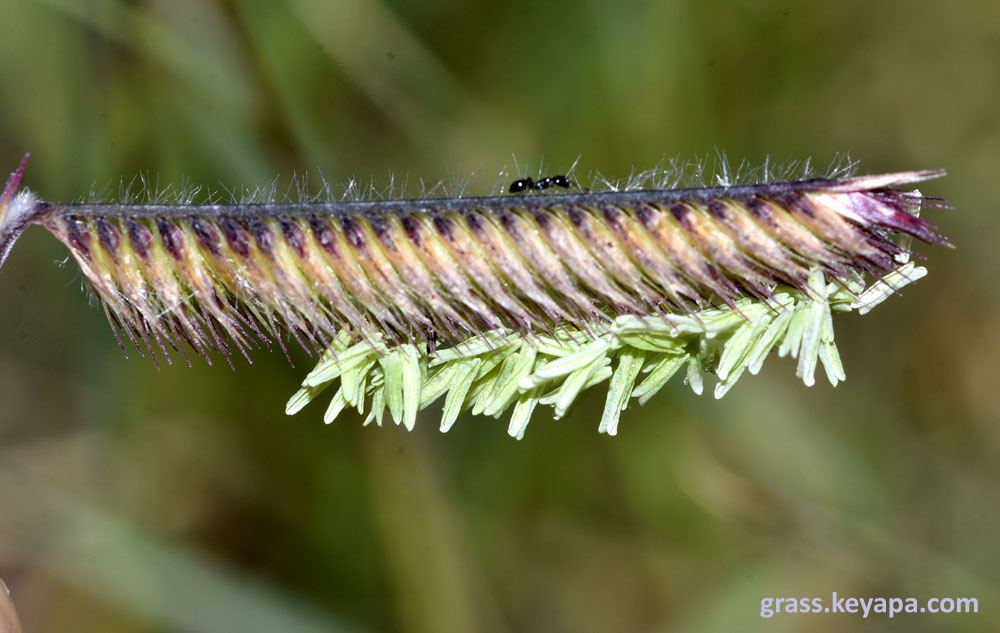
Male flowerhead of Bouteloua dactyloides (Colorado)

In 1977, a movie called Star Wars was just starting out on its path to becoming one of the most successful science fiction franchises in history. Marty McFly had yet to drive his DeLorean back to the future; Arnold Schwarzenegger was a relatively unknown bodybuilder whose metamorphosis into the Terminator was years into the future, and even E.T. had no need to phone home just yet.

Male flowerheads of Bouteloua dactyloides (Colorado)

In this same year, in a university town in New Jersey, plant clippings from a garbage bin that was being emptied by trash collectors accidentally fell onto a lawn of Kentucky Bluegrass (Poa pratensis). The clippings had come from a nearby Rutgers University greenhouse that was housed in the Nelson Biological Sciences building. A grass species from the high plains of Oklahoma and Kansas was being grown there for turf studies, and its introduction into the heavily trampled and disturbed grounds of the Rutgers Busch Campus was in hindsight a fortuitous event (Quinn, 1998).

Front lawn of Library of Science and Medicine at Rutgers Busch Campus. Red arrows point to B. dactyloides clusters

Forty six years later, I knelt on the same grounds in front of the next door Rutgers Library of Science and Medicine (LSM) building and examined tiny male flowerheads of Bouteloua dactyloides (commonly called buffalo grass in the USA). They marked the occurrence of the same plant(s) that had escaped almost five decades earlier, and their expansion and spread using both stolons and seeds moved me. I felt a sense of being connected through time  by this humble native grass to that past accident so long ago.

It was relatively easy to determine the extent of the spread at this time of the year. The species starts to brown earlier during autumn, and it stood out against the still darker green masses of other turf grasses. I could see clearly that it was now present on different lawn areas that were separated by concrete paths, and that some of the irregularly shaped clones were quite large.

Mobile phone pic of male flowerheads of Bouteloua dactyloides in lawn of Library of Science and Medicine, Rutgers University Busch Campus. 

I noted the GPS coordinates and measured the sizes of the clusters that I could ID as B. dactyloides. Many were vaguely round, oval, or rectangular in shape, with diameters of half a meter for the smaller ones, and sizes that approached bedroom size for some of the larger ones.

Room size cluster of Bouteloua dactyloides (light brown area) next to Rutgers Library of Science and Medicine

The survival of the original plant for almost half a century is notable, because B. dactyloides has been touted as a low-maintenance, drought tolerant, and native alternative to the usual European grasses that dominate the northeast lawns in the USA today. I myself considered its use on my own lawn in NJ at one time some years ago. 

Unfortunately, its intolerance to shade and its inability to be competitive in rainy wet areas has always raised questions as to whether it would be a successful replacement to the proven imported turf grasses. In this case, not only had it survived for almost half a century, but it had managed to spread significantly against formidable opposition from forbs and other types of grasses such as P. pratensis. This helps prove that it is possible to use this species as turf grass and for erosion control in disturbed soil in the Northeast.

Female reproductive structure of Bouteloua dactyloides (Colorado)

As an important aside, I know some people follow trees over time, but there are many herbaceous plants that can exist for very long periods, and it is just as rewarding to follow their lives over time. In fact, the longest lived organism in the world is a herbaceous seagrass, which has been calculated to be 80,000 to 200,000 years old  (Arnaud-Haond et al, 2012)! It is amazing to think how the world has seen so much change during that astounding duration. 

In the same way, although spanning an exponentially shorter span, when I first laid my eyes on the spreading clusters of B. dactyloides in front of the LSM library a couple days back, I truly felt an emotional attachment to them. I studied at this same university in the 1990s, and I had likely passed by the same individual many times on the way to my studies. It made me feel the ticking of time with a more visceral emotion than mere objective contemplation, and it humbles me that this clonal individual might still be flourishing and thriving and growing when I'm long gone from the world. 

Literature Cited:

Arnaud-Haond S, Duarte CM, Diaz-Almela E, Marbà N, Sintes T, Serrão EA. Implications of extreme life span in clonal organisms: millenary clones in meadows of the threatened seagrass Posidonia oceanica. PLoS One. 2012;7(2):e30454. doi: 10.1371/journal.pone.0030454. Epub 2012 Feb 1. PMID: 22312426; PMCID: PMC3270012.

Quinn, J. A. (1998). Natural Expansion of Buchloe dactyloides at a Disturbed Site in New Jersey and Its Implications for Turf and Conservation Uses. The Journal of the Torrey Botanical Society, 125(4), 319–323. https://doi.org/10.2307/2997245

Friday, September 29, 2023

How I do botanical backgrounding in photographs

Cynodon dactylon (Bermuda grass) in Parque del Amor, Lima, Peru. The beach is down below a cliff, and you can see the waves as they rush to shore.

Note: I am by no means an expert at photography, so apologies for any mistaken notions I may have, but here are a few things I've learned.

I am a big fan of macrophotography, and I have been doing it for several years now.

But sometimes I want to show more than just the specimen, especially when the picture I am taking includes scenery that is well known or significant.

In this case, my goal is to have a sharp foreground showing the specimen(s), but with a soft blurry background that does not take away the scenery completely. In order to accomplish this, you need to create something called a shallow depth of field. 


Bromus tectorum (cheatgrass) in foregound of Continental Divide scenery in Rattlesnake Gulch Trail, El Dorado State Park, Colorado, USA.

Creating this shallow depth of field is more an art than a science, and it involves fiddling with various settings in your DSLR camera, as well as correctly positioning yourself and your subject.  This includes:

1. Aperture

This refers to the amount of light that reaches the camera sensor, and the metric it uses is called the f-stop. The lower the f-stop, the greater the amount of light that reaches the sensor, and the shallower the depth of field (the blurrier the background). 

For example, an f-stop of 3 means more light gets to the sensor, which creates a shallower depth of field than if the f-stop is 9. So using an f-stop of 3 would get you a blurrier background compared to using an f-stop of 9, all other things being equal.

Dactyloctenium aegyptium in foreground and our cruise ship in background (in Costa Maya, Mexico)

2. Focal length 

This refers to how wide your angle of view is, and it also affects the magnification. It is measured in millimeters (mm), and the rule of thumb is that the longer the focal length, the greater the magnification, the narrower your field of view, and the shallower the depth of field (the blurrier the background).

So, a focal length setting of 100 mm provides greater magnification, a narrower field of view, and a shallower depth of field than a lens with a focal length of 20 mm.

Bouteloua dactyloides (Buffalograss) in foreground of Buffalo Bill sculpture in Oakley, Kansas.

3. Distance between camera and specimen

There are also things you can do beyond just fiddling with your camera settings to create a soft blurry background and a sharply focused subject. The distance you keep between your camera and the actual specimen also makes a big difference.

The smaller the distance between the camera and the specimen, the shallow the depth of field (the blurrier the background). 

Sporobolus michauxianus (formerly Spartina pectinata) near Lower Bluestem Trail, Boulder, CO, USA. 

Putting all these factors together, the golden rule of botanical backgrounding therefore is:

In order to get a shallower depth of field (blurrier and softer background) while maintaining a sharp focus on the specimen, you need a lower f-stop, a higher focal length, and a shorter distance between camera and specimen.

Here's an example of how focal length, aperture, and distance to the specimen can affect the depth of field and how blurry the background gets using the same specimen and background.

In the first pic below, the specimen is Avena barbata, with the Moras Salt Mines in the Sacred Valley of Peru in the background. The f-stop used here is 8, the focal length is 20 mm, and I was standing relatively far away from the specimen when I took the pic. Notice how relatively clear the background is when compared to the actual subject of the photo. This makes the picture too "busy", and detracts from the focus of your photograph, which is the grass in the foreground.

Avena barbata (?) in the Moras Salt mines in the Sacred Valley of Peru

Now compare that picture above with the picture below. This is the same specimen, but this time I am using an f-stop of 2.8, a focal length of 100 mm, and I am closer to the specimen. Notice how relatively clear the specimen is, but how blurry the background has become. Normally, I would not want a photo like this when I'm doing botanical backgrounding of my photo (too shallow a depth of field and thus too blurry in back), but it does illustrates how aperture, focal length, and distance to the specimen heavily influences the depth of field and the contrast between subject and background. 

It also highlights how much of an art it is trying to get a good optimal mix between a too-clear background that steals focus from the subject, and one that is a completely unrecognizable blur.  

Avena barbata (?) in the Moras Salt mines in the Sacred Valley of Peru

Sounds relatively simple right? Now good luck with your pics, and I hope this short article helps you when you are taking botanical photographs and want a good background for it.

My camera is a Nikon D3400, and for macrophotography I use a Tokina AT-X pro lens.

ps.

I should note that taking the types of backgrounding pics where the specimen is very close to the ground means more than just worrying about focal length, aperture, and distance to specimen. Most times I need to lie flat on the ground to take pics, or take "blind" pics (taking pics without looking into viewfinder) after adjusting the settings, hoping for a photo that is in focus. Someone mentioned that there is visual equipment that will allow you to take pics while holding the camera at awkward angles, but I don't have that (yet). In the meantime, this is hard work and not as easy as I make it out to be above. 

Sunday, September 10, 2023

A Short History of Ornamental Grasses

World's Fair Pavilion in Forest Park, in St. Louis

Ornamental non-bamboo grasses have become such a ubiquitous feature of suburban and urban landscapes nowadays, that it might surprise some people that their widespread use is a relatively new phenomenon here in the USA.

This was brought home to me after I visited the World's Fair Pavilion in Forest Park, St. Louis last week.

The park itself is amazingly large, but what interested me most was a building that was surrounded by large stands of beautiful ornamental grasses. This World's Fair Pavilion was built in 1909 from proceeds of the World's Fair that was held in 1904. It's built on top of a hill and is surrounded by a large expanse of lawn and other plants.

Gigantic Panicum virgatum in Forest Park, St. Louis

The largest Panicum virgatum specimens I have ever seen in masses graced both sides of the area in front of the pavilion. There were also stands of Miscanthus sinensis, as well as the usual stately Calamagrostis. These ornamental grasses dominate the landscape today, but pictures of the same pavilion from the 1930s showed no signs of the stately and graceful grasses. Instead, shrubs and bushes and trees were the norm (see image below).

The pavilion in the 1930s. From the Missouri Historical Society. Note the lack of ornamental grasses.

The drastic change in the landscaping is significant. Although the use of bamboo for landscape decoration was popular even during ancient times, ornamental non-bamboo grasses did not enjoy the same popularity. However, during the 1930s, the renowned  German nurseryman, Karl Foerster pushed for their use in Germany and Europe. He collected grass seeds and plants from all over the world, and after cultivating them in his nurseries he introduced them to the market.

Calamagrostis to the left, Panicum virgatum to the right. In Forest Park, St. Louis

Among the many plants he introduced, perhaps his most famous creation is the outstanding ornamental grass Calamagrostis × acutiflora 'Karl Foerster', which he released to the market in 1950 as a natural hybrid of C. epigejos (native to Europe, Asia and Africa) and C. arundinacea (native to Eurasia, China and India).

Calamagrostis in background, Cenchrus setaceus in foreground, in Colorado

This rise in the use of ornamental grasses in Europe was not mirrored in the USA until much later, but various growers were instrumental in pushing for this new paradigm.

In the early 1960s, Kurt Bluemel began the introduction of ornamental grasses into America through his nursery in Maryland, called Kurt Bluemel Inc. Educated in Germany and Switzerland, Bluemel was passionate about grasses, and by the time he passed away decades later, he was well known as Der Gras König, the Grass King. 

Kurt Bluemel. From Baltimore Sun.

He is said to have carried his first grass specimens in his luggage when he came to America, and his collaboration with Wolfgang Oehme, a German-born landscape architect based in Towson, was highly influential in creating a growing appreciation for ornamental grasses in the country. Some of his notable works include creating the savannas at Disney World's Animal Kingdom, and Busch Gardens. 

Panicum virgatum

By the 1980s, the momentum behind ornamental grasses had finally reached a crux, and an influx of growers finally pushed it into the mainstream. In 1986, John and Jill Hoffman established the Hoffman Nursery in North Carolina, which specialized in ornamental grasses. 

John Hoffman. From Hoffman Nursery.

John's interest in ornamental grasses was stoked during a visit to Germany, where he met the plant breeder Ernst Pagels. Pagels was an enthusiastic supporter of grass-filled gardens, and this along with the support of his mentor,  J.C. Raulston at North Carolina State University, fueled his passion. Today, Hoffman Nursery is one of the largest suppliers of ornamental and native grasses in the country.

Miscanthus sinensis

The trend towards landscaping with grasses then moved from the East Coast to the West Coast through the efforts of people like horticulturalist John Greenlee. In order to complete an oak savanna project in California in the 1980s, he travelled to Kurt Bluemel's Nursery in Maryland, where he was astounded by the hundreds of varieties of ornamental grasses that were on display. He ended up trucking a load of the grasses in a tractor trailer from Maryland to California, and after a stint in Brazil with the renowned landscape architect Roberto Burle Marx (who is also held in high esteem in the aroid community), he finally opened the first ornamental grass nursery in the West Coast.

John Greenlee. From Greenlee Meadow Collection.

Fast forward to today, when people routinely use ornamental grasses both in residential and commercial landscaping. And although many of the varieties used are the showy exotics (such as Miscanthus sinensis and Cenchrus setaceus), the use of native grasses as ornamentals (such as Trypsacum dactyloides in Florida, and Bouteloua gracilis in Colorado) is also widespread.

Bouteloua gracilis in Colorado

Meanwhile, new varieties and species continue to be introduced into the market. Not only do they contribute linear structure to a design, but their ease of maintenance, resistance to herbivores like deer, and their ability to impart movement to an otherwise static landscape, make ornamental grasses perfect components for any project.

Looking out from the pavilion in Forest Park, St. Louis. White flowerheads are Miscanthus sinensis cultivars

Friday, July 21, 2023

A Beautiful Bouteloua Bonanza

Bouteloua curtipendula (side oats grama)

Species from the genus Bouteloua (from the subfamily Chloridoideae) are one of the dominant plants of the shortgrass prairie.

These relatively small grasses include Bouteloua gracilis (blue grama grass), Bouteloua dactyloides (buffalo grass), and Bouteloua curtipendula (side oats grama)

The shortgrass prairie is an ecoregion that is semi-arid, with cool winters and warm summers. It occupies a slice of land in North America to the west of the more famous tall grass prairies, with a region of mixed grasses between them. As indicated by the name, the ecoregion is dominated by short-statured grasses such as Bouteloua spp.

Modified from wikipedia By User: TheshibbolethHowpper 

A lot of the attention on prairies in general are focused on the tallgrass species, such as Andropogon gerardii, Schizachyrium scoparium, Panicum virgatum, and the like, but as I travelled through the states with mixed and short grass prairies, I fell into serious liking (even loving!) for the short-statured grasses that are found in these expansive areas.

Both B. gracilis and B. dactyloides are really small grasses, but their reproductive structures are quite distinctive and in my eyes quite beautiful. The inflorescence of B. gracilis (blue grama grass) is small, but easily seen with the naked eye even from the height of a person, since they usually occur in masses. 

B. gracilis

The species is especially attractive when the bright green anthers start poking out from the spikelets, and I have seen this species used quite liberally as ornamentals here in Colorado, and elsewhere, such as western Kansas. I remember my first experience with this species was in New Mexico several years back. At the time, I had never seen such an odd looking inflorescence.

B.gracilis with green anthers and ant on top!

B. dactyloides (buffalo grass) is even more unusual when it comes to reproduction. It is one of the few grasses that are mostly dioecious, with some individuals having only female flowers, and some individuals having only male flowers. In addition, most grasses have perfect flowers, which contain both male and female reproductive parts in the same flower, but B. dactyloides flowers are mostly unisexual, either having male OR female parts. 

B.dactyloides 

The staminate (male) flowerheads are distinctive, with bright orangey anthers. Unlike B.gracilis, it is a bit harder to spot B. dactyloides by its flowerhead from a distance, but I've found that experience seeing the grass many times does help.

B.dactyloides male staminate flowerhead

The female pistillate structures of B. dactyloides are even more unusual. They are hidden beneath the leaves, the 3 to 5 spikelets protected by spikes. Each spikelet has only one floret, and once fertilized the entire spike structure falls to the ground.

B.dactyloides female pistillate flowerhead

The species has been used as turf grass, and I remember wanting to see whether I could use it in my lawn in New Jersey. The main problem with its use as a lawn is that it does tend to brown and go into hibernation as the cold approaches, which would be slightly problematic in a suburban environment used to green lawns all year round.

B. dactyloides staminate spikelet

Finally, perhaps the most beautiful species in the genus that I've seen so far is Bouteloua curtipendula (side oats grama).

This is a somewhat larger species than the two others, and its inflorescence is a long spike. The spikelets have iridescent violet and green hues interspersed with cream, and look like streamlined and aerodynamic hood ornaments on a race car.

Bouteloua curtipendulaa (pre-anthesis)

The appearance of orange anthers later simply adds to the alluring look of this species. I usually see specimens of this species as lone individuals, unlike B. gracilis and B. dactyloides, which are more rhizomatous and spread out.as clusters or colonies. 

Bouteloua curtipendulaa with orange anthers and white stigma

There are other species in the genus here in Colorado, such as Bouteloua hirsuta, which has a rachis that extends well past the spikelets, and I am hoping that I get to see and photograph these as well in the short time that I am here. But in the meantime, I spend time marveling at the various little beauties that I find as I hike the the hidden and not so hidden pathways in the area.

Bouteloua gracilis with green anthers

Tuesday, July 11, 2023

The Case for Urban Open Spaces

Bouteloua dactyloides staminate spikelet (from another location)

One of the first things I noticed here in Colorado is the prevalence of land called "Open Spaces". These Open Spaces are preserved land that is not developed, although they may be adjacent to the usual parks and other recreational locations.

According to the department that manages these areas in the city of Boulder:

The open space lands teem with native plants and wildlife and are home to threatened and endangered species. They serve as a buffer between Boulder and nearby development. They sustain agriculture uses and add untold benefits to the natural environment - clean air, water, and earth. The lands shape the urban mosaic of the Boulder Valley and provide residents with passive recreation opportunities. Trails are used by walkers, hikers, bicyclists, horseback riders, dog walkers and other passive recreational uses.

I visited one of these Open Spaces in nearby Broomfield, which has kept their city beautiful by preserving large tracts of land. In the Open Space that I visited there, walking paths crisscrossed the place, and people were jogging, walking their dogs, and generally just enjoying nature. I did some botanizing one morning, and found many native grasses, although they were outnumbered by the usual naturalized exotics that have become ubiquitous wherever humanity has taken hold.

Part of an Open Space in Broomfield, CO
I spent  an enjoyable morning just walking the paths and looking at the critters, and managed to identify some of the major species during my botanizing. As always, I am always open to corrections of my identifications.

One of the most notable denizens of the area was Bromus inermis, which existed in large clusters and is commonly called Smooth Brome. You can identify it not only by the recognizable spikelets and habit, but by a W crimp in the middle of the leaves. This species is an introduced forage grass, but it has become somewhat invasive in many places.

Bromus inermis
The native Pascopyrum smithii (called Western Wheatgrass here) was also quite abundant. It is rhizomatous, and so exists in the area in large groupings.

Pascopyrum smithii
Close to it I also saw Thinopyrum obtusiflorum, which looks somewhat similar, but is significantly taller than its neighbor. This species is not native, but had been introduced from Eurasia. It has a few common names, such as tall wheatgrass, rush wheatgrass, and Eurasian quackgrass.

Thinopyrum obtusiflorum
Another naturalized Eurasian species was also quite abundant. Agropyron cristatum is called crested wheat grass, and the sight of its flowerheads en masse was quite attractive.

Agropyron cristatum
There were also stands of what I first took to be escaped cultivated plants. but which may instead be a native called Hordeum brachyantherum (meadow barley). These were one of the taller species in the community, dwarfing everything but some of the Thinopyrum obtusiflorum specimens.

Hordeum brachyantherum
The smaller species I found along the sides of the path, and included native grasses from the genus Bouteloua (which has become one of my fav genera, and which I'll explore more in a later article).

Bouteloua gracilis (called Blue Grama grass here) was in evidence along the margins, their distinctive flowerheads dangling bright green anthers. This species is one of the dominant inhabitants of the short grass prairies in Eastern Colorado.

Bouteloua gracilis
I also found some specimens of the equally diminutive Bouteloua dactyloides (called buffalo grass here), another dominant species of the short grass prairies that has been used as turf. More on this later, but it is one of the few dioecious grasses, with some individuals having only staminate flowers,  and others only pistillate flowers.

Bouteloua dactyloides (staminate spikelet)
Other species that I found included the natives Panicum capillare, Bouteloua curtipendula, and Hordeum jubatum, as well as a few clusters of the invasive Bromus tectorum. In a creek, I even found a lone cattail (Typha sp, not Poaceae) surrounded by the invasive Phalaris arundinacea (Reed Canary Grass).

Phalaris arundinacea surrounds a lone cattail (Typha sp)
The variety of species was fantastic, and I loved the time I spent botanizing. All in all, I have to say that I am fully and heavily in support of creating such Open Spaces. I would rather see natural areas like these preserved, than more gated communities, mini-malls, McMansions and parking lots. 

As noted above, some of the advantages include:

  • They serve as home to threatened and endangered species.
  • They serve as a buffer between a city and nearby development.
  • They sustain agriculture uses and add untold benefits to the natural environment - clean air, water, and earth.
  • The lands shape the urban mosaic and provide residents with passive recreation opportunities. Trails are used by walkers, hikers, bicyclists, horseback riders, dog walkers and other passive recreational uses.

In addition, I believe Open Spaces give an airy and open vibe to a city, provide habitats for a large variety of plants and animals, and serve as a shining example of how nature and people can coexist together.

Kudos to the city of Broomfield, Boulder, and all the other enlightened communities in Colorado that have the foresight and the perseverance to protect the natural beauty of the land!

Friday, April 28, 2023

The Rock Growers of the Sacred Valley in Peru

Using a wide angle lens to photograph Machu Picchu scene

The Sacred Valley (Valle Sagrado) area in Peru boasts some of the most beautiful landscapes in the world. It is dotted with the ancient ruins of Incan structures, their smooth stone walls fitted seamlessly together. Hidden within their intricate puzzle-like geometries lie secret images of animals, including those that this amazing people held sacred,  such as snakes, condors,  and pumas.

I visited this place last week, including the ruins of the world famous Machu Picchu, as well as the ruins of Pisac, Ollantaytambo, and Saqsaywaman. Remarkably, and especially in the wetter environment of Machu Picchu, the depressions and crevices in the stone walls and boulders held various plants, including some tiny grass species that were wonders to behold.

The genus Boutelou of the subfamily Chloridoideae is one that I have so far seldom encountered in the USA, but I found gorgeous specimens of this grass both in the ruins of Ollantatytambo and in Saqsaywaman.

Boutelou flowerhead in Saqsaywaman
Boutelou inflorescence have a characteristic form, with the spikelets in rows on only one side of the flowerhead. Some flowerheads also twist and curve as they mature, creating attractive botanical structures.

Boutelou growing on mossy soil on rock in Saqsaywaman
In Saqsaywaman, I found a thriving colony of this grass in a single large boulder. The rock had small depressions filled with moss and soil, and in each of these depressions lived one or more individuals, many of whom drooped as they were bursting with bunches of colorful flowerheads.

Boutelou inflorescence in Ollantaytambo
In Machu Picchu, I also found a beautiful tiny species that nestled in the moist crevices of stone walls. I only found these in a localized area in that park, but it was amazing to discover every single one of the individuals as the tour wound its way past that area. The dark green leaves seemed to shyly peek from their rocky cradles, and the spikelets were so tiny (perhaps 1 mm long, not including the long awns) that I had to use full magnification on my macro lens.

Tiny spikelets of unknown sp growing on rock walls in Machu Picchu
The tiny spikelets themselves with their single awns remind me of Muhlenbergia spp. But the overall habit of the plants could not have been more different. Instead of the characteristic thin bladed bunch grass that I have seen as ornamentals and beach residents, these miniscule jewels sported relatively thicker grass blades.

Tiny spikelets of wall growing unknown sp. in Macchu Picchu
The difficulty in taking good photos of the tiny specimens were further exacerbated by on and off rain. It was drizzling occasionally when we were there, and many of the flowerheads of the specimens were decorated in droplets of water. The rain also prevented me from using my camera during parts of the tour. 

Tiny grass sp growing out of crevice in moist rock wall in Machu Picchu
As mentioned in previous posts, the members of the Poaceae are relatively scarce as true epiphytes, probably due to the prevalence of wind pollination in the family. But given even small portions of soil, moss, or other available substrate, it seems that grasses are also fully capable of exploiting these niche habitats.

Using a wide angle lens to view of the ruins of Ollantytambo