Showing posts with label Megathyrsus. Show all posts

Tuesday, August 15, 2023

How Invasive Grasses Killed Hundreds of People in Hawaii During America's Deadliest Fire in a Century

Wildfire near Yosemite National Park, United States, in 2013. (Wikipedia, public domain)

Invasive grasses have long been known to create grass-fire cycles that allow these species to expand rapidly across the environment. In such a process, the grasses provide abundant tinder material for fires, whether started naturally via lightning or through artificial means. Generally, they are optimized for utilizing and promoting fires due to several factors:

(a) their creation of high fuel loads, which refers to how much fuel is present and available to burn. Grasses in general, and invasive grasses in particular can form very high density clusters.

(b) their low live to dead biomass. Annual invasive grasses in particular create vast fields of very dry dead matter after they flower and seed.  

(c) their high surface to volume ratios. Grasses generally have thin blades, which means they have a lot more surface area compared to their interior volume. Higher values are correlated to shorter fuel ignition times, and hence faster fire spread rates.

Add in the fact that grasses typically recover rapidly following fires, and the result is that fires kill off most of their potential competitors, and allow the grasses to expand their range and continue the cycle ad infinitum.

A prime example of such a cycle is one undergone by Taeniatherum caput-medusae (medusahead grass), which along with Bromus tectorum (cheatgrass) and others have devastated vast areas of sage habitats in the Great Basin.

Hawaii is no stranger to invasive grasses, most of which were deliberately introduced as potential forage or as ornamentals, but have since escaped into the wild and have outcompeted the natives in the islands. These include Megathyrsus maximus (called Guinea Grass in that area), Melinis minutiflora (called Molasses grass in some places), and Cenchrus setaceus (called fountain grass in some places).

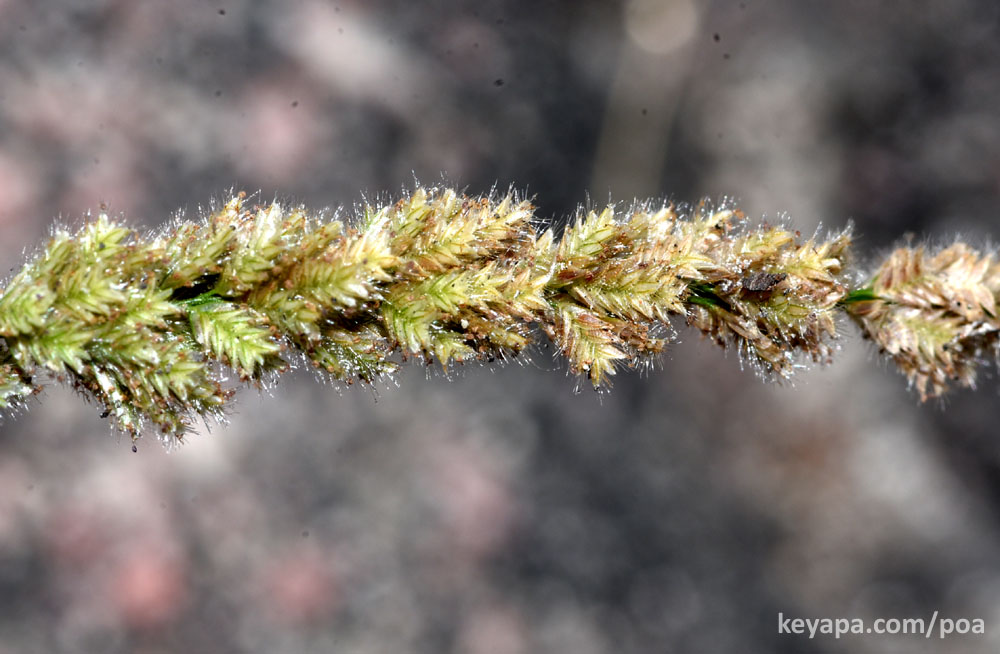
Megathyrsus maximus spikelets (inset inflorescence), with purple stigmas and yellow-orange anthers

Last week, a massive fire destroyed the town of Lahaina in Maui and became the deadliest fire in the USA in a century. As of this writing, 99 people have been confirmed dead, but officials warn that the final tally could be double or triple that.

The initial cause of the fire is not known, but changes in the climate in Hawaii (including long-term declines in average annual rainfall and drought), coupled with the spread of invasive grasses to produce vast grasslands, are thought to be major factors in creating and maintaining the large wildfires after its initial start.

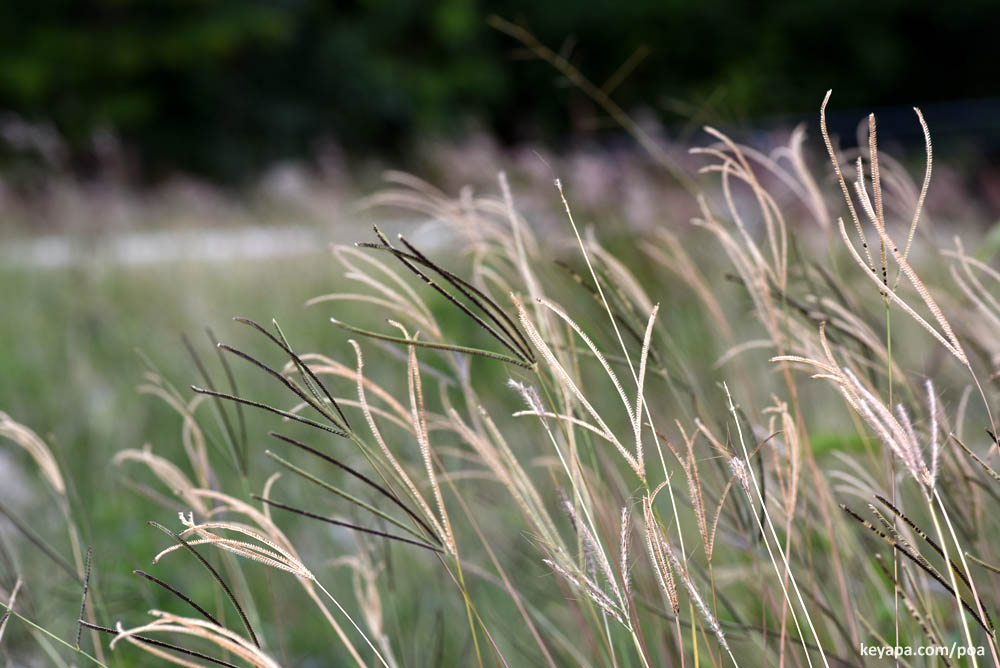
Escaped Cenchrus setaceus rows in Mulholland Dr, in Los Angeles, California

It's been a few years since I travelled to Hawaii, but I watched the popular TV series Lost a couple years back. This show was mostly shot in Hawaii, and it was interesting to see how many times I saw what seemed to be large expansive stands of Megathyrsus maximus, which is a large species and thus easier to see identify. The clusters were not only in savanna habitats, but also seemed to exist as smaller groups within forested areas.

I also remember visiting California this year, and seeing masses of escaped Cenchrus setaceaus along the roadsides in San Diego and even in Mulholland Drive in Los Angeles, where they doubtless increase the likelihood of spreading and exacerbating any incoming fire.

In the end, this major tragedy again highlights the importance of not only implementing measures to curb and address global climate change, but it should also focus people's attention on the importance of stopping the spread of invasive grasses. 

Perhaps most people may (sadly) not care about the destruction of sage brush habitats by such invasive grasses, but they surely will care about people's homes and lives being lost to the same types of invaders. A good start would be to enact legislation that will address this problem now, including banning or regulating the sale of invasive ornamentals and forage.


Monday, December 12, 2022

A Fantastic Botanical Caribbean Cruise Trip

Dactyloctenium aegyptium in foreground and our cruise ship in background (in Costa Maya)

We went on our first cruise in 3 years since the pandemic. Our ship landed in 4 destinations, and I spent some time botanizing close to shore. 

The locations varied in terms of the ease of botanizing and the diversity of species found.

Melinis repens in Costa Maya

COCOCAY, BAHAMAS

The first island is wholly owned by Royal Caribbean, and it is a tiny piece of land that is immaculately kept as clean as an urban park.

Most of the specimens I found were ornamental grasses that were deliberately planted, including Trypsacum dactyloides and the fountain grass Cenchrus setaceus (?) .

Trypsacum dactyloides, with male flowers (orangey anthers and filament showing) on the left and female flowers (purple stigma showing) on the right

However,  scattered along the undergrowth I found smaller specimens, such as an Axonopus sp and a single specimen that looks like a tiny Eragrostis or  Poa sp. These tiny weedy species still thrived despite the wholly artificial nature of the location.

COZUMEL, MEXICO

I walked along the Avenida Rafael E. Melgar, the coastal road that leads from the International Cruise Terminal to the downtown proper of San Miguel de Cozumel. It was a pleasant 5 km walk along a well maintained sidewalk, and I descended at times onto the beach proper, which was mostly rocky and small.

Along the way I encountered not only the usual weedy species that seemed to proliferate in all urban locations, but lawn turf grasses and the occasional coastal inhabitants like Paspalum vaginatum. This species had rigid looking leaves and robust stolons, which it used to crawl along the rocky and sandy beaches.

Paspalum vaginatum (inset inflorescence)

I also came upon a few specimens that looked remarkably like Andropogon spp on first look.

Andropogon sp (?)

Many of the larger areas had specimens of Megathyrsis maximus, which managed to rake in some sun along the edges of wooded lots next to the sidewalks.

Megathyrsus maximus spikelets (inset inflorescence), with purple stigmas and yellow-orange anthers

Quite a few areas had the turf grass Cynodon dactylus, which also showed up as escaped specimens in cracked sidewalks and parking lots.

Cynodon dactylum, with white anthers and purple stigmas

Amazingly, I also came upon many more specimens of the same tiny putative Eragrostis or  Poa sp that I had encountered once in Cococay. In one case, it had swamped the original inhabitants of a stone container along the sidewalk!

Unknown Eragrostis sp/Poa sp (?)

But by far the most exciting find I made was a species that I at first was disinclined to think was a grass. It had an inflorescence that looked nothing like the usual spikelets, but I later typed it as Paspalum fimbriatum.

Paspalum fimbriatum

The spikelets of this species had glumes and lemma that formed a fringe around the florets. Its  leaves are relatively broad,  with a slight sinuous quality in some. 

Other specimens that I encountered in Cozumel were:

Melinis repens

Dactyloctenium aegyptium

Dichanthium sp

Cenchrus spinifex (?)

Andropogon sp (?)

Sporobolus jacquemontii (which I also encounter a lot in Florida)

Eragrostis sp (?)

Eustachys sp

Eragrostis sp (?) in Cozumel, Mexico

ROATAN, HONDURAS

This stop was the least attractive in terms of surroundings.  Our ship docked in the center of the city Coxen Hole, and it was raining sporadically the entire time.

I walked east along Main St. after disembarking from the ship, although in hindsight I probably should have gone the opposite direction. 

The empty lots were filled with Megathyrsus maximus, while sprouting from the cracks in the sidewalks and other marginal places I found the usual "weedy" species, including Eustachys sp, Digitaria sp, Echinochloa crus-galli, Eleucine indica, and a single Cenchrus sandbur sp.

I returned to the ship after enduring the sporadic rains for perhaps a couple of hours, with the hope that the next landfall would yield better returns. 

Eustachys sp growing on the rocky beach at the pier 

COSTA MAYA, MEXICO

I was not disappointed, because the stop at the Puerto Costa Maya near the town of Mahahual was the most fruitful of all.

The port itself was clean and large, with the usual tourist shops. But it was the surrounding area that made the area a prime spot for botanizing grasses.

The streets were wide and clean, with resorts and large private homes interspersed with empty lots. Closer to the Port, the wide street (Avenida P del Puerto) did not have sidewalks along the sides, but it instead had a very wide island that was filled with trees and plants. Amazingly enough, a dirt path run through the center of the island, so pedestrians using this "sidewalk" seemed to be in some forest path! It was a rather innovative idea, and one that I had never encountered before.

Path between stands of vegetation in the street island of(Avenida P del Puerto)! A great concept for urban and suburban roads

It goes without saying that I felt safe wandering into the smaller side streets, and just a few blocks from the port I came upon an empty lot that was filled with all sorts of species. 

Field of Botanizing Dreams. Eustachys sp and Dichantium sp in foreground, pinkish Melinis repens in background.

It was a literal field of botanizing delights, with waving masses of Eustachys sp mingling with clusters of pink and red Melinis repens. 

Melinis repens

Other inhabitants included the ubiquitous Dactylocnium aegyptium, Dichantium sp, as well as Cenchrus sp and an unknown species that was probably a Paspalum. There was even a large Megathyrsus maximus to one side.

Eustachys sp (left) and Dichantium sp (right)

Beyond the field I continued in the general direction of Mahuhual Beach, and I continued to encounter interesting specimens.

Once in awhile I came upon individual plants that I typed as Andropogon (perhaps A. virginicus because of a sheath that partly covers the spikelets) , which surprised me, as I always associated that clade with North America, and not tropical regions.

Andropogon sp (?), habit and spikelets

I also found an attractive broad leaved grass that I identified as Paspalum mandiocanum. The leaves had minute dark sinuous curves along their edges, and I found specimens along the sides of one of the main thoroughfares (Carretera A Mahahual).

Paspalum mandiocanum

Even the crabgrasses caught my attention. One specimen had a beautiful sinuously striped rachis and ciliated spikelets, and I typed it as Digitaria ciliaris.

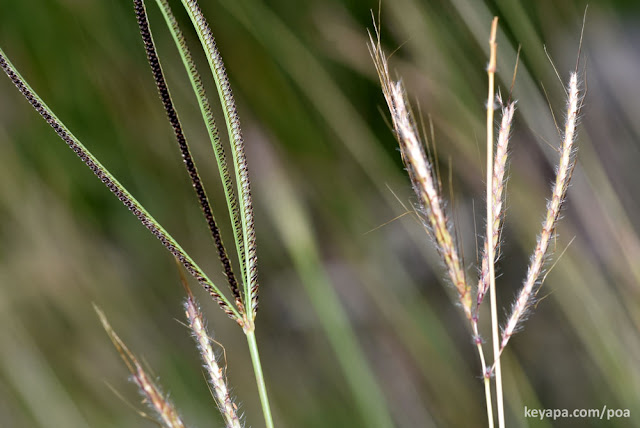
Digitaria ciliaris

I also encountered specimens that I could not type, including a tallish and elegantly slim grass that had alternating green and white appearance to its culms (due to the leaf sheaths staying close to the culm). I typed it to perhaps Hyparrhenia rufa.

Unknown species (Hyparrhenia rufa?)

All in all, it was a great day for botanizing, and a great end to my December Caribbean Cruising trip!