Showing posts with label Art and Culture. Show all posts

Thursday, November 30, 2023

Cruising the Ocean and a Sea of Grass.

Looking out at the ocean from the balcony of a Celebrity cruise ship

We took a cruise this month, and we had a balcony that allowed us to watch the ocean from our stateroom. I spent many hours just sitting and reading and watching the sea go by, and marveling at the immensity of the view outside.

Looking out at the ocean always makes me feel small, almost insignificant. Its vastness, its seeming permanence, puts many things into perspective.  Paradoxically, it also imbues me with a deep serenity that makes cruising a favorite way to relax in between bouts of work.

In almost the same way, looking out across vast grasslands gives me the same feelings. There is this spot nearby with a large field of grass where I sometimes park my car and just spend an hour or two reading. The panorama might be a colorful green or a rust red instead of the dark blue of the seas, but the solitude and the tranquility of the landscape never fails to make me happy. 

I sit and read by a sea of grass

This equivalence between an ocean and vast grasslands is replete in literature and history.

When European settlers first arrived, they encountered what many described with wonder and awe as a  "sea of grass" that spread for 60 million ha, and stretched from the Rocky Mountains to what is now Indiana, and from Texas north into Canada. These were of course the prairies of that time, most of which have been diced and sliced and now occupy but a fraction of their previous immense area.

But the feelings of almost religious wonder at the vastness of grasslands might actually be inherent in our makeup. In Egyptian mythology, the afterlife is depicted as an endless Field of Reeds (A'Aru),  where the souls of people who have passed away can exist in a bountiful paradise. 

Field of Reeds (Moon Knight, Marvel)

In a similar way, the acclaimed film Gladiator depicts the afterlife as a vast field of wheat, with the protagonist running his hands through the wheat in one of the most iconic scenes in the movie.

The endless fields of wheat in the film Gladiator

In Dan Simmons' Hyperion, the planet Endymion contains a region called the Sea of Grass, which the protagonists must cross using so-called wind-wagons that surf above the meters tall "grass".

Dan Simmons' Hyperion and The Sea of Grass

"My God," breathed Brawne Lamia.

It was as if they had climbed the last hill of creation. Below them, a scattering of docks, wharves and sheds marked the end of Edge and the beginning of the Sea. Grass stretched away forever, rippling sensually in the slight breeze and seeming to lap like a green surf at the base of the bluffs. The grass seemed infinite and seamless, stretching to all horizons and apparently rising to precisely the same height as far as the eye could see. There was not the slightest hint of the snowy peaks of the Bridle Range, which they knew lay some 800 kilometers to the northeast. The illusion that they were gazing at a great green sea was nearly perfect, down to the wind-ruffled shimmers of stalks looking like whitecaps far from shore.

"It's beautiful," said Lamia, who had never seen it before.

Barring aside the improbability of windwagons being borne on the tops of masses of plants (no matter how strong the culms), the idea of travelling above vast seas of grass to distant lands is irresistibly attractive, and even romantic. Perhaps such adventures will be possible in far-off places with less gravity than ours, but for now, I'm content to just spend time by my decidedly more earthly landscape.

*sighs and goes back to reading Hyperion, while gazing at the dark brooding masses of clouds now gathering above his Sea of Grass*

Where's that windwagon?


Sunday, October 22, 2023

Creepy Corn Day (aka Halloween)

Corn stalks for sale at Lowes in New Jersey 

It's that time of the year again when spooky shenanigans slither into the normal daily lives of people. It's when kids in costumes defy the odds and gather candies from strangers, and the Simpsons treat us to another round of entertaining stories about really weird stuff. 

Yes, it's Creepy Corn Day (aka Spooky Corn Day, aka Halloween), which should be that celebration's official name, given that so much of the traditions associated with this day are related to the species Zea mays (corn/maize).

This was the thought that came to me while I was walking outside a Lowes in New Jersey last week and I saw another bunch of dried corn plants for sale. It made me wonder about all the other things during Halloween that involved this grass.

Corn Shucks

The dried bunches of corn that I saw are called corn shucks, and they were traditionally used by farmers during the end of the harvest to dry out the corn and to clear land for other plantings. The dried stalks were later used for bedding and feed for animals, and the corn itself was milled. During modern times, mechanical harvesters have obviated the need for this, but their common use in the past made people associate them with Fall and Halloween. Plus, they truly do look kinda spooky.

We're gonna get ya!

Candy Corn

I was not so familiar with this particular Halloween tradition, but it seems is very popular with kids. It's a type of candy that boasts a whopping 28 grams of sugar per handful, and is made out of various ingredients, including (you guessed it!) corn syrup. It is the most popular candy treat during Halloween in many states, and in 2019, it was estimated that more than 95% of holidays shoppers bought some of this confectionary. More than 9 billion of the candy is produced each year!

The candy seemed to have been first created by the Wunderlee Candy Company in Philadelphia in 1880s, but its popularity and association with Halloween did not occur until the 1950s, when the tradition of handing out candies to visiting children became popular.

Candy Corn

Corn Mazes

The idea and implementation of plant mazes has been with us since ancient times, but the use of corn fields to create mazes during the Autumn was not started until the early 1990s.

In 1993, a man named Don Frantz was flying over a corn field when the idea came to him. It didn't hurt that he had been involved in other creative endeavors, including  shows in Broadway and the Super Bowl halftime show. Frantz and another man named Adrian Fisher created the first corn maze in Lebanon Valley College in Annville, Pennsylvania. They named it "The Amazing Maize Maze", and  the maze was modeled in the shape of a dinosaur named "Cornelius the Cobasaurus".

The popularity of corn mazes spread, and today they are another staple of  Halloween...ahem...I mean, Creepy Corn Day.

Sunday, September 24, 2023

Guardians of the Weed Field

A Lovecraftian Field of Cogongrass

This was written in March of 1986 for a paper, but the events in it happened almost a decade earlier, in the late 1970s. The weed field in the story was dominated by the usual dominant species in the Philippines, probably Imperata cylindrica (cogongrass) and Saccharum spontaneum (wild sugarcane).

I remember the day they burned the field down.

I was a fifth-grader then, perhaps only 10 years of age, and on my way to my school's elementary school library. Lunchtime had just began, and for the next hour or so I would eagerly wade through a Hardy Boys or Nancy Drew mystery; I had not yet discovered science fiction books (in the guise of the ever popular Star Trek series) and the lives of those teenage detectives seemed to me the height of adventure. It was while thinking of these same detectives that I noticed  faint wisps of smoke rising  from beyond one of the school's  many playgrounds.

To one side of my school there lay a wild tangle of rank grasses and thorny plants - a virtual no-man's land that was part of the school property. This weed field extended from the school's side and half way to the horizon and was some 50 meters across, which made it one really gigantic monster to my over-active 5th grade imagination.

Saccharum spontaneum, Philippines

Nestled between this field and the school was a small area that had been cleared of the meters high weeds, and here we students did our gardening; we toiled and troubled over our sickly-looking vegetable plants, all the while wondering about the "jungle" that nearly surrounded us and the positively gruesome creatures that we knew lived within it. Like normal pre-teens however, the thought of what lay concealed within that wild land did not repulse us but drew us towards it, and we once dared each other to walk into the field and stay there for an hour or so, a peso to the fellow who came out whole and alive. Finally, one or two takers walked into the field when our Practical Arts teacher was conveniently busy with something else, but they were soon dragged back by this enraged gentleman (who had threatened us all with F grades if we failed to reveal the whereabouts of our missing classmates) and sent to the principal. Needless to say, we never tried that stunt again. 

Imperata cylindrica, Philippines, from Amazing Lingsat.

Now I could see smoke rising from the weed field; it came from half a dozen or so fires that raged throughout the land. Plants that were once so tall and proud now became blackened ash that filled the air and rained all over the side of the school nearest to the field. A growing crowd of excited students watched as men from the school started new fires in an effort to hasten the weed field's demise, their tiny figures barely visible in the distance as clouds of ash and smoke rolled in from the burning field to cover a nearby playground. I thought at first that the fires would spread to the school proper, but the men obviously knew what they were doing and somehow controlled its spread.

I stayed watching for a while longer, then continued on my way to the library. The afternoon passed, and it was soon time to go home. But my school bus was late (as usual) and so I decided to see what had happened to the weed field.

Playing field in school. From D. Gamboa and E. Nacion.

While I was busy slaving away in my hot, stuffy classroom, the workmen had done their work - more than half of the field had been converted to ash. The weed field looked fearsome and awe-inspiring no more; in fact, it looked downright pitiful that fateful afternoon - a victim of my school's expansionist policies. I learned later that a school chapel would be built over the ashes of the field.

I found the weed field's creatures that day. They were stored in glass jars filled with formaldehyde, their scaled bodies coiled tightly in death. The jars stood like brooding sentinels on open wooden shelves. There were dozens and dozens of the slain creatures, from foot-long green snakes to pythons reaching three meters in length. They had escaped the fires only to be caught and killed by the ever-vigilant workers. 

I remember feeling sorry for these misunderstood "monsters", who we children had feared and perhaps even hated for so long. In death, they did not seem menacing even to my young eyes, but instead seemed so pitiful. They were the guardians of the weed field and they had guarded it well for so long; and when their home died, they had died loyally with it.

Sunday, September 10, 2023

A Short History of Ornamental Grasses

World's Fair Pavilion in Forest Park, in St. Louis

Ornamental non-bamboo grasses have become such a ubiquitous feature of suburban and urban landscapes nowadays, that it might surprise some people that their widespread use is a relatively new phenomenon here in the USA.

This was brought home to me after I visited the World's Fair Pavilion in Forest Park, St. Louis last week.

The park itself is amazingly large, but what interested me most was a building that was surrounded by large stands of beautiful ornamental grasses. This World's Fair Pavilion was built in 1909 from proceeds of the World's Fair that was held in 1904. It's built on top of a hill and is surrounded by a large expanse of lawn and other plants.

Gigantic Panicum virgatum in Forest Park, St. Louis

The largest Panicum virgatum specimens I have ever seen in masses graced both sides of the area in front of the pavilion. There were also stands of Miscanthus sinensis, as well as the usual stately Calamagrostis. These ornamental grasses dominate the landscape today, but pictures of the same pavilion from the 1930s showed no signs of the stately and graceful grasses. Instead, shrubs and bushes and trees were the norm (see image below).

The pavilion in the 1930s. From the Missouri Historical Society. Note the lack of ornamental grasses.

The drastic change in the landscaping is significant. Although the use of bamboo for landscape decoration was popular even during ancient times, ornamental non-bamboo grasses did not enjoy the same popularity. However, during the 1930s, the renowned  German nurseryman, Karl Foerster pushed for their use in Germany and Europe. He collected grass seeds and plants from all over the world, and after cultivating them in his nurseries he introduced them to the market.

Calamagrostis to the left, Panicum virgatum to the right. In Forest Park, St. Louis

Among the many plants he introduced, perhaps his most famous creation is the outstanding ornamental grass Calamagrostis × acutiflora 'Karl Foerster', which he released to the market in 1950 as a natural hybrid of C. epigejos (native to Europe, Asia and Africa) and C. arundinacea (native to Eurasia, China and India).

Calamagrostis in background, Cenchrus setaceus in foreground, in Colorado

This rise in the use of ornamental grasses in Europe was not mirrored in the USA until much later, but various growers were instrumental in pushing for this new paradigm.

In the early 1960s, Kurt Bluemel began the introduction of ornamental grasses into America through his nursery in Maryland, called Kurt Bluemel Inc. Educated in Germany and Switzerland, Bluemel was passionate about grasses, and by the time he passed away decades later, he was well known as Der Gras König, the Grass King. 

Kurt Bluemel. From Baltimore Sun.

He is said to have carried his first grass specimens in his luggage when he came to America, and his collaboration with Wolfgang Oehme, a German-born landscape architect based in Towson, was highly influential in creating a growing appreciation for ornamental grasses in the country. Some of his notable works include creating the savannas at Disney World's Animal Kingdom, and Busch Gardens. 

Panicum virgatum

By the 1980s, the momentum behind ornamental grasses had finally reached a crux, and an influx of growers finally pushed it into the mainstream. In 1986, John and Jill Hoffman established the Hoffman Nursery in North Carolina, which specialized in ornamental grasses. 

John Hoffman. From Hoffman Nursery.

John's interest in ornamental grasses was stoked during a visit to Germany, where he met the plant breeder Ernst Pagels. Pagels was an enthusiastic supporter of grass-filled gardens, and this along with the support of his mentor,  J.C. Raulston at North Carolina State University, fueled his passion. Today, Hoffman Nursery is one of the largest suppliers of ornamental and native grasses in the country.

Miscanthus sinensis

The trend towards landscaping with grasses then moved from the East Coast to the West Coast through the efforts of people like horticulturalist John Greenlee. In order to complete an oak savanna project in California in the 1980s, he travelled to Kurt Bluemel's Nursery in Maryland, where he was astounded by the hundreds of varieties of ornamental grasses that were on display. He ended up trucking a load of the grasses in a tractor trailer from Maryland to California, and after a stint in Brazil with the renowned landscape architect Roberto Burle Marx (who is also held in high esteem in the aroid community), he finally opened the first ornamental grass nursery in the West Coast.

John Greenlee. From Greenlee Meadow Collection.

Fast forward to today, when people routinely use ornamental grasses both in residential and commercial landscaping. And although many of the varieties used are the showy exotics (such as Miscanthus sinensis and Cenchrus setaceus), the use of native grasses as ornamentals (such as Trypsacum dactyloides in Florida, and Bouteloua gracilis in Colorado) is also widespread.

Bouteloua gracilis in Colorado

Meanwhile, new varieties and species continue to be introduced into the market. Not only do they contribute linear structure to a design, but their ease of maintenance, resistance to herbivores like deer, and their ability to impart movement to an otherwise static landscape, make ornamental grasses perfect components for any project.

Looking out from the pavilion in Forest Park, St. Louis. White flowerheads are Miscanthus sinensis cultivars

Friday, May 5, 2023

If scientific names became common (the case of Avena in Peru)

Avena fatua spikelets in Ollantaytambo, Peru

I eat a bowl of oatmeal everyday, and during our trip to Peru I tried to keep the same daily routine. Thus, we visited small grocery stores and super mercados in search of this food item, as well as water and various veggies. 

During one such trip I was startled to notice that the oatmeal packages in the store shelves were all labeled "Avena"!

Oatmeal for 1.30 soles!

Avena of course is the genus name of the oats, including the cultivated species Avena sativa. I have been boning up on my Spanish, and it was a small revelation to find out that in that language, oatmeal is known by the genus name of the plant.

Avena fatua in the Moras Salt mines in the Sacred Valley of Peru

This is I think similar in the way Spanish (and several other languages) use modifications of the species name of corn to designate that particular food plant. The binomial is Zea mays, and in Spanish the word for corn is "maiz", just like some other countries call it "maize".

Spikelets in A. fatua, some showing empty glumes

I've found this custom eminently laudable and something that would help (in a very small way) introduce laypeople to scientific nomenclature. Wouldn't it be interesting if rice is called "Oryza", or barley called "Hordeum"?

Maybe even fictional novels and movies could help spread the use of such monikers. I remember Stephen King, in his Dark Tower novels, uses the word "Oriza" to designate various items in the work that are associated with rice. These included a society of women warriors called "Sisters of Oriza", who wielded plate-like throwing weapons called orizas, and whose founder was named Lady Oriza. 

Seeds between dried glumes

Finally, speaking of  "Avena", during the trip one of the most common field grasses was of the genus Avena, likely Avena fatua. I saw this species all over the Sacred Valley area, including at the ruins of Ollantaytambo and Moray, as well as the town of Urubamba and the Moras Salt Mines. Even though this is considered a weedy introduced species, I've found the plant quite attractive, with its many drooping large and awned spikelets.

Just because it's weedy, does not mean it can't be physically attractive!


Saturday, February 25, 2023

Ideas are like Grass

Osage Plains Prairie in Missouri, by Pat Whalen. To learn more about the importance of protecting original prairie in Missouri, and how you can get involved, please visit www.moprairie.org

I was scrolling through some posts about the Disney Plus TV show Willow when I came upon a quote that immediately resonated with me.

It is seemingly a direct quote from a novel by the well known author Ursula K. Le Guin, in her 1974 novel The Dispossessed.

I admit that I have never read any of her novels, although perhaps I now should, but the quote went thus:

It is of the nature of idea to be communicated: written, spoken, done. 

The idea is like grass. It craves light, likes crowds, thrives on crossbreeding, grows better for being stepped on.

I like the analogy, and her science is mostly correct as well.

Grasses are creatures of open habitats. Most despise the low lit interiors of forests. Grasses crave light, much as we do.

Grasses also tend to exist in numberless crowds. There are of course times when individual shoots are the norm, such as when environments are not ideal, or the flow of a species' history channel it into a solitary existence. But for the most part, grasses thrive in crowds.

Grasses share. Not only via the usual hybridizations, but also through fascinating processes like lateral gene transfer.

Her contention that a grass "grows better for being stepped on" is a bit more complicated. Trampling on first look is not that good for individual grasses. However, when viewed from the perspective of entire populations or grassland ecosystems, trampling can be very beneficial.

This is because some grasses and their ecosystems have evolved to benefit from grazing. For example, trampling by herds of animals can maintain grasslands by removing weeds (such as tree saplings). Herds can also help mulch the soil through the trampling of vegetation into the soil, and break hard soil crusts. So in that sense, Ursula K. Le Guin's contention that ideas and grasses benefit from trampling is quite tenable.

 Now, excuse me while I go and see whether I should buy one of her novels...


Monday, February 13, 2023

The use of open grasslands as a movie trope in epic quests (Willow 2022-2023)

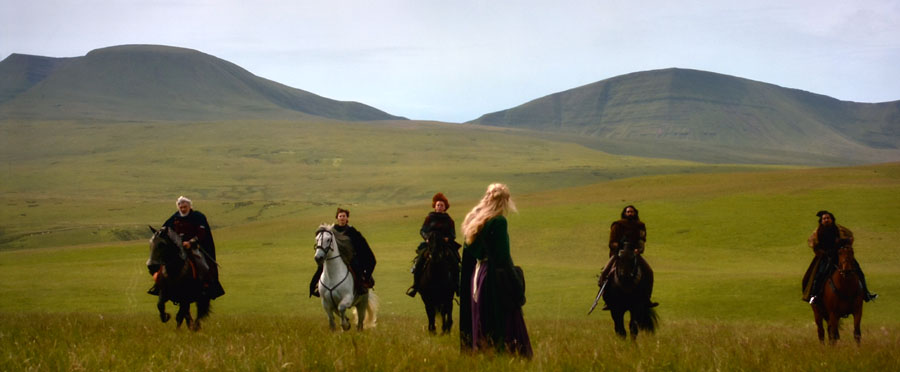
The start of the quest (Willow 2022)

The new Disney Plus series Willow is a sequel to the beloved 1980s movie of the same name. It is an epic fantasy where the heroes go on a journey to rescue a prince from the clutches of a rising evil.

I had decided to watch the show during a particularly slow day. I was not expecting much from it, because I tend to like science fiction, but I was very pleasantly surprised when the series captivated me, and I now highly recommend it.

It was funny, deliberately cheesy, and somewhat campy in that the creators of the show introduced modern colloquialisms and music into the episodes. I also learned that the deceptively simple storyline was actually replete with symbolism and layers of complexity after watching a fantastic podcast called What the Force.  

Like many other high fantasy shows, the plot involves an epic quest. Interestingly enough, the director of the show depicted the start of the long journey by using wide angle shots of the protagonists on horses as they travelled across the open expanse of beautiful grasslands (the show was shot in Wales, and featured gorgeous scenery throughout the series). This scene was reminiscent of some other movies and shows that I had watched, and I realized that open grasslands are oftentimes used as a trope to characterize long epic journeys.

The quest continues (Willow 2022)

Movie or film tropes are a way of telling a story by using metaphorical language and scenes. They are used fairly often, and some common examples of cinematic tropes include the use of black for villains, and the frequent use of comedic sidekicks.

The use of open grasslands in Willow and in other shows made me think of why such landscapes are frequently selected to depict journeys or quests. I seldom see long epic journeys on fantasy films starting out with the protagonists hacking their way through the thick constricted underbrush of some deep dark forest.

A barrier between the open grasslands (Willow 2022)

When one thinks about the start of an epic fantasy quest in the movies, one cannot help but imagine that the journey will be filled with wondrous adventures and travels to exciting and far off lands for the protagonists. Thus, the director of such films needs to match his vision with the expectations of the avid watchers of the show, and the use of dark, cramped, and confined landscapes (such as the interiors of forests) would likely not entice them to ease happily into the story. 

Instead, he or she would opt for wide open spaces, panoramic scenery, and limitless vistas, attributes which are inherent to vast grasslands, as anyone who has ever stood in awe in the middle of old growth grasslands (or even grain fields) knows.

So the next time you watch high fantasy, such as LOTR, the Hobbit or Willow, see whether you can spot the ways the film producers use open ecosystems as a trope to entice and settle viewers into their equally expansive and sweeping world creations. 

The heroes meet up with the "Chosen One", Elora Danan (Willow 2022)

Saturday, October 22, 2022

It's Corn! A Kid and His Love for a Big Lump with Knobs


I admit I do not follow current fads, and I am definitely not on TikTok, Instagram, or most of the various social media channels out there. 

So it took me awhile to discover this interesting and funny meme that had taken first TikTok by storm, and then various other media outlets, including some mainstream news channels (where I finally found it).

A kid named Tariq was interviewed about his liking for corn, and his enthusiasm and love for it was captured later in a song that went viral (view video above).

Watch it and the original interview below and you'll be singing praises as well to corn/maize (Zea mays), which is definitely one of the most important grasses in the world.
 
The original interview:


Thursday, October 20, 2022

Halloween Horrors in the Cornfields

Yeah, Zea mays (maize/corn) can be spooky

It's that time of the year again when pagan rituals (aka Halloween) sweep across this land, and in honor of that occasion I just have to list some of the horror movies that have made cornfields one of the least likely places to visit during night time.

I remember mentioning that I get spooked hiking forests at night, but I think being stuck in a field with tall grasses like corn would not be Disney time either.

We'll start with the better one of the lot - the movie adaptation of Stephen King's short story.

Children of the Corn (1984 original + all the sequels)


But here are more goodies that I dug up from youtube (in year descending order). I cannot vouch for their quality (other than Signs, Jeepers Creepers, and Escape the Field, which were ok), but if you're into dark and dangerous cornfields (and scarecrows!), you'll probably dig most of them.

This next one actually looked good, and was released by Lions Gate, a major studio. I dug it up (yes, I know I used the term "dig" twice...because Halloween) as a streamed movie in my cable lineup and watched it after posting this. It was ok, though the ending might be confusing. Reminds me of the 2010 Predators movie mixed with King's In the Tall Grass (more on that later).

Escape the Field (2022)

This next one is also in one of the streaming services, but it looks so horribly campy that I am giving it a pass.

Sharks of the Corn (2021)

The next several movies I have not seen, nor am I probably ever going to watch them (except for 1922 maybe, which is based on a Stephen King story).

Scarecrows (2018)

1922 (2017)

Husk and sequels (2011)

The Fields (2011)

A Brush with Death (2007)

Dark harvest (2004)

I watched this one a while back by M. Night Shyamalan and it was good drama, but probably not as good as his Sixth Sense, which was a classic.

Signs (2002)

Jeepers Creepers and sequels (2001)

Psycho Scarecrow (1997)- Full Movie


Finally, we'll end with another adaptation of a Stephen King work. No cornfields this time, but a field of another tall grass (Miscanthus spp in real life it turns out) that is just as deadly.

In the Tall Grass (2019)


Happy Halloween!


Friday, May 6, 2022

Book Review: The Death of Grass by John Christopher

by ISFDB

I admit that I probably would not have read this before my interest in the Poaceae.

I am an ardent science fiction reader, but this post-apocalyptic novel was published in 1956, and I tend not to read older SF. Nevertheless, once I started reading it, I found to my surprise that it was actually quite interesting, although some of the language and viewpoints of the characters were quite dated and made me cringe and roll my eyes.

The story involves the spread of a virus named Chung-Li, which devastates rice crops in China, causing mass starvation. Although confined at first to rice, the virus soon develops variants which attack all members of the grass family. Caught in the backdrop of this ecological catastrophe, a mild mannered British man named John and his family try to safely make it to his brother David, who has started growing potatoes in a farm that is sheltered in a well protected valley. On the way they pick up various other people who can help them, and John slowly transforms into a hardened survivor who will stop at nothing to protect his family.

The Chung-Li virus devastates rice crops

The author does a very good job of emphasizing the importance of the grass family to the very fabric of our lives. Not only does he show the disintegration of governments and societies when the virus expands worldwide, but at various points in the narrative, the characters note the disastrous consequences of the loss of grasses because these make up the vast majority of our food.

"Yes," John said, "wheat is a grass, too, isn’t it?"

"Wheat," David said, "and oats and barley and rye – not to mention fodder for the beasts."

In addition, the author is thoughtful enough to mention the scientific name of the grass family, and even goes so far as to throw in the taxonomic nomenclature of some grass  genera and tribes. 

Roger went on: "The appetite of the Chung-Li virus was for the tribe of Oryzae, of the family of Gramineae. Phase 5 is rather less discriminating. It thrives on all the Gramineae."

"Gramineae?"

Roger smiled, not very happily. "I’ve only picked up the jargon recently myself. Gramineae means grasses – all the grasses."

John thought of David. "We’ve been lucky."

"Grasses," he said, "that includes wheat."

"Wheat, oats, barley, rye, that’s a starter. Then meat, dairy foods, poultry. In a couple of years’ time we’ll be living on fish and chips – if we can get the fat to fry them in."

Wheat is also affected, by Bluemoose

The disappearance of grasses not only impacts the entire food chain that enables civilization, but it also impacts the surroundings, as noted by one of the protagonists:

‘They frightened me. I hadn’t understood properly before quite what a clean sweep the virus makes of a place. Automatically, you think of it as leaving some grass growing, if only a few tufts here and there. But it doesn’t leave anything. It’s only the grasses that have gone, of course, but it’s surprising to realize what a large amount of territory is covered with grasses of one kind or another.’

Although the author has done his botanical homework, he seemingly stumbles at certain points in the narrative. For example, as rationing starts to take its toll on the country, some children complain about the rationing of sweets.

"Potato-cakes,’"John said, "and the empty tin circulating along the tables for you all to have a sniff. Very nourishing too." 

Davey said: ‘Well, I don’t see why they’ve rationed sweets. You don’t get sweets out of grass, do you?’

But of course, most sugar is actually derived from sugarcane (Saccharumn officinarum), which is also a grass!

Overall, I found the novel interesting and entertaining, and the author does not shy away from describing the savagery of man when civilization collapses. In one of the Stephen King novelettes, the phrase "arc of descent" is used, and I think that phrase is quite apt in describing the way the protagonist in this book evolves from beginning to end. 

If you have the time and inclination, give it a go. An electronic version (kindle) is available from amazon.com, and probably from other booksellers worldwide.

Enjoy!

Dying maize/corn


Friday, February 4, 2022

The Symbolism of the Bamboo Planet as Home of the New Jedi Temple (Star Wars: The Book of Boba Fett Episode 6)

SPOILERS WARNING!

Do not read if you are about to watch episode 6 of the Boba Fett Saga.

What a great episode in the new Star Wars series on Disney Plus!

Not only did we get to see many of the major characters in Star Wars come back, but the setting for most of the new episode is on a planet that seems to be dominated by various bamboo species!

In this episode, the Mandalorian travels to where he believes Luke Skywalker has taken Grogu.

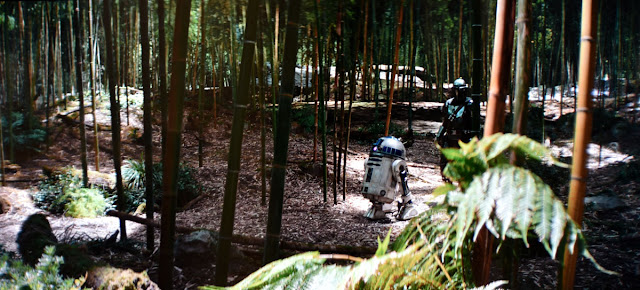
When he lands, the first thing he meets is the venerable R2-D2, who guides him through a bamboo forest to a clearing, where ant-like robots are building what looks to be a stone structure. 

R2-D2 guides the Mandalorian
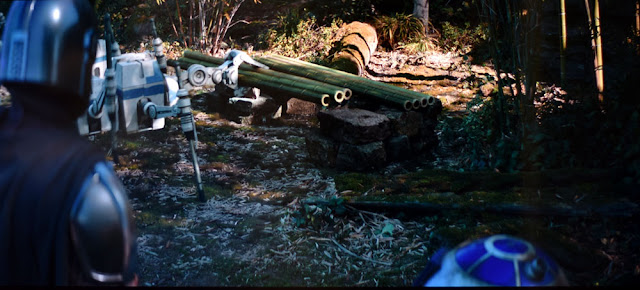
When the Mandalorian presses him on the whereabouts of Grogu, R2-D2 shuts down and the Mandalorian is forced to rest on a bench that the ant-like robots made for him using stones and bamboo poles.
The bamboo bench
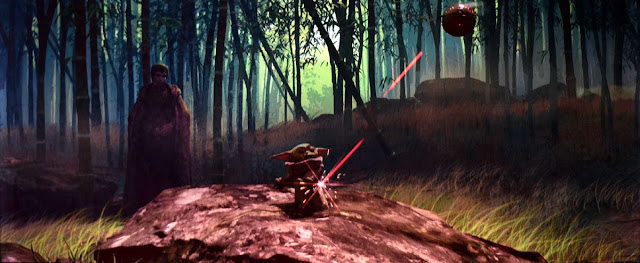
Meanwhile, we cut to Luke Skywalker and Grogu in the bamboo forest. Luke is teaching Grogu how to become a Jedi, and there are many scenes of them in various settings surrounded by bamboo.

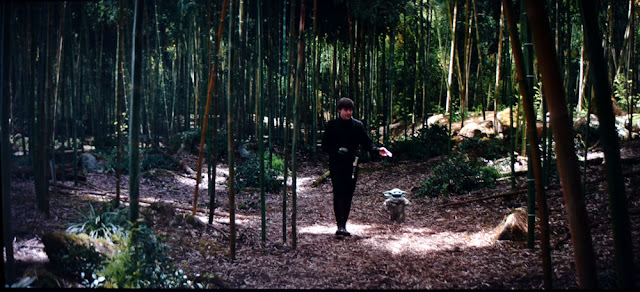
In one scene, they are walking along a trail through the bamboo forest, and Luke asks Grogu whether he wants to remember what happened to him in the past. When Grogu seemingly gives assent, Luke places his hand on top of Grogu and we suddenly see scenes of battle, with Clone Troopers killing Jedi and Grogu staring in horror at the devastation.

Luke Skywalker and Grogu walking along a bamboo grove
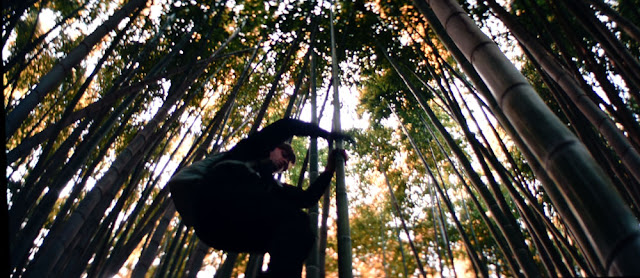
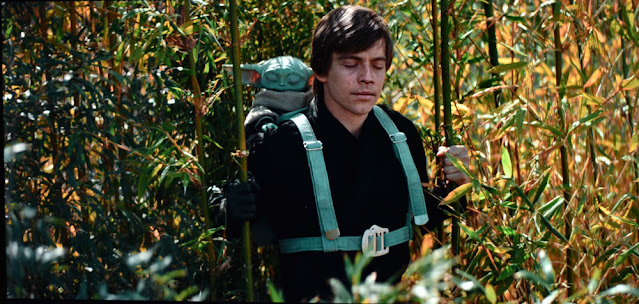
In another scene, Luke takes Grogu on his shoulders, just like he did Yoda when he himself was being trained as a Jedi, and Luke runs through a forest filled with huge bamboos, before climbing nimbly up to the top of the canopy. 
Luke Skywalker climbing up bamboo stand with Grogu on his shoulders
There Luke tells Grogu about the Force, and how the world exists in balance, and that through the Force Grogu will find balance as well.  It is a moving moment, with the two staring out towards the wider world, and bamboo leaves fluttering around them in the breeze.
Feeling the Force
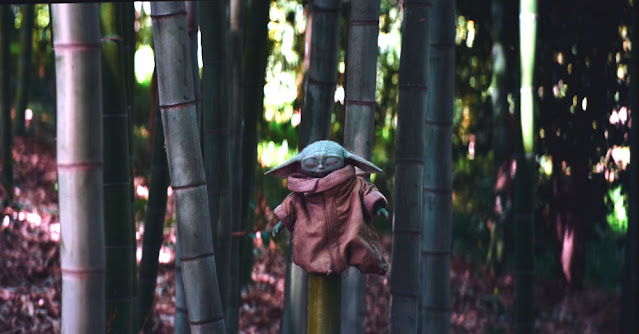
Finally, we cut to a small clearing surrounded by gigantic bamboo, and we see Grogu balancing successfully on a bamboo culm, while Luke draws his lightsaber and displays his swordsmanship. It is another moving moment in an episode with so many deep emotional currents.
Grogu balancing on a bamboo culm
My favorite character Ahsoka Tano then suddenly shows up. There is no fanfare, no big reveal. The Mandalorian suddenly realizes he is not alone, and when he stands quickly from his rest and draws his gun, he is confronted by Ahsoka, who is casually leaning on some bamboo culms and waiting for him. 

Ahsoka Tano talks to the Mandalorian
She tells him that the structure being built is going to be a new Jedi temple, and that Grogu will be its first pupil. When the Mandalorian insists on seeing Grogu, she leads him through the bamboo groves and tells him he has the option of seeing Grogu, but that this meeting would only cause more difficulty for the child. After some thought, the Mandalorian decides that he will not see Grogu, but he asks Ahsoka to give the child a suit made from Mandalorian armor.

Near the end, we see Ahsoka and Luke talking by a lake, bamboo trees behind them, as Luke asks her what he should do with Grogu. Ahsoka responds that he should trust his instincts, and when she turns to leave, Luke wonders whether he would see her again. She says "perhaps" and wishes him farewell in that most time honored of fashion: "May the Force be with you."

Luke Skywalker 
The continuous use of scenes with bamboo in this episode is likely not accidental. 

In many Asian cultures, bamboo symbolizes harmony and balance, mainly due to the fact this grass features an unmatched combination of flexibility and strength in the structure of its culm. This is analogous to the balance that Luke tells Grogu is inherent in the Force. George Lucas had been heavily influenced by Eastern mysticism in his creation of the Star Wars Jedi ethos, and especially by Taoism, and the series continues to hew to this bias by using bamboo as the primary setting for Grogu's training.

The fact that the planet will also be home to the new Jedi Temple is also heavily symbolic. Bamboos are the fastest growing plants in the world, and they can also be used to symbolize the nascent growth of the Jedi after their decimation by the Sith Emperor.

I cannot emphasize enough how cool this episode was, not only because of the introduction of many of the most beloved characters in the Star Wars universe, but also because of the many beautiful scenes of bamboo that surrounded (and perhaps defined) them.

Go watch it!