Showing posts with label Stenotaphrum. Show all posts

Monday, November 21, 2022

Letting Your Lawn Grasses Flower

Stenotaphrum secundatum (St. Augustine Grass) flowerhead with orange anthers and purple stigmas

Notwithstanding the growing complaints about lawns, a lawn of turf grass has some aesthetic  qualities. Lawns are clean looking to some people, and they project a sense of ordered structure that a mélange of different plants squeezed together might not.

Paspalum notatum (Bahiagrass) with purple anthers and stigmas

But aside from a few weedy species like Poa annua that thwart the mower's blades by flowering close to the ground, the various turf grass species are kept from showing their full reproductive selves by the regular mowing that homeowners do. This incessant desire to keep the lawn grasses short prevents the grasses from pushing up flowerheads and scattering pollen and seeds to the winds, while making it difficult for homeowners to identify the grass from just their vegetative structures.

Zoysia matrella with tiny spikelike flowerheads

Most turf grasses have relatively tiny inflorescences, a consequence of the fact grasses are wind-pollinated and have no need to expend energy on unneeded colorful petals and sepals. In addition, turf grasses are usually species which have evolved to be grazed, so they eschew tall stalks and flowerheads and keep close to the ground. 

But it is still fascinating to see the usually colorful stigmas and anthers via some magnification, and by setting aside parts of the lawn as temporary no-mower areas, owners can finally see the turf grasses flower, as well as type them more accurately to species.

Eremochloa ophiuroides (centipede grass) with silvery stigmas and purple anthers

So take some time to see what the flowers of your own lawn looks like. Make at least some part of your lawn no-mow until the tiny flowerheads and seedheads rise up to scatter your lawn's grass seeds to the wind.

Sunday, August 14, 2022

Uncovering the lair of the sand centipede

I love my wife, but whenever I hike with her my botanizing is reduced to a minimal level.

So when I got the chance to explore a nearby trail on my own, I jumped at the opportunity and took my Nikon 3400 DSLR and  macro lens with me.

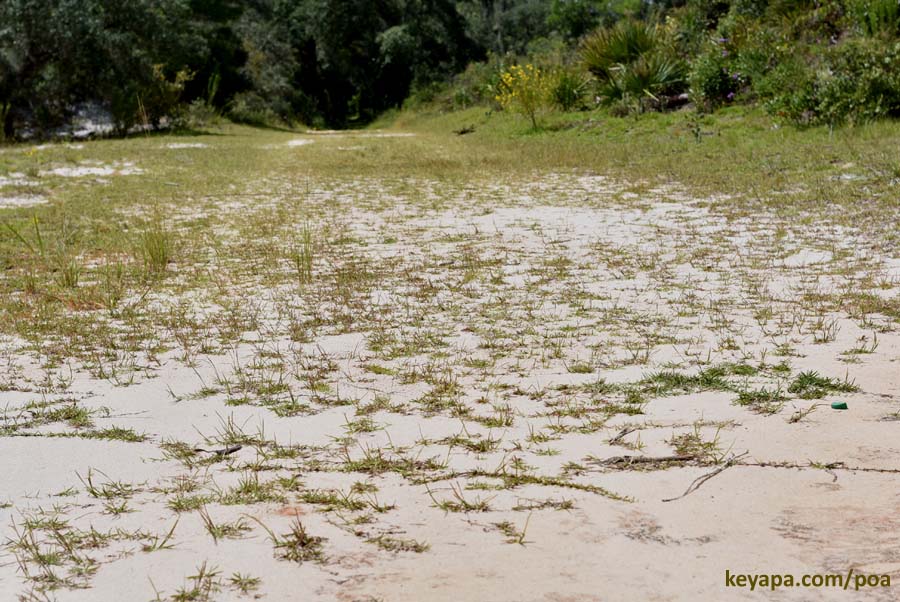
The beginning portion of the trail featured a wide sandy path, and on a previous excursion I had noticed really interesting critters that seemed to be slithering under the sand.

The trail covered with "sand centipedes"

It was the usual hot and humid Florida summer day, but this time I literally knelt to observe the little critters. The ground was really hot, but I was entranced by what I saw.

The long bodies of this grass formed sinuous patterns, the leaves half submerged in the sand and looking like the segmented legs of a centipede. I had to be careful not to keep stepping on one, although I knew that they were tough hombres that could take a few adversities and keep on ticking.

A half buried sand centipede as it crawls along the burning ground

Amazingly enough, many of them were in bloom or past bloom, and multitudes of flower and seedheads rose from the ground like the compound eyes of arthropods. They really did look like segmented critters!

Like a stomatopod with 2 eyes peering up from the sand

I identified the species as Eremochloa ophiuroides, which is a turf grass here in the southeast USA. It was introduced to the country in 1916 from China, and these specimens must have "escaped" from nearby lawns. Its common name in the area is "centipedegrass", which either refers to the overall body form or the segmented appearance of the inflorescence.

Inflorescence and stoloniferous culm that had been half buried in the sand

The species looks superficially like Stenotaphrum secundatum (which is called St. Augustine Grass here), but it is smaller and the inflorescence looks quite different.

Interestingly enough, I saw an ant going up and down the flowerheads, and I photographed what looked like aphids perched at the base of the rows of spikelets. The ant seemed to be attracted to the lumpish specks, and I was reminded of some recent research that hypothesized that  E. ophiuroides might be pollinated by various insects (Joseph et al, 2020).

Ant cultivating aphids on the inflorescence?

The spikelets themselves were quite small, but the silvery stigma and purple anthers were cute, and I spent some time getting macro shots of the structures. 

Purple anthers and silvery stigmas

I must have spent an hour or more in the heat and sun examining this population of "sand centipedes". I love tiny critters, and the small size of this species was quite attractive. True, it might only be a common turfgrass to some, but the exotic location that I found them in and the fact that they were in bloom captivated the explorer in me. Beauty lies all around us, even in the most common of things.  You just need to open your mind's eye and see.

Literature Cited

V Joseph S, Harris-Shultz K, Jespersen D. Evidence of Pollinators Foraging on Centipedegrass Inflorescences. Insects. 2020 Nov 13;11(11):795. doi: 10.3390/insects11110795. PMID: 33202733; PMCID: PMC7696019.


Tuesday, May 31, 2022

Say this 5 times fast: Stenotaphrum secundatum!


 A lawn in a lawn right?

But interestingly enough, the species of grass used to create lawns varies widely as one goes from one region to another in the USA.

In our home in New Jersey, our really old lawn (which I inherited from previous owners) is a mishmash of cool season grasses like Poa pratensis (Kentucky blue grass), Fescue spp, and Lolium spp (eg. Perennial Ryegrass). 

By Kevin Thiele from Perth, Australia

In Florida however, we were confronted by completely different species, those more adapted to the warmer weather all year round. In our case, a rhizomatous and stoloniferous grass called Stenotaphrum secundatum, which has the local name St. Augustine grass (and various other common names around the world).

From a distance, the major difference is probably the lighter color of the lawn. But when you actually look closely the change in habit is very obvious. S. secundatum is a creeper - its stolons or aboveground horizontal stems allowing it to "crawl" along the ground like some green hued centipede. This behavior is quite unlike its cool season brethren in the north, which at best have underground rhizomes. 

I was so taken by this creeping behavior that I potted one, set it down on our lanai, and attempted for a short while to see how far it would stretch along the cement floor in its search for soil. It grew by around 5 cm in 12 days before I had to stop the experiment due to eternal circumstances, but I may repeat the experiment again later.  

Potted grass as it crawls out of the pot and starts to search for soil

The composition of the lawn also affects how it is viewed even from far away sometimes. For example, in the image below, the lighter green areas are S. secundatum, while the dark lot is likely Paspalum notatum (Bahia grass). The border between the two species was amazingly straight most times, although S. secundatum seems to have the more pronounced tendency to encroach onto the other territory. In addition, I noticed various other plant species (aka weeds in lawn parlance, haha) had a harder time establishing themselves in the dense masses of culms and blades and stolons that S. secundatum creates. 

Lawns from high up

A third type of turf grass in the community is a very small, fine leaved species used for the golf areas, and the next time I'm there I'll be sure to take a sample and try to ID it. I know some people are quite ambivalent (or even hostile) towards turf grass, but after being in an HOA community that uses various species to populate the landscape, I have started to become quite interested in the ecology of lawn grasses.

More to come on this perhaps.