Showing posts with label Personal. Show all posts

Thursday, November 30, 2023

Cruising the Ocean and a Sea of Grass.

Looking out at the ocean from the balcony of a Celebrity cruise ship

We took a cruise this month, and we had a balcony that allowed us to watch the ocean from our stateroom. I spent many hours just sitting and reading and watching the sea go by, and marveling at the immensity of the view outside.

Looking out at the ocean always makes me feel small, almost insignificant. Its vastness, its seeming permanence, puts many things into perspective.  Paradoxically, it also imbues me with a deep serenity that makes cruising a favorite way to relax in between bouts of work.

In almost the same way, looking out across vast grasslands gives me the same feelings. There is this spot nearby with a large field of grass where I sometimes park my car and just spend an hour or two reading. The panorama might be a colorful green or a rust red instead of the dark blue of the seas, but the solitude and the tranquility of the landscape never fails to make me happy. 

I sit and read by a sea of grass

This equivalence between an ocean and vast grasslands is replete in literature and history.

When European settlers first arrived, they encountered what many described with wonder and awe as a  "sea of grass" that spread for 60 million ha, and stretched from the Rocky Mountains to what is now Indiana, and from Texas north into Canada. These were of course the prairies of that time, most of which have been diced and sliced and now occupy but a fraction of their previous immense area.

But the feelings of almost religious wonder at the vastness of grasslands might actually be inherent in our makeup. In Egyptian mythology, the afterlife is depicted as an endless Field of Reeds (A'Aru),  where the souls of people who have passed away can exist in a bountiful paradise. 

Field of Reeds (Moon Knight, Marvel)

In a similar way, the acclaimed film Gladiator depicts the afterlife as a vast field of wheat, with the protagonist running his hands through the wheat in one of the most iconic scenes in the movie.

The endless fields of wheat in the film Gladiator

In Dan Simmons' Hyperion, the planet Endymion contains a region called the Sea of Grass, which the protagonists must cross using so-called wind-wagons that surf above the meters tall "grass".

Dan Simmons' Hyperion and The Sea of Grass

"My God," breathed Brawne Lamia.

It was as if they had climbed the last hill of creation. Below them, a scattering of docks, wharves and sheds marked the end of Edge and the beginning of the Sea. Grass stretched away forever, rippling sensually in the slight breeze and seeming to lap like a green surf at the base of the bluffs. The grass seemed infinite and seamless, stretching to all horizons and apparently rising to precisely the same height as far as the eye could see. There was not the slightest hint of the snowy peaks of the Bridle Range, which they knew lay some 800 kilometers to the northeast. The illusion that they were gazing at a great green sea was nearly perfect, down to the wind-ruffled shimmers of stalks looking like whitecaps far from shore.

"It's beautiful," said Lamia, who had never seen it before.

Barring aside the improbability of windwagons being borne on the tops of masses of plants (no matter how strong the culms), the idea of travelling above vast seas of grass to distant lands is irresistibly attractive, and even romantic. Perhaps such adventures will be possible in far-off places with less gravity than ours, but for now, I'm content to just spend time by my decidedly more earthly landscape.

*sighs and goes back to reading Hyperion, while gazing at the dark brooding masses of clouds now gathering above his Sea of Grass*

Where's that windwagon?


Saturday, November 25, 2023

The Muscovy Duck Intervention

Mounds of Zoysia matrella (Manila grass) along banks of canal leading to the sea

I was walking along the main thoroughfare Lloyd G. Smith Boulevard in Aruba last week when I came upon an odd sight in Wilhelmina Park.

The tiny Zoysia matrella (aka Manila grass) is a common turf grass in tropical countries, where it is sometimes known in the horticultural world by the incorrect name "Zoysia tenuifolia". It is in the subfamily Chloridoideae and forms thick beautiful sod using both aboveground stolons and underground rhizomes.

Muscovy duck strutting in Wilhelmina Park, Aruba.

I had been wandering around Wilhelmina Park, and was now looking at the river/canal that emptied into the sea, and lay between Governor's Beach and Renaissance Beach. Curious looking mounds of grass dotted the banks of the river, and so I walked gingerly to a particularly prominent cluster of these mounds. The mounds were soft to the touch and velvety looking, and rising from them were multitudes of very tiny flowerheads.

Zoysia matrella flowerheads

I had never seen so many flowering Z. matrella before, and  because they were so tiny (less than 5 mm length) I had to take some time photographing. I was so engrossed in my work that I almost jumped up in surprise when I heard a hissing sound almost next to me.

A really weird looking bird had suddenly appeared, and it was strutting back and forth close to me in what I took to be a threatening manner. In many ways it looked like a regular duck, but it had a red warty face that only a mother could love.

Zoysia matrella flowerhead showing white anthers and purplish stigma

It was also hissing like a snake, and bobbing its head up and down rapidly. I stepped warily away from it and prepared to defend myself, but the bird simply continued to look at me and bob its head up and down.

Did it have some nest hidden near the river bank? Was I somehow trespassing into its territory?

What I took to be the remnants of duck feathers next to Z. matrella flowerheads

I wondered too whether the duck had been using the mounds as a nest, because I found remnants of what seemed to be bird feathers on the grass surface. Perhaps I really was invading its turf (no pun intended), and so I immediately vacated the area and went back to the nearby path.

It was only much later when I googled and identified the critter, that I found out Muscovy ducks use the head bobbing motion as a friendly greeting. I also found out that this species could not quack like normal ducks, but instead hissed, and so there was nothing sinister about the sounds it was making!

I felt sorry I was slightly mean to the duck. I had tried shooing  it away from the mounds of Z. matrella, not knowing it was simply trying to be friendly. It may have been ugly as sin, but it meant well, and next time I'll learn to not so easily judge a book by its cover.

Saturday, October 14, 2023

Following Buffaloes

Male flowerhead of Bouteloua dactyloides (Colorado)

In 1977, a movie called Star Wars was just starting out on its path to becoming one of the most successful science fiction franchises in history. Marty McFly had yet to drive his DeLorean back to the future; Arnold Schwarzenegger was a relatively unknown bodybuilder whose metamorphosis into the Terminator was years into the future, and even E.T. had no need to phone home just yet.

Male flowerheads of Bouteloua dactyloides (Colorado)

In this same year, in a university town in New Jersey, plant clippings from a garbage bin that was being emptied by trash collectors accidentally fell onto a lawn of Kentucky Bluegrass (Poa pratensis). The clippings had come from a nearby Rutgers University greenhouse that was housed in the Nelson Biological Sciences building. A grass species from the high plains of Oklahoma and Kansas was being grown there for turf studies, and its introduction into the heavily trampled and disturbed grounds of the Rutgers Busch Campus was in hindsight a fortuitous event (Quinn, 1998).
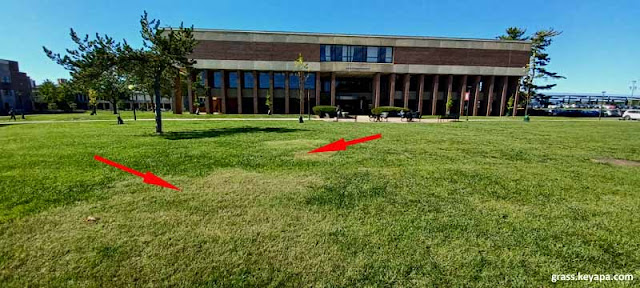
Front lawn of Library of Science and Medicine at Rutgers Busch Campus. Red arrows point to B. dactyloides clusters

Forty six years later, I knelt on the same grounds in front of the next door Rutgers Library of Science and Medicine (LSM) building and examined tiny male flowerheads of Bouteloua dactyloides (commonly called buffalo grass in the USA). They marked the occurrence of the same plant(s) that had escaped almost five decades earlier, and their expansion and spread using both stolons and seeds moved me. I felt a sense of being connected through time  by this humble native grass to that past accident so long ago.

It was relatively easy to determine the extent of the spread at this time of the year. The species starts to brown earlier during autumn, and it stood out against the still darker green masses of other turf grasses. I could see clearly that it was now present on different lawn areas that were separated by concrete paths, and that some of the irregularly shaped clones were quite large.
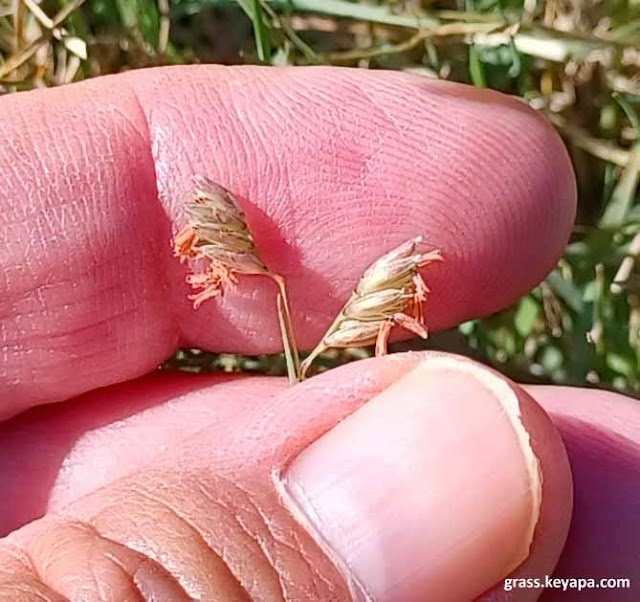
Mobile phone pic of male flowerheads of Bouteloua dactyloides in lawn of Library of Science and Medicine, Rutgers University Busch Campus. 

I noted the GPS coordinates and measured the sizes of the clusters that I could ID as B. dactyloides. Many were vaguely round, oval, or rectangular in shape, with diameters of half a meter for the smaller ones, and sizes that approached bedroom size for some of the larger ones.

Room size cluster of Bouteloua dactyloides (light brown area) next to Rutgers Library of Science and Medicine

The survival of the original plant for almost half a century is notable, because B. dactyloides has been touted as a low-maintenance, drought tolerant, and native alternative to the usual European grasses that dominate the northeast lawns in the USA today. I myself considered its use on my own lawn in NJ at one time some years ago. 

Unfortunately, its intolerance to shade and its inability to be competitive in rainy wet areas has always raised questions as to whether it would be a successful replacement to the proven imported turf grasses. In this case, not only had it survived for almost half a century, but it had managed to spread significantly against formidable opposition from forbs and other types of grasses such as P. pratensis. This helps prove that it is possible to use this species as turf grass and for erosion control in disturbed soil in the Northeast.

Female reproductive structure of Bouteloua dactyloides (Colorado)

As an important aside, I know some people follow trees over time, but there are many herbaceous plants that can exist for very long periods, and it is just as rewarding to follow their lives over time. In fact, the longest lived organism in the world is a herbaceous seagrass, which has been calculated to be 80,000 to 200,000 years old  (Arnaud-Haond et al, 2012)! It is amazing to think how the world has seen so much change during that astounding duration. 

In the same way, although spanning an exponentially shorter span, when I first laid my eyes on the spreading clusters of B. dactyloides in front of the LSM library a couple days back, I truly felt an emotional attachment to them. I studied at this same university in the 1990s, and I had likely passed by the same individual many times on the way to my studies. It made me feel the ticking of time with a more visceral emotion than mere objective contemplation, and it humbles me that this clonal individual might still be flourishing and thriving and growing when I'm long gone from the world. 

Literature Cited:

Arnaud-Haond S, Duarte CM, Diaz-Almela E, Marbà N, Sintes T, Serrão EA. Implications of extreme life span in clonal organisms: millenary clones in meadows of the threatened seagrass Posidonia oceanica. PLoS One. 2012;7(2):e30454. doi: 10.1371/journal.pone.0030454. Epub 2012 Feb 1. PMID: 22312426; PMCID: PMC3270012.

Quinn, J. A. (1998). Natural Expansion of Buchloe dactyloides at a Disturbed Site in New Jersey and Its Implications for Turf and Conservation Uses. The Journal of the Torrey Botanical Society, 125(4), 319–323. https://doi.org/10.2307/2997245

Tuesday, October 10, 2023

Grasses all day, every day, and grasses ever after, amen!

My life, as well as the lives of billions of other people, are intertwined with grasses...we are touched by them....from the time we wake up in the morning, to the time we sleep at night.

This was what I tried to convey during a talk with Matt Candelas of In Defense of Plants.

In my case, when I wake up in the morning, I (like literally billions of other people around the world) encounter members of the grass family, or derivatives of it, throughout the day.

The first thing I do in the morning is eat a bowl of oatmeal, and oatmeal of course is from the grass Avena sativa. 

When I eat my bowl of oatmeal, I put  some sugar into the mix of fruits, and around 80% of sugar in the world is derived from a grass, sugarcane (Saccharum officinarum).

I walk out to my car, and I'll see suburban lawns stretching to the horizon, and the turf grass of course is a mix of various grass species. In Florida it would be Stenotaphrum secundatum (St. Augustine grass), Paspalum notatum (Bahia grass) and maybe Cynodon dactylon (Bermuda grass), while in the Northeast you get various mixes of Poa pratensis (Kentucky bluegrass), Festuca spp, and Lolium spp.

Such species are what people normally think of when you mention the word "grass" to them. Ornamental grasses also fall into this category of grasses that are used in landscaping.

When I drive my car to work, the ethanol in my gasoline tank is likely as not made from Zea mays. In fact, around 40% of all corn production is used as bioethanol!

During lunch, I might go out and get a burger, and where would that be without the bread that frames the delicious ingredients between them? Bread of course is from a grass that we call wheat,  (Triticum aestivum and its ilk).

Maybe I also eat some snacks for lunch, and if you are brave enough to look at the ingredients of your candy or chips, you'll probably find something called high fructose corn syrup in it. This is a very common ingredient of packaged foods, because it adds to the sweetness of the food, and this is of course derived from a grass that we already mentioned above, Zea mays (corn/maize).


In fact, if you live in the USA, your body is probably mostly derived from that single grass species. Here is a great documentary that explores in some depth the ubiquity of Z. mays in American life.  

Finally, during some part of the day, I'll probably eat rice (Oryza sativa) during either lunch or dinner (and sometimes breakfast too!). Rice is, of course, one of those grasses that have been essential in the creation and and molding of entire civilizations (which I'll look into next time).


And I'm not even including all the times we use bamboo implements and tools!

So no matter how you look at it, the family Poaceae is by far the most influential and important plant family in the world. It's grasses all day, every day, and grasses ever after, amen!

Sunday, September 24, 2023

Guardians of the Weed Field

A Lovecraftian Field of Cogongrass

This was written in March of 1986 for a paper, but the events in it happened almost a decade earlier, in the late 1970s. The weed field in the story was dominated by the usual dominant species in the Philippines, probably Imperata cylindrica (cogongrass) and Saccharum spontaneum (wild sugarcane).

I remember the day they burned the field down.

I was a fifth-grader then, perhaps only 10 years of age, and on my way to my school's elementary school library. Lunchtime had just began, and for the next hour or so I would eagerly wade through a Hardy Boys or Nancy Drew mystery; I had not yet discovered science fiction books (in the guise of the ever popular Star Trek series) and the lives of those teenage detectives seemed to me the height of adventure. It was while thinking of these same detectives that I noticed  faint wisps of smoke rising  from beyond one of the school's  many playgrounds.

To one side of my school there lay a wild tangle of rank grasses and thorny plants - a virtual no-man's land that was part of the school property. This weed field extended from the school's side and half way to the horizon and was some 50 meters across, which made it one really gigantic monster to my over-active 5th grade imagination.

Saccharum spontaneum, Philippines

Nestled between this field and the school was a small area that had been cleared of the meters high weeds, and here we students did our gardening; we toiled and troubled over our sickly-looking vegetable plants, all the while wondering about the "jungle" that nearly surrounded us and the positively gruesome creatures that we knew lived within it. Like normal pre-teens however, the thought of what lay concealed within that wild land did not repulse us but drew us towards it, and we once dared each other to walk into the field and stay there for an hour or so, a peso to the fellow who came out whole and alive. Finally, one or two takers walked into the field when our Practical Arts teacher was conveniently busy with something else, but they were soon dragged back by this enraged gentleman (who had threatened us all with F grades if we failed to reveal the whereabouts of our missing classmates) and sent to the principal. Needless to say, we never tried that stunt again. 

Imperata cylindrica, Philippines, from Amazing Lingsat.

Now I could see smoke rising from the weed field; it came from half a dozen or so fires that raged throughout the land. Plants that were once so tall and proud now became blackened ash that filled the air and rained all over the side of the school nearest to the field. A growing crowd of excited students watched as men from the school started new fires in an effort to hasten the weed field's demise, their tiny figures barely visible in the distance as clouds of ash and smoke rolled in from the burning field to cover a nearby playground. I thought at first that the fires would spread to the school proper, but the men obviously knew what they were doing and somehow controlled its spread.

I stayed watching for a while longer, then continued on my way to the library. The afternoon passed, and it was soon time to go home. But my school bus was late (as usual) and so I decided to see what had happened to the weed field.

Playing field in school. From D. Gamboa and E. Nacion.

While I was busy slaving away in my hot, stuffy classroom, the workmen had done their work - more than half of the field had been converted to ash. The weed field looked fearsome and awe-inspiring no more; in fact, it looked downright pitiful that fateful afternoon - a victim of my school's expansionist policies. I learned later that a school chapel would be built over the ashes of the field.

I found the weed field's creatures that day. They were stored in glass jars filled with formaldehyde, their scaled bodies coiled tightly in death. The jars stood like brooding sentinels on open wooden shelves. There were dozens and dozens of the slain creatures, from foot-long green snakes to pythons reaching three meters in length. They had escaped the fires only to be caught and killed by the ever-vigilant workers. 

I remember feeling sorry for these misunderstood "monsters", who we children had feared and perhaps even hated for so long. In death, they did not seem menacing even to my young eyes, but instead seemed so pitiful. They were the guardians of the weed field and they had guarded it well for so long; and when their home died, they had died loyally with it.