Showing posts with label Dunes. Show all posts

Monday, April 12, 2021

Sentinels of the Dunes


I posted awhile back about the importance of grasses in maintaining the dune ecosystems that are the foundation of coastal areas. Without such grasses, we would not have the wide sandy beaches that give people so much joy. In the northeast USA, the predominant species is Ammophila breviligulata, which I also discussed in an earlier post. During our trip to Florida I had ample opportunity to see another species that becomes dominant as one goes farther south.

Dried seedheads in Tybee Beach
Uniola paniculata is a larger species that can grow to 2 meters high, and it is easily identified by its seedheads. I encountered it first in Tybee Beach, near Savannah, GA. It was March, so the inflorescences were all dried and brown, but no one can mistake the beautiful seedheads for anything else.

Like other dune grasses, this species accumulates sand around it, and in fact grows much more rapidly when buried in it. It reproduces mainly by asexual means, by forming buds along the bases, but it also produces seeds. The seeds reportedly can be carried long distances by ocean currents! 
A provider of nesting for various birds at Tybee Beach
As I walked along Tybee beach, I looked in wonder at the tall dunes that dominated the rear of the beach, each topped by stands of U. paniculata. They looked almost elven amidst the whitish desolate sands, and I gave thanks to these Sentinels of the Dunes, who stand watch to protect the integrity of the beach, and thus gift us such blessings.


Saturday, June 6, 2020

A short history of my obsession with grasses

Bambusa malingensis
Bambusa malingensis
I've recently wondered when my interest in grasses first manifested itself.

My fascination with a specific plant group for a long time was confined to Aroids, and I maintained one of the longest running aroid-specific websites on the internet when I started my Thaumatophyllum (at the time, Meconostigma) site in 2005.

Of course, I have almost always been involved with one species of grass, Oryza sativa (rice), which I have grown almost every year for more than a decade as something like a ceremonial ritual. But I think this interest did not extend beyond to other grasses until Summer of 2011, when I obtained my first ornamental grass, Imperata cylindrica 'Red Baron' (Japanese Blood Grass, but more well known in its wild form as Cogon grass).

Imperata cylindrica 'Red Baron' (Japanese Blood Grass)
This started my first love affair with grasses, and that JBG is still with me and thriving wildly to this day. In fact, it interested me so much that I bought a few more grasses in 2012, including a Miscanthus sinensis 'Gold Bar', which I unceremoniously stuck below the front passenger seat after I bought it ;-)

Miscanthus sinensis 'Gold Bar'
I also remember 2012 was when we went on a road trip to Florida, and I took several pictures of grasses that we met along the way.

Cortaderia selloana (Pampas grass)
The first were specimens of Cortaderia selloana (Pampas grass) in the Carolina Premium Outlets on the outskirts of Raleigh, North Carolina.

Cortaderia selloana (Pampas grass)

There were some truly impressive specimens of this species in that outlet, with a central plant near the entrance rising perhaps 3-4 meters high. The outlet had also planted them on the islands next to the parking lots, and I had a field day taking photos of the grass while waiting for my wife to finish shopping.

Miscanthus sinensis
Miscanthus sinensis cultivar
In addition, the outlet had a few Miscanthus sinensis specimens scattered about, although I was admittedly less impressed with these than the flowering Cortaderia.

Bambusa malingensis
Bambusa malingensis
Once we got to Florida, we visited The Fairchild Botanical Garden in Miami, where I admired the huge bamboo groves, and on the way back home, we also visited Myrtle Beach, where I marveled at the tall Sea Oats (Uniola paniculata) waving in the sea breeze,

Uniola paniculata
Uniola paniculata at Myrtle Beach

Spikelets of Uniola paniculata

It was at this point that for some reason my interest in grasses wavered then waned, and for about 6 years I barely thought about them due to a rising interest in Banyan Trees (Ficus spp).

This changed in Summer of 2018, and it had to do with Cogon grass (Imperata cylindrica) again. This time, I became interested in the invasive wild form, and my fascination with this one species started to slowly encompass other species in the Poaceae.

During our trip to Baanf National Park in Canada in Fall 2018, I took quite a lot of pictures of grasses in that area, and by the next Summer, I had been enmeshed enough in the family to start this site.

Hordeum jubatum in Lake Louise (Baanf National Park)
In a way, it was a case of positive feedback, where my interest in grasses pushed me to write articles and take pictures of them, while the solid presence of my work provided an impetus for me to write even more and study them even more.

This coming July will mark the first year anniversary of this site. I have enjoyed the journey immensely and I am hoping that my ramblings and photos will encourage others to be just as fascinated by this plant family as I am.


Tuesday, October 1, 2019

American Beach Grass (Ammophila breviligulata) in Seaside Heights, NJ

American Beach Grass - Ammophila breviligulata

I visited the beachtown of Seaside Heights, NJ in late September, and was instantly amazed at the endless fields of Ammophila breviligulata (American Beach Grass) that decorated the tall dunes between the streets and the beach proper.

American Beach Grass - Ammophila breviligulata

It turns out that the United States Army Corp of Engineers have been very busy this year, replenishing the sand dunes that protect towns from storms at sea and planting literally hundreds of thousands of the remarkable grass.

American Beach Grass - Ammophila breviligulata
Spikelike panicles waving int he wind
A. breviligulata is a foredune pioneer species that helps in the development of sand dunes by capturing sand, while its long roots help to stabilize the resulting dunes.

American Beach Grass - Ammophila breviligulata
Spike-like panicles wave int he wind
It rapidly colonizes bare new dunes by sending out rhizomes with very long internodes, and from its nodes new ramets spring up. It can also withstand very high rates of sand accretion of up 1 meter per year, another trait that makes it a prime candidate for beach sand dune maintenance.

American Beach Grass - Ammophila breviligulata
Close up of single inflorescence
The species is fairly easy to identify. The dorsal surface of its leaf blades are decorated with deep vertical lines, and the blades roll together towards their tips.

American Beach Grass - Ammophila breviligulata
Lines on leaf surface

American Beach Grass - Ammophila breviligulata
Rolling near tip of leaves
Old brown leaf sheaths wrap around the bases of the grass.

American Beach Grass - Ammophila breviligulata
Old leaf sheaths
The long narrow spike-like panicles of the species are also easily spotted, and the spikelets are fairly large, making it somewhat easy to take in situ macro photos.

American Beach Grass - Ammophila breviligulata

American Beach Grass - Ammophila breviligulata

I have to say again how amazing it was to see the fields of A. breviligulata, and it would be interesting to come back to see how the species prospers (or not) as the years pass.

Tuesday, September 10, 2019

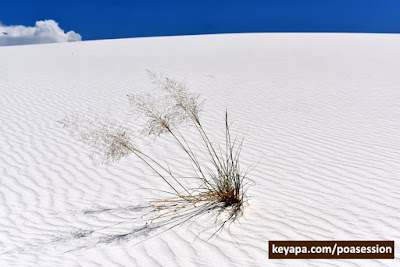
Sporobolus airoides (alkali sacaton) in White Sands National Monument, New Mexico

Sporobolus airoides - Alkali Sacaton
Sporobolus airoides specimen next to dune
I visited the White Sands National Monument in New Mexico in September 2019 in order to see some of the tenacious grasses that have managed to gain a foothold in this rugged environment, and I wasn't disappointed.


The dunes themselves were eerily beautiful, an otherworldly world of towering white sand dunes that stretched away for kilometers in all directions. The origin of this natural wonder lies several hundred million years in the past, when the continents still formed the massive landmass called Pangaea. During this time, the area that would become southern New Mexico was covered by a shallow sea called the Permian Sea. The rise and fall of the sea level at this time created layers of gypsum and other minerals on the sea floor. Over the next several million years the bottling up of the Tularosa Basin where the monument lies, the deposition of more minerals from the surrounding mountains, and the final drying of the lake (Lake Otero) that covered the basin slowly resulted in t he creation of the White Sands Monument that people see today.

You can learn more about the origins of the monument here.


The environment in the dunes is a harsh one for any organism trying to live on it. Not only does the sand shift and threaten to bury plants that take root in it, but water is usually at a premium and the very high salt concentrations in the gympsum sand make it toxic to most plants.

Nevertheless, I found many plants living in the relatively flat areas between dunes. Chief among them was Sporobolus airoides, which is commonly called Alkali Sacaton in the local language. This grass is a halophyte, an organism that tolerates and in fact flourishes in areas of high salt concentrations, and I found that most of the grasses I encountered were of this species.

In some of the more established specimens, mounds of sand had accumulated at the bases, and this reminded me of how beach dune grasses also trapped grains of sand on their bases, and thus helped in the stabilization of the beach dunes.

Sporobolus airoides during sunset
I spent some time taking in situ macro photographs of the inflorescence, which had tiny spikelets with unequal glumes and one floret nestling in each of them.

Sporobolus airoides - Alkali Sacaton

Sporobolus airoides - Alkali Sacaton

Sporobolus airoides - Alkali Sacaton

In addition to the widespread S. airoides, I also stumbled on other grasses. One was Oryzopsis hymenoides, or Indian Rice Grass, which looks superficially like S. airoides, and whose seeds are a major food source for various desert animals.

Oryzopsis hymenoides - Indian Rice Grass

The Native Americans also used the seeds to make bread when their maize crops did not do well.

Oryzopsis hymenoides - Indian Rice Grass
Spikelets of Indian Rice Grass
The other grass I found while on a hike was Schizachyrium scoparium, commonly known as Little Bluestem. This species is commonly a denizen of the prairies, and in fact was one of the major components of the tallgrass prairies of yore. Its presence in the dunes was at first a mystery, but I found out it was explained by the fact the water table in the lower parts of the dunefield is quite high, which provides enough water for this species even in the absence of enough precipitation.

Schizachyrium scoparium - Little Bluestem

All in all, the trip to the White Sands National Monument was fantastic, and I would wholeheartedly recommend this for anyone interested in how organisms can survive in extreme environments.

Monday, September 9, 2019

Redfieldia flexuosa (Blowoutgrass) in Great Sand Dunes National Park, Colorado


The huge dunefields of Great Sand Dunes National Park in Colorado, which feature sand dunes up to 200 meters tall, is a tough place for any plant to survive. It is dry, the dessicating winds are harsh, and the threat of being buried by the ever shifting sands is a daily battle for those few organisms that make this area their home.

I visited this National Park in September 2019, and the first plants I noticed as I entered the dunefield was Psoralidium lanceolatum (lemon scurfpea), which formed large colonies along  the sandy perimeter of the actual dunes.

Redfieldia  flexuosa - blowout grass
A colony of blowout grass
This legume gave way to Redfieldia flexuosa (blowoutgrass), which was the most common species I encountered as I slogged my way deeper into the sandy depths of the dunefield. As indicated by their common name, blowout grass tends to be found in the sandy depressions between dunes called "blowouts." However, I also found them high up the sides of tall dunes, clinging improbably to the sand in almost vertical colonies.

Redfieldia  flexuosa - blowout grass
A colony of blowout grass clinging to the side of a dune
I did not encounter individual specimens of this species in the dunes, but small to large colonies, a possible consequence of the fact the grass has fast growing rhizomes that allow it to quickly spread.

The rhizomes grow at varying depths, which might be an adaptation to the constantly fluctuating height of the sand dunes. Entire plants can be regrown from the rhizomes, even if they are buried deep in the sand.

Redfieldia  flexuosa - blowout grass
Habit of blowout grass
Blowout grass is readily identified by the presence of very fine panicles, which can be up to half the height of the plant. I took in situ macro shots of the spikelets, which are awn-less and have equal length glumes and two to six florets. The strong winds and fine sand particles that continually threatened to grit up my camera made the going rough, but I was happy with the results.

Redfieldia  flexuosa - blowout grass


Redfieldia  flexuosa - blowout grass

Redfieldia  flexuosa - blowout grass


Redfieldia  flexuosa - blowout grass


In the end, I really enjoyed finding and taking photographs of the blowout grass. It reminded me of the tenacity and adaptability of life, even in the harsh dry environment of  the sand dunes. If I had more time, it would have been interesting to map out the locations of all the R. flexuosa colonies in the various dunes.


Monday, August 12, 2019

Beach Sand Dune Formation by Grasses

Panicum amarum at Sandy Hook Beach, New Jersey
It's a common sight in beaches: sand dunes that rise behind the beach goers like towering castle ramparts. Most people barely pay any notice to these natural formations, but in fact these bulwarks act to protect the existence of the beach itself by preventing beach erosion. They also protect against coastal storms by absorbing the initial impacts of storm surges, thus preventing or delaying inland flooding.

Grasses like Ammophila breviligulata ("beach grass") and Panicum amarum ("bitter panic grass") play major roles in the formation and maintenance of coastal sand dunes. Sand dunes form when strong winds drive sand particles towards an obstruction on the beach, where the particles are stopped and start accumulating over time.

Grasses such as A. breviligulata and P. amarum  act as large obstructions, and sand soon accumulates at their bases (whether gradually or rapidly during storms). In this way, these grasses slowly help in the formation of the huge sand dunes that line our beaches.

Panicum amarum at Sandy Hook Beach, New Jersey
However, the forces that build dunes can also threaten to bury them. Fortunately, both grasses have evolved mechanisms to help them survive such burials. In the case of C3 grasses like A. breviligulata, the plants increase allocation to root biomass. C4 grasses like P. amarum on the other hand allocate more energy towards above ground structures like stems and leaves (Brown and Zinnert, 2018). But both practices result in the maintenance of photosynthetic rates and the continued survival of the plant.

The difference in their response stems from the photosynthetic methods employed by both. Grasses with C4 photosynthesis have higher photosynthetic rates at low CO2 levels, high light, and warm temperatures, which allows greater efficiency in their use of resources such as water and nitogren (that is, C4 grasses can fix more carbon per unit of water and nitrogen). This means that under burial stress, the limiting factor for C4 grasses is not nutrients or water, and they can concentrate instead of producing more above ground biomass to capture light.

Ammophila breviligulata at Sandy Hook Beach, New Jersey
These grasses also help maintain the structure of the dune due to their extensive fibrous root and rhizome system, which hold the sand particles together (Brantley et al, 2014).

I briefly visited Sandy Hook Beach  in New Jersey (Parking Lot D), and saw quite a lot of  flowering P. amarum, with a few flowering A. breviligulata interspersed in the dunes. This was interesting because the latter is normally the dominant dune species in the area, so I would be interested in revisiting the area again in more detail sometime in the near future.


REFERENCES:

Brantley, S.T., S.N. Bissett, D.R. Young, C.W.V. Wolner, and L.J. Moore. 2014. Barrier island morphology and sediment characteristics affect the recovery of dune building grasses following storm-induced overwash. PLoS ONE 9: e104747

Brown, J.K., Zinnert, J.C. 2018. Mechanisms of surviving burial: dune grass interspecific differences drive resource allocation after sand deposition. Ecosphere, 9:e02162.