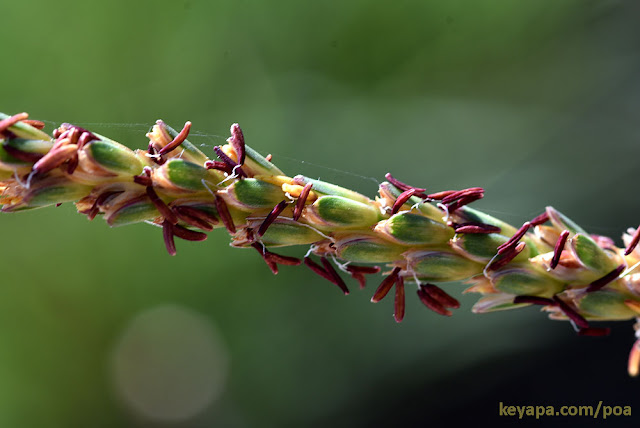
Showing posts with label Trypsacum. Show all posts

Sunday, September 10, 2023

A Short History of Ornamental Grasses

World's Fair Pavilion in Forest Park, in St. Louis

Ornamental non-bamboo grasses have become such a ubiquitous feature of suburban and urban landscapes nowadays, that it might surprise some people that their widespread use is a relatively new phenomenon here in the USA.

This was brought home to me after I visited the World's Fair Pavilion in Forest Park, St. Louis last week.

The park itself is amazingly large, but what interested me most was a building that was surrounded by large stands of beautiful ornamental grasses. This World's Fair Pavilion was built in 1909 from proceeds of the World's Fair that was held in 1904. It's built on top of a hill and is surrounded by a large expanse of lawn and other plants.

Gigantic Panicum virgatum in Forest Park, St. Louis

The largest Panicum virgatum specimens I have ever seen in masses graced both sides of the area in front of the pavilion. There were also stands of Miscanthus sinensis, as well as the usual stately Calamagrostis. These ornamental grasses dominate the landscape today, but pictures of the same pavilion from the 1930s showed no signs of the stately and graceful grasses. Instead, shrubs and bushes and trees were the norm (see image below).

The pavilion in the 1930s. From the Missouri Historical Society. Note the lack of ornamental grasses.

The drastic change in the landscaping is significant. Although the use of bamboo for landscape decoration was popular even during ancient times, ornamental non-bamboo grasses did not enjoy the same popularity. However, during the 1930s, the renowned  German nurseryman, Karl Foerster pushed for their use in Germany and Europe. He collected grass seeds and plants from all over the world, and after cultivating them in his nurseries he introduced them to the market.

Calamagrostis to the left, Panicum virgatum to the right. In Forest Park, St. Louis

Among the many plants he introduced, perhaps his most famous creation is the outstanding ornamental grass Calamagrostis × acutiflora 'Karl Foerster', which he released to the market in 1950 as a natural hybrid of C. epigejos (native to Europe, Asia and Africa) and C. arundinacea (native to Eurasia, China and India).

Calamagrostis in background, Cenchrus setaceus in foreground, in Colorado

This rise in the use of ornamental grasses in Europe was not mirrored in the USA until much later, but various growers were instrumental in pushing for this new paradigm.

In the early 1960s, Kurt Bluemel began the introduction of ornamental grasses into America through his nursery in Maryland, called Kurt Bluemel Inc. Educated in Germany and Switzerland, Bluemel was passionate about grasses, and by the time he passed away decades later, he was well known as Der Gras König, the Grass King. 

Kurt Bluemel. From Baltimore Sun.

He is said to have carried his first grass specimens in his luggage when he came to America, and his collaboration with Wolfgang Oehme, a German-born landscape architect based in Towson, was highly influential in creating a growing appreciation for ornamental grasses in the country. Some of his notable works include creating the savannas at Disney World's Animal Kingdom, and Busch Gardens. 

Panicum virgatum

By the 1980s, the momentum behind ornamental grasses had finally reached a crux, and an influx of growers finally pushed it into the mainstream. In 1986, John and Jill Hoffman established the Hoffman Nursery in North Carolina, which specialized in ornamental grasses. 

John Hoffman. From Hoffman Nursery.

John's interest in ornamental grasses was stoked during a visit to Germany, where he met the plant breeder Ernst Pagels. Pagels was an enthusiastic supporter of grass-filled gardens, and this along with the support of his mentor,  J.C. Raulston at North Carolina State University, fueled his passion. Today, Hoffman Nursery is one of the largest suppliers of ornamental and native grasses in the country.

Miscanthus sinensis

The trend towards landscaping with grasses then moved from the East Coast to the West Coast through the efforts of people like horticulturalist John Greenlee. In order to complete an oak savanna project in California in the 1980s, he travelled to Kurt Bluemel's Nursery in Maryland, where he was astounded by the hundreds of varieties of ornamental grasses that were on display. He ended up trucking a load of the grasses in a tractor trailer from Maryland to California, and after a stint in Brazil with the renowned landscape architect Roberto Burle Marx (who is also held in high esteem in the aroid community), he finally opened the first ornamental grass nursery in the West Coast.

John Greenlee. From Greenlee Meadow Collection.

Fast forward to today, when people routinely use ornamental grasses both in residential and commercial landscaping. And although many of the varieties used are the showy exotics (such as Miscanthus sinensis and Cenchrus setaceus), the use of native grasses as ornamentals (such as Trypsacum dactyloides in Florida, and Bouteloua gracilis in Colorado) is also widespread.
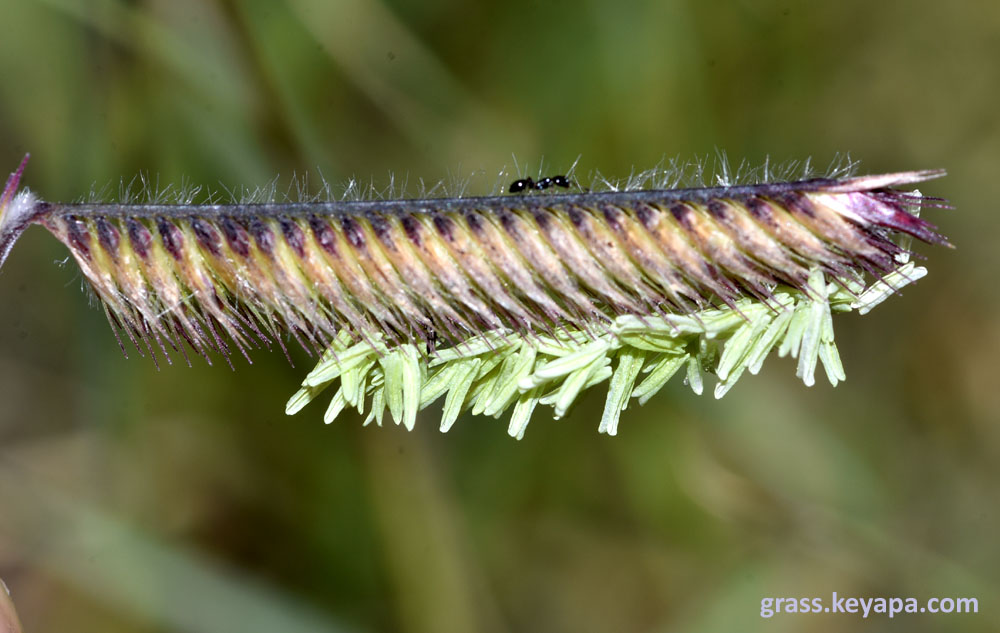
Bouteloua gracilis in Colorado

Meanwhile, new varieties and species continue to be introduced into the market. Not only do they contribute linear structure to a design, but their ease of maintenance, resistance to herbivores like deer, and their ability to impart movement to an otherwise static landscape, make ornamental grasses perfect components for any project.

Looking out from the pavilion in Forest Park, St. Louis. White flowerheads are Miscanthus sinensis cultivars

Tuesday, March 21, 2023

A Flowery Conundrum: Allergic Beauty

Purple pollen bearing anthers in T. dactyloides

 It's that time of the year again when the world conspires to make me as miserable as possible.

This year, the slow change in global climate has resulted in an even earlier start to the allergy season, and pundits note that this will also stretch the season, something that is bad news indeed to countless allergy sufferers like myself.

Nevertheless, I like taking long walks in the afternoon, and while i was strolling along the landscaped sidewalks of our suburban community, I noticed how the rows of ornamental Trypsacum dactyloides (with the common name Eastern Gamagrass)  had started flowering.

The colorful purple anthers of this species are borne on white filaments, and when I stood in front of masses of the columnar spike-like inflorescence, my allergy suddenly took a turn for the worse. I started sneezing, and my eyes started to water somewhat.

Masses of anthers and filaments in the stamens of T. dactylodes inflorescence

My reaction was not surprising, given that some of the inflorescence were positively groaning under the weight of tons of pollen-producing anthers. 

If you remember from previous posts, this species is monoecious, with imperfect (or unisexual) flowers. Monoecious means that there are both male and female flowers on the same individual plant, and unisexual flowers have only either male or female parts. Most grasses have perfect flowers, where both stamens and pistil are present in a flower. 

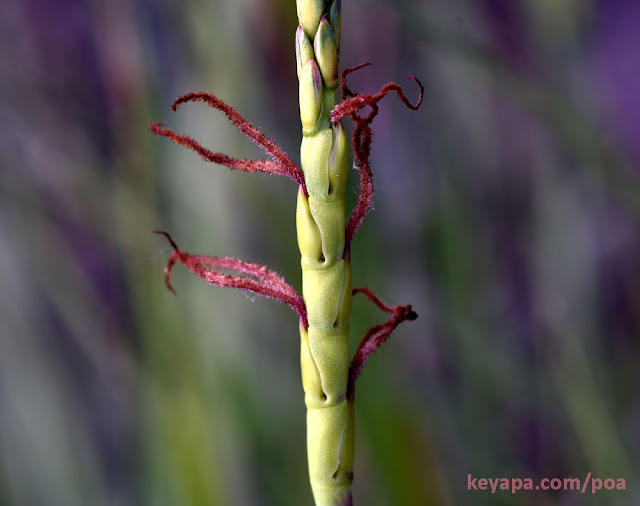
The stamen is composed of anthers and filaments and is the male part of the flower, and the pistils are the female part of the flower. The stigma is the outermost portion of the female pistil, and in this species it is feathery in appearance, and also an attractive purple color. The stigma is involved in capturing pollen from the air, and its feathery appearance probably aids in this function.

A spider hides near a spent stigma and some anthers

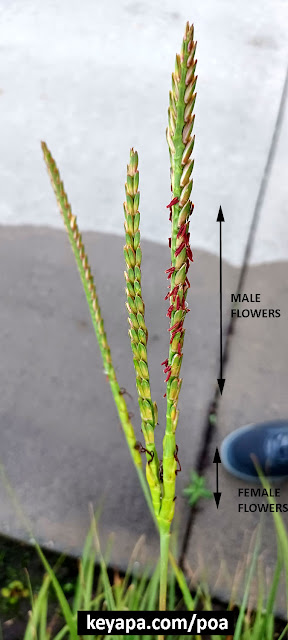
In Trypsacum dactyloides, the male flowers are located on the upper part of the inflorescence, while the female flowers are near the base. I noticed that in some plants, some of the inflorescence have matured anthers, while in the rest of their inflorescence, it is the stigma which is showing first. In other specimens, both anthers and stigma are present at the same time.

Stigma of T. dactyloides

T. dactyloides is native to the area, and I love how landscapers have used it extensively in both commercial and residential properties here in Central Florida. Its dark green leaves and fascinating floral structures make it a very attractive addition to the scenery. But the same colorful flowers that I enjoy so much might also be a major contributor to the misery I feel every time Spring rolls around. Such is the paradoxical nature of life!

Stigma of T. dactyloides


Monday, December 12, 2022

A Fantastic Botanical Caribbean Cruise Trip

Dactyloctenium aegyptium in foreground and our cruise ship in background (in Costa Maya)

We went on our first cruise in 3 years since the pandemic. Our ship landed in 4 destinations, and I spent some time botanizing close to shore. 

The locations varied in terms of the ease of botanizing and the diversity of species found.

Melinis repens in Costa Maya

COCOCAY, BAHAMAS

The first island is wholly owned by Royal Caribbean, and it is a tiny piece of land that is immaculately kept as clean as an urban park.

Most of the specimens I found were ornamental grasses that were deliberately planted, including Trypsacum dactyloides and the fountain grass Cenchrus setaceus (?) .

Trypsacum dactyloides, with male flowers (orangey anthers and filament showing) on the left and female flowers (purple stigma showing) on the right

However,  scattered along the undergrowth I found smaller specimens, such as an Axonopus sp and a single specimen that looks like a tiny Eragrostis or  Poa sp. These tiny weedy species still thrived despite the wholly artificial nature of the location.

COZUMEL, MEXICO

I walked along the Avenida Rafael E. Melgar, the coastal road that leads from the International Cruise Terminal to the downtown proper of San Miguel de Cozumel. It was a pleasant 5 km walk along a well maintained sidewalk, and I descended at times onto the beach proper, which was mostly rocky and small.

Along the way I encountered not only the usual weedy species that seemed to proliferate in all urban locations, but lawn turf grasses and the occasional coastal inhabitants like Paspalum vaginatum. This species had rigid looking leaves and robust stolons, which it used to crawl along the rocky and sandy beaches.

Paspalum vaginatum (inset inflorescence)

I also came upon a few specimens that looked remarkably like Andropogon spp on first look.

Andropogon sp (?)

Many of the larger areas had specimens of Megathyrsis maximus, which managed to rake in some sun along the edges of wooded lots next to the sidewalks.

Megathyrsus maximus spikelets (inset inflorescence), with purple stigmas and yellow-orange anthers

Quite a few areas had the turf grass Cynodon dactylus, which also showed up as escaped specimens in cracked sidewalks and parking lots.

Cynodon dactylum, with white anthers and purple stigmas

Amazingly, I also came upon many more specimens of the same tiny putative Eragrostis or  Poa sp that I had encountered once in Cococay. In one case, it had swamped the original inhabitants of a stone container along the sidewalk!

Unknown Eragrostis sp/Poa sp (?)

But by far the most exciting find I made was a species that I at first was disinclined to think was a grass. It had an inflorescence that looked nothing like the usual spikelets, but I later typed it as Paspalum fimbriatum.

Paspalum fimbriatum

The spikelets of this species had glumes and lemma that formed a fringe around the florets. Its  leaves are relatively broad,  with a slight sinuous quality in some. 

Other specimens that I encountered in Cozumel were:

Melinis repens

Dactyloctenium aegyptium

Dichanthium sp

Cenchrus spinifex (?)

Andropogon sp (?)

Sporobolus jacquemontii (which I also encounter a lot in Florida)

Eragrostis sp (?)

Eustachys sp

Eragrostis sp (?) in Cozumel, Mexico

ROATAN, HONDURAS

This stop was the least attractive in terms of surroundings.  Our ship docked in the center of the city Coxen Hole, and it was raining sporadically the entire time.

I walked east along Main St. after disembarking from the ship, although in hindsight I probably should have gone the opposite direction. 

The empty lots were filled with Megathyrsus maximus, while sprouting from the cracks in the sidewalks and other marginal places I found the usual "weedy" species, including Eustachys sp, Digitaria sp, Echinochloa crus-galli, Eleucine indica, and a single Cenchrus sandbur sp.

I returned to the ship after enduring the sporadic rains for perhaps a couple of hours, with the hope that the next landfall would yield better returns. 

Eustachys sp growing on the rocky beach at the pier 

COSTA MAYA, MEXICO

I was not disappointed, because the stop at the Puerto Costa Maya near the town of Mahahual was the most fruitful of all.

The port itself was clean and large, with the usual tourist shops. But it was the surrounding area that made the area a prime spot for botanizing grasses.

The streets were wide and clean, with resorts and large private homes interspersed with empty lots. Closer to the Port, the wide street (Avenida P del Puerto) did not have sidewalks along the sides, but it instead had a very wide island that was filled with trees and plants. Amazingly enough, a dirt path run through the center of the island, so pedestrians using this "sidewalk" seemed to be in some forest path! It was a rather innovative idea, and one that I had never encountered before.

Path between stands of vegetation in the street island of(Avenida P del Puerto)! A great concept for urban and suburban roads

It goes without saying that I felt safe wandering into the smaller side streets, and just a few blocks from the port I came upon an empty lot that was filled with all sorts of species. 

Field of Botanizing Dreams. Eustachys sp and Dichantium sp in foreground, pinkish Melinis repens in background.

It was a literal field of botanizing delights, with waving masses of Eustachys sp mingling with clusters of pink and red Melinis repens. 

Melinis repens

Other inhabitants included the ubiquitous Dactylocnium aegyptium, Dichantium sp, as well as Cenchrus sp and an unknown species that was probably a Paspalum. There was even a large Megathyrsus maximus to one side.

Eustachys sp (left) and Dichantium sp (right)

Beyond the field I continued in the general direction of Mahuhual Beach, and I continued to encounter interesting specimens.

Once in awhile I came upon individual plants that I typed as Andropogon (perhaps A. virginicus because of a sheath that partly covers the spikelets) , which surprised me, as I always associated that clade with North America, and not tropical regions.

Andropogon sp (?), habit and spikelets

I also found an attractive broad leaved grass that I identified as Paspalum mandiocanum. The leaves had minute dark sinuous curves along their edges, and I found specimens along the sides of one of the main thoroughfares (Carretera A Mahahual).

Paspalum mandiocanum

Even the crabgrasses caught my attention. One specimen had a beautiful sinuously striped rachis and ciliated spikelets, and I typed it as Digitaria ciliaris.

Digitaria ciliaris

I also encountered specimens that I could not type, including a tallish and elegantly slim grass that had alternating green and white appearance to its culms (due to the leaf sheaths staying close to the culm). I typed it to perhaps Hyparrhenia rufa.

Unknown species (Hyparrhenia rufa?)

All in all, it was a great day for botanizing, and a great end to my December Caribbean Cruising trip!


Wednesday, November 30, 2022

Bamboo, Bamboo Look-Alikes, and a 'Miracle' Grass at the Harry P. Leu Botanical Garden

Bambusa vulgaris 'Vittata' (Striped Timber Bamboo)

Bamboos form the subfamily Bambusoideae, and there is no doubt that they are some of the most beautiful grasses around. Their colorful culms, delicate leaves, and the majestic heights reached by some bamboo species, make them a favorite of many plant collectors and  growers, and their economic importance as structural materials is second to none in the Poaceae. In addition, bamboos hold a special place in the cultures of many East Asian countries.

Bambusa malingensis (?) dwarfs passersby

I visited the Harry P. Leu Botanical Garden in Orlando, FL and spent some time marveling over these plants, but also discovered a few other new grasses that I had never encountered before.

As always, the bamboos were probably one of the highlights for many of the people visiting the garden.  People were especially enthralled by the larger specimens, which towered over them and rose to reach the heights of the surrounding trees. Unfortunately, even though there were signs that urged people not to do so, I saw instances of culms with the initials of visitors carved into them. 

Bambusa vulgaris

There is a common misconception that the bamboos are the most "primitive" of the grasses (probably due to the fact some are woody), but recent studies show that the Bambusoideae diverged after the rice subfamily (Oryzoideae), and much later than the three earliest grass subfamilies (Anomochlooideae, Pharoideae, and Puelioideae). More on grass phylogeny in some future post, I promise.

Although many of the specimens I found were varieties of Bambusa vulgaris (Timber Bamboo), there were quite a few other species that caught my eye. 

A medium sized bamboo (Dendrocalamus minor 'Amoenus') that had a bluish tint to its culms entranced me.

Dendrocalamus minor 'Amoenus'

I was also interested in a smallish bamboo with the funny name of Pseudosasa japonica 'Tsutsumiana' that was hidden among its towering brethren. Its form and attractive foliage made me think it would make a nice houseplant, if only it stopped growing at a manageable height! But the highlight of my trip turned out to be some of the non-Bamboo grasses.

Pseudosasa japonica 'Tsutsumiana'

A few of the species that were also in the bamboo section of the park looked remarkably like small bamboo, but were in fact not in the subfamily Bambusoideae at all! 

Thysanolaena latifolia

Thysanolaena latifolia (called Tiger Grass in some places, and Broom Grass in others) had elegant broad leaves, and I thought at first it was another bamboo. The specimen I found in the shade sported dried flowerheads that looked like brooms, and in their native habitat they are in fact used for sweeping.

Thysanolaena latifolia seedheads

Another grass that really caught my attention was a small cutie that only reached to my calf called Pogonatherum paniceum. It looked like a bamboo as well, and it had gorgeous striped leaves and an attractive roundish habit. It is used as an ornamental in some places, and I have a feeling I might get one for my garden someday.

Pogonatherum paniceum

One other specimen that held my attention showed up near the end of my visit. The day was coming to a close, and I was hurrying towards the exit when I came upon an entire section that was dedicated to ornamental, and other, grasses.

In addition to the usual ornamental grass suspects like Miscanthus spp, as well as economically important species like Saccharum officinarum (Sugarcane), the lot had a species that I had been hearing about a lot in my sojourns on facebook, but which I had never seen in person.

Chrysopogon zizanioides (Vetiver grass) habit

Chrysopogon zizanioides, which is also called Vetiver grass, is a species which has its own groups in Facebook, and its many economic benefits has been been touted loudly and repeatedly by its many boosters around the world.

Chrysopogon zizanioides (Vetiver grass) seedheads

C. zizanioides is considered part of a low cost technology solution that has helped to solve various problems. It has a massive root system that grows vertically and deep into the soil, which makes it ideal for erosion control. These same roots also spread and slow down runoff so it passes harmlessly across farmland, and the ability of the grass to tolerate very high levels of heavy metals makes it ideal for soil remediation. It is also used for pest control in that it is attractive to many insect pests (e.g. stem borer moths), which lay their eggs on the plants instead of nearby crops. The larvae who feast on C. zizanioides die due to chemicals in the grass that interfere with their digestive system.

It really is  a so-called 'Miracle' Grass to the many people around the world who have used it! 

Here are some of the species that I discovered and mapped by GPS in the Harry P. Leu Botanical Gardens:

Bamboo:

Bambusa dissimulator
Bambusa eutuldoides 'Viridivittata'
Bambusa malingensis
Bambusa multiplex
Bambusa multiplex 'Golden Goddess'
Bambusa oldhamii
Bambusa textilis var gracilis
Bambusa vulgaris
Bambusa vulgaris 'Vittata' 
Dendrocalamus asper
Dendrocalamus minor 'Amoenus'
Otatea fimbriata
Pseudosasa japonica 'Tsutsumiana'

In addition to the bamboos, I was happy to find some Other Grasses:

Arundo formosana
Chrysopogon zizanioides
Miscanthus spp
Pogonatherum paniceum
Thysanolaena latifolia
Saccharum officinarum
Trypsacum spp

...and a few more that I had no time to survey due to the park closing.

For visitors to the park later, I created a google map of the specimens that I found. You can find it here:


Monday, March 7, 2022

Monoecious Monday: Trypsacum dactyloides

I like taking macrophotographs of grass reproductive structures, and when I was taking some pics of the native ornamental Trypsacum dactyloides (Eastern Gamagrass) I noticed something different. 

Grass flowers are notoriously tiny, and in fact the flowerheads that we see at the macro scale are aggregations of so-called "spikelets", which may contain one to many "florets" (the actual flowers). 

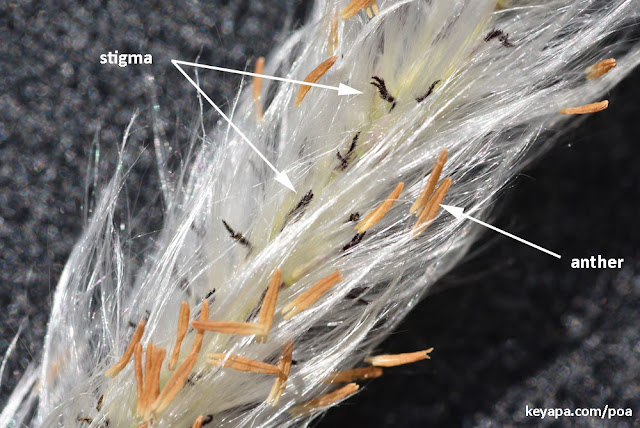
Male (anther) and female (stigma) structures in Imperata cylindrica (cogon grass)

All the florets that I had seen so far have been perfect, with each floret having both male and female parts. 

The male part is the stamen, which is composed of a filament holding up an anther, where the pollen resides. The female part is the pistil, which contains an ovary, a style, and a stigma. The anther and the feathery stigma are what people usually see easily when doing macro of grass flowers.

Feathery stigma and anthers hanging from filaments in Phalaris arundinacea (Reed Canary Grass)

The spikelets of T. dactyloides were surprising to me because at first glance I noticed that the male and female parts seem to be located on different parts, and thus different flowers!

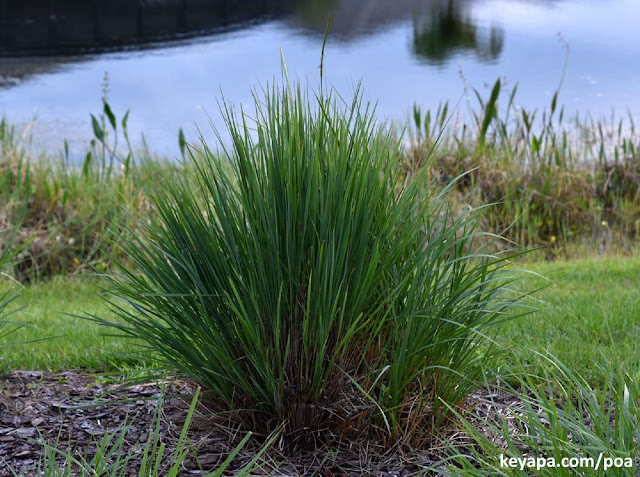
Trypsacum dactyloides is a native grass here in Florida that is widely used as an ornamental, both in city street plantings, and in suburban areas. It is an attractive plant, with wide dark green leaves and a kinda roundish habit.

It turns out that this species, unlike many other grasses, is monoecious, with imperfect (or unisexual) flowers. Monoecious means that there are both male and female flowers on the same individual plant, and unisexual flowers have only either male or female parts. 

Stigma of T. dactyloides

In T. dactyloides, the male florets are situated on the upper part of the grass inflorescence, while the female flowers are located in the lower part of the same inflorescence. This is in contrast to bisexual flowers, which contain both male and female reproductive organs, and which I am more familiar with from my previous photos of other grasses.

Purplish anthers of T. dactyloides
Another grass species which might be more familiar to people and which also is monoecious is maize (Zea mays). In this grass, the male flowers are seen as long "tassels" on the top of the plant, while the female flowers are lower down in the plant and are the ones that form the "ear". The latter is what develops into the corn cob that we all like to eat.

And just to add to the confusion, it should be noted that there are dioecious grasses, although this is even rarer. In this case, the separate male and female flowers are also on separate individual plants! An example of a dioecious grass is Bouteloua dactyloides (buffalo grass). Due to the male and female structures being on different plants, this species needs to cross-pollinate.

But whatever the type, all these species are successful in what they do, given that they are all thriving in today's competitive natural world.