Showing posts with label Invasive. Show all posts

Thursday, November 23, 2023

Buffelgrass invasion in the ABC (and why people should be worried)

Clusters of Cenchrus ciliaris (buffelgrass) with whitish flowerheads in Aruba

To say that the southern Caribbean islands of Aruba, Bonaire, and Curacao (which are fondly called the ABC islands) have a somewhat small number of grass species would be accurate, and these include quite a few invasive species that are also prevalent in many other Caribbean countries.

During my visit to these islands last week, one of the more prominent invasives was Chloris barbata (subfamily Chloridoideae), its digitate inflorescence a common sight in disturbed areas. This species was present not only in the most urban of areas, but it popped up even close to the beaches.

Chloris barbata in Bonaire's Te Amo beach

But a more ominous invasive in the ABC is Cenchrus ciliaris (of the subfamily Panicoideae, syn. Pennisetum ciliare, aka buffelgrass in the USA), which has been notorious for its ongoing threat to the iconic Saguaro in the southwest USA. This species crowds out native vegetation, and because it exists in dense clusters, it can create continuous fuel sources for fires. Such fires are deadly to the Saguaro and other desert plants, which have not evolved to live through it.

Cenchrus ciliaris near Mambo Beach in Curacao 

C. ciliariis is from Africa and parts of the Middle East and Asia, and it was brought to the USA as a source of cattle forage and erosion control. It can tolerate arid conditions, and is thus a good fit in the semi arid environments of the ABC islands.

During a bus excursion around Aruba, I saw large fields of what I took to be this species beyond the main urban areas. But even in the very midst of the few towns that dotted these islands, I found C. ciliaris hiding in plain sight.

Cenchrus ciliaris in middle of road in Curacao

In Curacao, rows of this grass lined the canals emptying into Mambo Beach, and I even found it in the middle of a street in front of the Maritime History Museum!

The presence and continued proliferation of this species in the islands should be worrisome to authorities and to the inhabitants. The history of C. ciliaris in the American Southwest has demonstrated its ability to overwhelm native habitats, and the recent huge fires in Hawaii that killed hundreds is a warning about what can happen if people are surrounded by fire-prone invasive grasses. The fact that buffelgrass has been recorded as burning up to 871 °C, and indirectly recorded to temperatures of 900 °C. (MacDnald et al, 2013), is testament to its potential threat to the environment and people.

Masses of flowering C. ciliaris in Aruba

Hopefully, the authorities in the island have been taking steps to address this before it has the potential to become a major problem.

Literature cited

McDonald, C.J., McPherson, G.R. Creating Hotter Fires in the Sonoran Desert: Buffelgrass Produces Copious Fuels and High Fire Temperatures. fire ecol 9, 26–39 (2013). https://doi.org/10.4996/fireecology.0902026


Monday, September 18, 2023

Second update on the rapid expansion of an invasive grass in Florida

Hillside with cogon grass. From Amazing Lingsat

The previous 2 posts on this topic:

Update on the rapid expansion of an invasive grass (December 30, 2021)

Rapid expansion of an invasive grass as viewed using Google StreetView (April 4, 2021)

About 20 months after the last update (December 30, 2021), I again visited the same location and checked on the pace of expansion of the Imperata cylindrica cluster.

The cogon grass cluster had been expanding at a rate of 0.6 meters per month to one side, and during the last check, it had moved 6 meters to the west (left) of a green optic cable marker (see pic below).

When I visited yesterday, the cluster had expanded laterally another 6 meters before encountering a large low lying tree (see pic below).

Cogon has continued lateral expansion all the way to tree on west (left). September, 2023

The cogon ramets had crowded to the right of the crown of the low lying tree, but has not yet been able to bridge the shadow gap and cross to the other side.

However, I found isolated ramets huddling under the tree's shadow, with the one furthest west about 3 meters in from the crown edge. In addition, the cogon cluster is at the same time growing around the tree from behind. The result of these two activities means that sooner or later, the cogon will make its way to the unshadowed west side of the tree. at which point it should again commence its rapid lateral movement.

Cogon slogging under the tree's shadow towards the other side. September 2023.

The expansion rate of 0.6-0.7 meters per month that I had calculated in previous posts was based on an unshaded environment. It's been 20 months since I checked in Dec 2021, and in that time, the cluster has moved around 9 meters sideways, which comes out to 0.45 meters per month. This is noticeably slower than before, but obviously understandable given the shaded territory that it is trying to cross.

An interesting side topic is the ability of the species to traverse shaded environments. Although there are some indications that cogon grass is able to tolerate some shading, the presence of ramets deep into the shade of the tree might be explained by something more interesting.

As a rhizomatous species, cogon grass may have clonal integration. That is, researchers have found that clusters of interconnected ramets have attributes that cannot be found in non-clonal species. Not only does information flow between the members of the genet, but nutrients and water can be translocated throughout the entire network of ramets. This ability to actively and deliberately move information and other materials allows these clonal grasses to withstand stresses in heterogeneous environments that separated individual plants cannot. 

Thus in this case, the ramets under the crown of the tree might be sustained by photosynthates flowing to it from the unshaded and larger clones. 

More information on clonal integration is discussed here:


I've been rather lax in checking up on this fascinating invasion recently (has 20 months gone already!!), but in future I'll try to update it every 6 months or so. 

Thursday, August 31, 2023

Update on Cogon Grass Reversion in Colorado

The previous article to this is here:

Cogon in Colorado: An Alarming Case of Natural Reversion from the Ornamental Variety

We will be heading back to the east this weekend, but before we leave I spent some time surveying the community for any other reversions.

I found a total of 17 clusters of Imperata cylindrica, and 12 of them had putative reversions. This means that more than 70% of the plantings gave rise to wild type Cogon grass. I mapped all the clusters for use later.

Cogon grass fills a planting area. The "hole" in the middle of the mass is because of the presence of a large sculptured rock

I determined that there was a reversion event by checking whether there were flowerheads and/or the body form had changed to all-green, along with a concomitant increase in height and size. Out of the 12 reverted clusters, a couple had flowerheads, but still had the reddish leaves and smaller size, but most of the reversions were distinctly different in vegetative form than the ornamental.

A short-statured bush is being choked by the surrounding cogon

This reversion of an ornamental form to the dangerous wild type again highlights the problem of ornamentals that are still being sold (including in big box stores) to consumers, even though some of the species are illegal in certain states (and in the case of cogon grass, the species is considered a federal noxious weed).

Unfortunately, the ornamental variety with its red-tinged leaves are beautiful, and even the wild type can be attractive. This is because the blades are quite straight and seem to rise up directly from the ground, and when I showed my wife the imposing stands of reverted cogon grass, she mentioned that they looked nice.

But not only is cogon grass a menace to native species, but it is also prone to causing large fires, and is thus a potential danger to people and human habitation.

Samples have already been given to the state university, and once it has been positively identified, actions to clear the infestations should begin.

Tuesday, August 15, 2023

How Invasive Grasses Killed Hundreds of People in Hawaii During America's Deadliest Fire in a Century

Wildfire near Yosemite National Park, United States, in 2013. (Wikipedia, public domain)

Invasive grasses have long been known to create grass-fire cycles that allow these species to expand rapidly across the environment. In such a process, the grasses provide abundant tinder material for fires, whether started naturally via lightning or through artificial means. Generally, they are optimized for utilizing and promoting fires due to several factors:

(a) their creation of high fuel loads, which refers to how much fuel is present and available to burn. Grasses in general, and invasive grasses in particular can form very high density clusters.

(b) their low live to dead biomass. Annual invasive grasses in particular create vast fields of very dry dead matter after they flower and seed.  

(c) their high surface to volume ratios. Grasses generally have thin blades, which means they have a lot more surface area compared to their interior volume. Higher values are correlated to shorter fuel ignition times, and hence faster fire spread rates.

Add in the fact that grasses typically recover rapidly following fires, and the result is that fires kill off most of their potential competitors, and allow the grasses to expand their range and continue the cycle ad infinitum.

A prime example of such a cycle is one undergone by Taeniatherum caput-medusae (medusahead grass), which along with Bromus tectorum (cheatgrass) and others have devastated vast areas of sage habitats in the Great Basin.

Hawaii is no stranger to invasive grasses, most of which were deliberately introduced as potential forage or as ornamentals, but have since escaped into the wild and have outcompeted the natives in the islands. These include Megathyrsus maximus (called Guinea Grass in that area), Melinis minutiflora (called Molasses grass in some places), and Cenchrus setaceus (called fountain grass in some places).

Megathyrsus maximus spikelets (inset inflorescence), with purple stigmas and yellow-orange anthers

Last week, a massive fire destroyed the town of Lahaina in Maui and became the deadliest fire in the USA in a century. As of this writing, 99 people have been confirmed dead, but officials warn that the final tally could be double or triple that.

The initial cause of the fire is not known, but changes in the climate in Hawaii (including long-term declines in average annual rainfall and drought), coupled with the spread of invasive grasses to produce vast grasslands, are thought to be major factors in creating and maintaining the large wildfires after its initial start.

Escaped Cenchrus setaceus rows in Mulholland Dr, in Los Angeles, California

It's been a few years since I travelled to Hawaii, but I watched the popular TV series Lost a couple years back. This show was mostly shot in Hawaii, and it was interesting to see how many times I saw what seemed to be large expansive stands of Megathyrsus maximus, which is a large species and thus easier to see identify. The clusters were not only in savanna habitats, but also seemed to exist as smaller groups within forested areas.

I also remember visiting California this year, and seeing masses of escaped Cenchrus setaceaus along the roadsides in San Diego and even in Mulholland Drive in Los Angeles, where they doubtless increase the likelihood of spreading and exacerbating any incoming fire.

In the end, this major tragedy again highlights the importance of not only implementing measures to curb and address global climate change, but it should also focus people's attention on the importance of stopping the spread of invasive grasses. 

Perhaps most people may (sadly) not care about the destruction of sage brush habitats by such invasive grasses, but they surely will care about people's homes and lives being lost to the same types of invaders. A good start would be to enact legislation that will address this problem now, including banning or regulating the sale of invasive ornamentals and forage.


Tuesday, July 25, 2023

Cogon in Colorado: An Alarming Case of Natural Reversion from the Ornamental Variety

Click here for a new update to this article.

The highly aggressive Imperata cylindrica is normally considered an invasive weed, but it is sold as an ornamental in some places due to an attractive variety called Japanese Blood Grass or Red Baron.

This variety has reddish leaves and is significantly smaller than the wildtype form. It is also notably less competitive than the latter. In addition, flowering in this variety is extremely rare, and it is cold tolerant. 

Ornamental form in New Jersey

The problem with the ornamental variety is that it has been shown to revert to the aggressive green form under certain environmental conditions, and so this variety cannot be sold, traded, or grown in certain states that have major cogon grass problems. The fear is that it might hybridize with the green form to form very aggressive, and cold tolerant, varieties that can become problematic even in cooler areas.

Cogon grass stand in Broomfield, CO. The dense mass has started to insinuate itself into the nearby shrubbery.

Natural conversion from the ornamental to the green form is probably very rare, and in the many years that I have known it in New Jersey, I never encountered such an event. However, I was walking along a street in Broomfield, CO, when I had to do a double take and take a closer look at a stand of grasses. Rising from the dense mass were flowerheads that looked similar to the distinctive inflorescence of I. cylindrica. 

Spent flowerhead

Most had already lost their spikelets, but a few still had the characteristic fluffy white seeds of the species sticking to them.

White hairy seeds of I. cylindrica from the reverted stand

There was no trace of red blades in the stand, and the grasses were up to more than 1 meter tall, which is significantly taller than I've ever seen the ornamental variety grow. All indications pointed to the fact that these were wild type cogon grass. In fact, the stand looked exactly like any cogon grass stand in Florida, the dense mass almost excluding all other plants from living in it.

Spent flowerhead with a few fluffy seedheads still attached

I surveyed the area and found at least two stands of reverted cogon grass in the vicinity. In the second stand, there was a mixture of both ornamental and green forms, with the green forms sprouting multiple flowerheads as well. In both stands, a few other plants managed to hold onto their spots, including Bromus inermis, which is normally one of the dominant naturalized exotics here in the Boulder area. Most will probably succumb to the much denser and more aggressive I. cylindrica over time.

Dense mass of reverted Cogon grass fills up all the available space. The brown flowerheads to one side are from a few Bromus inermis that have survived in their midst

Broomfield, CO is definitely not a subtropical or tropical location, so to say that I was surprised to find green-form cogon grass in the place would be an understatement. The ornamental variety of cogon grass seems to be used here though, probably because the assumption is that the cold and snow would keep it in "safe mode".

The reverted wild type form is significantly taller than the ornamental form, and is green in color.

However, the record heat prevalent in the southwest right now is probably increasing the average temperature in this area as well. Add in the wet winter and spring this year, and conditions might be optimal enough for the ornamental variety to revert. 

Ornamental form between Calamagrostis spp.

The origin of the cogon grass is likely ornamental forms that had been planted along the sidewalk. I found a couple of these sandwiched in between the usual Calamagrostis ornamentals. 

The question on whether these naturally-reverted forms will continue to survive is important. Will the cold and winter of Colorado convert these back to the ornamental form going forward, or will the warming climate allow it to flourish and start aggressively taking over swathes of the environment?

Time will tell.

Note: I have contacted the relevant authorities who can handle these clusters, so they will probably be extirpated going forward.

Unlikely pairing of Bromus japonicus and Imperata cylindrica "Japanese Blood Grass"

Friday, June 30, 2023

The Purple Sentinels of Mulholland Drive

Cenchrus setaceous in Mulholland Drive

Mulholland drive is a scenic and winding road through the canyons of Los Angeles that connects the Hollywood Hills to Malibu.  It overlooks the City of Angels, and has been the home site of many celebrities, including Madonna, Jack Nicholson, John Lennon, Roman Polanski, Marlon Brando, Demi Moore, and Bruce Willis. Mulholland Drive has also been made rather famous by the movie of the same name, which stars Naomi Watts and is directed by David Lynch.

I visited this famous area last month and drove around the many mysterious and narrow roads that ramified throughout the sheltered canyons. It was a fascinating trip, and one that I had never taken, even though I lived in Los Angeles in the 1990s. I had decided to visit here because of Clive Barker's novel Coldheart Canyon, which is about ghosts in a celebrity mansion that was hidden in one of the many beautiful canyons.

Crowds at Lake Hollywood Park, with the famous Hollywood sign in the background.

While driving through, I could not help but notice that purplish flowerheads decorated some of the canyon sides in very thick masses. I tagged it as Cenchrus setaceus (synonymous with the older name Pennisetum setaceum), which is commonly called fountain grass here in the USA. This species is from the subfamily Panicoideae, and has been heavily used as an ornamental because of its beautiful and abundant inflorescence. In fact, this species is one of the most commonly used ornamental grasses in Florida.

C. setaceus lines road, with hills and mansions in the background.

C. setaceus is a C4 bunchgrass that is not native to the USA, and hails instead from North Africa and Western Asia. It is particularly aggressive in warm, arid environments with full sun. Unfortunately, this makes Southern California an almost perfect place for it to grow, and it has escaped from cultivation and become invasive. It outcompetes other herbaceous native plants to decrease diversity and available habitats for wildlife, and also significantly increases the chances of fires in the area. To add insult to injury, the species is not good forage. 

C. setaceus with Washingtonia palm in background

All these negatives of course passed through my mind as I drove along Mulholland Drive and gazed at the passing masses of purple flowerheads. But I also had to acknowledge the beauty of the sight, one that tourists probably noticed as well. Perhaps they even think that the specimens along the road were planted deliberately to beautify the surroundings, an ironic twist to the current fate of this invasive grass, given that it was originally brought here as part of the horticultural trade.

C. setaceus pushing against native Opuntia (?) cacti

There are of course other invasive weedy grasses along that road, including the almost ubiquitous Avena fatua/Avena barbata, which dot the hillside, albeit in smaller numbers than in more natural settings. But fountainhead grass is surely the most noticeable, and the most attractive. So the next time you travel to Southern California and decide to visit the canyonlands of the City of Angels, keep an eye out for the Purple Sentinels of Mulholland Drive. 

PS. Coincidentally, it's been an interesting month that has just passed, one that was celebrated by and for the LGBTQ+ community. Its symbol, the Rainbow Flag, has a purple/violet band, which stands for spirit - for the courage, energy, and determination to stand up to bullying and oppression. This is something that is sadly needed in today's world, where it has become okay to persecute those who are "others". So here's to all the brave people who just want to be and show who they are. Be strong.

Tuesday, March 28, 2023

Mutual Assured Destruction: Revisiting an unlikely occupation

Flowering inflorescence of Imperata cylindrica, with orange anthers and purple stigmas

About a year ago, I wrote about how an invasive grass (Imperata cylindrica) started taking over an island in the parking lot of a building complex.

March 2022

A month or so after I posted that, the owner of the lot acted and when I next saw the lot in May, the entire island had been stripped of its vegetation and probably drenched in herbicides. They had pulled the trigger and given up on being able to selectively weed out the invasive, assuring the destruction of both the invasive grass and all the ornamental plants around it. Even so, I still saw a few blades of cogon grass poking out of the scene of destruction.

May 2022

I visited the area again last week, and the island was still bare, with even the two trees seemingly dead. The owners must have been repeatedly treating it in order to prevent any new regrowth of I. cylindrica. This repeated treatment and monitoring for a minimum of 2 years is a common practice when treating I. cylindrica infections, in order to ensure total eradication.

March 2023

I decided to revisit this old haunt because I had encountered another cluster of I. cylindrica that was weirdly similar to the situation in that parking island last year. In this new case, the invasive grass had grown on the mulched beds of two sidewalk Palm trees, and covered almost 20 m2 at the bases of the trees. 

I. cylindrica cluster around the bases of sidewalk Palm trees

I had spotted it even from a distance because some of the ramets in the cluster were flowering, even though they had been cut close to the ground. When I came near I noticed that the white flowerheads were covered in orange anthers and purple stigmas.

I'm very surprised the cluster had avoided being eliminated by the groundskeepers in the neighborhood, who are usually quite liberal with the use of herbicides to keep most of the area weed free. Perhaps the presence of the palm trees, which are also monocots and thus susceptible to the same types of chemicals as grasses, had so far dissuaded them from acting.

I'm also slightly surprised that the thick mulch (tree bark) around the tree bases have had very little effect in preventing the spread of the invasive. The tenacity of this species can be admirable, even as the authorities curse its weedy nature, and I'll be sure to revisit the cluster occasionally when I can to see how it fares.

A nearby field of flowering I. cylindrica

Friday, August 26, 2022

A New Invader: "Villainous" Ventenata and the Invasion of a Native Ecosystem

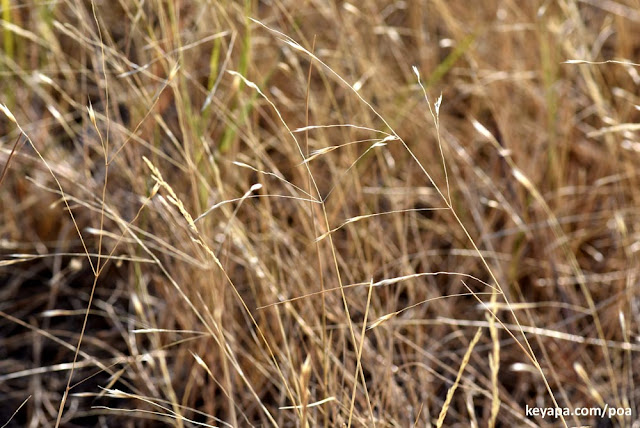
Wispy inflorescence of Ventenata dubia in foreground

In an earlier post I discussed how a group of winter annual grasses are spreading like wildfire in the vast Sagebrush ecosystem in the western part of the USA. 

This armageddon is destroying not only the pristine sagebrush shrubs which are critical to numerous animals like the sage grouse, but it also is significantly lowering the forage value of the land as palatable perennial grasses are replaced by the mostly unpalatable invasives.

In addition to earlier invasives like Bromus tectorum (cheatgrass) and Taeniatherum caput-medusae (medusahead grass), a newer species has been creating problems for land managers.
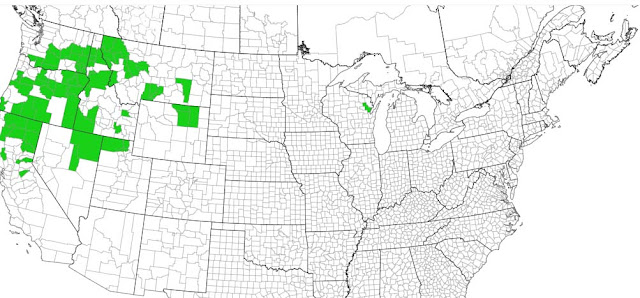
Distribution of V.dubia (EDDMaps, 2022)

Ventenata dubia was first discovered in Washington State in the early 1950s.  It is native to Southern Europe and North Africa, and it has rapidly spread at the rate of 1.2 million hectares per year (Native Invasive Plant Council, 2001), which means an area three times the size of Rhode Island is being invaded every year! It now is found in 11 states and 5 Canadian provinces, and land managers are frantically trying to slow its spread while it is still possible to do so.
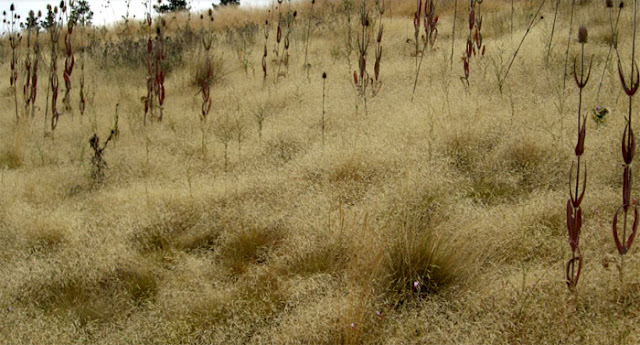
Invasion by Ventenata dubia (photo credit: Novak et al)

Like other winter annual grasses that have caused havoc in the local ecosystem, V. dubia tends to create a so-called grass-fire cycle, where its presence increases the probability of fires, which in turn removes its competitors and allows it to overran the area. Another way that winter annuals can outcompete other plants is by germinating in fall or early winter, and senescing by mid-summer. This gives it a head start when it comes to taking advantage of the early spring moisture.
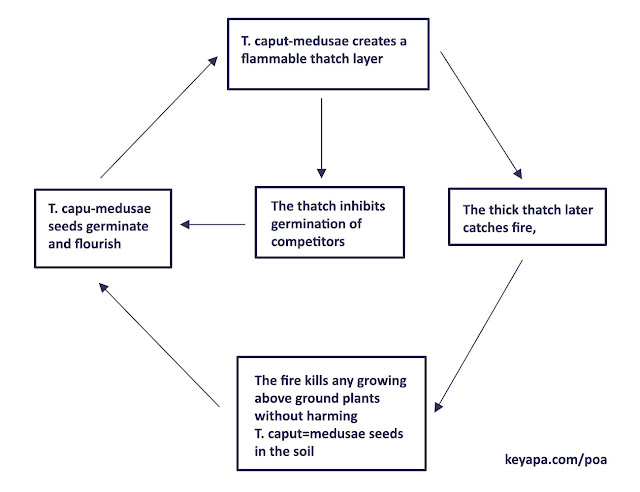
The grass-fire cycle of T. caput-medusae

This species has only recently arrived in Montana, and while botanizing in a local park in the city of Bozeman, I stumbled on a small cluster hidden amongst the other grasses.

On first look, the grass does not exactly inspire dread. Unlike T. caput-medusae with its alien looking inflorescence, or B. tectorum with its multitudes of sharp spear-like awns, V. dubia looks like a puny weakling that would roll over with the smallest puff of wind.
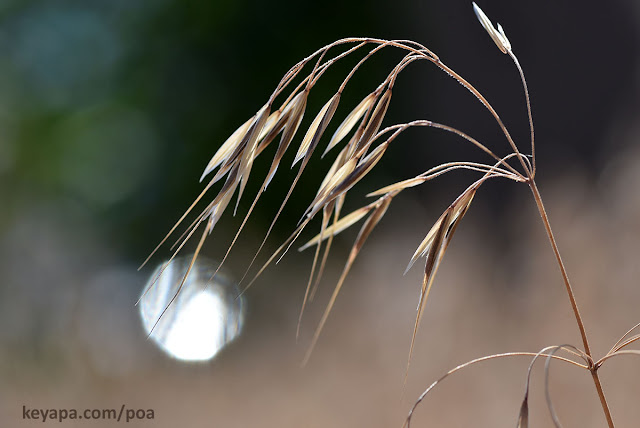
The sharp spear-like awns on B.tectorum is more intimidating than the diffused panicles of V. dubia

The inflorescence of this species is a spread out panicle, and its thin culm ends at the base with very shallow roots. But its outward appearance belies the heart of a bully. Some studies have shown that invasion by V. dubia in hay fields can result in losses of up to 50% (Prather and Steele, 2009), and like other hegemonic invaders, the diversity of native species suffers when it starts taking hold in an area (Jones et al, 2020).
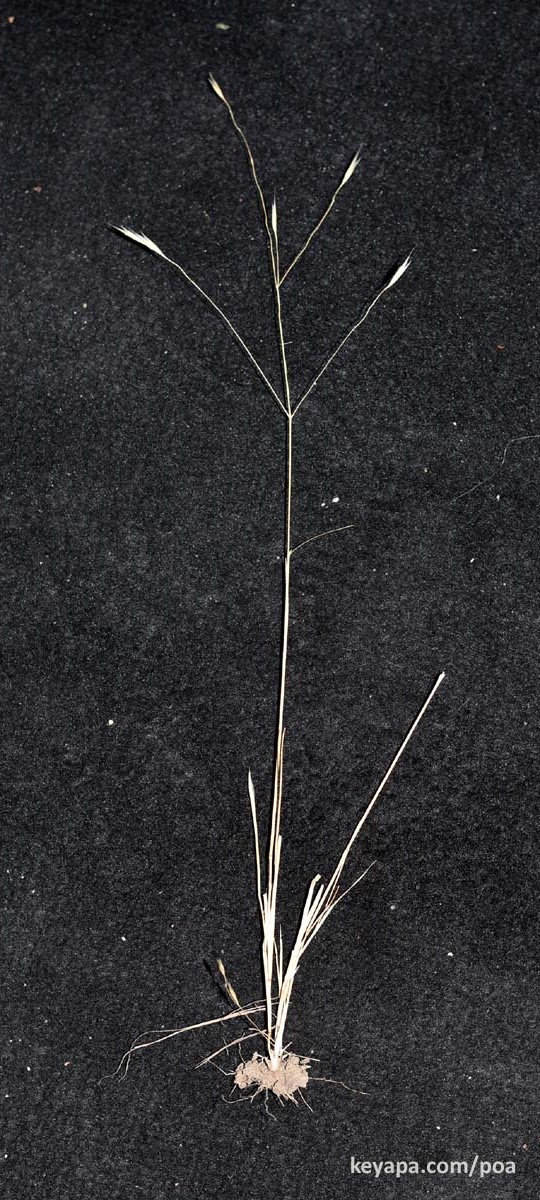
Ventenata dubia whole plant. Notice weak shallow roots

Even more frightening is the fact that this new invader seems to be able to successfully dominate habitats that earlier invasives like T. caput-medusae and B. tectorum cannot. In one study researchers found that it had invaded dry forest, woodland, and forest scablands ranging from 1250-1665 m of elevation, places which previously had been relatively immune to winter annual grass invasions. This is important to note, because it means that the spread of this species has increased the overall footprint of invasive annual grasses in the already battered Western USA (Applestein et al, 2022; Tortorelli et al, 2020).
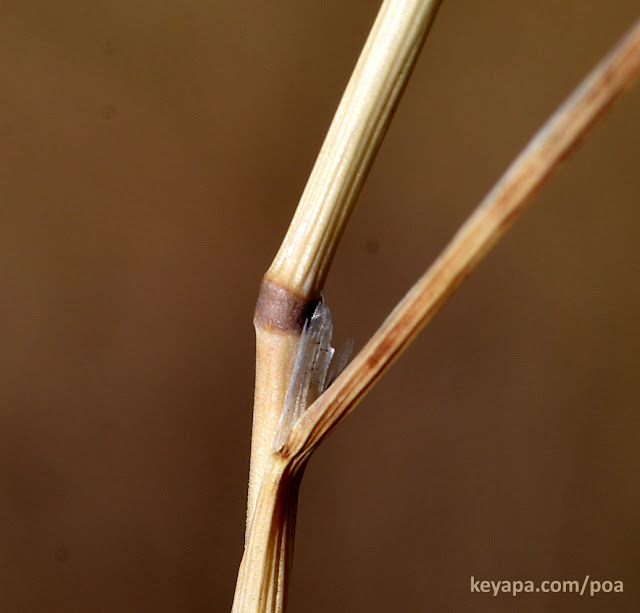
Very long ligule of V. dubia and the remnant dark red color of a node

I must admit I was lucky in finding the small cluster in that park in Bozeman, MT. The small size of V. dubia and its open diffuse panicles made it hard to distinguish from the masses of other dried grasses that dominated the landscape. 

But the specimens I found had panicles with horizontal branches that almost diverged at 90 degree angles, and the spikelets (the structure that holds the grass flowers) on the panicles were restricted to the ends of these branches, both of which are characteristics of the species. A quick check of the ligules (the membrane between the top part of a blade and the culm) also pointed to them as being V. dubia: the species has relatively long and large ligules. The very shallow roots of one specimen that I carefully uprooted is another characteristic of V. dubia, as is the dark nodes that were red earlier in its life cycle.

Dried spikelets of V. dubia with ribbed glumes and lemma with long awns.

Magnification also offered other clues as to their identity. The dried spikelets had no seeds, but each spikelet had a conspicuous lemma (a bract like  structure enclosing a flower) with a protruding awn, and the glumes (the two bracts enclosing the spikelet) were distinctly ribbed along the long axis.

The small infestation that I found may not remain so small, given the nature of V. dubia. But perhaps the much larger grasses around it will contain its spread, or perhaps it will be eradicated after its presence has been reported. Only time will tell.

As a last note, the spread of V. dubia is another major problem in an endangered ecosystem that many people don't even know about. But there is nothing "evil" or even "villainous" about the species, notwithstanding the title of the post. We tend to anthropomorphize other organisms when in the heat of emotion, but this species (like all the other "weedy" plants) is simply doing what it needs to do  in order to survive and prosper, with no malice in whatever green heart it has.

Literature Cited

Applestein, C., Germino, M.J. Patterns of post-fire invasion of semiarid shrub-steppe reveals a diversity of invasion niches within an exotic annual grass community. Biol Invasions 24, 741–759 (2022). https://doi.org/10.1007/s10530-021-02669-3

EDDMapS. 2022. Early Detection & Distribution Mapping System. The University of Georgia - Center for Invasive Species and Ecosystem Health. Available online at http://www.eddmaps.org/; last accessed August 26, 2022.

Jones, L., Davis, C., & Prather, T. (2020). Consequences of Ventenata dubia 30 years postinvasion to bunchgrass communities in the Pacific Northwest. Invasive Plant Science and Management, 13(4), 226-238. doi:10.1017/inp.2020.29

Stephen J. Novak, Massimo Cristofaro, Dorothy Maguire1, and Rene F.H. Sforza. The Invasive Grass Ventenata (Ventenata dubia): A New Threat for Nevada

Prather, T. S., and V. Steele. 2009. Ventenata control strategies found for forage producers.

Tortorelli, C, Krawchuk, M, Kerns, B. Expanding the invasion footprint: Ventenata dubia and relationships to wildfire, environment, and plant communities in the Blue Mountains of the Inland Northwest, USA. Appl Veg Sci. 2020; 23: 562– 574. https://doi.org/10.1111/avsc.12511

Thursday, June 30, 2022

At My Signal, Unleash Hell: How Invasive Annual Grasses Use Pestilence Against Their Native Perennial Rivals

Taeniatherum caput-medusae (Medusahead Grass) Inflorescence

In previous posts, I touched upon some of the ways invasive grasses manage to overwhelm native populations. 

Usually, this involves having some direct competitive advantage over their rivals. This may include pathogen release (they leave behind all the pathogens that afflict them back in their own native land), some intrinsic competitive abilities, or through some life cycle advantages (for example, as in the diagram below, the ability of Taeniatherum caput-medusae or Medusahead Grass to create flammable litter that prevents competitor germination and clears the rest via frequent wildfires).

How T. caput-medusae (Medusahead Grass) dominates its competitors

Amazingly, however, a new way that invasive annual grasses manage to dominate their perennial native rivals has been discovered. In California, more than 9 million ha of land have been invaded by European winter annual grasses like Avena fatua (Wild Oats), which have usurped the native perennial bunchgrasses. Vast fields of these invasives have paradoxically enough, created the so-called "Golden Hills of California", which have become iconic to that region.

Golden Hills of California

The ability of these invaders to dominate the landscape was thought to be through direct competition with native perennial bunchgrasses, such as Nassella (Stipa) pulchra and Elymus glaucus. But some studies showed that the exotics were in fact poor direct competitors, and other factors were needed to explain their dominance. 

Avena fatua, an exotic and invasive annual grass in California

One of these factors turned out to be a virus!

The barley and cereal yellow dwarf viruses (B/CYDVs) are a family of viruses that are generalized pathogens of grasses, and can cause stunting and slow growth. They travel from host to host via intermediate vectors, which are various species of aphids. The aphids take in the virus from an infected plant when they suck on the phloem, and then transfer it to another plant when they move to new pastures.

Aphids on spikelets of T. caput-medusae (Medusahead Grass)

The invasive grasses compete against their perennial grass rivals by amplifying the population of the aphids, and this in turn significantly increases the pool of infectious viruses. Researchers found that aphids not only were much more attracted to the exotic annual grasses, but that their fecundity increased significantly in the presence of these species. Aphid densities were up to 800 times greater in areas with dense stands of the invasive annual A. fatua, and the infection rate of native grasses with B/CYDV more than doubled! The negative effect of this pathogen on perennial bunchgrasses is more severe than on the short-lived annuals, and this difference is enough to tip the scales of the competition.

By unleashing the viral pathogens against their more vulnerable perennial rivals, A. fatua and other exotic annual grasses have managed to dominate the California landscape. This unusual type of competition (called "apparent competition"), seems to also be available to other exotic annual grasses such as T. caput-medusae, which typically dominate their own areas through more direct methods.

Golden Medusahead Grass carpeting the ground in Oregon

References:

Borer ET, Adams VT, Engler GA, Adams AL, Schumann CB, Seabloom EW. Aphid fecundity and grassland invasion: invader life history is the key. Ecol Appl. 2009 Jul;19(5):1187-96. doi: 10.1890/08-1205.1. PMID: 19688926.

Malmstrom, C.M., McCullough, A.J., Johnson, H.A. et al. Invasive annual grasses indirectly increase virus incidence in California native perennial bunchgrasses. Oecologia 145, 153–164 (2005). https://doi.org/10.1007/s00442-005-0099-z