Showing posts with label Cogon grass. Show all posts

Thursday, November 30, 2023

Cruising the Ocean and a Sea of Grass.

Looking out at the ocean from the balcony of a Celebrity cruise ship

We took a cruise this month, and we had a balcony that allowed us to watch the ocean from our stateroom. I spent many hours just sitting and reading and watching the sea go by, and marveling at the immensity of the view outside.

Looking out at the ocean always makes me feel small, almost insignificant. Its vastness, its seeming permanence, puts many things into perspective.  Paradoxically, it also imbues me with a deep serenity that makes cruising a favorite way to relax in between bouts of work.

In almost the same way, looking out across vast grasslands gives me the same feelings. There is this spot nearby with a large field of grass where I sometimes park my car and just spend an hour or two reading. The panorama might be a colorful green or a rust red instead of the dark blue of the seas, but the solitude and the tranquility of the landscape never fails to make me happy. 

I sit and read by a sea of grass

This equivalence between an ocean and vast grasslands is replete in literature and history.

When European settlers first arrived, they encountered what many described with wonder and awe as a  "sea of grass" that spread for 60 million ha, and stretched from the Rocky Mountains to what is now Indiana, and from Texas north into Canada. These were of course the prairies of that time, most of which have been diced and sliced and now occupy but a fraction of their previous immense area.

But the feelings of almost religious wonder at the vastness of grasslands might actually be inherent in our makeup. In Egyptian mythology, the afterlife is depicted as an endless Field of Reeds (A'Aru),  where the souls of people who have passed away can exist in a bountiful paradise. 

Field of Reeds (Moon Knight, Marvel)

In a similar way, the acclaimed film Gladiator depicts the afterlife as a vast field of wheat, with the protagonist running his hands through the wheat in one of the most iconic scenes in the movie.

The endless fields of wheat in the film Gladiator

In Dan Simmons' Hyperion, the planet Endymion contains a region called the Sea of Grass, which the protagonists must cross using so-called wind-wagons that surf above the meters tall "grass".

Dan Simmons' Hyperion and The Sea of Grass

"My God," breathed Brawne Lamia.

It was as if they had climbed the last hill of creation. Below them, a scattering of docks, wharves and sheds marked the end of Edge and the beginning of the Sea. Grass stretched away forever, rippling sensually in the slight breeze and seeming to lap like a green surf at the base of the bluffs. The grass seemed infinite and seamless, stretching to all horizons and apparently rising to precisely the same height as far as the eye could see. There was not the slightest hint of the snowy peaks of the Bridle Range, which they knew lay some 800 kilometers to the northeast. The illusion that they were gazing at a great green sea was nearly perfect, down to the wind-ruffled shimmers of stalks looking like whitecaps far from shore.

"It's beautiful," said Lamia, who had never seen it before.

Barring aside the improbability of windwagons being borne on the tops of masses of plants (no matter how strong the culms), the idea of travelling above vast seas of grass to distant lands is irresistibly attractive, and even romantic. Perhaps such adventures will be possible in far-off places with less gravity than ours, but for now, I'm content to just spend time by my decidedly more earthly landscape.

*sighs and goes back to reading Hyperion, while gazing at the dark brooding masses of clouds now gathering above his Sea of Grass*

Where's that windwagon?


Thursday, August 31, 2023

Update on Cogon Grass Reversion in Colorado

The previous article to this is here:

Cogon in Colorado: An Alarming Case of Natural Reversion from the Ornamental Variety

We will be heading back to the east this weekend, but before we leave I spent some time surveying the community for any other reversions.

I found a total of 17 clusters of Imperata cylindrica, and 12 of them had putative reversions. This means that more than 70% of the plantings gave rise to wild type Cogon grass. I mapped all the clusters for use later.

Cogon grass fills a planting area. The "hole" in the middle of the mass is because of the presence of a large sculptured rock

I determined that there was a reversion event by checking whether there were flowerheads and/or the body form had changed to all-green, along with a concomitant increase in height and size. Out of the 12 reverted clusters, a couple had flowerheads, but still had the reddish leaves and smaller size, but most of the reversions were distinctly different in vegetative form than the ornamental.

A short-statured bush is being choked by the surrounding cogon

This reversion of an ornamental form to the dangerous wild type again highlights the problem of ornamentals that are still being sold (including in big box stores) to consumers, even though some of the species are illegal in certain states (and in the case of cogon grass, the species is considered a federal noxious weed).

Unfortunately, the ornamental variety with its red-tinged leaves are beautiful, and even the wild type can be attractive. This is because the blades are quite straight and seem to rise up directly from the ground, and when I showed my wife the imposing stands of reverted cogon grass, she mentioned that they looked nice.

But not only is cogon grass a menace to native species, but it is also prone to causing large fires, and is thus a potential danger to people and human habitation.

Samples have already been given to the state university, and once it has been positively identified, actions to clear the infestations should begin.

Tuesday, July 25, 2023

Cogon in Colorado: An Alarming Case of Natural Reversion from the Ornamental Variety

Click here for a new update to this article.

The highly aggressive Imperata cylindrica is normally considered an invasive weed, but it is sold as an ornamental in some places due to an attractive variety called Japanese Blood Grass or Red Baron.

This variety has reddish leaves and is significantly smaller than the wildtype form. It is also notably less competitive than the latter. In addition, flowering in this variety is extremely rare, and it is cold tolerant. 

Ornamental form in New Jersey

The problem with the ornamental variety is that it has been shown to revert to the aggressive green form under certain environmental conditions, and so this variety cannot be sold, traded, or grown in certain states that have major cogon grass problems. The fear is that it might hybridize with the green form to form very aggressive, and cold tolerant, varieties that can become problematic even in cooler areas.

Cogon grass stand in Broomfield, CO. The dense mass has started to insinuate itself into the nearby shrubbery.

Natural conversion from the ornamental to the green form is probably very rare, and in the many years that I have known it in New Jersey, I never encountered such an event. However, I was walking along a street in Broomfield, CO, when I had to do a double take and take a closer look at a stand of grasses. Rising from the dense mass were flowerheads that looked similar to the distinctive inflorescence of I. cylindrica. 

Spent flowerhead

Most had already lost their spikelets, but a few still had the characteristic fluffy white seeds of the species sticking to them.

White hairy seeds of I. cylindrica from the reverted stand

There was no trace of red blades in the stand, and the grasses were up to more than 1 meter tall, which is significantly taller than I've ever seen the ornamental variety grow. All indications pointed to the fact that these were wild type cogon grass. In fact, the stand looked exactly like any cogon grass stand in Florida, the dense mass almost excluding all other plants from living in it.

Spent flowerhead with a few fluffy seedheads still attached

I surveyed the area and found at least two stands of reverted cogon grass in the vicinity. In the second stand, there was a mixture of both ornamental and green forms, with the green forms sprouting multiple flowerheads as well. In both stands, a few other plants managed to hold onto their spots, including Bromus inermis, which is normally one of the dominant naturalized exotics here in the Boulder area. Most will probably succumb to the much denser and more aggressive I. cylindrica over time.

Dense mass of reverted Cogon grass fills up all the available space. The brown flowerheads to one side are from a few Bromus inermis that have survived in their midst

Broomfield, CO is definitely not a subtropical or tropical location, so to say that I was surprised to find green-form cogon grass in the place would be an understatement. The ornamental variety of cogon grass seems to be used here though, probably because the assumption is that the cold and snow would keep it in "safe mode".

The reverted wild type form is significantly taller than the ornamental form, and is green in color.

However, the record heat prevalent in the southwest right now is probably increasing the average temperature in this area as well. Add in the wet winter and spring this year, and conditions might be optimal enough for the ornamental variety to revert. 

Ornamental form between Calamagrostis spp.

The origin of the cogon grass is likely ornamental forms that had been planted along the sidewalk. I found a couple of these sandwiched in between the usual Calamagrostis ornamentals. 

The question on whether these naturally-reverted forms will continue to survive is important. Will the cold and winter of Colorado convert these back to the ornamental form going forward, or will the warming climate allow it to flourish and start aggressively taking over swathes of the environment?

Time will tell.

Note: I have contacted the relevant authorities who can handle these clusters, so they will probably be extirpated going forward.

Unlikely pairing of Bromus japonicus and Imperata cylindrica "Japanese Blood Grass"

Tuesday, March 28, 2023

Mutual Assured Destruction: Revisiting an unlikely occupation

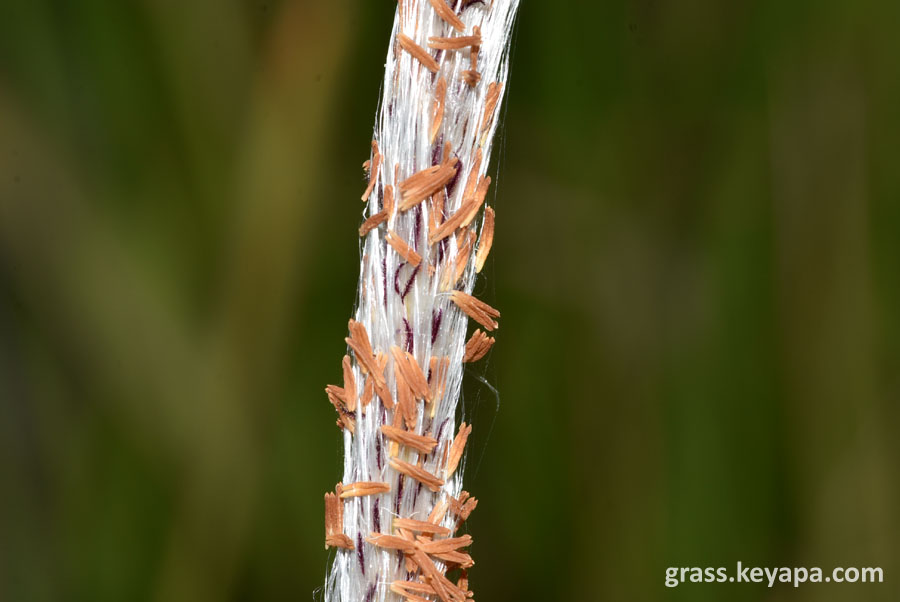
Flowering inflorescence of Imperata cylindrica, with orange anthers and purple stigmas

About a year ago, I wrote about how an invasive grass (Imperata cylindrica) started taking over an island in the parking lot of a building complex.

March 2022

A month or so after I posted that, the owner of the lot acted and when I next saw the lot in May, the entire island had been stripped of its vegetation and probably drenched in herbicides. They had pulled the trigger and given up on being able to selectively weed out the invasive, assuring the destruction of both the invasive grass and all the ornamental plants around it. Even so, I still saw a few blades of cogon grass poking out of the scene of destruction.

May 2022

I visited the area again last week, and the island was still bare, with even the two trees seemingly dead. The owners must have been repeatedly treating it in order to prevent any new regrowth of I. cylindrica. This repeated treatment and monitoring for a minimum of 2 years is a common practice when treating I. cylindrica infections, in order to ensure total eradication.

March 2023

I decided to revisit this old haunt because I had encountered another cluster of I. cylindrica that was weirdly similar to the situation in that parking island last year. In this new case, the invasive grass had grown on the mulched beds of two sidewalk Palm trees, and covered almost 20 m2 at the bases of the trees. 

I. cylindrica cluster around the bases of sidewalk Palm trees

I had spotted it even from a distance because some of the ramets in the cluster were flowering, even though they had been cut close to the ground. When I came near I noticed that the white flowerheads were covered in orange anthers and purple stigmas.

I'm very surprised the cluster had avoided being eliminated by the groundskeepers in the neighborhood, who are usually quite liberal with the use of herbicides to keep most of the area weed free. Perhaps the presence of the palm trees, which are also monocots and thus susceptible to the same types of chemicals as grasses, had so far dissuaded them from acting.

I'm also slightly surprised that the thick mulch (tree bark) around the tree bases have had very little effect in preventing the spread of the invasive. The tenacity of this species can be admirable, even as the authorities curse its weedy nature, and I'll be sure to revisit the cluster occasionally when I can to see how it fares.

A nearby field of flowering I. cylindrica

Saturday, November 27, 2021

The Vexing Problem of Invasive Ornamental Grasses

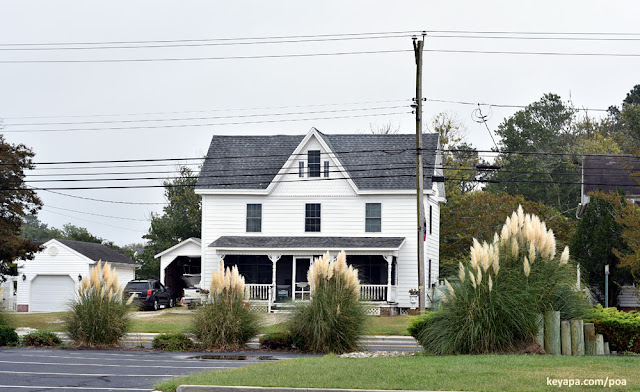
Cortaderia  selloana in Virginia 

The use of ornamental grasses has been growing rapidly since the 1970s, when Cortaderia selloana (pampas grass) and Festuca glauca (blue fescue) were the only well known ornamental grasses sold in West Coast retail stores.

It's a different situation today, with ornamental grasses gracing many residential and commercial areas, and even having their own sections in gardening stores.  

But look closely at the selection in many stores and you'll come to realize that many (if not most) of the ornamental grasses are not native to the region in which they are being sold.

Huge Cortaderia selloana on sidewalks in Virginia 

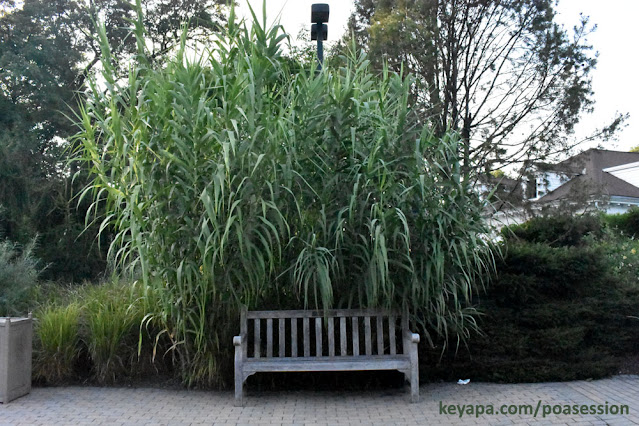
Unfortunately, many people select ornamental  grasses without any consideration about their potential for harming the environment, and  the horticultural industry itself may exacerbate  the problem by continuing to sell plants that have been proven to be invasive. This lack of awareness extends to even reputable botanical gardens and arboretum, and I have repeatedly seen some institutions make heavy use of ornamental grasses like Miscanthus sinensis. Granted, these non-native grasses are often beautiful, but this dependence on such cultivars creates problems due to the potential invasiveness of the species. 

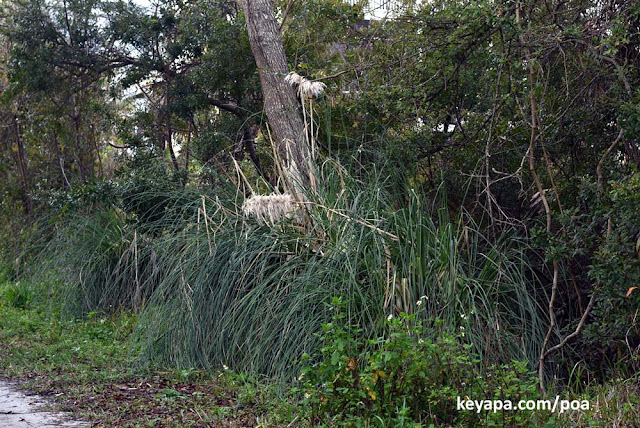
Escaped Cortaderia selloana in Florida

It's not all black and white though. What may be invasive in one region, might be relatively benign in another clime. For example, Imperata cylindrica is one of the most invasive grass in many subtropical and tropical areas in the world, but a red  cultivar (called Japanese Blood Grass)  is relatively harmless in colder areas, even though it can allegedly revert to an all-green invasive form when grown in a more suitable climate.


Large Miscanthus sinensis in parking lot of suburban strip mall in NJ

However, a species that may at first seem non-invasive can become invasive over time. This might have been the case with the popular  Cortaderia selloana (pampas grass) from South America.

Escaped Miscanthus sinensis at forest edge in NJ

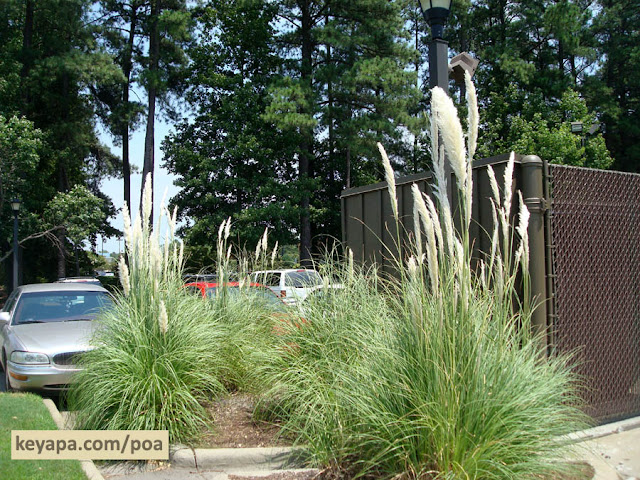
This species became very popular in the late 19th century, with society becoming enamored of the large pure white inflorescence and using it almost everywhere. At one point, half a million of the plumes were being sold yearly. But for decades, the invasive nature of C. selloana seems to have been overshadowed by a close relative. C. jubata. In fact, even in the 1970s, researchers reported most of the infestations they found were of C. jubata, and non-cultivated C. selloana did not exist far from human habitation. This seems to have changed by the 1990s, when new surveys showed that C. selloana had become the more invasive of the two, with outcrossing populations found in many different native habitats. Even the morphology of these populations had changed, with the pure white plumes becoming darker.

Arundo donax in an arboretum in NJ

There are sterile options when it comes to non-native ornamental  grasses, including hybrids of M. sinensis. These can be a way out of the trap of desiring particular grasses that have the potential to be invasive, although consumers have to do their research  before buying such species.

In the end, there are several possible solutions to the problem of invasive  ornamental  grasses:

  1. Make it illegal for the retail industry to sell invasive species, and enforce the law.

  2. If possible, sell sterile cultivars of any non-native species.

  3. Continue to inform people about the problems associated with non-native ornamentals, even those that do not seem to be currently invasive.

  4. Promote the use of native ornamental grasses, such as Panicum virgatum, Schizachyrium scoparium, and Andropogon gerardii cultivars. Emphasize not only the environmental reasons for using these, but also their beauty and adaptability.
Only through the rigorous implementation of all these will we be able to make sure we continue to protect the integrity and beauty of our native habitats.

Cortaderia selloana in North Carolina parking lots

References

Lambrinos, JG (2004). A tale of two invaders. The dynamic history of pampas grass and jubata grass in California. Cal-IPC News. Vol. 12, Nos. 3/4


Saturday, May 8, 2021

A rare flowering of Japanese Blood Grass - that isn't so rare after all...


Last year I posted about the flowering of my ornamental Japanese Blood Grass (Imperata cylindrica), and noted that such flowerings were supposedly very rare. 

Interestingly enough, I was surprised to find that the same cluster of JBG had again flowered this year (and at about the same date!), with 2 flowerheads coming out of some of the more peripherally positioned ramets.

The flowerheads were already a bit spent, and the drizzle that caused them to droop under the water load did not help when I first saw them, but there was no question that flowering of JBG may not be so rare after all. Although perhaps some unique environmental condition in that cluster's location is causing this annual flowering, it's certainly unusual for this to happen (according at least to reports on the web).


Sunday, April 4, 2021

Rapid expansion of an invasive grass as viewed using Google StreetView

Cogon grass flowering
Last month I talked about using Google Street View as a tool to view the progress of invasive species over time. The example I used showed how a row of Neyraudia reynaudiana (Burma Reed) appears and fills the side of a road over the course of several years, but one cannot tell from the images whether it was outcompeting other plants or simply filling an empty niche.

In contrast, the series of images that I viewed in Google Street View recently clearly shows another invasive grass actively displacing other species as it expands. The location in this case is along a roadside in Kissimmee, Florida, and the invasive species is Imperata cylindrica (Cogon grass).

Cogon grass in 2011
Cogon grass is much smaller than Burma Reed, but it shows a characteristic form when seen even from a distance. It forms dense clusters of relatively straight blades, and the earliest image from 2011 has this invasive grass occupying only around 25% of the distance between two electrical poles.

Cogon grass in 2014 (in red)
However, images from 2014 show that the dense cluster of I. cylindrica had expanded to cover perhaps 50% of the distance, and by 2015 the invasive grass had seemingly already bridged the gap. By 2016, there is no doubt that the Cogon grass had managed to reach the opposite electrical pole and had displaced other plants.

Cogon grass in 2015 (in red)
I visited the area recently, and I measured the distance between the two poles as approximately 50 meters. This means that the Cogon grass cluster expanded laterally at around 7.5 meters per year.

Cogon grass in 2016 (in red)
Interestingly enough, this cluster continues to expand along the roadside even today. In 2018, the vegetation that lies to the left of the images above does not seem to show any Cogon grass infestation (see below).
No clearly visible cogon grass in 2018 between these 2 poles

But when I visited the location in March 2021, the cogon grass had occupied the area all the way to an optical cable line marker, which was placed about halfway between the poles. 

Cogon grass reaches halfway point by 2021
It would be interesting to continue to monitor the expansion of this invasive cluster later, when I again drop by the location in late 2021.

Saturday, April 3, 2021

Flowering of Imperata cylindrica (Cogon grass)


I love seeing a grass flowering en masse, and this goes double for a species with a beautiful inflorescence.

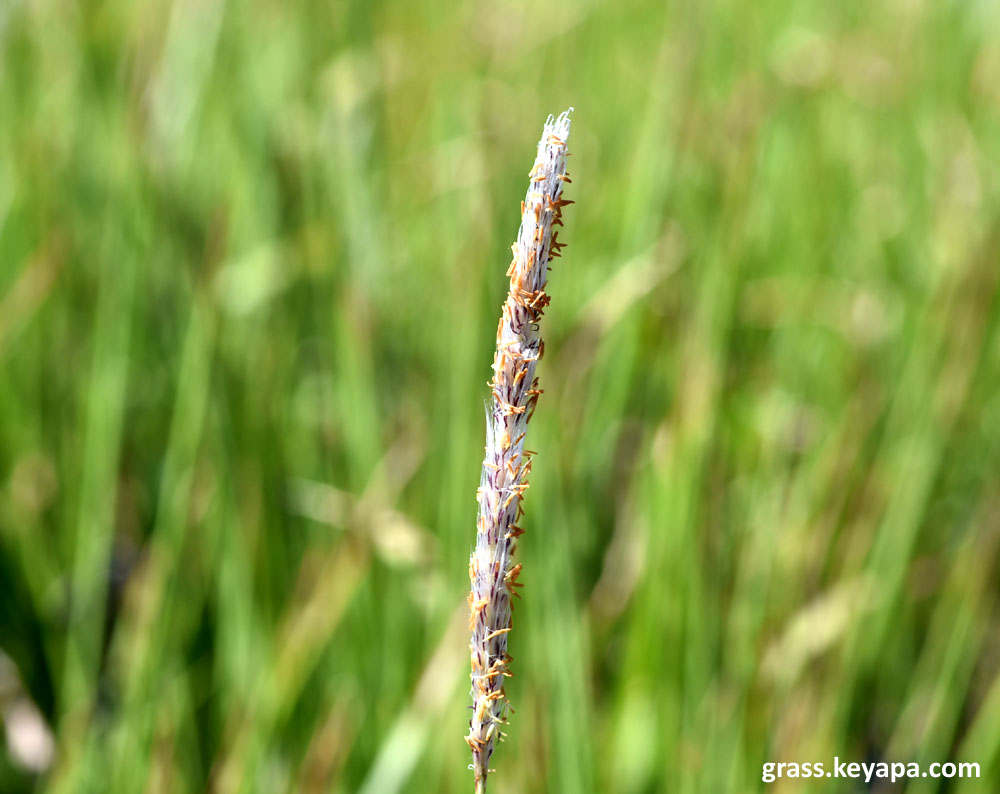
Although Imperata cylindrica (Cogon grass) is an invasive, it has quite attractive flowerheads, which are white spikes that look fluffy as they mature (see image below).

A single flowerhead
A closer look at the seeds show silky hairs rising from the spikelet. The hairs aid in dispersing the seed by wind (see image below). 

Seeds of Cogon grass
When I visited Florida in March 2021, I managed to see some examples of mass flowering for this species. It is actively controlled as an invasive weed, but the fluffy flowerheads are so distinctive that I have repeatedly spotted even small clusters of this species along the roadside as I sped by in a car!

I'd like to share with you some photographs of the mass flowerings that I saw. Enjoy!