|
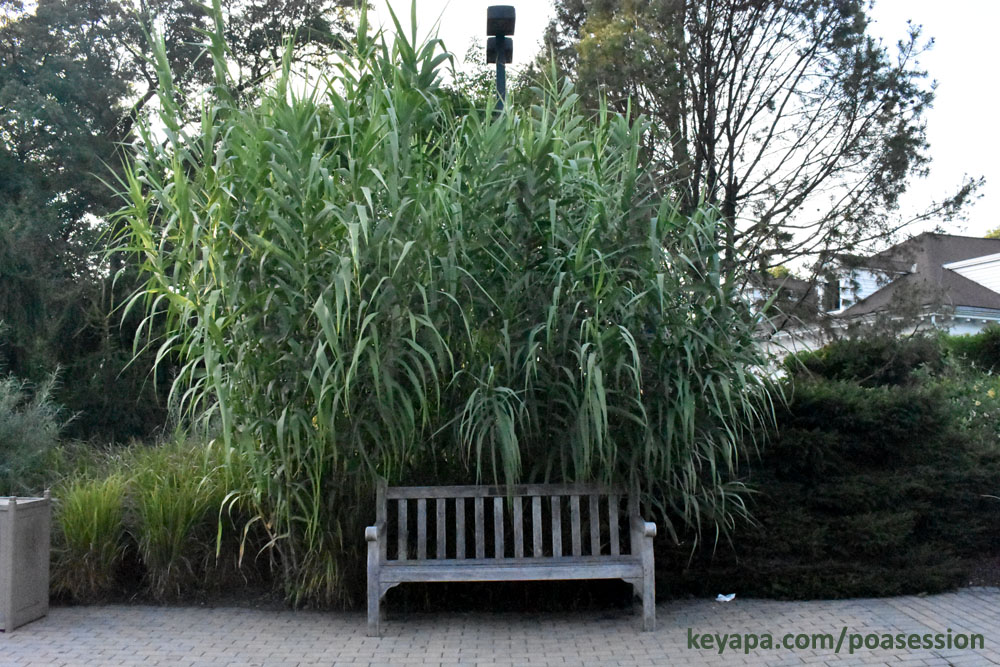
| Arundo donax in Morristown, NJ |
A year ago, I was at the National Arboretum in Washington, DC in the dead of winter. I was there mostly for the Bonsai displays, but it turned out the arboretum also had an entire section set aside for ornamental and lawn grasses.
 |
| Arundo donax in Wasgington, DC |
While strolling through this section, I suddenly came upon the dried remains of an absolutely amazing grass specimen.
The grass was so tall that it almost matched the height of a nearby tree! This would not have been that much of a rarity if it was a bamboo, but this species was most definitely not of the subfamily Bambusoideae.
I managed to find the label for the specimen, and found out it was
Arundo donax, which at the time was new to me. This species is also known by a host of common names, including carrizo, arundo, Spanish cane, Colorado river reed, wild cane, and giant reed.
Now fast forward more than a year later. I was in the Frelinghuysen Arboretum in Morristown, New Jersey, and I was suddenly again confronted by the enormous 6 meter tall plant!
I really did not expect the grass to survive at such a high latitudes, but there it was right in front of me, towering over a wooden bench and nearby parked cars.
Arundo donax is one of the fastest growing plants, and it is able to add up to 10 cm to its height everyday (Dudley et al, 2008). It is also one of the most invasive grasses around in riparian ecosystems, able to outcompete both herbaceous and woody vegetation after a fire (Coffman et al, 2010).
The interesting thing about its competitiveness though, is that unlike many of the invasive grasses, it is a C3 plant, which normally is not as efficient and productive as C4 plants. Researchers found that its dominance and productivity was actually due to its highly active Rubisco enzyme, which is the main enzyme involved in photosynthesis, and which results in the species having a photosynthetic capacity similar to C4 grasses (Weber et al, 2016).
I encountered this species again on a trip to New Mexico in September 2019, when I noticed that they were growing along the walls of some homes in Albuquerque. In this case, I was driving when I noticed grasses that seemed to reach all the way to the electrical lines!
I know that
A. donax is considered an invasive grass (although there are plans to harness its productivity for bioenergy projects), but it really is quite an interesting species. I look forward to encountering it more (and when flowering) in the future.
REFERENCES:
Coffman, G., Ambrose, R., Rundel, P., 2010. Wildfire promotes dominance of invasive giant reed (Arundo donax) in riparian ecosystems. Biol. Invasions 12, 2723-2734.
Dudley, T.L., A.M. Lambert, A. Kirk, and Y. Tamagawa. 2008. Herbivores of Arundo donax in California. Pages 146-152 in Proceedings of the XII International Symposium on Biological Control of Weeds. Wallingford, UK: CAB International.
Webster R, Driever S, Kromdijk J, McGrath J, Leakey A, Siebke K, Demetriades-Shah T, Bonnage S, Peloe T, Lawson T, & Long S.. High C3 photosynthetic capacity and high intrinsic water use efficiency underlies the high productivity of the bioenergy grass Arundo donax, Scientific Reports (2016).