Tuesday, October 5, 2021

What is the most bio diverse place on the planet Earth?

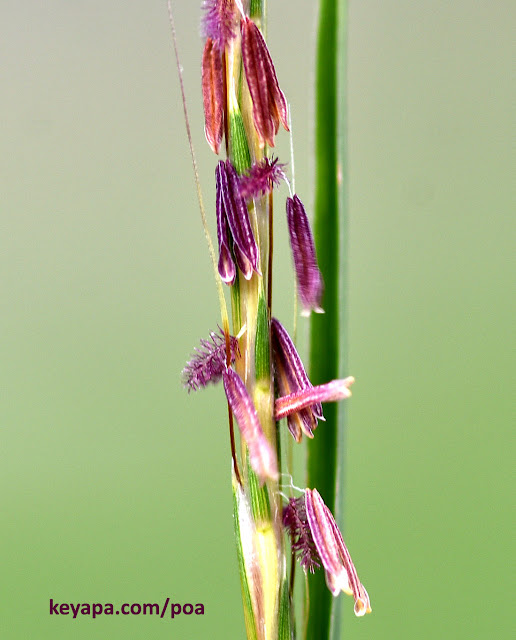
The grass Cenchrus setaceus (Pennisetum setaceum) spikelets

If you ask people which place in the world has the most species in a given area, many of them would probably pick the tropical rainforests.

The concept of the tropical rainforests as being the most diverse ecological environment on Earth has been drummed into us continuously by popular culture, but it turns out that answer is only partially correct.

By Dukeabruzzi - Own work, CC BY-SA 4.0

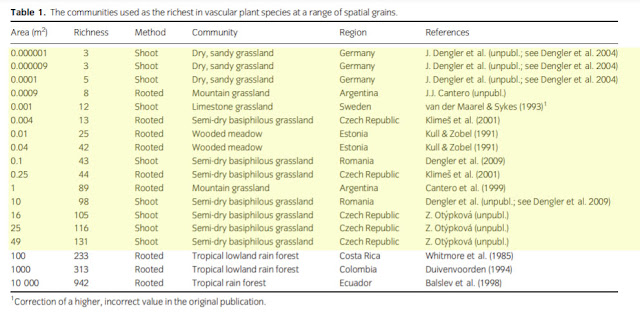
When researchers counted the number of vascular plant species in different environments around the world, they discovered that the answer to that question depends on how large an area you consider when counting (Wilson et al, 2012).

The most diverse environment in the world when you look at an area greater than 100 m2 is indeed the tropical rainforest. For example, a tropical rainforest in Ecuador had 942 species of vascular plants living in 1 hectare (10,000 m2) of land.

But when you look at smaller areas, the answer turns out to be different. When they counted the number of species of vascular plants in an area smaller than 100 m2, they found out that the most diverse environments are actually temperate grasslands. For example, a mountain grassland in Argentina had an absolutely amazing 89 vascular plant species packed into a single square meter (click table below)! 

I'll admit that actually blew my mind because I can't imagine fitting almost 100 plant species (not individual plants, but different species!) into an area only half the size of a small twin bed.

(Wilson et al, 2012)

But the even more amazing thing is that a new study seems to indicate that researchers may be undercounting the total number of species in grasslands if they only look at aboveground structures, and that total species richness could be up to 65% higher (Rucinska et al, 2021).

In the end, the studies indicate grasslands were the most diverse environments at all the smaller scales that the researchers examined, and it and the tropical rainforests can thus be doubly crowned the most biodiverse places on planet Earth.

Given this fact, my hope is that people come to realize that our ancient and "old growth" grasslands can be just as diverse and species rich as rainforests, and must therefore be just as cherished and protected.

Spikelets of the native grass Little Bluestem (Schizachyrium scoparium)

References:

Anna Rucinska, Sebastian Swierszcz, Marcin Nobis, Szymon Zubek, Maja Boczkowska, Marcin Olszak, Jan G. Kosinski, Sylwia Nowak, Arkadiusz Nowak (2021).
Is it possible to understand a book missing a quarter of the letters? Unveiling the belowground species richness of grasslands. Agriculture, Ecosystems & Environment, 2021, 107683, ISSN 0167-8809


Wilson, J. Bastow; Peet, Robert K.; Dengler, Jürgen; Pärtel, Meelis (1 August 2012). "Plant species richness: the world records". Journal of Vegetation Science. 23 (4): 796–802.


Wednesday, September 29, 2021

A purple find in Mt. Rainier

If you are the type of plant nerd who craves rarity, then the Poaceae is likely not for you.

The adaptability of grasses as a whole means that individual species tend to be geographically widespread and able to exist in diverse environments. There are rare and endemic grasses, but they tend to be in the minority, and most don't really have any unusual features that sets them apart from the rest of the family.

We were hiking the skyline loop near Mt. Rainier in Washington State this September when I stumbled on a grass that really caught my eye. This long trail skirts the side of the dormant volcano, starting at 1600 meters above sea level and gaining altitude to a maximum elevation of more than 2000 meters. The sub-alpine environment is rocky and tree-less, with low lying plants, including various unremarkable graminoids.

But one particular specimen next to the path suddenly made me stop in my tracks.

The grass was half hidden behind one of the many rocks that littered the trail, and its slender stalks ended in gracefully drooping spikelets. It was a rather handsome specimen, but what made me really pay attention was the fact the entire plant was a dark purplish color! In fact, it looked even darker hued than my ornamental Andropogon gerardii 'Blackhawk", and it really stood out in the bright morning sun.

Unfortunately, I did not bring my macro lens on the hike, but I made do with the 50 mm lens and took a few pictures of the plant habit and spikelets..


When I returned home I spent some time trying to identify the specimen from the images I took, and finally decided that it was Vahlodea atropurpurea, which is also called Mountain Hair Grass.

This subalpine/alpine species is fairly rare, though circumboreal, and considered endangered in several places, including California and the New England states. It is not considered globally endangered, but I was still happy to have stumbled on the species during the hike, as its discovery reminded me that it is still possible to find quite unusual grasses even in touristy areas like Mt. Rainier.

Tuesday, September 28, 2021

There's snakes in them Painted Hills!

Painted Hills
The Painted Hills unit of the John Day Fossils Bed monument in Oregon is a beautiful landscape, filled with multi-colored hills that are a testament to the changing environmental conditions in the area over millions of years. But almost hidden among the ground cover is the same hegemonic grass species that is rapidly spreading in the Great Basin.

Medusahead seedheads rise above the surrounding ground cover
We spent a few hours in the park and hiked the five major trails. In all of the trails I found clusters of Taeniatherum caput-medusae. Some trails had only isolated small groups, but others had thousands of individual plants. The species was also relatively easy to identify, with the seedheads sporting twisted awns that made it seem like the head of the fabled Medusa.

It was even possible to determine larger clusters of the species from a distance. The dried grass formed a very dense looking golden mass, which stood out very clearly from the surrounding darker colored ground.

The carpet of medusahead was easy to distinguish on the desert floor
The carpet of medusahead grass serves as a foreground to the beautiful hills

When I moved closer to examine the golden carpet, I found dense thatches of medusahead, the individual plants so close to each other that they formed an almost impenetrable barrier to other species. T. caput-medusae has a very high silica content (which makes it unpalatable to grazing animals for much of its life cycle, with grazing capacities reduced by as much as 80 to 90%), and the thatch is not only slow to degrade but is also a source of fine fuels for any fire. These attributes contribute to its continued spread and dominance over existing plants in an area. 

Dense thatch of medusahead in Painted Hills
The Painted Hills is undoubtedly gorgeous, and this beauty is enhanced by the natural flora that surrounds the hills, whether it be the trees or the sagebrush or the bunch grasses and associated forbs. The continued encroachment and spread of T. caput-medusae in this protected environment would tarnish that beauty and result in a monotypic community that is also very fire-prone.


Monday, September 27, 2021

Snakes in Paradise

Taeniatherum caput-medusae (medusahead grass)
I visited the  Phoenix Park Vernal Pools in Fair Oaks, California last week.

The park is a designated National Natural Landmark because of its vernal pools, and for those who do not know what these are, vernal pools are a unique type of ephemeral environment which are filled with rain or snow water for part of the year, but which have no inlet or outlet. Vernal pools support an amazing range of plants and animal, some of which are very rare and endangered, and the reason I was there last week was to see whether I could catch a glimpse of the dried remnants of the Sacramento Orcutt grass (Orcuttia viscida) and perhaps Orcuttia tenuis.

Entrance to the Vernal Pool section of the park
If you are wondering why I am so intrigued by these species, then I would strongly suggest reading the article on vernal pool annual grasses from the Winter 2009 edition of the California Native Grasslands Association. You can read the PDF version here. It will go a long way to explaining why  find these rare grasses so fascinating, and why I made a special trip to see them in Sacramento during my West Coast trip.


I arrived in late morning, and there were a few people about. The park environment itself was dominated by the usual mix of golden-hued annual exotic grasses that have reshaped California, with a few trees scattered around. These annual exotics form the iconic golden hills in the state and its neighbors, and were brought over when Europeans arrived a few hundred years ago. 


The typical grasses in the menagerie that I saw included Avena spp (Avena fatua and A. barbata), Bromus spp (B.diandrus, as well as a species that I found quite curious called Briza minima.


In addition to the usual exotic grasses, I also found a colony of the hegemonic invasive grass Taeniatherum caput-medusae (medusahead grass). I have posted about this species before, and how it has been transforming rangeland in vast areas of the West, and it can be recognized by the twisted awns that resemble the snakes in the fabled Medusa's head.

Medusahead with the distinctive twisting awns
The medusahead formed its distinctive dense thatch as it sprawled along a 10 meter section parallel to the trail, pushing aside other grasses. This high-silica thatch prevents other plants species from growing in the midst of the stand of medusahead, and I was alarmed that the infestation might spread further and endanger the vernal pools.

Dense thatch of Taeniatherum caput-medusae (medusahead grass) in Phoenix Park
I took note of its location, then continued to wander the trails for awhile, taking pics but not exactly sure where the actual pools would be. I knew they would be dried up by now, but I had no idea how to distinguish the dried pools from the surrounding grounds. 

Fortunately, I met a local man who was also using the trail, and he kindly pointed out to me those areas which would have been filled with shallow water during earlier in the season. He mentioned that they stood out because wildflowers bloomed from them at one time.

Dark depression that marks the site of the vernal pool
The dry vernal pools were depressions that had a slightly darker color than the surrounding area. One of them was close to where I had been walking, and you can clearly see the outlines of the pool in the image above.

Since we were not allowed to step outside the trail,  I used a drone to view the pool from above, and again the pool was quite obvious from several meters up.
Vernal pool from several meters up.
It was while photographing the pool that I noticed the patch of yellow-white that lay near its center. The patch was quite distinctive, but I could not make out what it was from the trail, so I moved the drone closer to hover over it and took several pics. 

Taeniatherum caput-medusae (medusahead grass)
Possible medusahead grass in center of vernal pool

Imagine my surprise when I looked at the image later on my laptop and discovered that the white patch looked to be a thatch of medusahead grass!

A quick survey of the literature mentioned that this species could be found in the vicinity of vernal pools, and sometimes all the way to the high water mark of such pools. But like many other grasses, it did not seem to be able to proliferate in the pools themselves, so I am at a loss as to how this colony could thrive in this case. Perhaps there was a slight mound in that part of the pool that allowed the medusahead seedlings to take hold.

Whatever the reason, the best course of action would be to positively identify the grass, and take measures to remove these particular snakes from the park, and especially from the pools themselves. Without direct and decisive intervention, this hegemonic species might slowly take over the park, turning it into a monotypic stand of medusahead.

Sunday, September 26, 2021

Curious Critter: Briza minima


I was exploring the Vernal Pool area in Phoenix Park in Fair Oaks, California, when I chanced upon a most curious sight.

At first I thought it was some cocoon that was hanging from a grass stem, but I immediately saw that I was mistaken. What I had thought at first to be of animal origin was in fact the dried seedheads of a grass!

Briza minima  is called shivery grass or lesser quaking grass, to distinguish it from the much larger Briza maxima. This bigger species has many common names, and they include big quaking grass, great quaking grass, greater quaking-grass, large quaking grass, blowfly grass, rattlesnake grass, shelly grass, rattle grass, and shell grass.

Their  unusual forms have made them at times a favorite of the horticultural trade, and they have escaped multiple times and become an invasive in several countries, including the western USA.

When I took one of the delicate pods and shook it, I imagined I could hear tinny sounds emanating from the dried structure. I had to admit they looked quite interesting and I can understand why people could want such a grass in their gardens, but in this case, the results of that desire might be causing environmental problems due to its propensity to escape into the wild.

Monday, September 6, 2021

How roads are aiding our worst plant enemies

Japanese stiltgrass growing on abandoned railroad tracks along Ashokan Rail Trail
I was hiking the Ashokan Rail Trail in New York and noticed how the gravel path was frequently lined with masses of the invasive grass Microstegium vimineum (Japanese Stiltgrass), which crowded out other invasives, as well as the native flora.

This predilection of the species for roadsides and paths is one that I am familiar with, and so once I got home I looked up whether there was any reason for its behavior. My first thought was that roadsides created an environment with higher light levels than the interior of the canopy, but it turns out there are other reasons why such man made strictures aid invasive plants in general

The characteristic silver midrib of Japanese stiltgrass
Large scale studies have shown that M. vimineum presence in forests was strongly correlated with the presence and proximity of roads and other man-made paths. The probability of finding this species along the east facing sides of roads was as high as 83% in one study area. In addition, experiments revealed that the natural spread of this species was greatest in patches closer to roads, and that these patches also tended to have higher populations.  There was something in the areas around roads and paths that proved advantageous to the proliferation and spread of this invasive species,

Japanese stiltgrass lining the sides of a hiking path
One interesting and important finding from studies of M. vimineum is that the species if left to itself spreads very slowly, with seeds landing only 1 to 2 meters away from the parent plant. This was perplexing because land managers noticed that Japanese stiltgrass can quickly spread throughout an entire forest within a few years, which implied a rate of invasion that was orders of magnitude faster than it should be.
Japanese stiltgrass expanding from roadside into forest interior

It turns out that human activity along the forest roads is one of the major causes of the rapid and unnatural spread of stiltgrass in invaded forests, whether it's from hikers picking up seeds as they trudge along hiking paths, or vehicles doing the same along passable roadways.

In addition, the forest roads themselves can create conditions that are environmentally advantageous for this invasive grass. For example, the use of limestone gravel in many unpaved roads can raise the pH of the surrounding soil, which is favored by M. vimineum.

Unfortunately, it is neither possible nor perhaps even desirable to completely remove all human structures from parks and other forested areas in a quest to return the forests to their original pristine condition, But we can at least minimize the negative impact we have on these environments through more studies that delineate the many ways our presence in the natural world affect the denizens of the forests.

Sunday, September 5, 2021

Andropogon gerardii as an ornamental

Andropogon gerardii "Blackhawk"

 I've been interested in using various ornamental grasses in my yard, and last year I finally decided to test some of the Andropogon gerardii cultivars in the market.

I was not convinced this species had what I wanted in an ornamental grass, but I wanted to at least make sure I wasn't missing something.

Andropogon gerardii "Blackhawk"

I bought an A. gerardii "Blackhawk" and an A. geradii "Raindance". The former surprised me this Spring by prematurely coming out early, but then seemed to have problems and its above ground structures wilted. It was reduced for awhile to a few small stems that sprouted from the periphery, and I fully expected the plant to die completely or to only come back next Spring.

However, several months later the ornamental grass had come fully back, and had even pushed out tall inflorescence that towered above the shorter leaves.

Andropogon gerardii "Blackhawk"

I took some time to take some macro shots of the flowerheads of the 2 cultivars, but I must admit I am not a big enthusiast of the species as an ornamental. The flowerheads came up at different heights, and I just could not shake the feeling that the "Raindance" especially looked like it was simply a grassy weed that had not been pulled out.

However, the cultivar "Blackhawk" has at least one redeeming feature, and that is its dark color. The leaves right now are a very darkish red, and they are supposed to turn almost black in late September. This unusual color of the cultivar perhaps makes up for the somewhat disappointing flowerheads.

Overall, I think the Andropogon cultivars do not match the beauty of other native ornamentals, such a Panicum virgatum or Schyzachyrium scoparium.


Sunday, June 6, 2021

Frankenstein's Plants: Natural Genetic Engineering in Grasses


Frankenstein foreground from Wikipedia (Universal Studios, NBCUniversal). Background is Phragmites australis

The grasses (Family Poaceae) are the most successful and economically important plant family today. They are supremely adaptable and hardy, and exist in numberless hordes from the rainforests of the equator, to the driest deserts of the American West, and even to the cold and almost lifeless vastness of Antarctica. 

The ability of species in this family to adapt to different environmental conditions has been one of the factors which has made it so successful, and researchers have recently elucidated one of the reasons for this adaptability.

A new study has discovered that many grasses can readily absorb novel genetic information from  their environment, and incorporate them into their own genome (Hibdige et al, 2021)! They do this via a process called Lateral Gene Transfer (LGT), where a species can acquire new adaptive genes and traits from completely different species without any sexual reproduction.

Echinochloa crus-galli had evidence of at least 10 LGT

The groundbreaking study showed that many grass species have been involved in lateral gene transfer of multiple genes, some of the genes coming from other grass species that are far removed in terms of  evolutionary relationship.

The researchers looked at 17 species for protein coding LGT, examining from 15,000+ to  well over 30,000 genes for each species tested. They found that most of the genes had an evolutionary history similar to the species that harbored them, indicating that they had been passed down through the generations from parent to offspring as expected. But more than a hundred genes were found where the evolutionary history of the gene did not match the species.

Zea mays (maize/corn) had at least 11 LGT

This evidence of LGT was found in 13 of the 17 species tested, with Alloteropsis semialata showing 20 instance of LGT! The species that showed evidence of LGT included not only wild species, but several domesticated ones as well, including maize, millet, and wheat. In this case, maize (Zea mays) had 11 LGTs received from Chloridoideae and Paniceae, while wheat (Triticum aestivum) had 10 LGTs received from Andropogoneae, Chloridoideae and Paniceae. The researchers noted that the LGTs may be beneficial for the crops, as the transferred genes included functions related to abiotic stress tolerance and disease resistance. 

Such instances of LGT are an amazing way for a grass to "leap frog" the slower evolutionary pathways and suddenly acquire traits very quickly, some of which are not only useful but staggering in their significance. For example, in another earlier study (Christin et al, 2012), researchers looked at the grass genus Alloteropsis, which contain species that  use C3 or C4 photosynthesis. They discovered  that fundamental elements of the C4 pathway (which is very adaptive in hotter and drier environments) were acquired via LGT from C4 grass taxa that diverged from the Alloteropsis group more than 20 million years ago!  

Distribution of LGT in tested grass species

The mechanism of this lateral transfer of genes is still unresolved, although the researchers noted that it seems to be more prevalent in species that have rhizomes. Such grasses have the capability of producing full individuals from broken pieces of their rhizomes, so one could imagine a situation where an LGT between these below ground structures and a concomitant separation of the rhizome later could lead to new separate individuals with sexual apparatus containing the gene. 

I am reminded again of the rhizomes of cogon grass (Imperata cylindrica), which have very pointed tips and have been shown to puncture other species of grass as the cogon expands. Perhaps such instances of hostility was a gateway to the prevalence of LGT in grasses, or perhaps it is only one of many multiple mechanisms for such an absolutely amazing phenomenon.


The sharp pointed rhizome of Imperata cylindrica
 

Literature Cited

Christin PA, Edwards EJ, Besnard G, Boxall SF, Gregory R, Kellogg EA, Hartwell J, Osborne CP. Adaptive evolution of C(4) photosynthesis through recurrent lateral gene transfer. Curr Biol. 2012 Mar 6;22(5):445-9. doi: 10.1016/j.cub.2012.01.054. Epub 2012 Feb 16. PMID: 22342748.

Hibdige, S.G.S., Raimondeau, P., Christin, P.-A. and Dnning, L.T. (2021), Widespread lateral gene transfer among grasses. New Phytol. https://doi.org/10.1111/nph.17328

Sunday, May 30, 2021

Fat leaves and thin leaves: How they can tell us where grasses evolved

Correlation between leaf shape and habitat type across 578 grass species (Gallaher et al, 2019)

I hike a lot, and many of the places I hike into are in forests and woodlands, so it's no surprise that I've become somewhat familiar with the grasses that inhabit the shaded interior of these forested environments. 

One thing I have noticed is that the denizens of these habitats tend to have wider leaves compared to species that live out in the open, and I just read a paper that used this fascinating fact to try to resolve the evolutionary origins of the family Poaceae.

The wide leaves of Oplismenus undulatfolius, which inhabit the shady undergrowth

The evolutionary origins of grasses are still under intense study, but differing hypothesis place their original habitat either in forest interiors, in the open, or in forest margins. A new study sought to delineate these options by looking at the various leaf shapes in grass species (Gallaher et al, 2019). Forest grasses it turns out, do tend to have wider leaves than those species in the open, but unfortunately such changes in leaf shape might also be affected by other factors, such as climate and the photosynthetic pathway used by each species (whether C3 or C4).

The broad leaves of a Dichanthelium, another denizen of more shaded areas

In order to determine how various factors influenced leaf shape and size, the study generated phylogenies for 578 grass species representing all the Poaceae tribes and subtribes, and approximately 75% of all grass genera. Leaf shape for the various species in this phylogeny was then correlated with precipitation, solar irradiance, temperature, photosynthetic pathway, and habitat.

They found that leaf shape in the grass family was strongly correlated with the habitat of the species, and that leaf shapes across the entire family converged towards certain shapes becoming associated with specific habitats. So for example, open habitats tended to have grasses with linear leaves, and ovate leaves tended to be present in grass species in the forest understory. Meanwhile, species that lived in forest margins tended to have lanceolate leaf shapes, an intermediate form between the shadier forest interior and the more open plains. They also found out that leaf shape is not strongly related to all other variables, whether it be temperature, precipitation, solar radiation levels, or even photosynthetic pathway. In addition, they noted that grasses have smaller leaves in open and drier areas, and in areas with high solar irradiance.

Ammophila breviligulata with narrow leaves. Habitat is open beach areas.

Interestingly as well, they noticed that the evolution of leaf shape closely tracked habitat changes over the course of grass evolution, and their estimates placed the forest understory as the most likely ancestral habitat of the grasses. Looking within the family, they found that the most probable habitat of the bistigmatic clade, core grasses, BOP clade, Oryzoideae, and Bambusoideae was forest margins, while the crown node of the Pooideae was either derived from open areas or the forest margins,

In addition, they estimated that there were between 12 to 41 transitions by grasses in the move to open habitats over evolutionary time, and all of them were from forest margins. This highlighted the importance of the forest margin ecotone as a launchpad to the eventual diversification and movement of many in the family to having more linear leaves as an adaptation to open environments. Linear leaves are advantageous in these less restrictive habitats because they allow faster heat loss to avoid damage to leaf tissue, as well as help prevent mechanical damage due to wind and other stresses. 

All these changes in leaf shape as grasses moved from the forest margins to open habitats occurred in the Cretaceous or Paleocene, which was long before the first signs of grass-dominated ecosystems in the Eocene, and the eventual dominance of grasslands beginning in the Miocene. 

So the next time you are hiking, take note of the grasses and how their leaf shapes tracks the environment, and marvel at the evolutionary changes that allowed this family to escape the shadier environments of the forest to eventually claim dominance of the wider open spaces.

The narrow leaves of Panicum virgatum, another typical denizen of open areas

Literature Cited:

Gallaher, T.J., Adams, D.C., Attigala, L., Burke, S.V., Craine, J.M., Duvall, M.R., Klahs, P.C., Sherratt, E., Wysocki, W.P. and Clark, L.G. (2019), Leaf shape and size track habitat transitions across forest–grassland boundaries in the grass family (Poaceae). Evolution, 73: 927-946. https://doi.org/10.1111/evo.13722


Tuesday, May 18, 2021

Ya picked the wrong plant to mess with pardner!

Phalaris arundinacea in 2020, with Yellow Flag Iris behind and to the right
Iris pseudacorus (Yellow Flag Iris) is a non-native that is found in semi-aquatic and aquatic habitats throughout North America. It is an attractive plant with yellow flowers that nonetheless can use its rhizomes to form dense monotypic stands that displace other plants in the area.

I was interested in the fact that the species co-existed with Phalaris arundinacea (Reed Canary Grass) along the shores of a nearby pond, and I have been watching the two species grow quickly this Spring.

Yellow Flag Iris surrounded by yellow border, and P. arundinacea to the left
There are large groups of Yellow Flag Iris around the pond, but the one I was interested in sat right next to and behind a big stand of Reed Canary Grass, their respective ramets almost intermingling with one another.

The Iris seemed to have sprouted tall earlier than the grass, but the latter quickly made up the difference and at this time is more than double the height of its erstwhile competitor.

Yellow Flag Iris (foreground), P. arundinacea (back), cattails (tall plants to right)
Both species are weedy invasives, and both have been known to aggressively outcompete and take over wetlands and other semi aquatic and aquatic environments. So I am very much interested in how the meeting between these two plants will resolve itself over time.

One thing I already noticed is that the Yellow Flag Iris clump next to the grass seems to be smaller than the one farther away, and have yet to bloom while their brethren have already pushed out their yellow flowers. But perhaps this is simply because that group is younger, and not because of competition from the Reed Canary Grass.

On first glance, the much larger P. arundinacea seems to be the clear favorite. I can almost see it looking at the Iris and saying "Hmmmmm...ya picked the wrong plant to mess with this time pardner!" 

But there are reports that show allelopathic activity in Yellow Flag Iris, and it is fairly common in the plant world for seemingly innocuous smaller plants to be the more aggressive and successful competitor, so I will definitely be looking with interest on this spot over the summer.

Saturday, May 8, 2021

A rare flowering of Japanese Blood Grass - that isn't so rare after all...


Last year I posted about the flowering of my ornamental Japanese Blood Grass (Imperata cylindrica), and noted that such flowerings were supposedly very rare. 

Interestingly enough, I was surprised to find that the same cluster of JBG had again flowered this year (and at about the same date!), with 2 flowerheads coming out of some of the more peripherally positioned ramets.

The flowerheads were already a bit spent, and the drizzle that caused them to droop under the water load did not help when I first saw them, but there was no question that flowering of JBG may not be so rare after all. Although perhaps some unique environmental condition in that cluster's location is causing this annual flowering, it's certainly unusual for this to happen (according at least to reports on the web).