Monday, January 16, 2023

Family Ties - Grass Phylogeny I

Phylogeny of the Poaceae (Gallaher et al, 2022)

I bet we've been together for a million years, And I bet we'll be together for a million more...(from the TV series Family Ties)

Updated (2023-01-18) : Added table of subfamilies with number of genera and species.

I've discovered the joys of being able to identify some grasses to species. And I know how important such skills are in expanding one's knowledge. But there is just as much merit to studying the larger picture, and studying the way species are grouped together. This means that in order to truly understand a group of organisms, you have to study the relationships between the members of the group, as well as their evolutionary history.

This is where phylogeny becomes useful, because it is the study of how organisms are related to one another via evolution.

Our understanding of the relationships between grasses and their evolution has progressed in leaps and bounds. In many ways, the Poaceae are the most extensively studied plant family, due to the economic importance of some of its members (rice, wheat, corn sugarcane, etc), and this is reflected in the many phylogenetic and evolutionary studies of the group.

A few recent studies in 2022 in particular have expanded on the detailed evolutionary history of the Poaceae (Gallaher et al, 2022; Huang et al, 2022).

Some of the more recent discoveries:

  • Grasses originated at the Early–Late Cretaceous boundary, with plastome studies finding a crown date of 98.54 mya (million years ago), and nuclear genome studies dating it to 101 mya. Both are consistent with fossil phytolith studies.
  • Grasses probably first evolved in West Gondwana (Africa and South America).
  • The ancestral habitat of the family was either the deep shade of the tropical forest understory or forest margins.
  • Forest margins provided the transition zone before grasses moved to open habitats, and this move was independently evolved several times.
  • Some grasses shifted back to closed habitats, but this is a lot less frequent than the move to open spaces.
  • There are 12 subfamilies in the family Poaceae, which are grouped into 3 larger clades: the BOP, PACMAD, and the APP clades (much more on these groupings below). All the subfamilies are monophyletic, with the possible exception of one subfamily (Puelioideae of the APP).
  • C4 photosynthesis evolved independently multiple times in the family, but only in the PACMAD clade, and only in 4 subfamilies within this clade: the Aristidoideae, Chloridoideae, Micrairoideae, and Panicoideae (the PACM of PACMAD). There is evidence it first evolved in the Chloridoideae 41-50 mya.
  • Specialized freezing tolerance evolved in the Pooideae (BOP clade) in the Northern Hemisphere, and the Danthonioideae (PACMAD clade) in the Southern Hemisphere.

In order to more easily remember and thus understand the relationships between these subfamilies and the species under them, the different subfamilies are grouped into 3 major clades.

Each of the clades are monophyletic (ie. all the members of a clade are derived from a single common ancestor), and each clade name is an acronym of the names of the subfamilies within that clade. They are easily memorized using easy acronyms that you should remember.

  1. APP
  2. BOP
  3. PACMAD

I'll skip the APP clade for later, as it represents the earliest diverging grasses that most people never encounter.

The two major grass clades are the BOP and the PACMAD groups, which represent more than 99% of the species in the family.

The BOP acronym stands for Bambusoidea (the bamboos), Oryzoidea (rice and its relatives), and Pooideae (many of the cold season turf grasses like Kentucky Bluegrass).

Now some may balk at trying to remember such tongue twisting subfamily names, but I use a trick that makes it somewhat easier. That is, every single subfamily name ends in "eae", and the 4 letters before that are always slight alterations of "oid", including "soid","coid","doid" or "zoid".

This makes it relatively easy to remember the names. For example, bamboos are BAMBU-zoid-EAE. And the rice subfamily is ORY-zoid-EAE. Finally, the turf grasses and other Northern Hemisphere cool season species are PO-oid-EAE.

Easier right?

Bamboo sp of the subfamily BAMBUSOIDEAE

The PACMAD clade is the other large grouping of grasses, and the acronym stands for the Panicoideae (e.g. many of the warm season grasses in USA tallgrass prairies like Andropogon spp), Aristidoideae (Aristida spp in Pine Savannahs in the Southeast USA), Chloridoideae (e.g. Muhly grasses), Micrairoideae, Arundinoideae (e.g. Phragmites), and the Danthonioideae (e.g. Pampas grasses of Cortaderia spp). The names can be easily remembered using the same rules as for the BOP clade:

PANI-coid-eae

ARISTI-doid-eae

CHLORI-doid-eae

MICRAI-roid-eae 

ARUNDI-noid-eae

DANTHONI-oid-eae 

Schizachyrium scoparium of the PANICOIDEAE

The relationships between the subfamilies and the time they diverged are summarized in the diagram below (mya= millions of years ago). The phylogeny is derived from studies of chloroplast DNA sequences in the paper by Gallaher at al, 2022, which has some differences from that presented by the equally recent Huang et al, 2022. 

Click here for image by itself.

As can be seen from the diagram above, the crown dates for the core grass subfamilies (BOP and PACMAD) range from 74 mya (million years ago) for the Oryzoideae, to 14 mya for the Aristidoideae. In the PACMAD clade, the Panicoideae is sister to the rest of the clade, while in the BOP, the Oryzoideae is the sister group to the Bambusoideae and the Pooideae.

However, in the Huang paper (which looked at the nuclear genome phylogeny), the Aristidoideae is sister to PCMAD, and not the Panicoideae, and the Micrairoideae is possibly sister to Panicoideae. The Puelioideae may represent two separate subfamily lineages.

It would be interesting to see how this discrepancy is resolved in future studies.

It's also interesting to compare the subfamilies with regards to the number of species and genera within. As can be seen in the table below (Soreng et al, 2017), the largest subfamilies are the Pooideae in the BOP clade (with 4126 species), and the Panicoideae in the PACMAD clade, with 3325 species.

SubfamilyMajor cladeGeneraSpecies
BambusoideaeBOP1361698
OryzoideaeBOP19117
PooideaeBOP2194126
PanicoideaePACMAD2423325
AristidoideaePACMAD 3367
ChloridoideaePACMAD 1211603
MicrairoideaePACMAD 9192
ArundinoideaePACMAD 1436
DanthonioideaePACMAD 19292
AnomochlooideaeAPP24
PharoideaeAPP312
PuelioideaeAPP211

Here is a list of the major subfamilies and some selected species within each.

Bambusoideae (B in BOP)

These are the bamboos, which many people don't realize are also grasses. 

This subfamily diverged 54 million years ago, and probably originated in the Indomalayan region. All are C3 plants, and there are more than 1600 species in this group.

The bamboos are grouped into 3 groups, with the temperate woody bamboos at one end, and the tropical woody and herbaceous bamboos at the other.

Bamboos are thè tallest grasses in the world, with some species more than 30 m tall!

Example of the bamboos include Bambusa, Phyllostachys, and Dendrocalamus.

Bambusa vulgaris in the BAMBUSOIDEAE

Oryzoideae (O in BOP)

This subfamily contains about 117 species, and includes the two domesticated rice, the Asian species (Oryza sativa) and the African species (Oryza glaberrima). It originated 74 mya, most likely in the Afrotropics, and all the species are C3 plants. 

Rice is one of the most economically important plants, with its grains feeding billions of people everyday.


Oryza sativa in the ORYZOIDEAE

Pooideae (P in BOP)

This is the biggest grass subfamily, with more than 4100 species! It includes all the cold season turf grasses common in the USA, as well as domesticated food species such as wheat (Triticum spp) and oats (Avena spp). It originated 62 mya, most likely in the Palaearctic.

It is one of two subfamilies that has evolved specialized freezing tolerance. In this group, ice binding proteins evolved which decreased the rate of the formation of ice, as well as altering the shape of the ice crystals being formed. These anti-freeze proteins prevent the formation of large crystals that can physically damage cells and tissues. Thus, the Pooideae dominate cool areas in the Northern Hemisphere. All are C3 plants.

Some example genera in this subfamily include Calamagrostis, Avena, Briza, Phalaris, Festuca, Lolium, Poa, Phleum, Triticum, Elymus, Hordeum, Leymus, Bromus, Nasella, Stipa , Taeniatherium.

Briza minor  of the POOIDEAE

Phleum alpinum  of the POOIDEAE

Taeniatherum caput-medusae  of the POOIDEAE

Phalaris arundinacea of the POOIDEAE

Bromus tectorum of the POOIDEAE

Panicoideae (P in PACMAD)

This subfamily is the largest in the PACMAD clade, and second largest in the Poaceae with more than 3300 species). It includes many of the warm season grasses, such as the major tall grass prairie species in the USA, as well as ferocious global invaders like cogon grass. 

It evolved 62 mya in the Afrotropics, and this is one of the subfamilies that dominate warmer areas in the world, with many of its members using C4 photosynthesis. In fact, this subfamily contains the majority of grasses with C4 photosynthesis.

It also includes some of the most economically important plants like maize/corn (Zea mays) for food, and Saccharum officinarum (sugarcane).

Genera in this subfamily include Andropogon, Microstegium, Imperata, Schizachyrium, Miscanthus, Saccharum, Sorghum, Zea, Paspalum, Cenchrus, Setaria, Spinifex, Panicum, Oplismenus, Digitaria, Dichanthelium, Melinis, Chasmanthium,Chrysopogon.
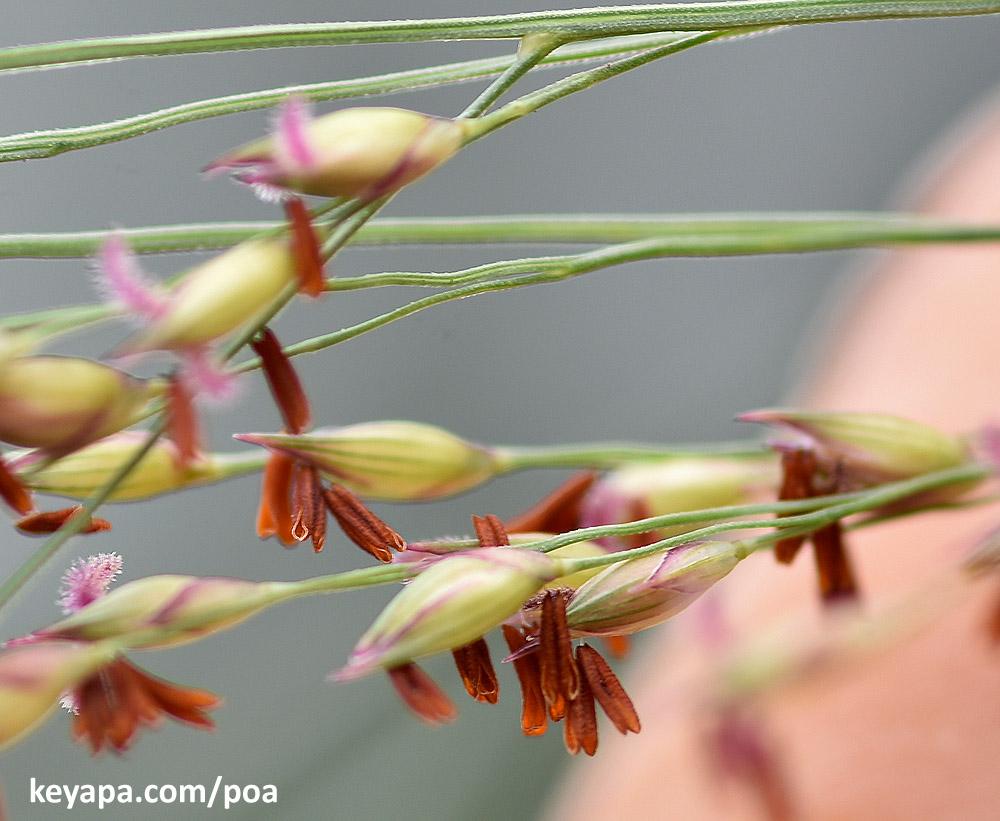
Panicum virgatum in the PANICOIDEAE

Andropogon gerardii  in the PANICOIDEAE

Oplismenus undulatifolius  in the PANICOIDEAE

Melinis repens  in the PANICOIDEAE

Paspalum fimbriatum  in the PANICOIDEAE

Imperata cylindrica of the PANICOIDEAE

Aristidoideae (first A in PACMAD)

This subfamily has around 367 species, and it is one of the four grass subfamilies that has C4 members.

 It originated fairly recently, an estimated 17 mya in the Afrotropics, and it includes some of the well known grasses that form the foundation of the Longleaf Pine savannas in the Southeastern USA, such as Aristida beyrichiana.

Aristida beyrichiana in the ARISTIDOIDEAE

Chloridoideae (C in PACMAD)

This subfamily evolved 55 mya in the Afrotropics, and includes many C4 plants. Along with the Panicoideae, it is one of the dominant grasses in the warmer parts of the world. The subfamily has around 1600 species.

Some of the grasses in my must-see list include species in this subfamily, including Swallenia alexandrae, which is found only in the Eureka Dunes in Death Valley National Park, CA, and the Orcutt grasses, which are endemic to ephemeral vernal pools in the same state.

Some genera in this subfamily are Muhlenbergia, Orcuttia, Eleusine, Cynodon, Chloris, Sporobolus, Swallenia, and Bouteloua.

Chloris virgata of the CHLORIDOIDEAE

Muhlenbergia sericea of the CHLORIDOIDEAE

Cynodon dactylon of the CHLORIDOIDEAE

Micrairoideae (M in PACMAD)

This is a relatively small family whose members are generally not known. It originated around 41 mya, probably in the Indomalayan region. It has around 200 species. It is sister to the Arundinoideae below.

Arundinoideae (second A in PACMAD)

This subfamily diverged 50 mya, probably in the Afrotropics. It only contains 36 species, but its most notable members are the well known genera Arundo and Phragmites.

Phragmites australis is a major invasive in some parts of the world, and might hold the title of the most widespread plant in the world. I have seen it in Florida and I have seen lots of it high north too. It is amazingly adaptable.

Phragmites australis in the ARUNDINOIDEAE

Arundo donax in the ARUNDINOIDEAE

Danthonioideae (D in PACMAD)

This subfamily diverged 51 mya, and contains around 300 species. I've always thought of them as the Pooideae equivalent in the Southern Hemisphere, although its sister group is the Chloridoideae.

Like the Pooideae, all species in this subfamily use C3 photosynthesis. And like the Pooidea, some members of this subfamily have independently evolved mechanisms for freezing tolerance. The freeze tolerant members of this subfamily produce ice-nucleation proteins that allow them to control where ice crystals form. Thus, they can prevent damage by limiting crystal formation in the extra-cellular spaces and the leaf surfaces, but not within the cell interiors.

The most notable genus in this clade is Cortaderia, which includes the pampas grasses like Cortaderia selloana

Cortaderia selloana of the Danthonioideae

Knowledge about the relationships between members of the Poaceae, and how they are grouped together, allows us to derive general rules that govern the ecology and biology of these amazing organisms.  

So the next time you recognize or focus on a particular species, remember to find out where they belong in the subfamilies of the Poaceae. Are they in the PACMAD or BOP clade? What subfamily do they belong to, and when did this group originate? Which other subfamily is closest phylogenetically to that taxon? All questions that will surely help you understand that species in a deeper way. 

Chasmanthium latifolium of the PANICOIDEAE

References:

Gallaher, Timothy J., Peterson, Paul M., Soreng, Robert J., Zuloaga, Fernando O., Li, De-Zhu, Clark, Lynn G., Tyrrell, Christopher D., Welker, Cassiano A. D., Kellogg, Elizabeth A., and Teisher, Jordan K. 2022. "Grasses through space and time: an overview of the biogeographical and macroevolutionary history of Poaceae." Journal of Systematics and Evolution, 60, (3) 522–569. (The Biogeography of Grasses (Poaceae)) https://doi.org/10.1111/jse.12857.

Huang W, Zhang L, Columbus JT, Hu Y, Zhao Y, Tang L, Guo Z, Chen W, McKain M, Bartlett M, Huang CH, Li DZ, Ge S, Ma H. A well-supported nuclear phylogeny of Poaceae and implications for the evolution of C4 photosynthesis. Mol Plant. 2022 Apr 4;15(4):755-777. doi: 10.1016/j.molp.2022.01.015. Epub 2022 Jan 31. PMID: 35093593.

Soreng, R.J., Peterson, P.M., Romaschenko, K., Davidse, G., Teisher, J.K., Clark, L.G., Barberá, P., Gillespie, L.J. and Zuloaga, F.O. (2017), A worldwide phylogenetic classification of the Poaceae (Gramineae) II: An update and a comparison of two 2015 classifications. Jnl of Sytematics Evolution, 55: 259-290. https://doi.org/10.1111/jse.12262

Friday, January 6, 2023

A tale of two contrasting little beauties

Inflorescence of Cynodon dactylon showing purple-pink anthers and stigmas

Update: Change species of Dichanthelium to Dichanthelium portoricense (2025-05-15)

I have always been fascinated more by tiny species than by large showy ones. Even my brief flirtation with the Orchids shows this preference, where I gravitated towards the tiny micro-orchids like Lepanthes. This bias towards the tiny means that I am always on the lookout for Poaceae that are cute and pretty, and last week I focused on two species here in Florida that fulfilled that goal, but were otherwise quite different. 

One is a native, a tight rosette bunchgrass that prefers a shaded and moist habitat. The other is a fast spreading aggressive immigrant, a commonly encountered prolific producer of rhizomes and stolons that luxuriates in the full sun. 

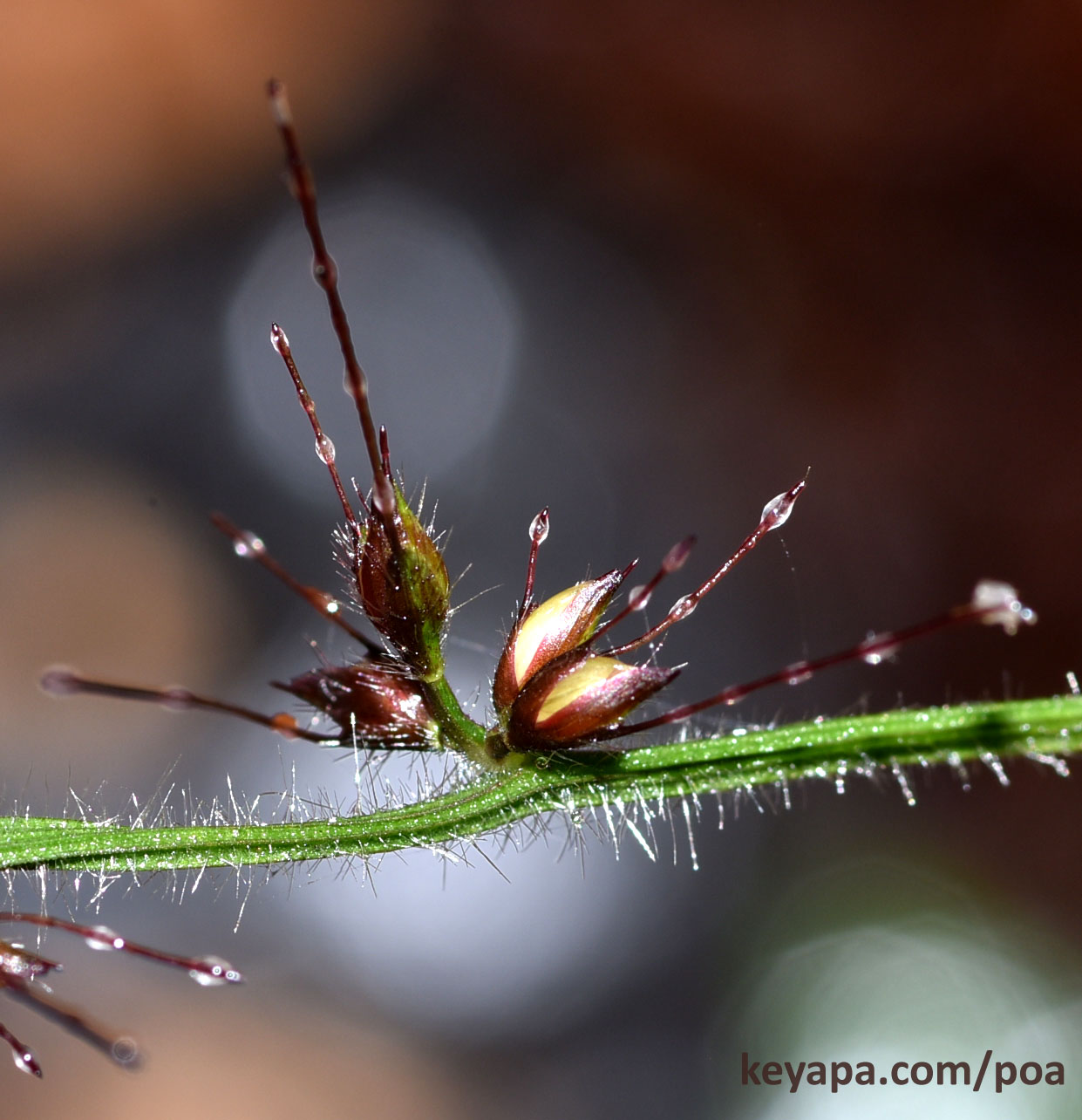
The native is from a genus that I have waxed lyrical about in the past. Dichanthelium portoricense forms a tight rosette. It's quite small, and with its dark green leaves and dark culms it is a really attractive species.

Dichanthelium portoricense

I found specimens of it under a tree in an area with usually dry whitish sand. The tree must be giving them a shady microhabitat place to live, as well as a bit more moist ground. The species is native to the southeastern USA and parts of the Caribbean, and the subspecies is typically found in Georgia, Florida, and the West Indies. It usually lives in relatively undisturbed habitat and prefers moist sandy soil, so longleaf pine savannas would be one place to look for this.

Inflorescence of Dichanthelium portoricense - even the spikelets are cute!

I must admit I was excited to see this beautiful critter under the tree. Its small size, dark culms, and dark green blades with borders made it stand out against the whitish soil and brown detritus around it. Some of the specimens also had flowerheads in bloom, the tiny spikelets marked with purple glumes and stigmas.

I must have spent an hour just looking and photographing the few specimens that I found, but I went home happy and satisfied after that brief hike and discovery.

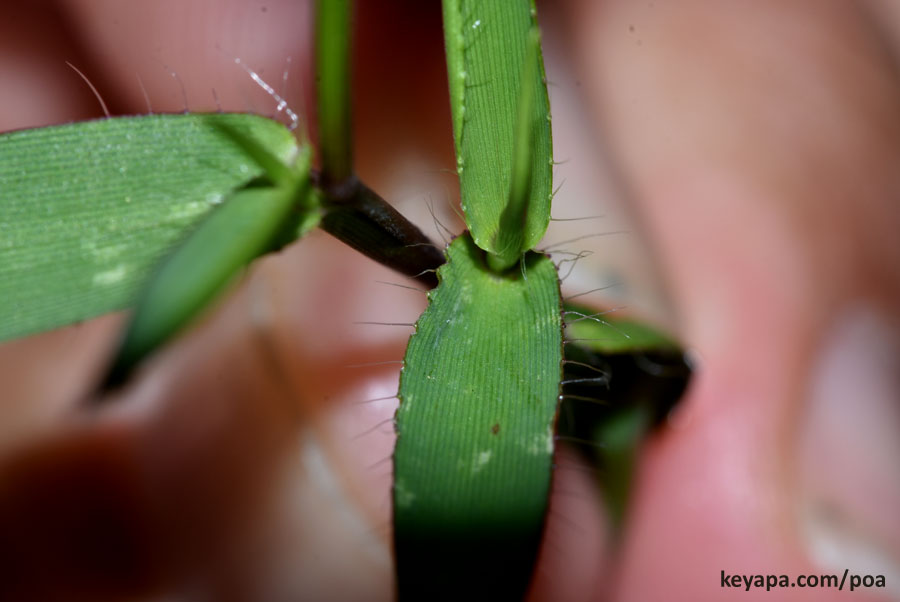
The edges of the leaf blades of Dichanthelium portoricense showing long hars

The second species that I encountered was one that I passed by almost everyday whenever I walked to the gym, but one which I had not yet seen flowering because it was kept cropped and short. There is a golf course in that path, and I have often marveled at the beautiful fine grass that adorned the tee and putting greens. I've even sometimes had the urge to take off my shoes and walk on the fine lawn - although I'm sure this would have annoyed someone just trying to play ;-)

I knew that it was Bermudagrass (Cynodon dactylon), but my attempts at photographing more than just its blades were continuously thwarted. Until, that is, I happened upon some "wild" specimens of this species nearby!

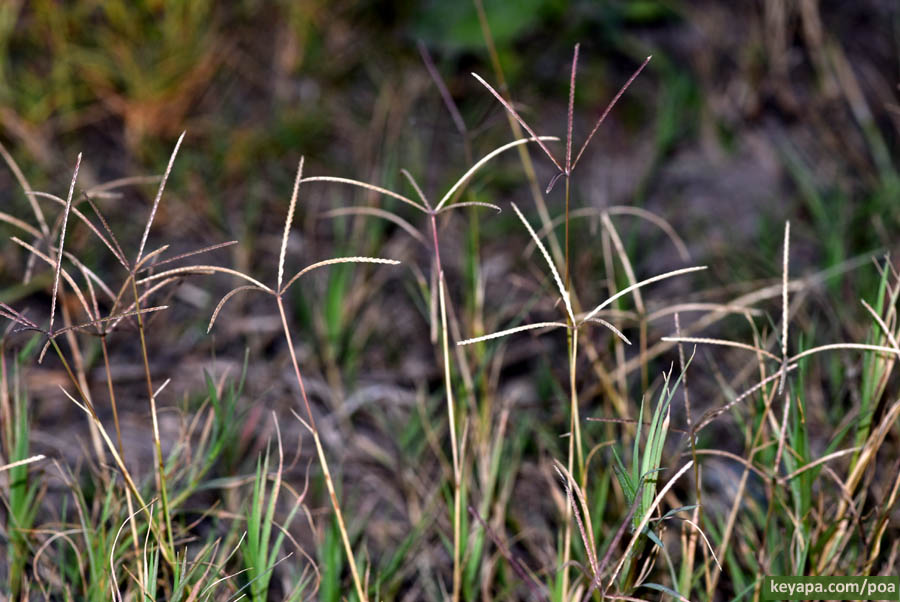
Masses of flowerheads of Cynodon dactylon

The flowerheads were gorgeous, the distinctive digitate inflorescence rising from the ground like tiny umbrellas.

C. dactylon is native outside the Americas, and is a common turf grass. Its strong rhizomes and stolons allow it to form a dense mat and makes it quite competitive against other plants. It has been shown to strongly inhibit the growth of competitors, and even though it has such fine leaves and a short stature, its roots can go extremely deep into the soil. Some studies showing it going more than 2 meters down!

 Flowerhead of Cynodon dactylon

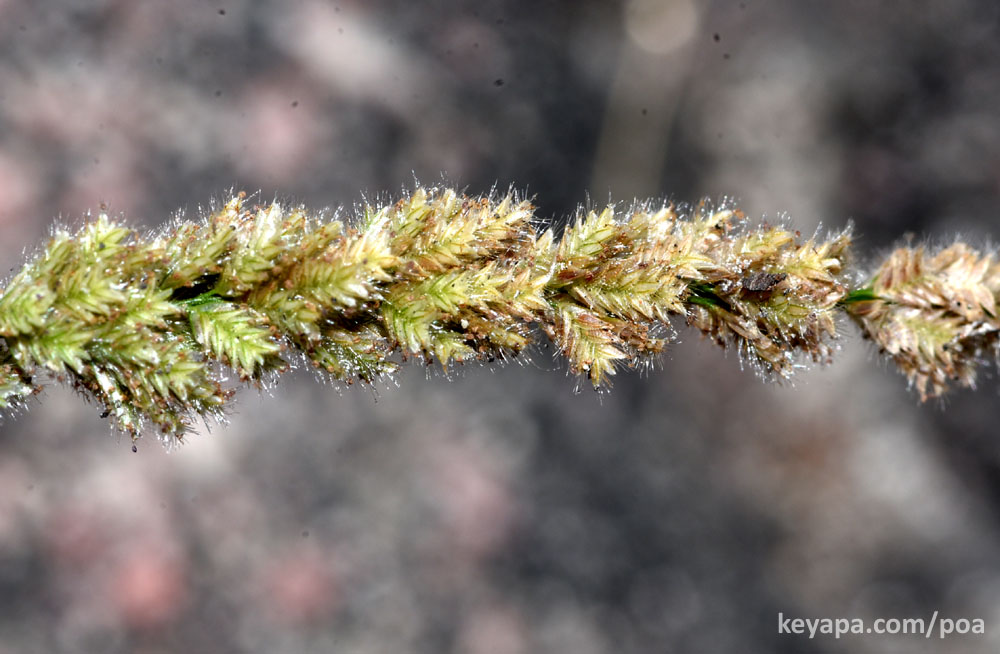
Its inflorescence is quite distinctive, with multiple racemes (usually 4, though I also saw 5, and references note can be from 3-7) radiating out from a common point. The spikelets themselves look like a weird Pacman, or some armored reptilian head!

Dried spikelets of Cynodon dactylon under portable microscope

The two small species had such contrasting looks and lifestyles, and yet I was ecstatic at being able to photograph and see these relatively smaller specimens in full flower. 

Now, my next challenge is to find the absolutely gorgeous Sporobolus discosporus in South Africa!

Sporobolus discosporus (c) Richard Gill


Saturday, December 31, 2022

A Whole New World: Using a Portable Digital Microscope


At first glance, the image above looks like a picture of some unusual tropical fruits. But the fruit-like structures are actually spikelets of a Paspalum grass species (Paspalum laeve perhaps?), with diameters of just 2 mm! 

The spikelets are of course normally borne on flowerheads that rise up from the surrounding leaf blades, as shown in the image below.


The macro lens on my camera can certainly do better than our naked eye, showing the individual spikelets in nice detail, as in the in situ images below. At this level, one can clearly see the stigma and anthers coming out of the enclosing glume.

In situ pics of flowerhead of Paspalum sp using camera and macro lens

But for really close work I got a relatively inexpensive portable Jiussion Portable USB Microscope.

I have not tried it on the field with my cellphone (I can only imagine the nightmare of trying to focus and stabilize the contraption out in the field), but I have used it with my laptop at home, and the results are quite good. 

Fuzzy stigma peering out from the enclosing glume of the spikelets of Paspalum sp

After downloading the necessary Windows application and drivers, and connecting the microscope via USB to the laptop, I was able to easily take pics. 

The pictures are not as good as using the macro lens of course, but the magnification is much greater. My only complaint would be that the stand is somewhat flimsy and trying to focus and stabilize the entire contraption is a bit of a work.

Nevertheless, the device will allow me to view the spikelet parts in much greater detail, which will help in identification and usher in a new world of hidden wonders.

The microscope is available on Amazon for those who are interested.

Spikelets of Imperata cylindrica. Notice the long white hairs rising from the base which help in its spread.

Tuesday, December 20, 2022

Who needs large petals and sepals? Eragrostis superba

(c) Riaan Lizamore

Grasses do not have large showy flowers like many other flowering plants because they are wind-pollinated. You can read more about wind pollination, and why grasses embraced a life without animal pollinators here.

The specialized reproductive structures that they do have can be exquisitely beautiful, but this beauty can sometimes only be fully appreciated with the help of macro lenses.  

I have a particular fondness for grass inflorescence that have purple or reddish hues, but the absolutely gorgeous pink and light green colors of the spikelets in this Eragrostis superba floored me when I first saw it. In the image, the orangey-pink anthers are held on whitish filaments, with white fuzzy stigmas poking out from between them. The green-striped structures that enclose them are specialized spikelet bracts. For a primer on grass structures, click here.

The species is native to Africa, but also occurs in other disparate locations, such as California and Hawaii. It lives in sandy soils in open woodlands or sparse grassland up to about 1,500 m in altitude. It can also occur as a pioneer in disturbed areas. Some common names for this plant include "Weeluisgras", "Sawtooth love grass" and "Wilmann love grass".

After seeing specimens like this, I am starting to really like this genus of grasses.


Thursday, December 15, 2022

Common Names: So long, and thanks for all the fish!

Ornamental variety of Imperata cylindrica (aka. kugon, cogon, alang-alang, spear grass, blady grass...ughhhhh!!!!!)

I noticed I completely ignored using common names in the last few posts I have made (especially the botanizing ones), and I find it does not bother me at all.

Maybe I'm just too lazy (yes!), but hunting around for the common names when posting about multiple species during a botanizing trip is just too much work. Plus, some common species have literally a crowd of common names, and it just gets too unwieldy to keep posting them when the scientific names are exact (well, at least until those nefarious taxonomists get into a sadistic mood).

When introducing or focusing on individual species I will likely post the various common names, but I'll probably skip on them from now on in most posts, and da*n the search bots.

I figure if you care enough about something, you learn its proper name. 

Btw, that beautiful (very rare) purple flowerhead of the ornamental variety of I. cylindrica is one reason why I like that species, notwithstanding it is considered one of the top 10 weeds in the world ;-)

Monday, December 12, 2022

A Fantastic Botanical Caribbean Cruise Trip

Dactyloctenium aegyptium in foreground and our cruise ship in background (in Costa Maya)

We went on our first cruise in 3 years since the pandemic. Our ship landed in 4 destinations, and I spent some time botanizing close to shore. 

The locations varied in terms of the ease of botanizing and the diversity of species found.

Melinis repens in Costa Maya

COCOCAY, BAHAMAS

The first island is wholly owned by Royal Caribbean, and it is a tiny piece of land that is immaculately kept as clean as an urban park.

Most of the specimens I found were ornamental grasses that were deliberately planted, including Trypsacum dactyloides and the fountain grass Cenchrus setaceus (?) .

Trypsacum dactyloides, with male flowers (orangey anthers and filament showing) on the left and female flowers (purple stigma showing) on the right

However,  scattered along the undergrowth I found smaller specimens, such as an Axonopus sp and a single specimen that looks like a tiny Eragrostis or  Poa sp. These tiny weedy species still thrived despite the wholly artificial nature of the location.

COZUMEL, MEXICO

I walked along the Avenida Rafael E. Melgar, the coastal road that leads from the International Cruise Terminal to the downtown proper of San Miguel de Cozumel. It was a pleasant 5 km walk along a well maintained sidewalk, and I descended at times onto the beach proper, which was mostly rocky and small.

Along the way I encountered not only the usual weedy species that seemed to proliferate in all urban locations, but lawn turf grasses and the occasional coastal inhabitants like Paspalum vaginatum. This species had rigid looking leaves and robust stolons, which it used to crawl along the rocky and sandy beaches.

Paspalum vaginatum (inset inflorescence)

I also came upon a few specimens that looked remarkably like Andropogon spp on first look.

Andropogon sp (?)

Many of the larger areas had specimens of Megathyrsis maximus, which managed to rake in some sun along the edges of wooded lots next to the sidewalks.

Megathyrsus maximus spikelets (inset inflorescence), with purple stigmas and yellow-orange anthers

Quite a few areas had the turf grass Cynodon dactylus, which also showed up as escaped specimens in cracked sidewalks and parking lots.

Cynodon dactylum, with white anthers and purple stigmas

Amazingly, I also came upon many more specimens of the same tiny putative Eragrostis or  Poa sp that I had encountered once in Cococay. In one case, it had swamped the original inhabitants of a stone container along the sidewalk!

Unknown Eragrostis sp/Poa sp (?)

But by far the most exciting find I made was a species that I at first was disinclined to think was a grass. It had an inflorescence that looked nothing like the usual spikelets, but I later typed it as Paspalum fimbriatum.

Paspalum fimbriatum

The spikelets of this species had glumes and lemma that formed a fringe around the florets. Its  leaves are relatively broad,  with a slight sinuous quality in some. 

Other specimens that I encountered in Cozumel were:

Melinis repens

Dactyloctenium aegyptium

Dichanthium sp

Cenchrus spinifex (?)

Andropogon sp (?)

Sporobolus jacquemontii (which I also encounter a lot in Florida)

Eragrostis sp (?)

Eustachys sp

Eragrostis sp (?) in Cozumel, Mexico

ROATAN, HONDURAS

This stop was the least attractive in terms of surroundings.  Our ship docked in the center of the city Coxen Hole, and it was raining sporadically the entire time.

I walked east along Main St. after disembarking from the ship, although in hindsight I probably should have gone the opposite direction. 

The empty lots were filled with Megathyrsus maximus, while sprouting from the cracks in the sidewalks and other marginal places I found the usual "weedy" species, including Eustachys sp, Digitaria sp, Echinochloa crus-galli, Eleucine indica, and a single Cenchrus sandbur sp.

I returned to the ship after enduring the sporadic rains for perhaps a couple of hours, with the hope that the next landfall would yield better returns. 

Eustachys sp growing on the rocky beach at the pier 

COSTA MAYA, MEXICO

I was not disappointed, because the stop at the Puerto Costa Maya near the town of Mahahual was the most fruitful of all.

The port itself was clean and large, with the usual tourist shops. But it was the surrounding area that made the area a prime spot for botanizing grasses.

The streets were wide and clean, with resorts and large private homes interspersed with empty lots. Closer to the Port, the wide street (Avenida P del Puerto) did not have sidewalks along the sides, but it instead had a very wide island that was filled with trees and plants. Amazingly enough, a dirt path run through the center of the island, so pedestrians using this "sidewalk" seemed to be in some forest path! It was a rather innovative idea, and one that I had never encountered before.

Path between stands of vegetation in the street island of(Avenida P del Puerto)! A great concept for urban and suburban roads

It goes without saying that I felt safe wandering into the smaller side streets, and just a few blocks from the port I came upon an empty lot that was filled with all sorts of species. 

Field of Botanizing Dreams. Eustachys sp and Dichantium sp in foreground, pinkish Melinis repens in background.

It was a literal field of botanizing delights, with waving masses of Eustachys sp mingling with clusters of pink and red Melinis repens

Melinis repens

Other inhabitants included the ubiquitous Dactylocnium aegyptium, Dichantium sp, as well as Cenchrus sp and an unknown species that was probably a Paspalum. There was even a large Megathyrsus maximus to one side.

Eustachys sp (left) and Dichantium sp (right)

Beyond the field I continued in the general direction of Mahuhual Beach, and I continued to encounter interesting specimens.

Once in awhile I came upon individual plants that I typed as Andropogon (perhaps A. virginicus because of a sheath that partly covers the spikelets) , which surprised me, as I always associated that clade with North America, and not tropical regions.

Andropogon sp (?), habit and spikelets

I also found an attractive broad leaved grass that I identified as Paspalum mandiocanum. The leaves had minute dark sinuous curves along their edges, and I found specimens along the sides of one of the main thoroughfares (Carretera A Mahahual).

Paspalum mandiocanum

Even the crabgrasses caught my attention. One specimen had a beautiful sinuously striped rachis and ciliated spikelets, and I typed it as Digitaria ciliaris.

Digitaria ciliaris

I also encountered specimens that I could not type, including a tallish and elegantly slim grass that had alternating green and white appearance to its culms (due to the leaf sheaths staying close to the culm). I typed it to perhaps Hyparrhenia rufa.

Unknown species (Hyparrhenia rufa?)

All in all, it was a great day for botanizing, and a great end to my December Caribbean Cruising trip!