Saturday, October 22, 2022

It's Corn! A Kid and His Love for a Big Lump with Knobs


I admit I do not follow current fads, and I am definitely not on TikTok, Instagram, or most of the various social media channels out there. 

So it took me awhile to discover this interesting and funny meme that had taken first TikTok by storm, and then various other media outlets, including some mainstream news channels (where I finally found it).

A kid named Tariq was interviewed about his liking for corn, and his enthusiasm and love for it was captured later in a song that went viral (view video above).

Watch it and the original interview below and you'll be singing praises as well to corn/maize (Zea mays), which is definitely one of the most important grasses in the world.
 
The original interview:


Thursday, October 20, 2022

Halloween Horrors in the Cornfields

Yeah, Zea mays (maize/corn) can be spooky

It's that time of the year again when pagan rituals (aka Halloween) sweep across this land, and in honor of that occasion I just have to list some of the horror movies that have made cornfields one of the least likely places to visit during night time.

I remember mentioning that I get spooked hiking forests at night, but I think being stuck in a field with tall grasses like corn would not be Disney time either.

We'll start with the better one of the lot - the movie adaptation of Stephen King's short story.

Children of the Corn (1984 original + all the sequels)


But here are more goodies that I dug up from youtube (in year descending order). I cannot vouch for their quality (other than Signs, Jeepers Creepers, and Escape the Field, which were ok), but if you're into dark and dangerous cornfields (and scarecrows!), you'll probably dig most of them.

This next one actually looked good, and was released by Lions Gate, a major studio. I dug it up (yes, I know I used the term "dig" twice...because Halloween) as a streamed movie in my cable lineup and watched it after posting this. It was ok, though the ending might be confusing. Reminds me of the 2010 Predators movie mixed with King's In the Tall Grass (more on that later).

Escape the Field (2022)

This next one is also in one of the streaming services, but it looks so horribly campy that I am giving it a pass.

Sharks of the Corn (2021)

The next several movies I have not seen, nor am I probably ever going to watch them (except for 1922 maybe, which is based on a Stephen King story).

Scarecrows (2018)

1922 (2017)

Husk and sequels (2011)

The Fields (2011)

A Brush with Death (2007)

Dark harvest (2004)

I watched this one a while back by M. Night Shyamalan and it was good drama, but probably not as good as his Sixth Sense, which was a classic.

Signs (2002)

Jeepers Creepers and sequels (2001)

Psycho Scarecrow (1997)- Full Movie


Finally, we'll end with another adaptation of a Stephen King work. No cornfields this time, but a field of another tall grass (Miscanthus spp in real life it turns out) that is just as deadly.

In the Tall Grass (2019)


Happy Halloween!


Monday, October 17, 2022

Beauty and the Beast: The Alligator and the Muhly


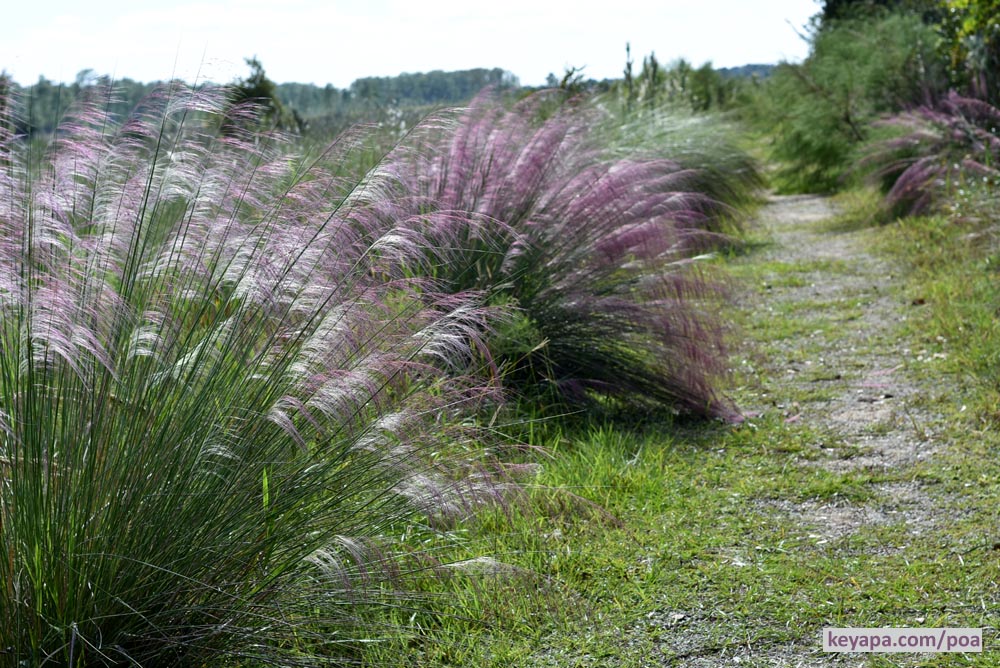
Gorgeous specimens of Muhlenbergia sericea along the sides of the trail

There is no doubt that species in the genus Muhlenbergia are some of the most beautiful grasses out there, and I mostly encountered them as ornamental grasses in the Northeast USA. But they exist in plentiful varieties as native plants in Florida, a fact that astonished me when I first encountered them in Jacksonville's Atlantic Beach. 

This group of grasses are also a prominent fixture in the Nature Conservancy's Disney Preserve in Florida, and when I visited the place to hike a couple days back, they were garbed in masses of absolutely gorgeous pinkish blooms.

Juvenile alligator hiding under the beautiful M. sericea

They also seemed to provide an unusual service to the other inhabitants of the park.

Under one large specimen, a juvenile alligator had parked itself under the heavy shade (see image above), perhaps seeking protection from the gawking passersby and other hikers around it. The combination of the airy pink blooms and the primeval looking reptile was striking. 

Beautiful inflorescence of M. sericea

I typed the species to Muhlenbergia sericea, which in some circles is still grouped as a variety of M. capillaris (M. capillaris var. filipes). At the non-macro level, the inflorescence of many of the Muhlenbergia spp look similar, but a closer look at their extremely miniscule spikelets will normally allow people to differentiate between the species.

Spikelets of M. sericea

Unlike the spikelets of M. capillaris, those of  M. sericea have two very long awns (see image below). Both glumes (the outer bract-like structures enclosing the floret) are awned, with one of the glumes having a very long awn. The second long awn is from the lemma, another bract-like structure that holds the male and female reproductive organs of the floret.

Two spikelets of M. sericea, each with with two very long awns. One spikelet is showing purple anthers and the filament, as well as the fuzzy stigma. 

Seeing an alligator is not that unusual in Florida (although this was the first time I've seen one in a bit), but happening upon a gator and a grass (which is in full glorious bloom) certainly is unusual and picturesque.

Wednesday, October 12, 2022

Winter is Coming: How Grasses Conquered the Long Freeze

Tundra (By Education Specialist)

There are vast areas of the world where cold temperatures create problems for plants.

Such "cold stress" happens when temperatures that are below what are optimal for plants creates physiological problems for the individual plants. Depending on the species, optimal growing conditions usually hovers between 10℃ and 30℃. 

There are two types of cold stress, depending on the temperatures involved.

Chilling refers to cold stress where the temperatures range between 0℃ and 15℃, whereas freezing refers to cold stress where the temperatures are below freezing (0℃). 

In the case of freezing, plants can respond via two different methods. Freezing avoidance is when the plant is able to delay or even prevent freezing altogether in their tissues. In contrast, in freezing tolerance, the plants do not prevent ice crystal formation, but they avoid damage by controlling the size of the crystals and/or where the crystals are formed. Freeze-tolerant plants can survive even freezing of their tissues, and represent the extreme adaptation to conquering the cold over long time periods.

Deschampsia antartica (c) Lomvi2 - Wikipedia

Grasses initially evolved as tropical plants that loved the warmth. But over time, the grasses have managed to adapt to the cold and have become the most widespread vascular plant family, and present in all continents. Indeed, the grass Deschampsia antartica is only one of two vascular plants that are native to Antarctica, and its optimal growing temperature is an amazing 10℃!

Freezing can kill grasses via the formation of ice crystals. At first, ice crystals form in the extracellular spaces between cells, which causes water to be pulled from the cell interior. The loss of intracellular water (and later solutes) results in dehydration and osmotic stress. As ice crystals continue to form into the interior of the cells, the cell membranes start to degrade and programmed cell death occurs.

The evolution of the ability to tolerate freezing in the Poaceae is fascinating, and is confined mostly to species in two different subfamilies of the Poaceae. Grasses in the subfamilies Pooideae (in the Northern Hemisphere) and Danthonioideae (in the Southern Hemisphere) live in cold temperate continental regions, and they have solved the problem in two different ways. 

Hordeum jubatum of the subfamily Pooideae (Northern Hemisphere)

The grasses in subfamily Pooideae in the Northern Hemisphere all use the C3 mode of photosynthesis, and are commonly called the cool season grasses. They include many turf grasses (such as Poa pratensis or Kentucky Bluegrass), as well as food staples such as Triticum aestivum (wheat), Avena sativa (oat), and Hordeum vulgare (barley). 

The ancestors of the Pooideae evolved about 67 million years ago in small niches during the formation of the Eurasian mountain ranges. In this group, ice binding proteins evolved which decreased the rate of the formation of ice, as well as altering the shape of the ice crystals being formed. These anti-freeze proteins prevent the formation of large crystals that can physically damage cells and tissues.

Cortaderia selloana from the subfamily Danthonioideae (Southern Hemisphere)

In contrast, cold-acclimated grasses from the subfamily Danthonioideae in the Southern Hemisphere have evolved a different method for conquering the cold. The members of this group are also C3 grasses, and include the large ornamental grass Cortaderia selloana (Pampas grass). The freeze tolerant members of this subfamily produce ice-nucleation proteins that allow them to control where ice crystals form. Thus, they can prevent damage by limiting crystal formation in the extra-cellular spaces and the leaf surfaces, but not within the cell interiors.

The independent evolution of such mechanisms by the Danthonioideae and Pooideae to tolerate freezing have enabled grasses to dominate large areas where there are extreme seasonal fluctuations in temperature, and contributed to the grassy world we live in today. 

As an interesting aside, at the other end of the temperature spectrum, C4 grasses such as those in the grass subfamilies Chloridoideae and Andropogoneae - which include corn/maize (Zea mays), the bluestems (Andropogon spp), sugarcane (Saccharum officinarum), and cogon grasses (Imperata cylindrica) - have extended the range of environments conquered by the Poaceae to much warmer and drier climes. 

For a quick look at the difference between C3, C4 and CAM photosynthesis in grasses, click here.

Muhlenbergia sericea of the subfamily Chloridoideae, a C4 grass

Finally, to read more about the fascinating topic of cold adaptation in grasses in depth, check out the references below.

Note: In addition to the specialized mechanisms of freezing tolerance above, grasses can deploy other additional mechanisms for coping with the cold that are beyond the scope of this shirt post, such as accumulating fructan in their vacuoles, using supercooling (for shorter cold spells), and increasing anti-oxidant enzymes.

Phalaris arundinacea of the subfamily Pooideae

References:

Timothy J. Gallaher, T. J. Gallaher, Paul M. Peterson, P. M. Peterson, Robert J. Soreng, R. J. Soreng, Fernando O. Zuloaga, F. O. Zuloaga, De-Zhu Li, D. Li, Lynn G. Clark, L. G. Clark, Christopher D. Tyrrell, C. D. Tyrrell, Cassiano A.D. Welker, C. A.D. Welker, Elizabeth A. Kellogg, E. A. Kellogg, & Jordan K. Teisher, J. K. Teisher. (2022). Grasses through space and time: An overview of the biogeographical and macroevolutionary history of Poaceae. Journal of systematics and evolution, 60, 522-569. doi: 10.1111/jse.12857

Schubert M, Humphreys AM, Lindberg CL, Preston JC, Fjellheim S. 2020. To coldly go where no grass has gone before: A multidisciplinary review of cold adaptation in Poaceae. In: Annual Plant Reviews online.Wiley.523–562.

Thursday, October 6, 2022

The Mysterious Mound in Split Rock (Pennsylvania)

The mysterious grassy mound at Split Rock. The rock formation is behind it, hidden by trees.
Hidden behind a veil of tall trees in deep Pennsylvania lies Split Rock, a gargantuan rock with a cleft in its middle.

We stayed at the nearby Split Rock Resort and Lake Harmony last month and took one day to visit this strange rock formation, which was created 300 million ago when glaciers swept across the land and also created Lake Harmony.

Drone view of Split Rock with the cleft near middle
The rock itself was fascinating, and you can access the top by climbing up a wooden platform. But another thing that caught my eye as we walked from the parking lot was an equally strange small hill or mound that lay to the side of the formation. It was almost dead center in a clearing, surrounded by trees.

It was also covered in grass, but not turf grass. Instead, I noticed Panicum virgatum (switchgrass) and another species that I at first thought was Schizachyrium scoparium (Little Bluestem).

P. virgatum spikelets
The P. virgatum had beautiful purplish spikelets, with purple fuzzy stigmas and orange anthers.

P. virgatum spikelet showing purple stigmas and orange anthers
The other notable species I found was something that I at first thought was S. scoparium. It had fluffy flowerheads and a similar habit to that species.

A.virginicus seedheads
But when I used macro on the spikelets, the first thing that was noticeable was the very long and straight awns. S. scoparium has awns, but they are noticeably bent, and I decided that what I was seeing was Andropogon virginicus, which is a robust species that is even common in disturbed areas.

For more on the spiketlets of the beautiful S. scoparium, click here.

A. virginicus spikelet. (A) Sessile fertile floret with long awn. (B) Sterile floret on a stalk. (C)  Disconnected raceme connection to the other spikelets.
I have no idea how this mound was formed, or even whether it is a natural formation or one that was man-made. When I was there and it was getting into dusk, the entire place felt dark and otherworldly, and I could not help but wonder whether some eerie rituals were held atop this grassy knoll. The somber lighting, dark forested location, and weird clearing would be perfect for some Hollywood horror film. 

If you ever visit this area in Pennsylvania, then take some time to get a glimpse of this mysterious mound with its trove of native grasses, and the riven rock behind it. Just don't do it in the dark!

Tuesday, September 20, 2022

Volcanos, Carabaos, and Misidentifications - More Botanizing in Cavite, Philippines


Carabao are these huge bovine grazers that are much cooler than cows and are a fixture of tropical Southeast Asia. 

They are used in harness to help plow the soil for farming, and their milk is for drinks and eating. When curdled the milk becomes a delicious soft white cheese called kesong putih. You can even pour the milk onto white rice, sprinkle some salt, and dig into the yummy dish (it's one of my favs).

Modern water buffalo (Da - Own work, CC BY 2.5)

One of the grasses in the Philippines is called Carabao grass (Paspalum conjugatum), due mainly to the fact Carabaos (although not cattle) seem to love this species.

Habit of A. compressus

On a second (shorter) botanizing expedition into the semi urban wilderness of the town I stayed in, I encountered a small cluster of grass that I at first thought was this species.

The dark green leaves had an interesting crinkly quality to them that reminded me of Oplismenus undulatifolius, and the specimens crawled around on robust stolons that allowed it to monopolize the shaded area under a tree.

Each hairy node produced a new ramet, along with short fibrous roots.

Stoloniferous growth in A. compressus

I typed it first as Paspalum conjugatum (carabao grass), but after some research decided that it was Axonopus compressus. The dark green leaves and penchant for shade pointed to this species, and the inflorescence nailed it.  

Attractive crinkly leaf of A. compressus

This is another species used as turf grass in the local area, but it is also used as a cover crop under oil palms, where it suppresses weeds using allelopathic chemicals (Samedani et al, 2013).. 


Inflorescence of A. compressus

Misidentifying grass species like I initially did with A. compressus above is likely not that unusual, and it seems I also did it for one of the more common and large grasses in the country

Awhile back I posted about the Destructive Duo of Imperata cylindrica and Saccharum spontaneum. The photos in that post were from the periphery of Taal Volcano in the Philippines, and I had described the taller species in them as S. spontaneum, which is called talahib here.. 

I had a chance to visit the area in Tagaytay last week, and I again encountered the same very tall species, along with the shorter I. cylindrica. This time I toured a national tourist attraction called the People's Park in the Sky, which dates from the dictator Marcos era and was supposed to have become a mansion at the time.

Erianthus (?) flowerheads with Taal Lake and Volcano in background

The tall grass was just as majestic as before, their flowerheads hanging high above the crowds, and the species covering a large part of the hillside. I flew my drone to take pics, and you can see me in the orange cap as I positioned the DJI Mini 2.

Red showing large masses of Erianthus (?) along hillside

The arrangement of the rather stiff leaves reminded me of Phragmites australis or Arundo donax, although the very prominent white midrib reminded me of other Saccharum spp.

Inflorescence and leaves (with white midribs) of Erianthus (?)

As always when I encounter an unknown species, I took macro photos of some dried spikelets, and I was surprised to discover that the large grasses were definitely not S. spontaneum!

Spikelets of Erianthus (?)

The dried spikelets had very long and twisted awns, which is not characteristic of awns from S. spontaneum. The awns are instead a characteristic of Erianthus contortus and E. alopecuroides, although this is likely another species entirely.

Spikelet of Erianthus (?), showing twisting awn and white hairs at base

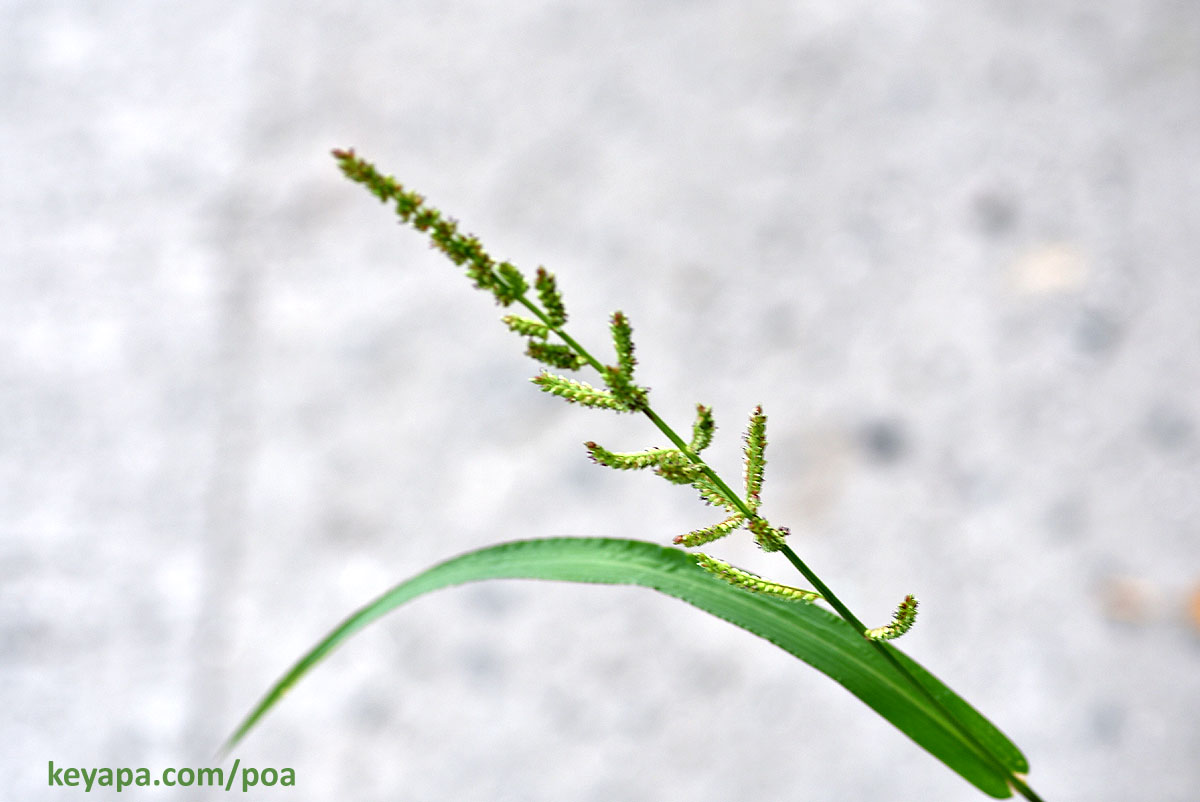
Finally, I also came upon some specimens of what I believe is Echinochloa crus-galli. This species is commonly known here as bayokibok (Tagalog), lagtom (Bikol), marapagay (Ilokano), as well as some other common names probably.

Echinochloa crus-galli inflorescence

Like some other weedy grasses, I encountered this species as well in New Jersey, so you can tell that it is a really adaptable organism. In the Philippines, it is one of the worst weeds in rice paddies, and has become resistant to the herbicides used against it.

Echinochloa crus-galli spikelets

After 2 weeks, my time in the Philippines had come to an end, and although it was short and busy, I was gratified that I was able to spend some time botanizing in the hot and humid tropical clime. I love exploring new and interesting places, and discovering, identifying, and learning about the various species that I encounter in my travels.

Literature Cited

B. Samedani, A. S. Juraimi, M. Y. Rafii, A. R. Anuar, S. A. Sheikh Awadz, M. P. Anwar, "Allelopathic Effects of Litter Axonopus compressus against Two Weedy Species and Its Persistence in Soil", The Scientific World Journal, vol. 2013, Article ID 695404, 8 pages, 2013. https://doi.org/10.1155/2013/695404

Monday, September 12, 2022

Visiting Sugarcane's Wild Relative - Saccharum spontaneum (Talahib) in the Philippines

I first spotted the fields of Saccharum spontaneum (talahib) while travelling towards the SM Bacoor shopping mall in Bacoor, Cavite, Philippines. The grasses were in full flower, their white flowers waving languidly in the breeze, and their culms rising more than 4 meters to tower over some of the shorter urban structures around them.

Entranced by their beauty, and by the fact they were smack dab in the middle of a bustling city, I visited them again yesterday. 

In order to get a better view of at least one part of the field, I flew my DJI Mini 2 drone and took some fly-by videos. Unfortunately, the very bright sunshine made it difficult for me to see what I was shooting at, but I got at least one good video of a part of the field.

Click here for full youtube video. 


Along with Imperata cylindrica (kogon or cogongrass), this species forms vast grasslands all over the country, and it is hypothesized to be one of the progenitors of cultivated sugarcane, which produces most of the sugar we use today.

Unlike S. officinarum (cultivated sugarcane), S. spontaneum is widely considered to be a "weed". although various uses for parts of the plant have been developed locally. For example, it is heavily used for making various items, such as hats, brooms, baskets, walls and even furniture. In terms of its medical uses, it has been used as an astringent, emollient, refrigerant, diuretic and aphrodisiac.  

Very prominent white midrib and serrated edges

Its leaf blades are somewhat narrow (unlike S. officinarum), perhaps a cm or so in width, and it has a very prominent white midrib. The leaf margin are serrated, and you can feel the sharp edges by running your finger (carefully) down the leaf.

Sheath

The Saccharum complex of species has been quite muddled and is polyphyletic. Hybridization between wild species and cultivated ones have resulted in a range of intermediate forms. In general, the cultivated S. officinarum has somewhat wider leaves and does not form extensive clonal clusters via extensive rhizomes. whereas S. spontaneum forms strong rhizomes and can thus quickly dominate an area as it spreads laterally. 

Ligule area

In order to examine the grass further, I gathered some samples of the inflorescence and took some macro shots when I got home.

The S. spontaneum spikelets come in pairs along the inflorescence branches. They do not have awns. One spikelet is pedicellate (has a stalk), while the other does not have a stalk ("sessile") and is fertile. The fertile spikelet has 2 florets, one of which is fertile. A mass of extremely long white hairs rise from the base (callus) of the spikelets. The hairs are 200-300% the length of the spikelets.

Pair of spikelets showing sessile and pedicellate spikelets

I have to admit I found the talahib fields beautiful, no matter that they were mainly composed of plants that were sometimes considered "weeds". The plumed inflorescence and towering presence of the grasses  en masse injected some beauty into the rather dirty and polluted city environment.

Single pedicellate spikelet


Tuesday, September 6, 2022

Dodging Tricycles and Jeepneys: My First Urban Botanizing in the Philippines

Jeepney in a crowded street, Cavite Province, Philippines

Heat. Humidity. Suffocation from carbon monoxide poisoning, with death or injury just an arm's length away as cars and tricycles and the ever colorful jeepneys zoom past me on narrow roads with no sidewalks.

Welcome to my first botanical expedition on the streets of Cavite Province in the Philippines.

I won't be here long, and I am otherwise busy, but I made it a point to walk the streets of the town I was in on the third day of my stay. I was excited to see what kinds of grasses thrived in this disturbed tropical urbanized area.

Of course some grasses are so successful that what I see in New Jersey (or Florida) also makes its home in this tropical location halfway around the world, and I wasn't disappointed.

In the home I am staying in, a new cluster of Imperata cylindrica (called kogon locally) has started dominating a side lawn, shading out the turf grasses and engulfing an ornamental plant. I caressed the long blade-like leaves, feeling the sharp edges and feeling almost proprietary towards this globe-trotting tropical invader. It's native to this country, but just as aggressive and dominant. In fact, it is so dominant that people here call the vast grasslands covered in this species "kogonales".

Imperata cylindrica - showing who's the boss

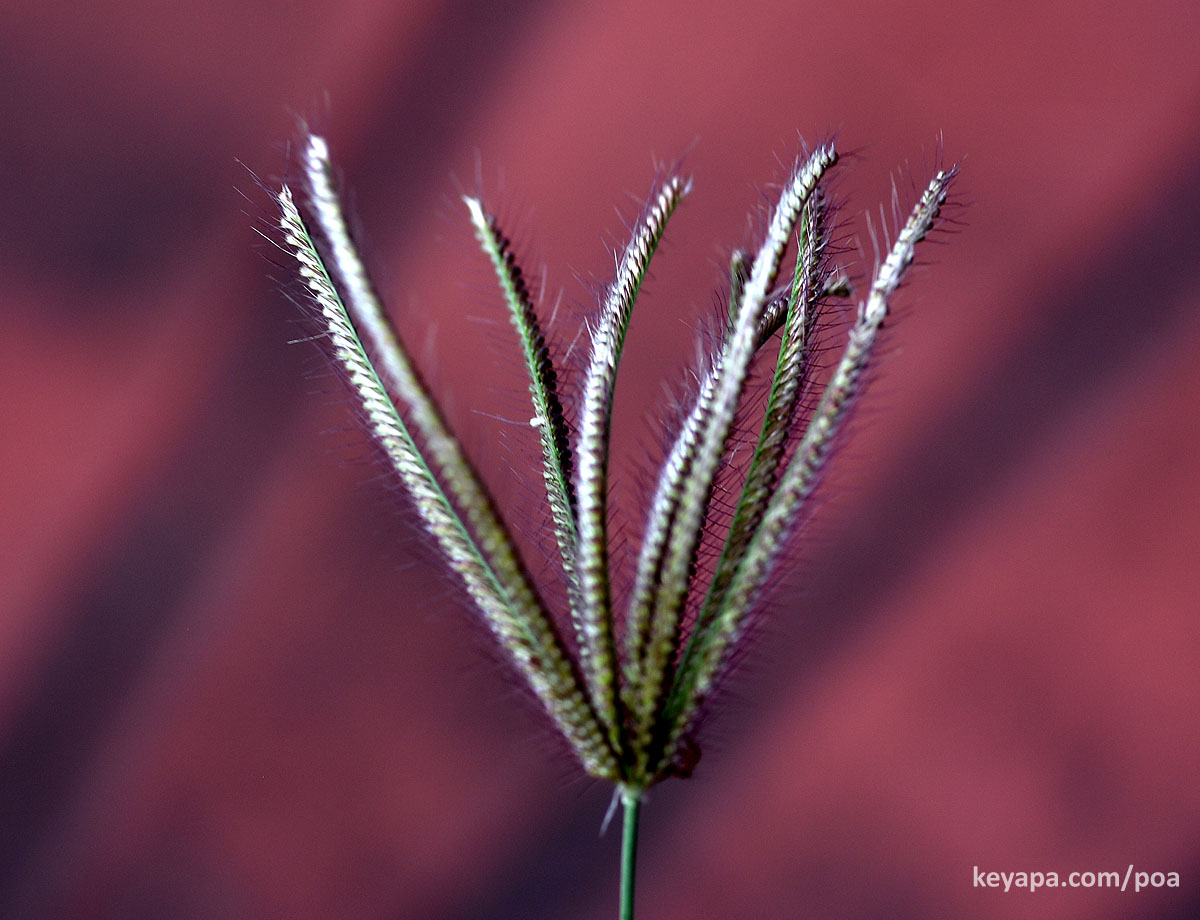
Once I stepped out of the home, a thriving colony of Dactyloctenium aegyptium (called damung-balang here) greeted me, their rather pretty inflorescence quite easy to identify. I have seen this same plant thriving in the heat in south Florida, and here it is a ubiquitous grass. In fact, it is one of the top weeds in vegetable and rice gardens, although it is native.

Dactyloctenium aegyptium - digitate inflorescence

The next grass I saw as I walked the suburban streets was one that at least was not in the USA. It had digitate inflorescence and strikingly enough, a row of encircling white hairs on some nodes! I typed it later as a Dichanthium spp, perhaps Dichanthium annulatum (called "lindi" here). It is naturalized in the area and probably came between 1945 and 1950s as a potential forage. Of course it escaped and is now probably found all over.

Dichanthium annulatum - inflorescence

Dichanthium annulatum - ring of white hairs around node

Dichanthium annulatum - ligule and white hairs

Dichanthium annulatum

I then entered a main road, vehicles whizzing past me close enough to feel the wind of their passing, and I encountered an individual flowering specimen that I at first thought I had last seen in the Nature Conservancy's Disney Wilderness Preserve in Florida. It had the same digitate inflorescence that seemed to curl inwards, and I was thinking it was Eustachys petraea. But looking later at lists of Philippines grasses, it is probably Chloris barbata.

Chloris barbata? - digitate inflorescence

Chloris barbata?- habit

On the sides of the main road were various stores and private residences (there does not seem to be any zoning going on obviously), and as I passed one home I noticed that a fine bladed grass had crawled up the side of a stone wall, using the cracks in the wall as its path. The specimen was stoloniferous, and had tiny spike-like inflorescence jutting out of the mass of blades at various points.

Zoysia matrella cliimbs up a wall

Zoysia matrella - the specimen had lots of spike like inflorescence

A quick inspection showed that it was a turf grass that had moseyed out of the home's lawn. I was thinking it looked slightly like Eremochloa ophiuroides (centipedegrass in the USA), another turf grass which I had profiled in an earlier post. But further study typed it as from the genus Zoysia, perhaps Zoysia matrella. 

This turfgrass genus is also an inhabitant of the lawns in the warmer parts of the USA, and I was not surprised to find it here as well. 

Zoysia matrella - inflorescence with purple stigmas and yellow anthers

An old "friend" made an acquaintance as I continued along the road. I encountered specimens of  Eleusine indica (called "paragis" here, as well as a LONG list of other common names due to the different dialects and languages in the country), the unmistakable inflorescence and white center a dead give-away for this ubiquitous weed. It has become naturalized in the country, and it is just as much of a pest here as in many other countries in the world.

Eleusine indica - inflorescence

Eleusine indica - white center

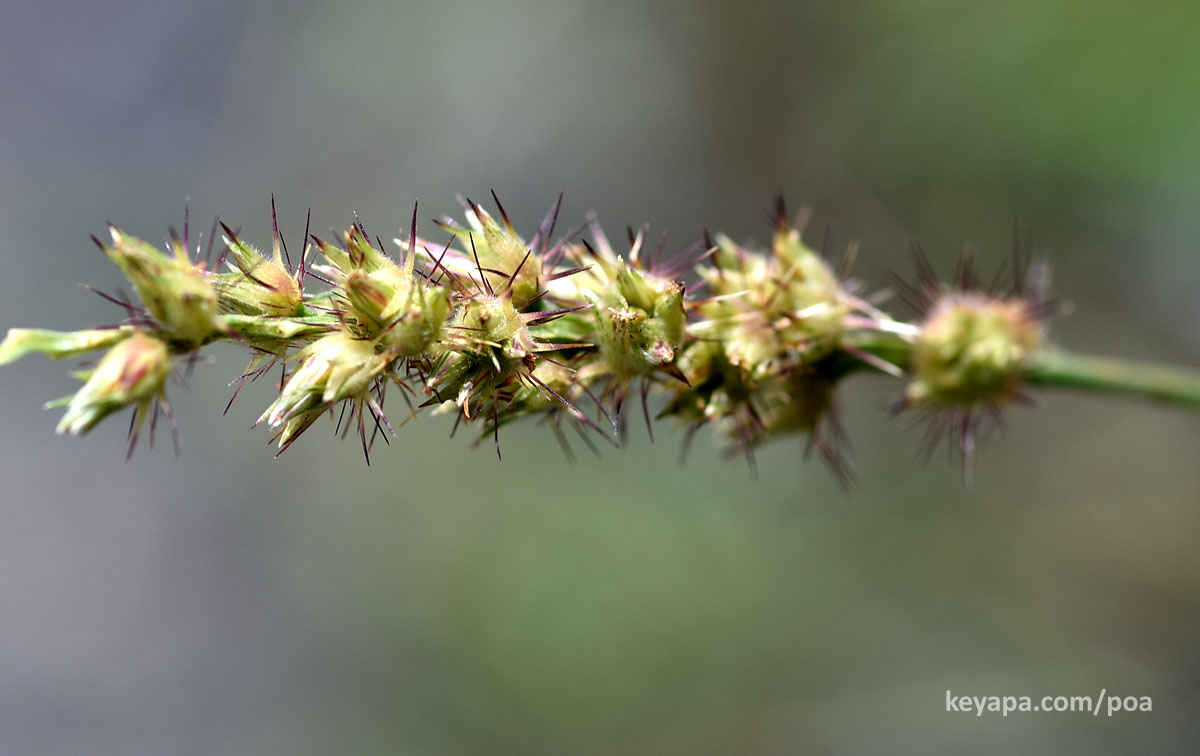
On the way home after ranging perhaps 0.5 km along the narrow dusty road, I stopped by a convenience store called Alfamart, and by chance happened upon a cluster of grasses that were living beneath the shade of a tired palm. The specimens were in flower, and the spikelets on the spike-like inflorescence reminded me of the sandbur (Cenchrus longispinus) that I had profiled in the USA. 

Cenchrus brownii - habit

Each spikelet had silvery white stigmas peeking out of the purple tinged spines, and in this case, I typed the species to perhaps Cenchrus brownii or Cenchrus echinatus. Both are native to the Americas but have become naturalized in the Philippines, and both are inhabitants of open waste spaces and other disturbed areas.

Cenchrus brownii - inflorescence with spikelets (and white stigmas) 

   
Cenchrus brownii -  inflorescence with spikelets

The spines on the spikelet function to attach to passing traffic, allowing the grass seeds to hitchhike using passersby. Unfortunately, the spines are also quite sharp and can pierce the skin (much to the horror of beachgoers everywhere with their bare feet), and I made the mistake of storing an inflorescence in my camera bag and later getting spiked when I reached into the bag! Definitely painful!  

Cenchrus seedhead attaching to unfortunate cameraman

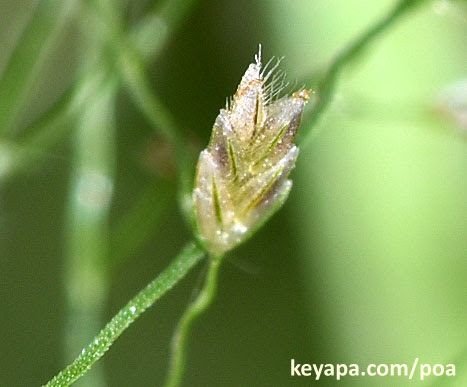
Finally, I saw one particularly tiny grass that seemed to crop up sporadically all over, whether in decrepit lawns, or cracks in the road. This particular species had fine panicles, and I was thinking that it was the notorious Poa annua, one of the most widespread grasses in the planet and one that is even threatening the ecology in far away Antarctica!

But a closer inspection revealed some discrepancies. For one thing, the spikelets seemed much smaller than those I had typed as P. annua in the USA (on the order of only 1-2 mm long at most). Nor were the tips of the leaf blades folded and boat like, and I did not find any long ligule at the blade junctions, a diagnostic characteristic of the species. In addition, the long hairs near the ligule did not seem to be present in P. annua. I am left with a mystery, but what is life without the added incentive of such goals? I can only hope that one day I will be pointed in the right direction. Below are images of the so far unknown (but very ubiquitous here) species.


Macros of the extremely tiny spikelets (note the dark red-brown seeds in some):


I have to say that the ability of many grasses to spread and colonize far away lands was on full display during this first botanical jaunt that I did. Fully half of the species I encountered were those that I had already encountered in the USA, half a world away! Of course the count was biased by the fact I limited my tour to a semi urban environment, which usually housed cosmopolitan disturbance specialists. But I was impressed anyways. 

Urban botanizing is not for the faint of heart in this town, what with the narrow roads with no sidewalks, and the allegedly rampant holdups (especially when one is lugging around relatively expensive stuff like a DSLR camera with a large macro lens). In this first botanical expedition in the heart of a bustling town in Cavite, Philippines, I did not cover a lot of ground (perhaps 0.5 km at most away from the house), but the diversity of grasses was still a pleasant surprise. I thoroughly enjoyed it, and will do a few more before the end of my stay.