Thursday, September 1, 2022

The Ancient Lost Savannas of Southeast Asia (Sunda Grasslands)


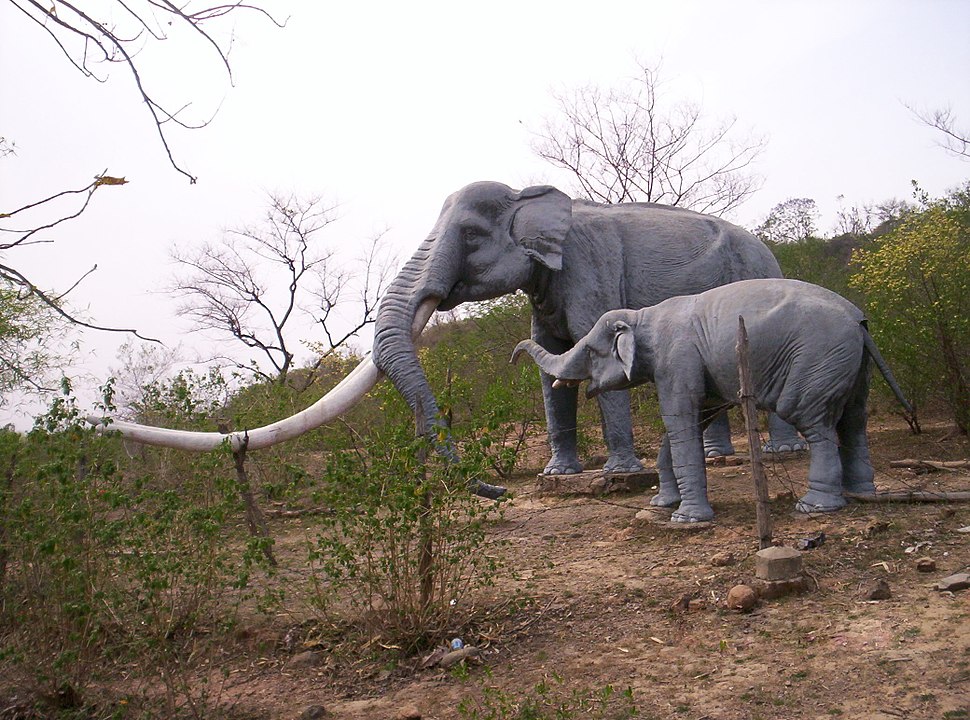
Stegodon trigonocephalus was a grazer that depended on ancient savannas (By I, Vjdchauhan)

The countries of Southeast Asia today are draped in closed canopy forests (where development has not cut them down), but new studies have found that vast areas had been grass biomes for a time in the recent past.

The Pleistocene epoch lasted from 2.6 million years ago (mya) to 11,700 years ago, when repeated glaciation events caused massive changes in the landscape. During the last glacial period, the lowering of sea levels caused the emergence of (now submerged) land masses that formed the continental shelf Sundaland, which included insular Indonesia and Malaysia today. Coupled with  a reduction in precipitation across the area, grasslands expanded to form savannas that stretched all the way from continental Asia to parts of the Philippines (Bird et al, 2005; Louys and Roberts, 2020, and see yellow area in image below), 

Sunda Grasslands in Yellow (Louys and Roberts, 2020)

The expansion of the grasslands in the mid-Pleistocene caused the extinction of megafauna browsers that depended on the forest. One such species that declined and disappeared was Gigantopithecus blacki, a gigantic forest dwelling ape that could have stood up to 3 meters high. Another was an extinct giant panda called Ailuropoda wulingshanensis.

Gigantopithecus blacki was a browser that went extinct after the forests decreased (By Concavenator)

This rise of the Southeast Asian savannas also resulted in the evolution of grazer megafauna that lasted until the late Pleistocene, when sea levels again rose and the grasslands were replaced by the closed canopy forests that hold sway over the area today. Animals that thrived in the grass savannas included the spectacular extinct elephants Elephas hysudrindicus and Stegodon trigonocephalus, as well as Bubalus palaeokerabau, an amazing water buffalo with enormous horns.

Modern water buffalo (Da - Own work, CC BY 2.5)
In order to help prove the existence of these ancient and forgotten savannas, a recent study examined the diet of modern and historical mammalian specimens (Louys and Roberts, 2020). They were able to determine whether the animals had a diet rich in C3 plants or C4 plants by looking at the ratio of carbon-13 to carbon-12 in the specimens. Both carbon-13 and carbon-12 are stable isotopes of the element carbon, although carbon-12 makes up the vast majority of the carbon on earth (around 99%).

If you remember, C4 and C3 refer to 2 different types of photosynthesis in plants, with the vast majority of plants using C3 photosynthesis. Grasses make up the bulk of C4 plants, and it turns out C4 plants take in more carbon-13 relative to C3 plants. The ratio of carbon-13 and carbon-12 in specimens can thus be used to determine whether the animal had a diet rich in C3 or C4 plants.

Their research showed (see image below) that in the Early Pleistocene, there were both C3 and C4 eaters, but by the Middle Pleistocene, most of the animals had a diet rich in C4 plants (ie. C4 grasses). The pendulum swung back by the Late Pleistocene such that by the Holocene, almost all the animals were eating C3 plants.

They interpreted this to mean that C4 grasslands expanded significantly in the Middle Pleistocene, but then gave way again to C3 forests by the Holocene.

(Louys and Roberts, 2020)

The short rise and fall of these tropical ancient savannas in Southeast Asia was something that I had never heard about before. That region of the world in its "natural" state today is so forested that there is a tendency to always think it has been that way since time immemorial.

Finding out that there were once vast savannas in these lands, with astounding creatures like the gigantic elephant Stegodon trigonocephalus roaming in large herds across the open landscape, truly boggles the imagination.

Literature Cited

Bird, Michael I, David Taylor, Chris Hunt (2005). Palaeoenvironments of insular Southeast Asia during the Last Glacial Period: a savanna corridor in Sundaland? Quaternary Science Reviews Volume 24, Issues 20–21

Louys, J., Roberts, P. Environmental drivers of megafauna and hominin extinction in Southeast Asia. Nature 586, 402–406 (2020). https://doi.org/10.1038/s41586-020-2810-y

Friday, August 26, 2022

A New Invader: "Villainous" Ventenata and the Invasion of a Native Ecosystem

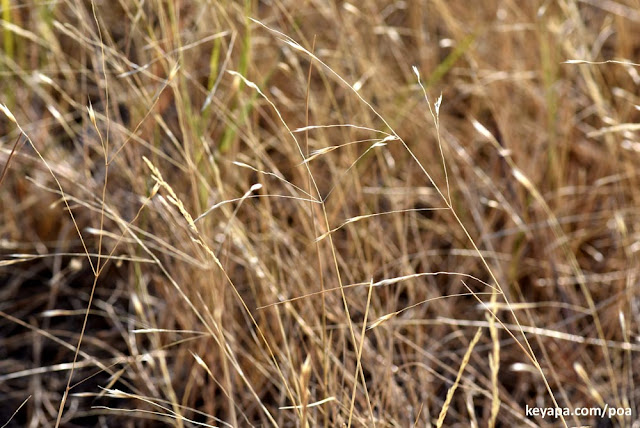
Wispy inflorescence of Ventenata dubia in foreground

In an earlier post I discussed how a group of winter annual grasses are spreading like wildfire in the vast Sagebrush ecosystem in the western part of the USA. 

This armageddon is destroying not only the pristine sagebrush shrubs which are critical to numerous animals like the sage grouse, but it also is significantly lowering the forage value of the land as palatable perennial grasses are replaced by the mostly unpalatable invasives.

In addition to earlier invasives like Bromus tectorum (cheatgrass) and Taeniatherum caput-medusae (medusahead grass), a newer species has been creating problems for land managers.
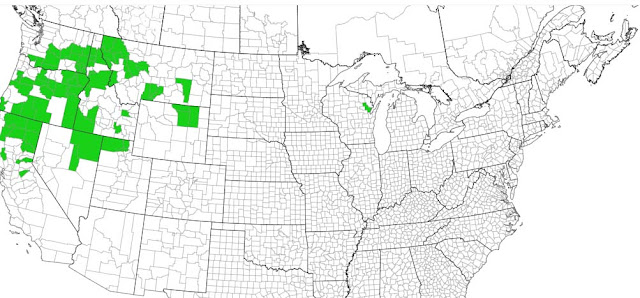
Distribution of V.dubia (EDDMaps, 2022)

Ventenata dubia was first discovered in Washington State in the early 1950s.  It is native to Southern Europe and North Africa, and it has rapidly spread at the rate of 1.2 million hectares per year (Native Invasive Plant Council, 2001), which means an area three times the size of Rhode Island is being invaded every year! It now is found in 11 states and 5 Canadian provinces, and land managers are frantically trying to slow its spread while it is still possible to do so.
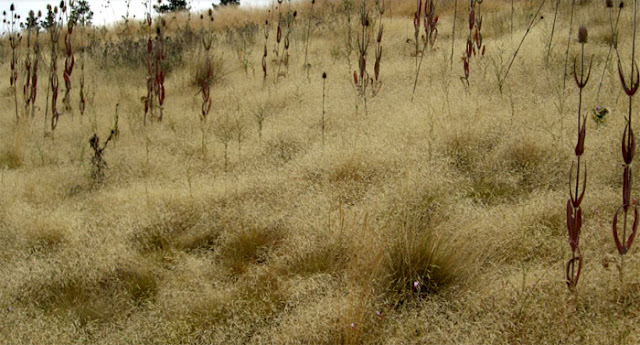
Invasion by Ventenata dubia (photo credit: Novak et al)

Like other winter annual grasses that have caused havoc in the local ecosystem, V. dubia tends to create a so-called grass-fire cycle, where its presence increases the probability of fires, which in turn removes its competitors and allows it to overran the area. Another way that winter annuals can outcompete other plants is by germinating in fall or early winter, and senescing by mid-summer. This gives it a head start when it comes to taking advantage of the early spring moisture.
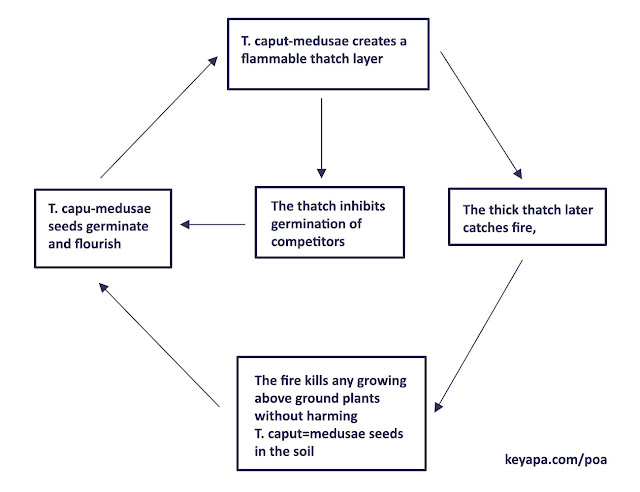
The grass-fire cycle of T. caput-medusae

This species has only recently arrived in Montana, and while botanizing in a local park in the city of Bozeman, I stumbled on a small cluster hidden amongst the other grasses.

On first look, the grass does not exactly inspire dread. Unlike T. caput-medusae with its alien looking inflorescence, or B. tectorum with its multitudes of sharp spear-like awns, V. dubia looks like a puny weakling that would roll over with the smallest puff of wind.
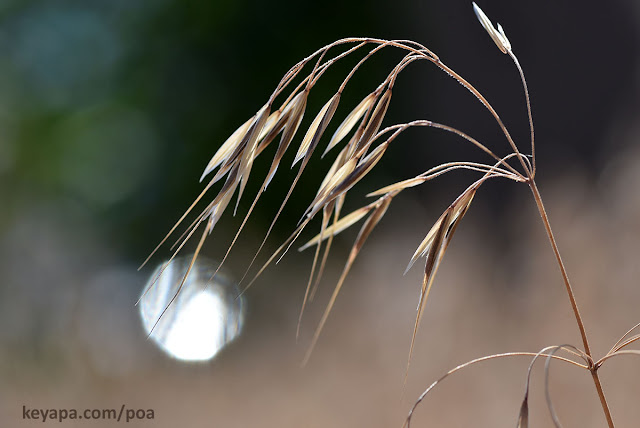
The sharp spear-like awns on B.tectorum is more intimidating than the diffused panicles of V. dubia

The inflorescence of this species is a spread out panicle, and its thin culm ends at the base with very shallow roots. But its outward appearance belies the heart of a bully. Some studies have shown that invasion by V. dubia in hay fields can result in losses of up to 50% (Prather and Steele, 2009), and like other hegemonic invaders, the diversity of native species suffers when it starts taking hold in an area (Jones et al, 2020).
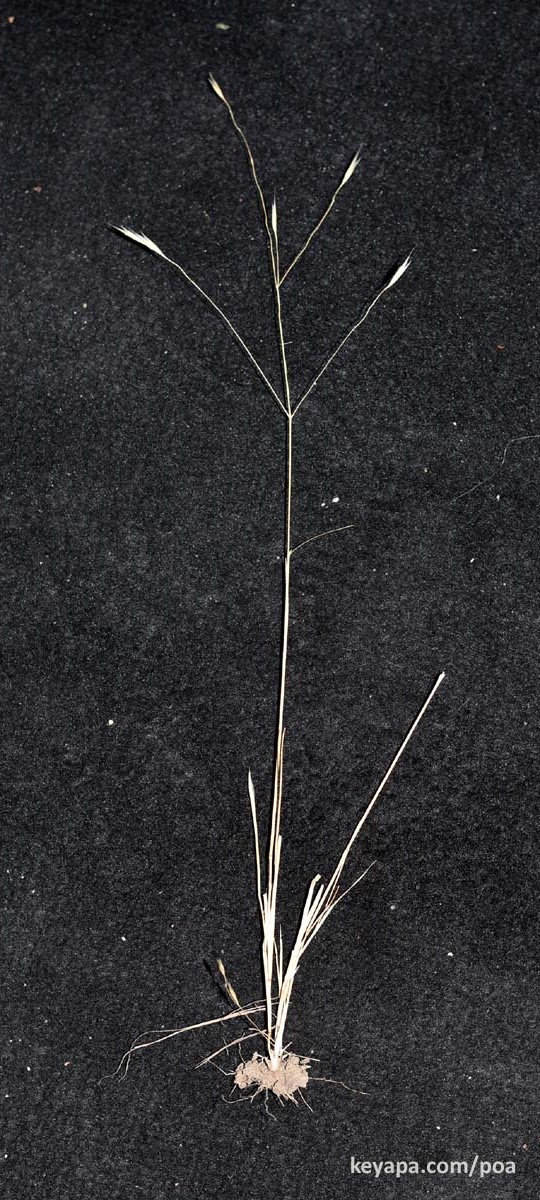
Ventenata dubia whole plant. Notice weak shallow roots

Even more frightening is the fact that this new invader seems to be able to successfully dominate habitats that earlier invasives like T. caput-medusae and B. tectorum cannot. In one study researchers found that it had invaded dry forest, woodland, and forest scablands ranging from 1250-1665 m of elevation, places which previously had been relatively immune to winter annual grass invasions. This is important to note, because it means that the spread of this species has increased the overall footprint of invasive annual grasses in the already battered Western USA (Applestein et al, 2022; Tortorelli et al, 2020).
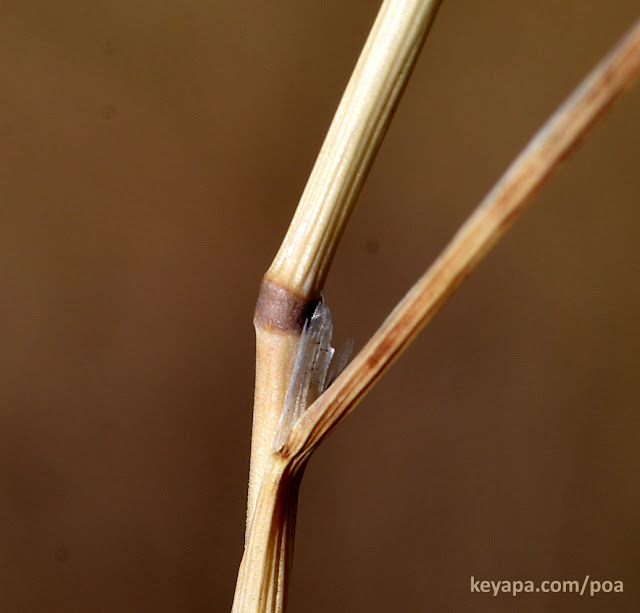
Very long ligule of V. dubia and the remnant dark red color of a node

I must admit I was lucky in finding the small cluster in that park in Bozeman, MT. The small size of V. dubia and its open diffuse panicles made it hard to distinguish from the masses of other dried grasses that dominated the landscape. 

But the specimens I found had panicles with horizontal branches that almost diverged at 90 degree angles, and the spikelets (the structure that holds the grass flowers) on the panicles were restricted to the ends of these branches, both of which are characteristics of the species. A quick check of the ligules (the membrane between the top part of a blade and the culm) also pointed to them as being V. dubia: the species has relatively long and large ligules. The very shallow roots of one specimen that I carefully uprooted is another characteristic of V. dubia, as is the dark nodes that were red earlier in its life cycle.

Dried spikelets of V. dubia with ribbed glumes and lemma with long awns.

Magnification also offered other clues as to their identity. The dried spikelets had no seeds, but each spikelet had a conspicuous lemma (a bract like  structure enclosing a flower) with a protruding awn, and the glumes (the two bracts enclosing the spikelet) were distinctly ribbed along the long axis.

The small infestation that I found may not remain so small, given the nature of V. dubia. But perhaps the much larger grasses around it will contain its spread, or perhaps it will be eradicated after its presence has been reported. Only time will tell.

As a last note, the spread of V. dubia is another major problem in an endangered ecosystem that many people don't even know about. But there is nothing "evil" or even "villainous" about the species, notwithstanding the title of the post. We tend to anthropomorphize other organisms when in the heat of emotion, but this species (like all the other "weedy" plants) is simply doing what it needs to do  in order to survive and prosper, with no malice in whatever green heart it has.

Literature Cited

Applestein, C., Germino, M.J. Patterns of post-fire invasion of semiarid shrub-steppe reveals a diversity of invasion niches within an exotic annual grass community. Biol Invasions 24, 741–759 (2022). https://doi.org/10.1007/s10530-021-02669-3

EDDMapS. 2022. Early Detection & Distribution Mapping System. The University of Georgia - Center for Invasive Species and Ecosystem Health. Available online at http://www.eddmaps.org/; last accessed August 26, 2022.

Jones, L., Davis, C., & Prather, T. (2020). Consequences of Ventenata dubia 30 years postinvasion to bunchgrass communities in the Pacific Northwest. Invasive Plant Science and Management, 13(4), 226-238. doi:10.1017/inp.2020.29

Stephen J. Novak, Massimo Cristofaro, Dorothy Maguire1, and Rene F.H. Sforza. The Invasive Grass Ventenata (Ventenata dubia): A New Threat for Nevada

Prather, T. S., and V. Steele. 2009. Ventenata control strategies found for forage producers.

Tortorelli, C, Krawchuk, M, Kerns, B. Expanding the invasion footprint: Ventenata dubia and relationships to wildfire, environment, and plant communities in the Blue Mountains of the Inland Northwest, USA. Appl Veg Sci. 2020; 23: 562– 574. https://doi.org/10.1111/avsc.12511
Tuesday, August 23, 2022

Cuddly Purple Cuties at Logan Pass

Anthers decorate the surface of its flowerheads. The "spikes" are the awns of each spikelet

We hiked the famous Hidden Lake trail in Glacier National Park's Logan Pass (in Montana, USA) a few days back, and the path to the lake  was through absolutely gorgeous and vast meadows.

Wildflowers were in bloom, and the land was covered in a riot of colors. The trail itself was a combination of raised boardwalks and packed earth, and along the sides I noticed grass flowerheads that I at first thought were from Phleum pratense (Timothy grass).

Meadows to Hidden Lake

But these were much smaller and shorter, and some had a dark color as they matured that I had not seen in the more common species.

When I started taking macro shots I discovered that the flowerheads were a beautiful purplish color under magnification. I typed it as Phleum alpinum, a circumboreal species that normally inhabits alpine and subalpine wetland environments. 

Phleum alpinum

This small cutie is a perennial that has awned glumes with one floret per spikelet. It loves less sandy soil, and seemed to form a healthy population up in the meadows of Logan Pass (elev 2000 m). Like many grasses, it seems unassuming at first glance. But a careful examination reveals a hidden beauty, which is made all the more precious by the work needed to uncover their allure.

If you ever visit the park (and I have to say it is one of the more majestic mountain destinations I have ever visited), then be sure to say hi to this cuddly purple blooming grass.

Peeking up from beside the boardwalk 


Sunday, August 21, 2022

An Unexpected Insect Slaughter

Idyllic setting of the massacre

Note: Gruesome photograph below. The squeamish have been warned.

Praying mantis, spiders, and other predators sometimes lurk in flowers in order to ambush visiting pollinators. But because grasses are mostly wind pollinated, they are usually spared the drama of such interactions. 

But two days ago while going through the sights in Glacier National Park's "Going to the Sun" road (in Montana,  USA), I stumbled upon the grisly remains of some past feast.

Masses of Phleum pratense (Timothy grass) formed an impressive foreground to one of the many majestic mountains that decorate the park, and while taking photographs I noticed one particular inflorescence seemed to have unmoving insects on it.

The grisly remains of four insects 

When I took macro shots of the specimens, I was surprised to discover that they were the desiccated remains of what looked like flies. As noted in a past post, insects like hoverflies do visit flowerheads of grasses like Phalaris arundinacea (Reed Canary Grass) to collect pollen. 

Hoverfly  visits P. arundinacea

I've also photographed spiders lurking menacingly in the inflorescence of Cenchrus purpureus (Napiergrass).

Spider lurks in C.purpureus

In the case of P. pratense there are even studies that show native bumblebees collect pollen from this species, although whether or not they aid in its pollination is uncertain. 

Such visitations allowed some predator (likely a spider) to take advantage of this behavior in order to nab a few unwary victims. Fortunately, I'm no big fan of flies, but it was a gruesome find anyways.

Sunday, August 14, 2022

Uncovering the lair of the sand centipede

I love my wife, but whenever I hike with her my botanizing is reduced to a minimal level.

So when I got the chance to explore a nearby trail on my own, I jumped at the opportunity and took my Nikon 3400 DSLR and  macro lens with me.

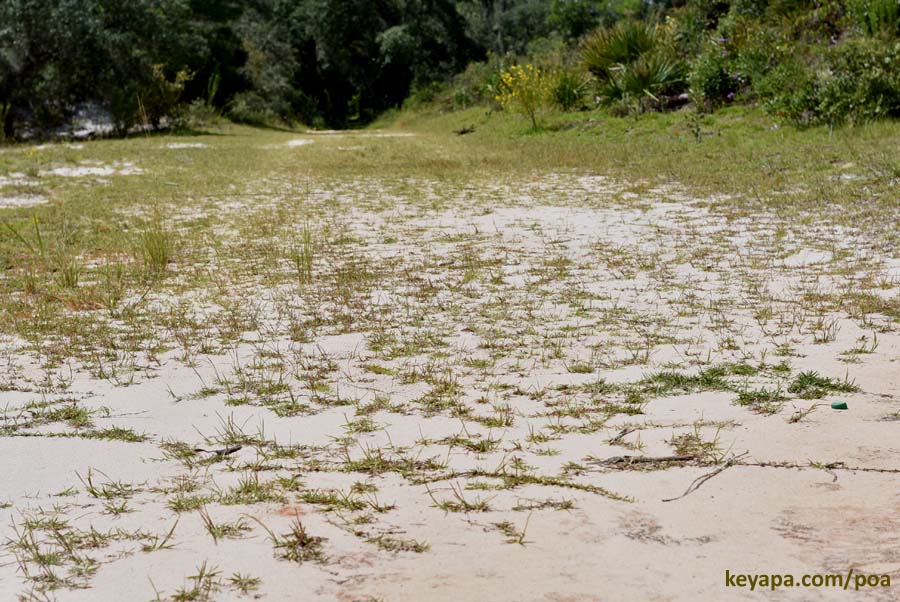
The beginning portion of the trail featured a wide sandy path, and on a previous excursion I had noticed really interesting critters that seemed to be slithering under the sand.

The trail covered with "sand centipedes"

It was the usual hot and humid Florida summer day, but this time I literally knelt to observe the little critters. The ground was really hot, but I was entranced by what I saw.

The long bodies of this grass formed sinuous patterns, the leaves half submerged in the sand and looking like the segmented legs of a centipede. I had to be careful not to keep stepping on one, although I knew that they were tough hombres that could take a few adversities and keep on ticking.

A half buried sand centipede as it crawls along the burning ground

Amazingly enough, many of them were in bloom or past bloom, and multitudes of flower and seedheads rose from the ground like the compound eyes of arthropods. They really did look like segmented critters!

Like a stomatopod with 2 eyes peering up from the sand

I identified the species as Eremochloa ophiuroides, which is a turf grass here in the southeast USA. It was introduced to the country in 1916 from China, and these specimens must have "escaped" from nearby lawns. Its common name in the area is "centipedegrass", which either refers to the overall body form or the segmented appearance of the inflorescence.

Inflorescence and stoloniferous culm that had been half buried in the sand

The species looks superficially like Stenotaphrum secundatum (which is called St. Augustine Grass here), but it is smaller and the inflorescence looks quite different.

Interestingly enough, I saw an ant going up and down the flowerheads, and I photographed what looked like aphids perched at the base of the rows of spikelets. The ant seemed to be attracted to the lumpish specks, and I was reminded of some recent research that hypothesized that  Eophiuroides might be pollinated by various insects (Joseph et al, 2020).

Ant cultivating aphids on the inflorescence?

The spikelets themselves were quite small, but the silvery stigma and purple anthers were cute, and I spent some time getting macro shots of the structures. 

Purple anthers and silvery stigmas

I must have spent an hour or more in the heat and sun examining this population of "sand centipedes". I love tiny critters, and the small size of this species was quite attractive. True, it might only be a common turfgrass to some, but the exotic location that I found them in and the fact that they were in bloom captivated the explorer in me. Beauty lies all around us, even in the most common of things.  You just need to open your mind's eye and see.

Literature Cited

V Joseph S, Harris-Shultz K, Jespersen D. Evidence of Pollinators Foraging on Centipedegrass Inflorescences. Insects. 2020 Nov 13;11(11):795. doi: 10.3390/insects11110795. PMID: 33202733; PMCID: PMC7696019.


Thursday, August 11, 2022

Life without Animal Pollinators: Why Grasses Embraced the Wind

Phalaris arundinacea grass inflorescence with white anthers and stigmas and foraging hoverfly.

Some people might be surprised to discover that grasses are flowering plants. That's because when they are compared to the large flowering structures sported by some other angiosperms such as orchids, grass flowers are miniscule indeed. They are not as large and showy as the flowers in some other plants because they are specialized for wind pollination, and thus have no colorful sepals or petals.

This reliance on wind for pollination is called anemophily, and it is in contrast with pollination via insects (entomophily) or vertebrates (zoophily). Around 10-12% of flowering plants are wind-pollinated (Ackerman, 2000), and such plants seem to have evolved specific traits that together make up a "wind pollination syndrome".

Imperata cylindrica inflorescence with purple anthers

Some of the traits in this syndrome are those which grasses exemplify, and include:

  1. Having many pollen grains compared to animal-pollinated plants
  2. Pollen grains are usually unornamented
  3. Having many flowers compared to animal-pollinated plants
  4. Petals are usually small or absent
  5. Nectaries are absent.
  6. Flowers are unscented
  7. Styles and stigma are feathery.
  8. Anthers with the pollen tend to have long filaments and are held away from the leafy structures to aid in wind dispersal
  9. Plants tend to occur in open habitats where wind is plentiful.
Panicum virgatum inflorescence with reddish-brown anthers and pink stigmas

On first look, people might think that wind-pollination is less effective and more "primitive" than pollination by insects and other animals. Indeed, Charles Darwin himself expressed surprise that any plant should display this type of pollination, given how "wasteful" it seemed to him (Darwin, 1876).

But amazingly enough, not only is wind pollination the derived condition (that is, plants started out as being animal-pollinated, but then evolved wind pollination), but studies have shown that anemophily is about as effective as animal pollination when it comes to the percent of pollen that manages to be captured by receptive stigmas! (Harder, 2000).

Andropogon gerardii inflorescence with yellow anthers and purple stigmas

The impetus for the evolution of wind pollination in plants that used to have animals as pollinators has been hypothesized to be situations where animal pollinators become unreliable. For example, some areas that are newly-colonized by a plant may have scarce or absent animal pollinators. In this case, this "pollen limitation" can result in the evolution of wind pollination in the species. Preliminary studies have supported this notion and have shown that pollen limitation is less of a problem in wind pollinated plants than in animal pollinated ones (Friedman and Barrett, 2009).

Paspalum notatum inflorescence with blackish purple stigmas and anthers

In the case of grasses, the very attributes that partly define the family - high density populations that dominate and saturate the environment - may necessitate the use of wind for pollination.  The lack of enough animal pollinators to assure reproduction in these relatively dense populations have pushed the Poaceae to use wind as the primary mechanism for the dispersal of their pollen.

So the next time you get an allergy due to pollen, don't blame the plants. Blame the lack of animal pollinators! ;-)

Cenchrus spp inflorescence with yellow-orange anthers and purple stigmas

References

Ackerman JD. Abiotic pollen and pollination: ecological, functional, and evolutionary perspectives. Plant Systematics and Evolution. 2000;222:167–185.

Darwin C. The effects of cross and self fertilisation in the vegetable kingdom. 2nd edn. London: John Murray; 1876.  

Friedman, J., & Barrett, S. C. (2009). Wind of change: new insights on the ecology and evolution of pollination and mating in wind-pollinated plants. Annals of botany, 103(9), 1515–1527. https://doi.org/10.1093/aob/mcp035

Harder LD. Pollen dispersal and the floral diversity of monocotyledons. In: Wilson KL, Morrison DA, editors. Monocots. Melbourne, Australia: CSIRO; 2000. pp. 243–257.

Thursday, August 4, 2022

The Many Faces of the Inflorescence of Bahia Grass (Paspalum notatum)


Paspalum notatum (aka Bahiagrass) is one of the species used as a perennial turfgrass here in the southeastern USA. It is also a forage grass, and is native to the southern parts of the American continent.

I was walking to the gym last week when I noticed that a lot of the wild grasses along the sides of homes under construction had the very distinctive inflorescence of this species rising up from the ground like little black penants. 

The two spike-like racemes of P. notatum bifurcate from a common point to form the rather attractive digitate flowerhead and seedhead. Each spikelet has two florets in it, one being fertile and the other sterile. 

The immature flowerhead is all green it seems, and as it develops you start seeing the black purple anthers and feathery stigmas (looking like the usual purple caterpillars) coming out of the spikelets.

P. notatum reproduction depends on the ploidy level of the individual plant. Those that are tetraploid (four sets of each chromosome)  are normally apomictic, with unfertilized but viable seeds being produced, while those that are diploid (two sets of chromosomes) are wind-pollinated and cross-pollinate. Seed production is high, and the species is highly successful in its distribution.

After fertilization, the spikelets seem to become darker colored, and after awhile dry out as light brown seeds, which are ready to be dispersed. 

I must admit, I really like this grass. Its flowerheads are distinctive and cute, and as a turfgrass it does not look as coarse and rough as Stenotaphrum secundatum (St.Augustine Grass), which is the other type of grass in our community.

Tuesday, July 26, 2022

Sandburs aren't 'Evil'

I was observing some of the grasses in Sandy Hook Beach, NJ last week, when I chanced upon some weird looking seedheads in the sand. They looked like round pods, but with sharp thorn-like protrusions decorating the surface.

I had briefly encountered this species before, but now I took some time to photograph it. Unfortunately, I did not have my macro lens with me, but the structures were large enough that I could get good enough pics.

Cenchrus longispinus is an annual whose spikelets are enclosed in tough, spiny burrs. These burrs can float, and dispersal by water is one way the grass spreads its seeds. The barbs that sprout out from the shell also aid in dispersal, as they can latch onto passing animals or the clothes and shoes of people. Unfortunately, the sharp spines are also quite capable of piercing human skin, and I can only imagine what it would be like to be walking on a sandy beach and suddenly step on a bunch of these well-protected propagules.

Indeed, a quick read of some of the articles on this grass will tell you just how much people loathe it. The word "evil" in particular is used a lot when describing sandburs, which is rather undeserved given that the definition of the term is that it is "profoundly immoral and wicked". In my opinion, this is something which should never be ascribed to animals or plants that are simply doing what they do to survive. There is likely no conscious desire on the grass to hurt people, or even to inconvenience or bother anyone. To it, we are simply nothing more than transportation for its progeny, and it neither wishes us harm nor well-being ;-)


Saturday, July 23, 2022

How many blades of grass in the world?


 Note: I welcome corrections to my calculations. Math was not exactly my best subject!

How many blades of grass in the world?

This is a question sometimes asked by people, and one which seldom gets any answer.

In fact, it's near impossible to resolve this question, with one major factor being that different species of grasses can attain different final maximum densities.

However, it is fun to calculate the number of blades of grass for narrower and more limited scenarios.

For example, would it be possible to calculate the total number of blades worldwide for a single species?

In this case, we would need to know 2 things: The density per given square area of that species, and the total area covered by the grass worldwide.

Only a few grass species have had their total coverage area estimated by researchers, and one of those is the aggressive Imperata cylindrica (cogon grass). There are some estimates that this species may cover as much as 500 million hectares worldwide, although the veracity of this staggering number is open to question.

Nevertheless, if we take this number as a given, and add in potential densities of cogon grass blades (0.25 per square cm or 2500 blades per sqm), then we quickly get really large numbers.

Since there are 10,000 sqm per hectare, then 1 hectare of cogon grass can have around 25 million blades of the grass. Multiply this by 500 million hectares and you get the absolutely huge number: 1.25 x 10¹⁶ blades of cogon grass in the world!

In order to put that number in perspective, if we take the current human population of the world at 7 billion people, then there would be almost 2 million blades of cogon grass for every single person.

Or to put it another way: if you lined up each cogon grass blade every meter in a straight line, you would get a line of plants that stretched 12.5 trillion km, or an absolutely mind boggling 1.3 light years! The distance from the sun to Pluto is only 5.9 billion km, so you could potentially have more than 2100 lines of cogon grass blades stretching from the sun to Pluto!

Imperata cylindrica (cogon grass) in flower

Now we can take it even one step farther, and examine a "fictional" situation.

How many blades of grass would there be if a species of grass covered all the land area in the world?

The winter annual invasive Taeniatherum caput-medusae (medusahead grass) has been seen to have as many as 21,500 plants per square meter, which comes to around 21.5 billion plants per square km. Since total land area of the world is approximately 130 million square km, then if this species covered the entire earth, then we would be talking about 2.795x10¹⁸ plants

To put this number in perspective, this would be about 400 million medusahead plants for every person in the world

Or to put it another way: if you lined up each medusahead grass every meter in a straight line, you would get a line of individuals that stretched 2.795e+15 km, or an absolutely mind boggling 288 light years! The distance to the nearest star Alpha Centauri is only less than 5 light years.

Taeniatherum caput-medusae (medusahead grass)
Such amazing numbers mean that grasses are likely the most populous meter-scale organisms on the planet today!

References

Sharp, Lee A.; Hironaka, M.; Tisdale, E. W. 1957. Viability of medusa-head (Elymus caput-medusae L.) seed collected in Idaho. Journal of Range Management. 10: 123-126. [2118]

Torell, Paul J. 1967. Dowpon--an aid to reseeding medusahead-infested rangeland. Down to Earth. 23: 6-8. [6005]

Sunday, July 17, 2022

Now, THAT'S a front yard!

Google Street View in May 2022

We were on our way to a hiking location here in North New Jersey, and  on the way we passed by some fairly upscale communities. Most had wide front lawns, the grasses kept immaculately low to the ground, with occasional homes sporting large ornamental grasses like Miscanthus sinensis and Calamagrostis cultivars.

But suddenly, I gasped and pointed at something to my fellow passengers in the car. One of the houses had a front yard that was absolutely wild. Lots of tall stately grasses waved in the wind, and there were so many of the tall grasses and shrubs and forbs that the house itself was almost obscured from view.

Unfortunately, we did not have time to stop, but I made a quick mental note of some landmarks around us. When I got home later, I used google street view to try to find the home again, although I was thinking it was a long shot. But amazingly enough, the house front yard was so distinctive I actually did manage to locate it! 

The google street view image was from spring of this year, so the plants were not as high as they are now, and thus not as majestic. But there was no doubt that I had found the right house.

I thought it was charming and daring of this homeowner to go against the grain by not using the usual turf grasses, and I liked the overall effect. But one of my passengers had exclaimed "It's like a jungle!" 

Oh well, you can't please everyone!

UPDATE (2022-07-23)

I managed to take a pic of the front lawn as it looks now, and it looks great. Sorry for the quality of the photo, but I was just using my smartphone at the time. Love the masses of Calamagrostis!


Friday, July 8, 2022

Ornamental Grass Hunting at the Big Box Stores (and Where Big Box Grasses Go to Die)

Leymus arenarius spikelets (taken using non-macro lens)

I am a big fan of ornamental grasses. 

In my time I have purchased many natives such as various Panicum virgatum cultivars ("Northwind",  "Thundercloud", "Heavy Metal", "Hot Rod"), Andropogon gerardii cultivars ("Black Hawk", "RainDance"), and even a few Schizachyrium scoparium like “Twilight Zone”. I even have potential invasives like Miscanthus sinensis "Morning Light" and Japanese Blood Grass (Imperata cylindrica), both of which I obtained a long time back before I knew they were considered iffy ornamentals.

Most of my purchases have been at specialized Garden Centers or from online, but every time I visit Lowe's or Home Depot, I make it a point to visit their Garden department in search of unusual grasses.

The typical store scatters the grasses across various sections, but Lowe's is a favorite of mine because some Lowe's stores even have an ornamental grass section!

You go, Lowe's!

On one trip to a New Jersey Lowe's I decided to list all the available ornamental grasses in the store. 

Most of the ornamental grasses were crowded into one bench, but there were still a few scattered here and there. The usual purple fountain grasses were available (Cenchrus setaceus/Pennisetum setaceum), as were varieties of Miscanthus sinensis ("Adagio", "Variegata"), and the really cute Festuca glauca (in this case, "Beyond Blue"). There were even pots of Cymbopogon citratus (Lemon grass), which normally is placed separately from other ornamentals. These are typical types for this region, as well as in Florida stores (especially the fountain grasses).

Interestingly enough, I did find a species that I normally don't see in New Jersey stores. A couple of pots had Cortaderia selloana (White Pampas Grass)!

An unusual Cortaderia selloana for sale

This species of course has been considered invasive for some time now, but it would be wrong to say it is not gorgeous when in full flower, and so it has been a favorite of lay gardeners in many places. I was surprised to see it here though, as  it usually grows better farther south.

But the species that really stopped me in my tracks was a row of Leymus arenarius. The grasses were in flower, and the blue green hue of the leaves of this native species made me love it on sight. It's safe to say that I will likely get this sand-loving grass in future if I have space for it in my new home.

Leymus arenarius - beautiful in blue

On the way back to my car, I saw some clearance racks that had been parked to the side of the store. Curious about what I would find, I walked closer and found myself staring at the dying and drying bodies of various potted grass specimens. 

Where box store grasses go to die

Most of the dried up plants had grown long, their limp blades obscuring the name tags. I peered closely and found that many of them were Calamagrostis spp, with a couple of Miscanthus sinensis cultivars thrown in and a lone Muhlenbergia sp. A few still had green blades poking up through the mass of dried gold, and I knew that these could still be saved.

When I asked some store reps about the items, they said those plants were going be thrown away if no one bought them at clearance. It seems too many were in stock, and most had deteriorated due to negligence and poor lighting. 

I left after awhile, feeling a bit sad for the dying grasses. There should be a way to calculate the correct stock, and a way to take better care of these ornamental plants.